A person spends hours every night chasing a satisfaction that never comes, promises themselves every morning that this was the last time, then goes back despite fearing for their marriage, work and health. This is what people usually mean by “sex addiction”, and doctors today call it compulsive sexual behavior disorder. It is not a strong desire or moral decay, but a pattern of loss of control with a medical definition and effective treatment. This page explains, in calm scientific language, what it is, how it is distinguished from other conditions and how it is treated, then leads you to a separate article on each of its aspects.
What is sex addiction?
Sex addiction is a popular description of a condition in which a person loses the ability to control repeated, intense sexual impulses and urges, so they return to the same behavior time after time despite serious attempts to stop, and despite the losses it brings them. The behavior may take different forms: excessive viewing of pornographic content, multiple successive relationships, or a mental preoccupation that consumes the whole day. The criterion is not the type of behavior or how often it happens, but three questions: Has the person lost control? Do they continue despite the harm? Does it cause them clear distress or disrupt their life?
Specialists prefer the term “compulsive sexual behavior” to the word “addiction”, because scientists still disagree about how similar its mechanisms are to substance addiction. But the name changes nothing about the person’s suffering, or their need for help.
Is it a recognized medical diagnosis?
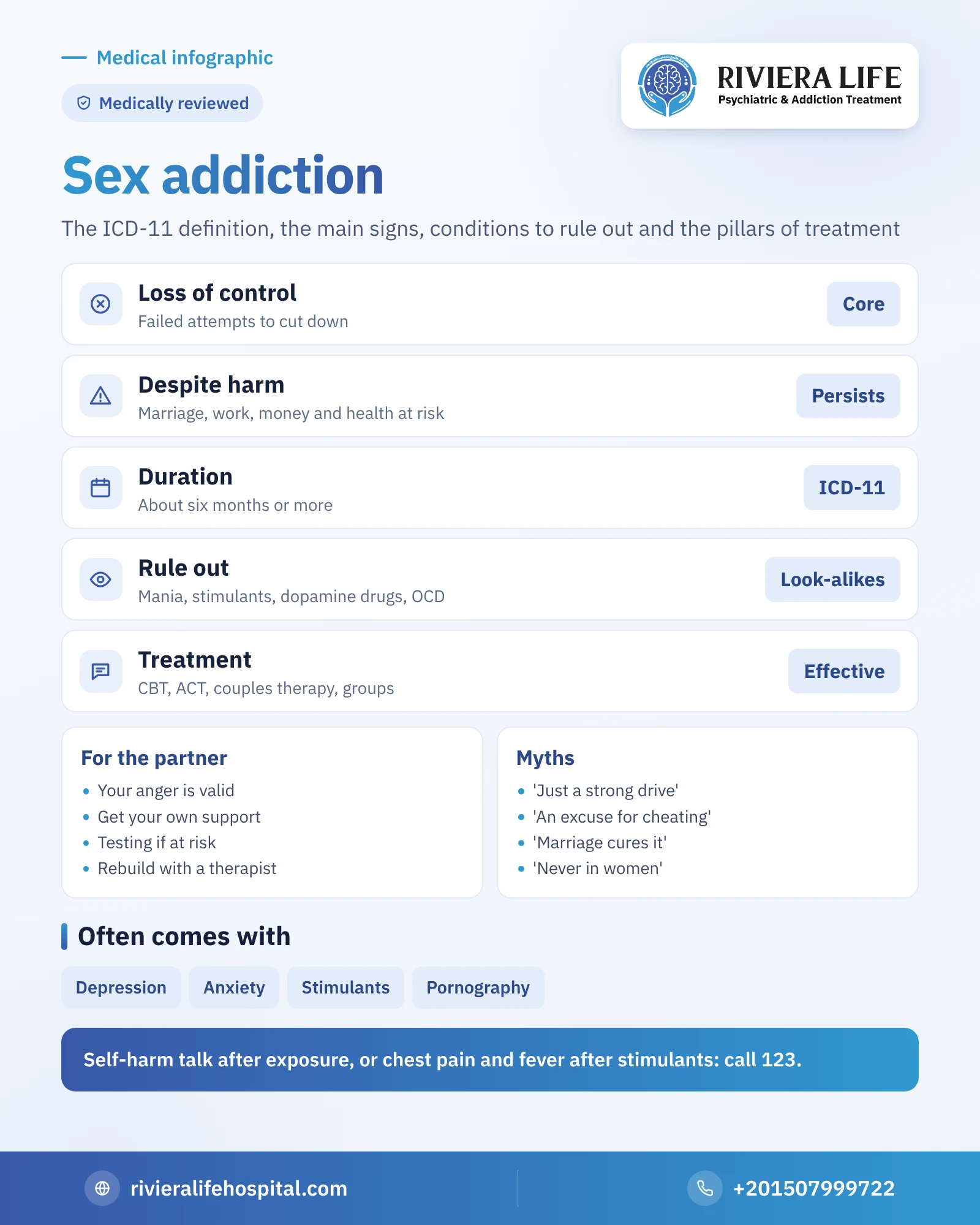
Yes, with an important detail. The World Health Organization included in the eleventh edition of the International Classification of Diseases a diagnosis called “compulsive sexual behaviour disorder” (Compulsive Sexual Behaviour Disorder), and placed it among impulse control disorders, not among addictions. The diagnosis requires that the pattern continue for a long time, about six months or more, and cause noticeable distress or impairment in family, professional or social life.
The fifth edition of the American diagnostic manual, however, has not adopted it as a standalone diagnosis so far. The international classification sets a condition that protects people from hasty conclusions: distress resulting only from the behavior conflicting with the person’s values or beliefs is not enough on its own for a diagnosis. Someone who feels guilty about a limited behavior they can control may need a conversation with a therapist, but they do not necessarily have the disorder.
How common is it?
Estimates vary widely between studies because of differences in definitions and the difficulty of disclosing this subject, but they center on a small proportion of adults not exceeding a few percent. It is seen more in men, although women suffer from it too and usually delay seeking treatment because of the heavier stigma. It mostly begins in the late teens or early adulthood, and many people wait years before talking about it with a doctor.
The main signs in brief
A single picture repeats in most cases: a preoccupation that crowds out duties and rest, failed attempts to cut down, continuing despite real losses, and a pleasure that shrinks over time until the behavior becomes just a release of tension after which guilt and anxiety return. This is usually accompanied by secrecy, lying and deleting records, and spending out of proportion to income. You can find a detailed explanation of these signs, and questions to help you assess your situation without diagnosing yourself, in the article Symptoms of sex addiction.
Why do some people lose control?
There is no single cause. Several things overlap: the role of the brain’s reward system, which learns that this behavior is the fastest route to relief; using it as a way to escape anxiety, sadness or loneliness; traits such as impulsivity; difficult childhood experiences in some patients; as well as the easy access that phones have provided. There are medical causes that must always be ruled out, which we explain along with the psychological factors in the article Causes of sex addiction.
Conditions that resemble it and must be ruled out
Before making this diagnosis, the doctor looks for other causes that may explain a sudden increase in sexual behavior, because their treatment is completely different:
- A manic or hypomanic episode: in bipolar disorder, desire may rise and caution fall for days or weeks, with little sleep, rapid speech and impulsive spending, then this calms down when the episode ends.
- Stimulant drugs: such as methamphetamine (shabu and ice) and cocaine, which raise sexual impulsivity and weaken judgment of risks.
- Some medicines and neurological diseases: such as the dopamine medicines used in Parkinson’s disease, frontal lobe injuries, and some types of dementia.
- Obsessional sexual thoughts: in OCD, the thoughts are rejected and frightening to the person, and they do not seek to act on them, which is fundamentally different from compulsive behavior.
How is it diagnosed?
The diagnosis is made by a psychiatrist or a clinical psychologist, through a confidential interview covering when the behavior began, how it developed, attempts to stop, the harm it causes, mood and sleep, and the use of any substances. The doctor may order blood tests or a neurological consultation if the symptoms appeared suddenly at a later age, and recommends tests for sexually transmitted infections when there is a risk. The specialist does not judge the person or their values, but tries to understand the function of the behavior in their life. Tests circulating online may help with reflection, but they do not distinguish between the disorder and similar causes.
Treatment: an overview
The goal is not to eliminate sexual desire, which is a natural part of being human, but to regain control so that the person acts according to their own choice and values. Treatment is usually based on:
- Cognitive behavioral therapy to understand triggers, break the cycle and build healthy alternatives.
- Acceptance and commitment approaches and mindfulness to deal with the impulse without giving in to it.
- Couples therapy when the relationship is affected, and support groups.
- Treatment of accompanying depression, anxiety or substance use.
- Medicines in some cases, decided by the doctor alone according to the case.
The full details, and the criteria for choosing a place of treatment, are in the article Treatment of sex addiction.
Sexual health and sexually transmitted infections
When compulsive behavior includes relationships with more than one person, the risk of sexually transmitted infections rises, such as HIV, hepatitis B, syphilis, gonorrhea and chlamydia. Many of these infections show no symptoms at first, which is why regular testing under medical supervision is part of care, not an accusation against anyone. The partner sometimes needs testing too. The good news is that most of these infections can be treated or controlled if discovered early, and some have preventive vaccines.
Sex addiction and drugs
The relationship between the two runs in both directions. Some patients use stimulants or alcohol to prolong the behavior or to overcome shame and guilt, and some who use stimulants discover that compulsive sexual behavior appeared with them and became linked to them until each one calls up the other. This link makes relapse in one a door to relapse in the other, which is why the patient needs one plan that treats both the substance use and the behavior, beginning with withdrawing the substance safely and then continuing psychotherapy. This may resemble related problems that we explain in the pornography addiction guide.
The role of the partner and the family
A wife or husband discovering this behavior is usually a real shock, in which betrayal mixes with anger and self-doubt. The partner has the right to be angry and to protect themselves and their health, and the right to receive independent psychological support, not only to be asked to support the patient. On the other hand, scandal and public threats rarely bring change; they push toward more secrecy. The most useful path is usually a specialist assessment of the patient, followed by couples sessions supervised by a therapist that rebuild trust step by step, with clear conditions agreed by both sides.
Common myths about sex addiction
Myth: sex addiction is just a strong desire or “virility”. The truth is that a high desire alone is not a disorder; the disorder is about loss of control and harm, and many patients find their enjoyment decreasing over time rather than increasing.
Myth: it is an excuse a cheater uses to justify his actions. The truth is that the diagnosis does not cancel responsibility; it explains why stopping is difficult and places on the person the duty of treatment and repair.
Myth: marriage treats it automatically. The truth is that compulsive behavior is often a way of escaping difficult feelings, and it moves with the person into marriage if it isn’t treated.
Myth: it doesn’t affect women. The truth is that it is less common in them but it exists, and stigma makes seeking help harder.
The sex addiction guide: each aspect in its own article
We have devoted an article to each question that concerns patients and their partners, answering it in depth:
- Symptoms of sex addiction: the behavioral and psychological signs of loss of control, what the partner notices, and when you need an assessment.
- Causes of sex addiction: the psychological, brain and social factors, and the medical causes that must be ruled out.
- Treatment of sex addiction: psychotherapy and couples therapy, the role of medicines, medical testing, and how to choose a place of treatment.
When does it become an emergency?
Most cases are treated in the outpatient clinic, but the feeling of shame after the behavior is exposed may be crushing, and the behavior may come together with stimulant use or a manic episode.
Seek urgent help immediately if you see
Call the ambulance on 123 or go to the nearest emergency department, and do not leave the person alone.
- Talk of wanting to die or self-harm after the behavior is exposed or under the pressure of scandal
- Chest pain, a very high temperature or seizures after using stimulants
- Severe agitation or strange, unrealistic ideas with little sleep for days
- Reckless behavior that may put the person or others in direct danger
And if the person has been in a high-risk situation for HIV transmission, they should see a doctor immediately, because post-exposure preventive treatment must begin within 72 hours.
When should you seek help?
If you have tried to stop many times and couldn’t, or the behavior has started taking your time, money and sleep, or threatens your marriage, work and health, this is a good time for an assessment, and you don’t need to wait for “rock bottom”. At Riviera Life, consultant psychiatrists assess the case in complete confidentiality and without judgment, rule out medical causes, then put together a plan that suits you, whether outpatient follow-up or an inpatient program. The first consultation is free via +201507999722.
Medical sources and referencesThe information in this article is based on reliable scientific sources
1Mayo Clinic — Compulsive sexual behavior: symptoms and causesmayoclinic.org2Mayo Clinic — Compulsive sexual behavior: diagnosis and treatmentmayoclinic.org3Kraus et al. — Compulsive sexual behaviour disorder in the ICD-11 (World Psychiatry)pmc.ncbi.nlm.nih.gov4WHO — Sexually transmitted infections: fact sheetwho.int5NHS — Symptoms of bipolar disordernhs.uk