The short answer
Gambling is betting money or something of value on an outcome decided by chance in hope of a bigger gain, and its types today include sports betting, online casinos, cards for money and the lottery. Gambling addiction is when a person loses the ability to control how long and how much they play and continues despite losses and harm. It is a disorder recognized in the American diagnostic manual and the International Classification of Diseases, the World Health Organization estimates its prevalence at about 1.2% of adults, and it is treated psychologically with good results.
- Most common types todaySports betting and online casinos
- Medical classificationA recognized disorder
- Global prevalenceAbout 1.2% of adults
It often starts with a small bet on a match with friends, or with an app on the phone promising a quick win, then months later the person finds themselves borrowing to make up for what they lost and hiding bank messages from their family. Gambling disorder, or what people call gambling addiction, is a medically recognized mental health condition, not just greed or a lack of morals. This page explains what it is, how betting turns into compulsion, what its signs and causes are, how it is treated and how the family can protect itself, then guides you to a separate article on each aspect.
What is gambling addiction?
Gambling is betting money or something of value on an outcome determined mainly by chance, in hope of getting a bigger gain. Gambling addiction is a repeated, persistent pattern of betting in which the person loses the ability to control how long and how much they play, and keeps going despite accumulating losses and clear harm to their money, work and family.
This definition is not a popular opinion. The fifth edition of the American Diagnostic and Statistical Manual classifies “gambling disorder” among substance-related and addictive disorders, and it is the only behavioral disorder placed in this category alongside drug and alcohol addiction. The eleventh edition of the International Classification of Diseases, issued by the World Health Organization, also lists it among “disorders due to addictive behaviours”, distinguishing between a predominantly online pattern and a predominantly offline pattern. This recognition matters, because it means the problem has clear diagnostic criteria and well-studied treatment.
How common is it?
The World Health Organization estimates that roughly 1.2% of adults around the world have gambling disorder, and that a much larger number suffer milder harm that does not reach the level of a diagnosis. The organization also points out that each high-risk gambler affects, on average, several people around them: a wife, children, parents and creditors. We do not have precise published Egyptian figures, but psychiatrists have noticed in recent years a clear increase in cases linked to sports-betting apps and casino games on the phone, especially among young people and students.
Common forms of gambling today
Gambling is no longer tied to a casino hall or a card table in a café. Most of the cases that reach treatment today started on a phone screen. Among the most widespread forms:
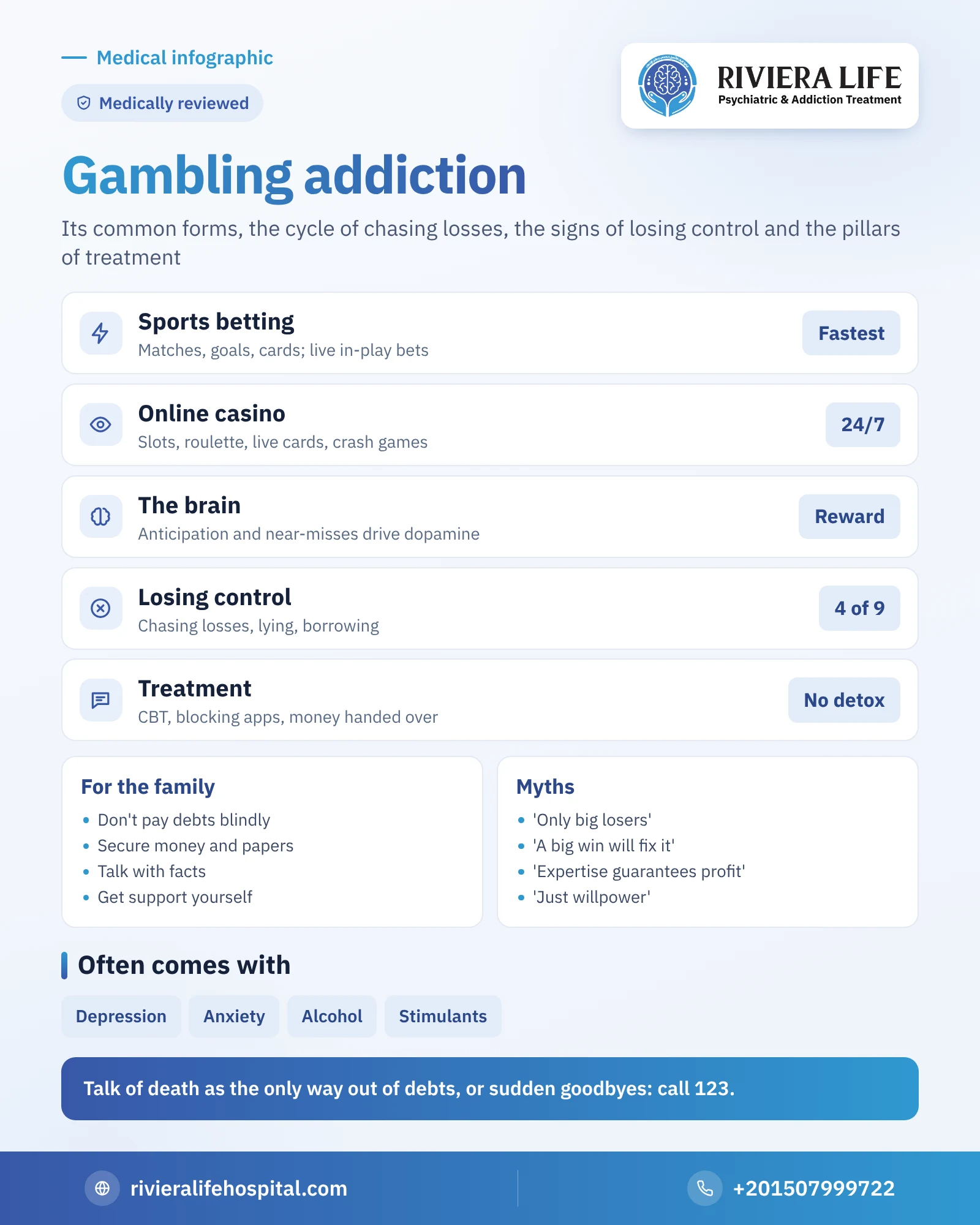
- Sports betting: betting on the results of football matches, the number of goals and cards; live in-play betting during the match has become the most dangerous pattern because of its speed.
- Online casinos: digital slot machines, roulette and live card games, and crash games in which a multiplier rises until it suddenly falls.
- Cards and backgammon for money: in cafés and gatherings, which may seem innocently social until the sums grow.
- The lottery, scratch cards and paid competitions: their sums are small, but repeating them daily can create the same pattern.
- Gambling-like patterns: such as random prize boxes inside some games, and impulsive short-term speculation, when practiced with a betting mindset rather than an investment one.
What makes the online form more dangerous is that it is available all day, and paid for with e-wallets and cards at the press of a button, so money loses its tangible feel, and it can easily be hidden from the family.
How does gambling affect the brain?
An unexpected win is one of the strongest drivers of the brain’s reward system, the same system that drugs exploit through dopamine. Strikingly, the brain reacts strongly to the anticipation itself, not just the win, which is why the player stays hooked even while losing. Many games are designed to feed this anticipation: small, intermittent wins whose timing cannot be predicted, “near-miss” results that suggest a win is close, and sounds and lights celebrating a win worth less than the bet itself.
With repetition, the person needs bigger bets to feel the same excitement, and feels tense and distressed when they try to stop, a picture very close to what happens in substance addiction, even though no substance enters the body.
When does gambling become an addiction?
The distinguishing sign is not the size of the sum, but loss of control and continuing to play despite harm. Among the most prominent indicators: constant thinking about betting, chasing losses by trying to win them back immediately, lying to hide how much one plays, borrowing or selling things to cover debts, and irritability when trying to stop. To diagnose the disorder, the doctor requires at least four of nine specific criteria within a year. You can find the psychological, behavioral and financial signs in detail, with questions to help you assess, in the article Symptoms of gambling addiction.
Why do some people fall into it and not others?
There is no single cause. A biological predisposition in the reward system and impulsivity usually meets mistaken ideas about luck and control, circumstances that push toward escape such as financial pressure, loneliness and depression, and an environment that makes betting easy and acceptable. Other known factors include starting to bet at a young age, a big early win that entrenches the illusion of talent, having another addiction, and taking some Parkinson’s disease medicines that affect dopamine. The full explanation is in the article Causes of gambling addiction.
How is gambling disorder diagnosed?
The diagnosis is made by a psychiatrist or a clinical psychologist through a detailed interview about the history of betting, the sums and debts, attempts to stop, and the effect on life. The doctor determines severity according to the number of criteria present: mild, moderate or severe. One of the most important things they do is rule out that the urge to gamble is part of a manic episode in bipolar disorder, because treatment is then completely different. They also always ask about depression, suicidal thoughts and alcohol or drug use, because these often accompany gambling.
Treatment of gambling addiction: an overview
Gambling is treatable and does not need detox, but it needs a serious plan. Treatment is based mainly on:
- Cognitive behavioral therapy, which corrects ideas about luck and control and trains the person to deal with the urge.
- Motivational interviewing for those still hesitant about stopping.
- Practical measures that cut off the route to betting: blocking sites and apps, and temporarily handing money management to a trusted person.
- Medicines decided by the doctor in certain cases, or to treat accompanying depression or anxiety.
- Family sessions, support groups and long-term follow-up to prevent relapse.
The details, when an inpatient program is needed, and how to choose a place of treatment are in the article Treatment of gambling addiction.
Gambling and substance addiction: dual diagnosis
Gambling often occurs together with other addictions. Some gamblers drink alcohol while playing, which weakens their ability to stop; some use stimulants to stay up in front of the screen for long hours; and others turn to sedatives to calm anxiety after a loss. Gambling is also clearly linked to depression and anxiety disorders. Treating gambling alone while leaving the other addiction or the depression untreated brings relapse closer, which is why the patient needs one plan that deals with the whole picture, and it may be useful to read the alcohol addiction guide if drinking is part of the problem.
The family’s role: where to start?
The family is usually the last to know and the first to pay the price. The most important things it needs to know at the start are three: that paying a gambler’s debts without a treatment plan gives them capital for a new round; that protecting the household’s money is not a punishment but a necessity; and that the family itself needs support and should not wait for the gambler’s agreement to seek it. Start by securing money and important documents, then open a calm conversation based on facts, and seek specialist advice for yourself before he accepts treatment.
Gambling in Egypt: the general framework
Gambling is rejected religiously and socially by most Egyptians, and the rules in force in Egypt limit entry to licensed casino halls to holders of foreign passports. But this has not prevented the spread of betting through sites and apps operating from outside the country and promoted on social media. Religious and social stigma may increase the gambler’s sense of shame so that they hide the problem longer, while the most useful path is to treat them as a patient who needs treatment, while respecting their values and beliefs within the sessions.
Common myths about gambling addiction
Myth: an addict is only someone who loses huge sums. The truth is that the criterion is loss of control and harm; a student who loses all his pocket money every week may be in a more dangerous situation than a wealthy person who bets a large sum he controls.
Myth: if he wins a big sum he will stop and pay his debts. The truth is that a big win usually strengthens the illusion and raises the size of the following bets.
Myth: expertise in football or in a particular game guarantees profit. The truth is that the platforms are designed to profit in the long run, whatever the player’s knowledge.
Myth: someone who gambles doesn’t need a doctor, just willpower. The truth is that it is a mental disorder with well-studied treatment, and willpower alone often collapses in the face of the first urge after a loss.
The gambling addiction guide: each aspect in its own article
We have devoted a separate article to each question that concerns the gambler and their family, answering it in depth:
- Symptoms of gambling addiction: the psychological, behavioral and financial signs, the diagnostic criteria, and when to seek an assessment.
- Causes of gambling addiction: how betting turns into compulsive behavior, and the psychological, biological and social risk factors.
- Treatment of gambling addiction: the stages of psychotherapy, the role of medicines, blocking apps, and preventing relapse.
- How to deal with a gambling addict: the family’s guide to conversation, the difference between support and enabling, and setting boundaries.
- My husband gambles: what should I do?: protecting money and children, dealing with debts, and the wife supporting herself.
When does it become an emergency?
Big losses and accumulating debts may push some gamblers into severe despair, and studies indicate that the risk of suicide among people with gambling disorder is much higher than among others. So don’t treat talk of despair as an exaggeration.
Seek urgent help immediately if you see
Call the ambulance on 123 or go to the nearest emergency department, and do not leave the person alone; you can also call the hotline of the General Secretariat of Mental Health and Addiction Treatment on 16328.
- Talk of wanting to die, or that the family would be better off without him
- Saying that death is the only solution to the debts
- Saying goodbye to people, giving away belongings, or suddenly writing a will
- A strange sudden calm after a period of severe despair
- Threats to harm himself or others after a big loss
When should you seek help?
If you bet more than you planned, hide your playing from those around you, or think about borrowing to make up for your losses, this is enough of a sign to seek an assessment, and there is no need to wait for the debts to double. And if you are from a gambler’s family, consulting on your own is a useful step even if he refuses. At Riviera Life, consultant psychiatrists and addiction specialists assess the case in complete confidentiality and put together a plan that suits its severity, from outpatient follow-up to an inpatient program with continuous supervision. The first consultation is free via +201507999722.
Medical sources and referencesThe information in this article is based on reliable scientific sources