











Types of drugs include opioids, stimulants, sedatives and nervous system depressants, cannabis, synthetic cannabinoids, hallucinogens, dissociative substances and inhalants. These groups differ in the way they affect the brain; some slow breathing and responsiveness, some increase arousal and strain the heart, and some change perception and the sense of reality. That is why the danger of a substance can’t be understood from its popular name, its appearance, or the feeling it causes at first.
People use the word “drugs” to refer to many substances, even though some of them don’t cause numbness in the literal sense. Also, the existence of a medical use for a particular substance doesn’t make taking it without supervision safe, and prescribing a medicine to a patient doesn’t mean they suffer from addiction. The difference is determined by the substance, the dose, the purpose, the way it is used and the follow-up, along with the person’s state of health.
This guide explains the classification of substances and their most prominent examples, then links each group to its neurological and physical harms. You will also find an explanation of the names in circulation, why the risks multiply when substances are mixed, and when symptoms call for urgent intervention, leading up to a precise answer to the question: what are the most dangerous types of drugs?
What are drugs?
Psychoactive substances are substances that change some brain functions, such as attention, mood, perception, consciousness and behavior. This is a broad description that includes illegal substances and prescribed medicines, and also, pharmacologically, alcohol, nicotine and caffeine. The social or legal use of the word “drugs”, however, may be narrower, and its limits differ according to the context and the country.
These substances are not equal in their likelihood of addiction, poisoning or chronic harm. The substance linked to a high risk of suppressing breathing is not necessarily the one that most causes hallucinations, and a substance that doesn’t produce clear physical withdrawal may still be able to weaken judgment or cause serious injuries. That is why assessment needs to look at more than one aspect.
Is every medicine that affects the brain considered a drug?
No. Many medicines affect the nervous system to treat pain, anxiety, epilepsy or other disorders, but a neurological effect alone doesn’t make a medicine an addictive substance. Even among medicines that may cause physical dependence, the risks and the methods of follow-up differ. A prescribed medicine shouldn’t be stopped out of fear of its name or of its inclusion in a general conversation about drugs; rather, its benefit and risks are reviewed with the doctor.
What is the difference between use, dependence and addiction?
Use means taking the substance, and doesn’t on its own prove the presence of a use disorder. Physical dependence is the body’s adaptation to repeated exposure, so that symptoms may appear on stopping or reducing the dose. Addiction, however, is linked to loss of control, continuing use despite harm, and giving the substance priority over important responsibilities and interests. Physical dependence may occur during prescribed treatment without the behavioral pattern that characterizes addiction.
This distinction helps avoid two mistakes: accusing every patient taking a medicine of addiction, and considering the absence of withdrawal symptoms as proof that there is no problem. The practical question is: has use gone out of control or is it causing ongoing harm?
How are types of drugs classified by their source?
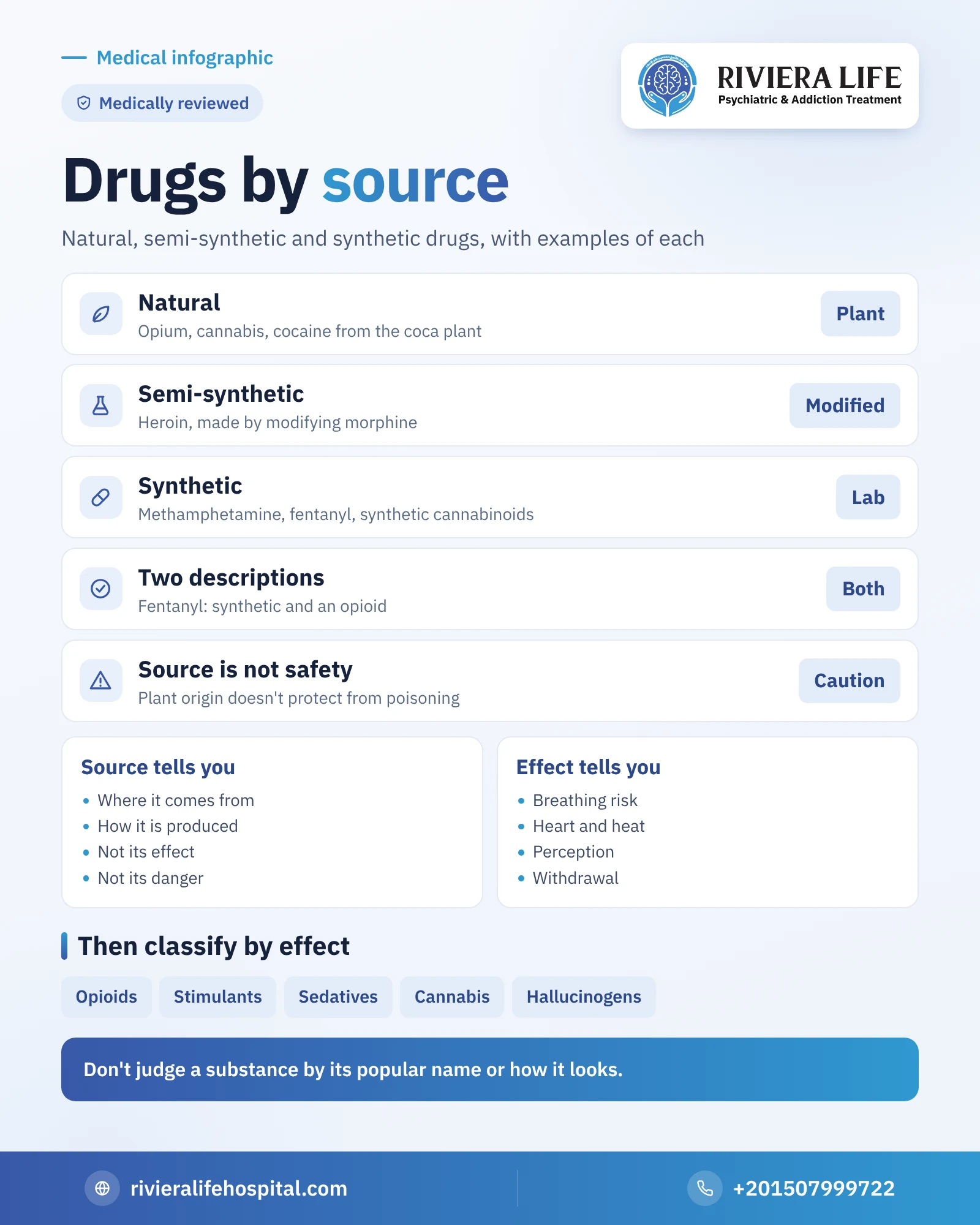
By their source, drugs are divided into natural, semi-synthetic and synthetic substances. This division shows the origin of the substance and how it is produced, but it isn’t enough to determine its effect on the nervous system or its degree of danger. So we start with the source, then move on to classification by effect to understand the differences between the groups.
Natural drugs
These substances derive their active compounds from plants or natural sources, such as opium, cannabis and cocaine extracted from the coca plant. This doesn’t mean that the product in circulation is free of processing or additives, or that being plant-based protects against poisoning and addiction.
Semi-synthetic drugs
These substances are produced by chemically modifying a natural compound; heroin is a well-known example because it is derived from morphine. The term “semi-synthetic” describes how the substance is produced, and doesn’t mean it is less harmful than a fully synthetic substance.
Synthetic drugs
These substances are produced chemically, and include methamphetamine, fentanyl and many synthetic cannabinoid compounds. These descriptions relate to origin, and are not a ranking that starts with a safe substance and ends with a dangerous one.
That is why a drug may belong to two correct descriptions at the same time: fentanyl is a synthetic substance and an opioid, and cocaine is a substance of plant origin and a stimulant. There is no contradiction between the two descriptions, because each deals with a different angle.
What are the types of drugs according to their effect on the nervous system?
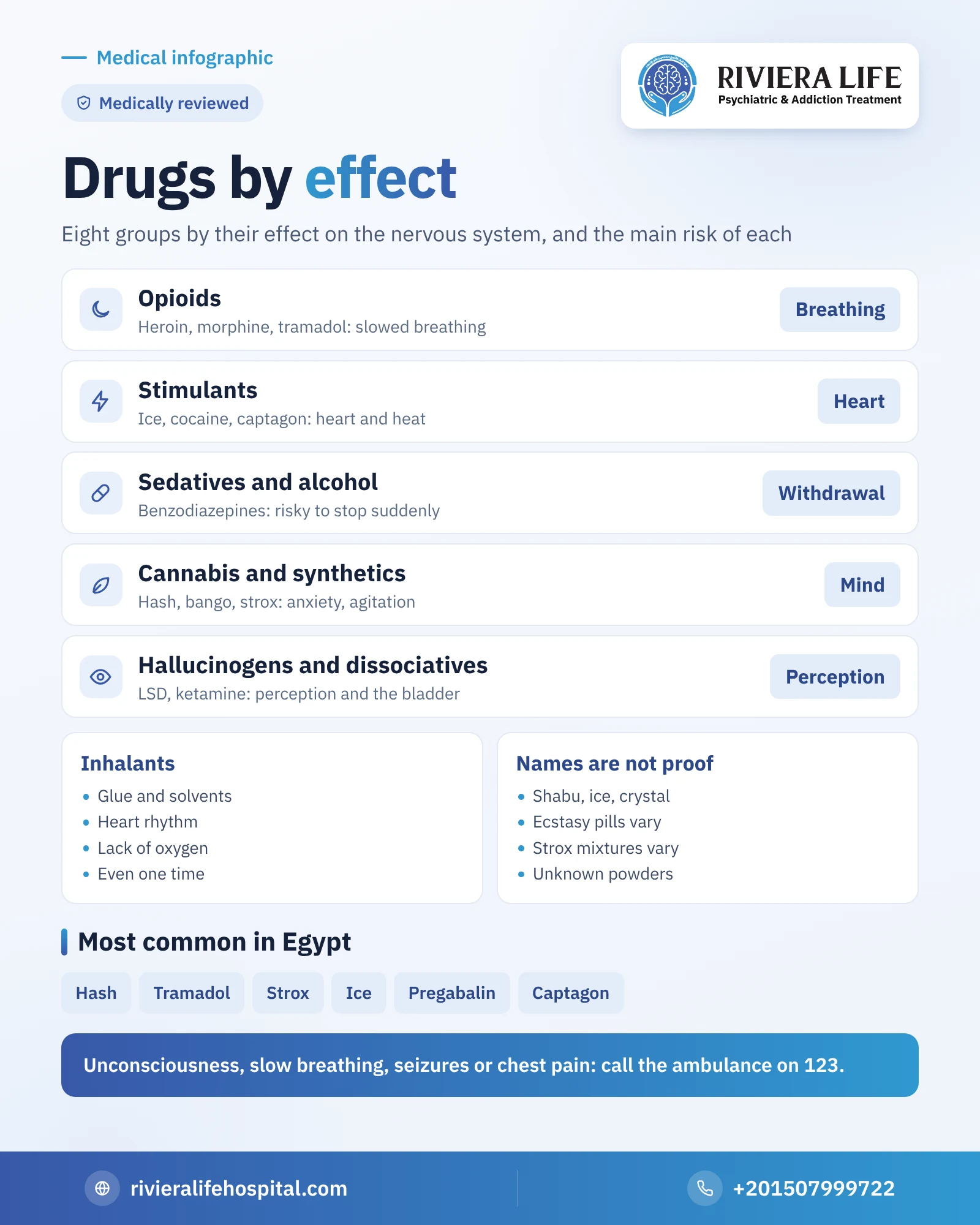
The most prominent types of drugs according to their neurological effect include opioids, stimulants, sedatives, cannabis, synthetic cannabinoids, hallucinogens, dissociative substances and inhalants. The following classification shows examples of each group, the nature of its effect, and the most important risks linked to it.
This is an educational arrangement that helps with comparison, because the boundaries of the groups aren’t completely separate. Opioids have a depressant effect, but they deserve a separate group because of the difference in their receptors, their risks and the treatment of their use disorder, and another substance may combine stimulation with altered perception.
Opioid substances
Opioids are a group that binds to opioid receptors found in the brain, the spinal cord and other parts of the body. They may relieve pain and cause drowsiness or euphoria, but their most prominent acute danger is slowing breathing to a degree that may threaten life. The danger increases with high potency or mixing them with sedative substances.
Heroin, opium and morphine
Opium contains compounds including morphine, while heroin is produced by modifying morphine. These substances share the opioid effect, but they aren’t identical in their properties or the circumstances of their use. After use, signs such as heavy limbs, drowsiness, nausea and narrowed pupils may appear, without these signs alone being enough to identify the substance.
With repeated use, tolerance and dependence may develop and controlling use becomes harder. Severe suppression of breathing may also cause a lack of oxygen reaching the brain; here the neurological injury becomes a result of poisoning and disturbed breathing, not just a temporary change in mood. A person who is hard to wake shouldn’t be considered “deeply asleep” without assessing their responsiveness and breathing.
Fentanyl and highly potent opioids
Fentanyl is a strong opioid painkiller with specific medical uses, but illegal or counterfeit products containing it may carry a high risk of overdose. The person may not know that the substance is present at all in the product they took. Its concentration can’t be estimated from the color of the powder or the size of the pill.
The risks of the unregulated market must be separated from the use of the medicine within medical care. Mentioning the name fentanyl doesn’t mean that every medical use of it is wrong; rather, it shows the importance of a known concentration, patient selection, dose control and monitoring of breathing. Likewise, it isn’t right to generalize that all substances in circulation in a particular country contain it without local evidence.
Tramadol and prescribed opioid painkillers
Tramadol is an opioid painkiller, and it also has effects on the transmission of serotonin and noradrenaline. Its misuse may lead to dependence, poisoning and seizures, and dangerous interactions with other medicines can occur. That is why it is not a safe option for staying up, increasing the ability to work, or treating a sexual problem oneself.
The principle of caution applies to other opioid painkillers, such as oxycodone and codeine, with differences in the properties of each medicine. Getting the substance in a strip of pills doesn’t cancel its risks, and taking a medicine prescribed for someone else doesn’t turn it into a suitable treatment for the one who takes it.
Stimulant substances
Stimulants are among the types of drugs that increase the activity of some nerve pathways linked to alertness, reward and the stress response. The person may feel temporary energy or confidence, but this may coincide with a fast heart, high blood pressure, little sleep and poor assessment of consequences. Apparent alertness doesn’t mean that concentration or performance has become better in a safe way.
Cocaine and crack
Cocaine affects the work of neurotransmitters, including dopamine and noradrenaline, by blocking their reuptake. It may cause temporary arousal and euphoria followed by exhaustion or distress and a desire to repeat. Among its risks are heart rhythm disturbance, chest pain, seizures and strokes, as well as anxiety, suspicion and hallucinations in some users.
Crack is a form of cocaine, not a substance entirely separate from it. The form of the substance and the way it enters the body affect the speed of the effect and the pattern of risk, but that doesn’t make the other forms safe. For details specific to this substance, you can refer to the cocaine guide.
Methamphetamine, shabu, ice and crystal meth
Methamphetamine is a strong stimulant that may cause disturbed sleep and appetite, increased movement and impulsivity. With repeated or heavy use, problems with memory and attention, or intense suspicion and psychotic symptoms, may appear. Lack of sleep becomes an additional factor that increases disturbed judgment and tension.
The names shabu, ice and crystal meth are used in many contexts to refer to methamphetamine, especially its crystalline forms. But they are names in circulation that don’t prove the composition of any particular sample, and aren’t suitable for ranking products from “lighter” to “stronger”. The relationship between the scientific name and the common names can be found in the methamphetamine guide.
Amphetamine and stimulant pills
There are stimulant preparations used medically in specific cases, but taking them without a prescription or in amounts contrary to the instructions may cause harm. The pressure of study or work doesn’t justify sharing a stimulant medicine or buying unknown pills on the pretext of improving concentration; medical assessment is different from trying to fight exhaustion chemically.
Also, the names of pills in circulation, including names historically linked to certain preparations, don’t guarantee that the current product contains the same composition. When seeking help, it is best to state what the person knows about the product, the symptoms and the accompanying medicines, while keeping open the possibility that the composition is different.
Ecstasy: a stimulant effect with altered perception
MDMA, linked to the name ecstasy, shows why the boundaries of classifications aren’t always strict. It has stimulant effects, may change the perception of time, feelings and communication, and is linked to changes in serotonin and other transmitters. It may be accompanied by a rise in pulse, blood pressure and body temperature, anxiety and disturbed sleep.
Among its dangerous complications are disturbed regulation of body temperature and salt imbalance, and it may progress to harm to the organs or the brain. That is why severe confusion or abnormal heat shouldn’t be explained as a normal part of a night out. Also, drinking excessive water isn’t a guaranteed treatment and may make some salt disturbances worse.
Likewise, the name ecstasy or the shape of the pill doesn’t prove that it contains MDMA alone. There may be other substances or different concentrations; that is why knowing the symptoms and their timing is more important than being reassured by a mark printed on the pill.
Sedatives and nervous system depressants
This group reduces the activity of some nervous functions, and may cause relaxation or drowsiness and slow responses. The word “depressant” describes an effect on the nervous system, and doesn’t necessarily mean that the substance causes depressive disorder. The degree of suppression of breathing and consciousness differs between substances, and the risks increase when they are combined.
Benzodiazepines and sleep medicines
Benzodiazepines include medicines such as diazepam, alprazolam and lorazepam. They work by strengthening the effect of an inhibitory neurotransmitter called GABA, and they have specific medical uses. They may cause drowsiness and weaken coordination and memory, so their effect on driving and work that requires alertness needs to be reviewed.
Physical dependence can develop while taking them according to a prescription, and this doesn’t automatically equal addiction. But stopping suddenly after regular use may cause severe withdrawal, including seizures. Therefore reducing or stopping them needs a plan set by the doctor, not a sudden family decision or a random trial of sedative alternatives.
Barbiturates and other depressant substances
Barbiturates are another group of nervous system depressants, and poisoning with them may cause severe suppression of consciousness and breathing. There are also substances such as GHB that may cause loss of consciousness and dangerous complications, especially when mixed with alcohol or other sedatives. Not everything described as a “sedative” can be treated as equally dangerous.
Alcohol within the neurological classification
Alcohol is considered a nervous system depressant, even though some people at first feel uninhibited and less reserved. It may weaken balance, memory and the ability to make decisions, while severe intoxication may cause loss of consciousness and disturbed breathing. Excessive chronic use is also linked to multiple physical and psychological harms.
Including it here helps in understanding interactions; alcohol is not a neutral element when taken with a sedative medicine or an opioid painkiller. Its withdrawal in a dependent person can also be dangerous, which makes assessment before stopping essential in cases at risk of complications.
Cannabis and its derivatives: hash, bango and marijuana
Cannabis is a category that includes many products differing in the concentration of active compounds, the most prominent being THC, responsible for many of the psychological effects. Hash usually refers to a resinous substance from the plant, while names such as marijuana and bango are used to describe plant products in different contexts. But the names aren’t enough to determine the concentration or the additives.
Cannabis may affect attention, short-term memory, motor coordination and the perception of time. Some people may feel relaxed, while others suffer anxiety, panic or suspicion. The concerns increase in those with a predisposition to psychotic disorders, and with repeated use and higher-potency products.
The phrase “natural” doesn’t mean that cannabis doesn’t cause a use disorder; difficulty cutting down or stopping may arise, and use may continue despite its effect on study, work and relationships. Smoking also adds exposure to substances produced by combustion, regardless of the product’s origin.
It is important to distinguish between a medical preparation with a defined composition and use, and a substance sold with the claim that it treats anxiety or sleep. Another person’s personal experience doesn’t determine its suitability, and relying on it to deal with every tension may turn into a pattern that is hard to change.
Synthetic cannabinoids: spice and similar mixtures
Synthetic cannabinoids are chemical compounds that act on receptors linked to the body’s cannabis system, but they don’t represent just another plant version of hash. Among their trade names in circulation worldwide are spice and K2, and local names may be linked to different products or mixtures whose content isn’t precisely known.
These products may cause severe agitation, confusion or hallucinations, and seizures, heart rhythm disturbances, kidney problems or loss of consciousness may appear. The same symptoms don’t occur in everyone, because the compound, its concentration and the additives may change from one package to another, and may not even be evenly distributed within the product.
That is why it isn’t right to assert that every product bearing the name strox or shadow, for example, contains one fixed substance, or that all the names refer to the same chemical category. The name the person hears is a starting point for taking the medical history, but it doesn’t replace dealing with the symptoms and appropriate assessment tests.
An important difference appears here between getting to know the types of drugs and trying to diagnose a sample by looking at it: the substance being dry herbs doesn’t mean that its effect comes from the plant itself, as it may carry added compounds that aren’t visible to the eye. Also, a negative routine test result doesn’t automatically rule out every new substance.
Classic hallucinogens: LSD and psilocybin
Classic hallucinogens affect pathways linked to serotonin, and may change the perception of colors, sounds, time and the sense of self. The experience may pass through severe anxiety, panic or loss of the ability to assess danger. A calm response can’t be guaranteed on the basis of a previous experience or the person being in a familiar place.
The likelihood of dependence and withdrawal in this category doesn’t match that of opioids or sedatives. But a lower risk of one harm doesn’t cancel other harms, such as injuries during disturbed perception or worsening psychological symptoms in some people. Perceptual disturbances may persist in a limited number of users and need assessment.
Dissociative substances: ketamine and PCP
Ketamine is a dissociative anesthetic with a medical use, and it affects glutamate transmission through receptors including NMDA. Outside medical supervision it may cause detachment from the surroundings, and weakness in memory, coordination and responsiveness. PCP is another dissociative substance that can cause severe disturbance of consciousness and behavior and dangerous neurological and physical symptoms.
Repeated non-medical use of ketamine is also linked to problems in the urinary tract and bladder. That is why the history of use should be mentioned to the doctor when pain, very frequent urination or blood in the urine appear, without assuming that the cause is one; these symptoms have other possibilities that require examination.
Inhalants and volatile solvents
Inhalants are a group that includes chemicals and gases misused to produce a psychological effect, and they don’t all share one mechanism. They may cause dizziness, slurred speech, poor balance and loss of consciousness. Some may lead to a serious heart rhythm disturbance or lack of oxygen, even without a long history of use.
Their danger increases because the product being present at home or at the workplace may make it seem familiar, even though the intended use of the product doesn’t mean that inhaling it is safe. Repeated exposure to some solvents may also be linked to neurological harm and problems with movement, attention and other organs.
This classification doesn’t mean every drug that enters through breathing; the name refers to a group of volatile compounds and gases, and is not an all-encompassing description of the route of use of all substances. This distinction prevents confusion between the nature of the substance and the route by which it enters the body.
Can the type of drug be known from its name or appearance?
The type of drug can’t be confirmed from its popular name or appearance alone; different names may refer to the same substance, and different substances may be sold under one name. After getting to know the basic groups, understanding these limits helps avoid confusing the product’s name with its actual composition.
The best-known drug names and their relationship to the active substances
Knowing some names helps in understanding talk about use, but the popular name isn’t an analysis report. Among examples of the relationship between the categories and the names:
- Methamphetamine: linked in different contexts to the names shabu, ice and crystal meth.
- Cocaine: may appear under its scientific name or popular names, and crack is one of its forms.
- Cannabis: its products include hash and marijuana, and the name bango is used locally for some plant products.
- Synthetic cannabinoids: names such as spice and K2 are linked to them, with the products and compounds differing.
- MDMA: linked to the name ecstasy, but the pills bearing the name may differ in their content.
Words such as “powder”, “pills” and “crystal”, however, describe the appearance more than they identify the substance. Not every powder is heroin, not every pill is a stimulant, and not every crystalline substance is methamphetamine. These limits become important if the family tries to choose a medical course of action based only on a form it found.
In a consultation, it is best to pass on the information as it is: the name that was mentioned, whether the substance is a prescribed medicine or an unknown product, and what changed after using it. Accuracy here also means admitting what we don’t know, instead of turning a guess into a fact that may delay the appropriate diagnosis.
Pills and powders of unknown composition
A product of unknown composition is not considered a separate pharmacological type, but it represents a fundamental problem when talking about types of drugs and their harms. The pill or powder may contain a substance different from what the person believes, or several substances, or an unexpected concentration. Packages and colors may look alike while the content differs.
The danger appears in that the person interprets the symptoms based on an unconfirmed name: they may expect stimulation and then signs of suppressed breathing appear, or they may expect calming and suffer agitation and a very fast heart. Also, a delay in feeling the effect doesn’t prove the absence or weakness of the substance, and doesn’t justify repeatedly taking an unknown product.
This applies to what is sold outside regulated pharmaceutical channels as pills for sleep, energy or pain. The content of a pill can’t be confirmed from the engraving or the picture alone, and the medical team must be informed that the source or composition is unknown when that is the truth.
The most common types of drugs in Egypt and the classification of each
These are the substances we encounter most in the Egyptian reality, arranged by their group. Click the name of the substance to go to its full guide: its symptoms, harms, how long it stays and how it is treated.
| The substance | The group | What it is in brief |
|---|---|---|
| Opioids | Opioids | A whole family acting on the opioid receptors |
| Heroin | Opioids | A semi-synthetic opioid made from morphine |
| Morphine | Opioids | A natural opioid and a strong medical painkiller |
| Tramadol | Opioids | A synthetic opioid painkiller that is often misused |
| Amphetamine | Stimulants | A family of synthetic stimulants |
| Methamphetamine (ice, shabu and crystal) | Stimulants | A strong synthetic stimulant in its crystalline form |
| Captagon | Stimulants | Stimulant pills from the amphetamine family |
| Cocaine | Stimulants | A stimulant from coca leaves; crack is one of its forms |
| Bouffa | Stimulants | A smoked stimulant whose composition isn’t precisely known |
| Flakka | Stimulants | A stimulant synthetic cathinone |
| Hash | Cannabis | The resin of the cannabis plant |
| Bango | Cannabis | Dried cannabis leaves and flowers |
| Marijuana | Cannabis | Dried cannabis flowers |
| Strox | Synthetic cannabinoids | Synthetic cannabinoids sprayed on herbs |
| Voodoo | Synthetic cannabinoids | A mixture of synthetic cannabinoids |
| Shadow | Synthetic cannabinoids | Synthetic cannabinoids with a variable composition |
| Spice | Synthetic cannabinoids | A synthetic cannabis known worldwide |
| Chemical | Synthetic cannabinoids | A general street name for manufactured substances |
| Pregabalin | Sedatives and medicines | A nerve medicine that is misused |
| Lyrolin | Sedatives and medicines | A brand name for pregabalin |
| Benzodiazepines | Sedatives and medicines | Prescription sedatives such as Xanax |
| Alcohol | Sedatives and medicines | A nervous system depressant |
| Ecstasy | Hallucinogens and dissociatives | A stimulant that alters sensation (MDMA) |
| The paper drug | Hallucinogens and dissociatives | A hallucinogen, the best known being LSD |
| Ketamine | Hallucinogens and dissociatives | A dissociative anesthetic with a medical use |
What is most worrying in recent years is the spread of synthetic mixtures such as strox and shadow, the misuse of medicines such as tramadol and pregabalin, and mixing more than one substance at the same time. To learn the signs that appear on a person according to the type of substance, see the guide Signs of drug use.
How do different types of drugs work inside the brain?
Substances affect the nervous system by changing the communication between nerve cells, the activity of receptors or the availability of neurotransmitters. This may result in a change in consciousness, movement, feelings and memory, or a disturbance of vital functions such as breathing and temperature regulation. No single mechanism explains the effect of all substances. For a broader explanation of what happens to reward, tolerance and dependence, see the guide Drug effects and the page Dopamine.
Changed communication between nerve cells
Nerve cells use chemical signals to communicate, and receptors help receive these signals and regulate the response. A substance may activate certain receptors, strengthen the effect of an inhibitory transmitter, or change how long a neurotransmitter stays between cells. That is why using different substances leads to different pictures of arousal, drowsiness or disturbed perception.
Opioids work through opioid receptors, benzodiazepines strengthen the effect of GABA, while ketamine affects glutamate pathways. Understanding these differences helps explain why a single medicine isn’t suitable for treating poisoning by all substances, and why a sedative substance the person takes on their own may make the poisoning more complicated.
Changed circuits of reward, learning and desire
Substances with addictive potential can change the work of the circuits that link experiences to reward and the drive to repeat them. With repetition, the substance may become linked to places, times, people or feelings, so these cues trigger a desire to use even after a period of stopping.
This can’t be reduced to the phrase “an increase in the happiness hormone”. Dopamine is a neurotransmitter with roles in motivation, learning, movement and more, and a change in how it works doesn’t mean the brain has permanently stopped producing it. Also, the development of addiction is influenced by the environment, mental health, previous experiences and biological factors, not by a single chemical explanation.
Weakened attention, memory and decision-making
Intoxication may weaken the ability to remember new information, follow a conversation, or estimate the speed of cars and distances. This differs from the cumulative effects of repeated use, which may overlap with lack of sleep, poor nutrition and psychological disorders or other illnesses.
Among practical examples is that a person may feel alert after a stimulant, but becomes more impulsive and less able to review their decisions. Another may seem calm after a sedative, while their response to sudden situations declines. That is why the person’s own feeling that they are “fine” isn’t enough on its own to judge whether it is safe to drive or operate equipment.
Disturbance of the nervous system’s vital functions
The nervous system controls breathing, temperature regulation and aspects of the pulse and blood pressure. Opioids may suppress breathing, while stimulants may cause overstimulation and high temperature. Lack of oxygen, a stroke or prolonged seizures may lead to neurological harm that goes beyond the temporary effect of the substance.
There are also injuries that may affect the peripheral nerves or balance and movement with some substances and repeated exposures. So the neurological harms of drugs shouldn’t be limited to mood, and numbness of the limbs or weakness in walking shouldn’t always be considered a passing symptom. The persistence of these signs calls for an assessment that looks into the substance and other possible causes.
Recovery of the nervous system after stopping use
Neurological and psychological functions can improve with treatment, staying away from use, and restoring sleep and nutrition, but the improvement differs from person to person. It is affected by the type of substance, the duration of use, the presence of injuries such as lack of oxygen or a stroke, and the treatment of accompanying problems.
There is no single period after which everything returns to normal, and difficulty concentrating at the start of recovery doesn’t mean the harm is permanent. The matter needs following the change over time, and asking for an assessment when symptoms persist or increase, instead of relying on a promise of a fixed period or a pessimistic interpretation without examination.
How do the health risks differ between types of drugs?
Each group of drug types has a “weak point” in the body where complications appear first, and this is what makes knowing the type useful for the doctor:
- Opioids, sedatives and alcohol: the greatest danger is to breathing and consciousness, and it multiplies when they are mixed.
- Stimulants such as ice and cocaine: the greatest burden is on the heart, blood vessels and body temperature, with psychological symptoms such as suspicion and hallucinations.
- Synthetic cannabinoids: agitation, seizures and heart rhythm disturbance, and the kidneys may be affected.
- Ketamine: its repeated use is linked to problems of the bladder and urinary tract.
- Inhalants: heart disturbances and lack of oxygen that may happen even from a single time.
The effects extend to sleep, nutrition, mental health, relationships and work, and not all of them are treated just by the substance disappearing from the test. You will find the detailed explanation organ by organ in the guide The harms of drugs.
What factors increase the danger of drug use?
The danger isn’t determined by the name of the substance alone; the characteristics of the body, the pattern of use and the accompanying substances affect the severity of the symptoms and the likelihood of complications. This explains the difference in response between two people, or between two experiences of the same person.
Individual factors and the pattern of use
The effect is determined by the interaction of the substance with the body and the context in which it was used. Among the most important factors:
- The type of the actual compound and its concentration, not the name in circulation alone.
- The amount of exposure, its frequency and the route by which the substance enters the body.
- Age, state of health, and the functions of the liver, kidneys, heart and breathing.
- Other medicines and using more than one substance.
- Lack of sleep, dehydration, high ambient temperature and exertion.
- The history of dependence, the previous period of stopping, and tolerance.
The last factor deserves special attention: tolerance may decrease after stopping, so the danger of going back to an amount the person used before increases, especially with opioids. Also, a previous experience without complications doesn’t guarantee that the next product carries the same composition or concentration.
During pregnancy or adolescence, considerations related to development and general health are added, which makes early intervention important. But this doesn’t mean that other ages are protected, or that comparing two people who took a product with the same name is useful for predicting what will happen.
Mixing drugs with alcohol, medicines and other substances
Mixing substances doesn’t balance their effects in a safe way. Combining an opioid with a sedative or alcohol may increase the suppression of consciousness and breathing, while mixing stimulants can raise the burden on the heart and temperature. Some drug interactions may lead to poisoning syndromes that need specialist intervention.
Also, taking a stimulant with a depressant doesn’t guarantee that one cancels the other; the person’s feeling of how intoxicated they are may change while the risks to breathing or the heart remain. It is a mistake to try to treat severe drowsiness with a stimulant substance, or to deal with agitation after use with sedative pills without medical guidance.
Even when the person doesn’t intend to mix, the product may be adulterated or may interact with a treatment they are already taking. That is why prescribed and non-prescribed medicines, alcohol and relevant supplements must be mentioned during assessment, and not just the substance believed to be the only cause.
What are the signs of drug poisoning that call for emergency care?
Call the local ambulance immediately if loss of consciousness, slow or abnormal breathing, a seizure, severe chest pain, or high temperature with severe confusion appear. Don’t wait to know the type of drug or to get a test result before calling for help.
Other important signs include blue lips, difficulty waking the person, sudden weakness in one side of the body, a sudden severe headache, or behavior indicating a direct danger of harming oneself or others. The absence of some of these signs doesn’t rule out poisoning, and the presence of one dangerous sign is enough to ask for an urgent assessment.
Until help arrives:
- Monitor responsiveness and breathing and follow the ambulance’s instructions. If breathing is not normal, start resuscitation according to your training and the responder’s guidance.
- Place an unconscious person who is breathing normally on their side if there is no suspicion of an injury that calls for special instructions, and keep monitoring them.
- Don’t give food, drink or medicines by mouth to someone whose consciousness is weakening, and don’t try to induce vomiting.
- When opioid poisoning is suspected, use naloxone if available according to its instructions or your training. The person’s improvement doesn’t cancel the need for emergency care.
- Remove sources of injury and give clear information to the paramedics. During a seizure, don’t put anything in the mouth and don’t restrain movement by force.
If the person is in severe agitation, keep a safe distance, reduce noise, and avoid arguing or holding them by force. The priority is to protect everyone and call for help, not to extract a confession of use during the crisis.
What are the most dangerous types of drugs?
No single drug is considered the most dangerous in all circumstances; but highly potent opioids, heroin, methamphetamine, cocaine, synthetic cannabinoids and mixtures of unknown composition are among the most prominent substances that may be linked to severe complications. The judgment changes according to what we measure: the risk of death by poisoning, neurological and psychological harm, chronic complications, or the risks of stopping after dependence.
When looking at the suppression of breathing and overdose, opioids stand out, especially unregulated products that contain strong opioids or are mixed with sedatives and alcohol. When looking at the heart, temperature, agitation and psychotic symptoms, stimulants such as methamphetamine and cocaine stand out. Synthetic cannabinoids and unknown products, however, add the risk of being unable to predict the compound, the concentration or the interaction of substances.
Inhalants shouldn’t be overlooked just because they are easy to get; fatal heart disturbances or lack of oxygen may occur with them. Likewise, sedatives and alcohol in severe dependence are important from the angle of the danger of withdrawal if stopping happens without assessment, even if the person doesn’t expect a danger because they are used to them.
In conclusion, understanding the types of drugs isn’t a way to choose a substance that seems less harmful, but to understand the difference in risks and take the appropriate step. A familiar name, a plant source or the form of a medicine doesn’t guarantee safety, and there is no experience with guaranteed results. When there is use causing harm, the beginning is a specialist assessment, and when there is disturbed consciousness or breathing, or seizures and chest pain appear, the priority is urgent medical help.
How does identifying the type of drug help in choosing treatment?
Knowing the category helps the doctor anticipate complications and choose the assessment, but it isn’t enough on its own to determine the plan. The team asks about the possible substances, medicines, the timing of symptoms, the pattern of use and the medical history, then assesses consciousness, breathing, circulation and the psychological state as needed.
Routine tests don’t detect all types of drugs, and some results may require confirmatory tests or interpretation in light of the medicines being used. Also, the presence of a substance in a test doesn’t on its own determine the severity of the current effect, nor does it prove addiction. You can read more on this aspect in the drug testing guide.
As for stopping, its organization differs from one substance to another. Withdrawal from sedatives or alcohol may cause dangerous complications, while exhaustion, low mood and craving may stand out with stimulants, and opioid withdrawal symptoms may be severe and need medical management. The experience of withdrawal from one substance shouldn’t be generalized to others, as the comparison table in the guide Drug withdrawal symptoms shows.
Recovery includes treating poisoning or withdrawal when present, then treating the use disorder and the accompanying psychological and physical problems, and follow-up. There are medication options for some disorders, while psychological and behavioral therapy and support occupy a fundamental place. The details of the stages and programs can be found in the addiction treatment guide.
Assessment and treatment at Riviera Life Hospital
If use has started to affect your health, sleep or work, or the family has noticed a repeated difficulty in controlling use, a specialist assessment is a suitable step even if the name of the substance isn’t confirmed. You don’t need to wait for a major deterioration or to agree in advance on describing the problem as addiction.
You can contact Riviera Life Hospital for Psychiatry and Addiction Treatment in Sheikh Zayed City to discuss medical and psychological assessment and care options. It is useful to prepare the names of the known medicines and substances, the history of use and the current problems, while making clear what you don’t know instead of guessing it. Signs of acute poisoning, however, call for the ambulance and the emergency department directly.
Frequently asked questions about types of drugs
How many types of drugs are there?
There is no final fixed number, because classification differs between dividing substances by effect, composition or source, and new compounds appear. They can be explained within main groups such as opioids, stimulants, depressants, cannabis, hallucinogens, dissociatives and inhalants, with synthetic cannabinoids separated for illustration because of their different risks.
Are natural drugs less harmful than synthetic ones?
The source isn’t enough to judge safety. Cocaine is of plant origin but may cause severe heart and neurological complications, and some synthetic substances are used medically under controls. The danger is determined by the compound, the concentration, the pattern of use and the state of health, not by the word “natural” or “synthetic” alone.
Are hash and bango the same substance?
Both names are linked to cannabis products, but they don’t necessarily describe the same product. Hash usually refers to the resin, while bango is used locally to describe plant products. The concentrations of compounds and additives may differ, so an identical effect can’t be assumed from the name alone.
Are ice, shabu and crystal meth different types?
These names are often used to refer to methamphetamine, especially its crystalline form. A difference in name isn’t enough to prove a difference in the substance or to rank its strength. The actual product may be of unknown composition or mixed, so the popular name remains insufficient information for chemical verification.
Do all types of drugs cause addiction in the same way?
No. Substances differ in their potential to cause a use disorder, and the degree of dependence and withdrawal also differs. Some substances that don’t cause a clear physical withdrawal pattern may carry risks of poisoning, disturbed perception and injuries. That is why safety isn’t measured by the presence or absence of withdrawal alone.
Can using drugs once cause harm?
Yes, poisoning, a dangerous interaction or an accident may occur from a single exposure, especially with a substance of unknown composition or mixing substances. But this doesn’t mean that every experience inevitably leads to addiction; acute poisoning and use disorder are two different concepts, and each has its own assessment.
Can the type of drug be known from the eyes, sleep or behavior?
Some signs may help the doctor weigh possibilities, but they don’t prove the type of substance. A change in pupil size, sleep or mood has multiple causes, and symptoms may overlap when substances are mixed. Assessment starts with information and examination, not with a home diagnosis from a single sign.
Does a drug test detect all types?
No. Detection depends on the substances the test was designed to look for, the type of sample, the timing and the measurement limits. Some synthetic compounds or medicines may not appear in the usual tests. A negative result isn’t used to ignore clear symptoms of poisoning that call for intervention.
Does the drug staying in a test mean its effect continues?
Not necessarily; the substance or some of its by-products may remain detectable after the visible effect has faded. Also, its disappearance doesn’t mean the end of the use disorder or the completion of recovery. The duration of the effect, the detection window and the improvement of neurological functions are three different things, and can’t be reduced to a single number of days.
Can all drugs be stopped at home?
There is no rule that suits everyone. The person may need direct supervision because of the substance, the severity of dependence, poisoning, an accompanying psychological disorder or a lack of safety at home. There is a particular warning against suddenly stopping some sedatives and alcohol when dependent, and the doctor determines the appropriate level of care.
Does memory improve after addiction treatment?
Memory and attention may improve with recovery and the treatment of sleep disturbance and accompanying problems, but the amount and speed of improvement differ. Persistent or worsening weakness needs assessment, especially if there was previously a lack of oxygen, a stroke or a head injury. A single result can’t be guaranteed for all cases.
Can addiction to more than one type of drug be treated?
Yes, a plan can be set to deal with use disorders of multiple substances. This needs knowledge of the interactions and accompanying risks and appropriate management of stopping, then follow-up of behavior and mental and physical health. Clearly mentioning all the substances helps build a more suitable plan.
Medical sources
- US Drug Enforcement Administration (DEA): Drugs of Abuse, 2024 edition — a reference for classifying the groups, their examples, and physical and psychological effects and poisoning.
- World Health Organization: Opioid overdose — the risks of suppressed breathing, mixing, and the response with naloxone.
- US Food and Drug Administration (FDA): dependence and withdrawal warnings linked to benzodiazepines — the difference between dependence and addiction and the risks of sudden stopping.
- US National Library of Medicine, MedlinePlus: Substance use disorder — the definition, assessment, symptoms and general principles of treatment.
- US Food and Drug Administration (FDA): ketamine prescribing information, 2026 update — dissociative effects, neurological and respiratory risks, and urinary tract complications.