The short answer
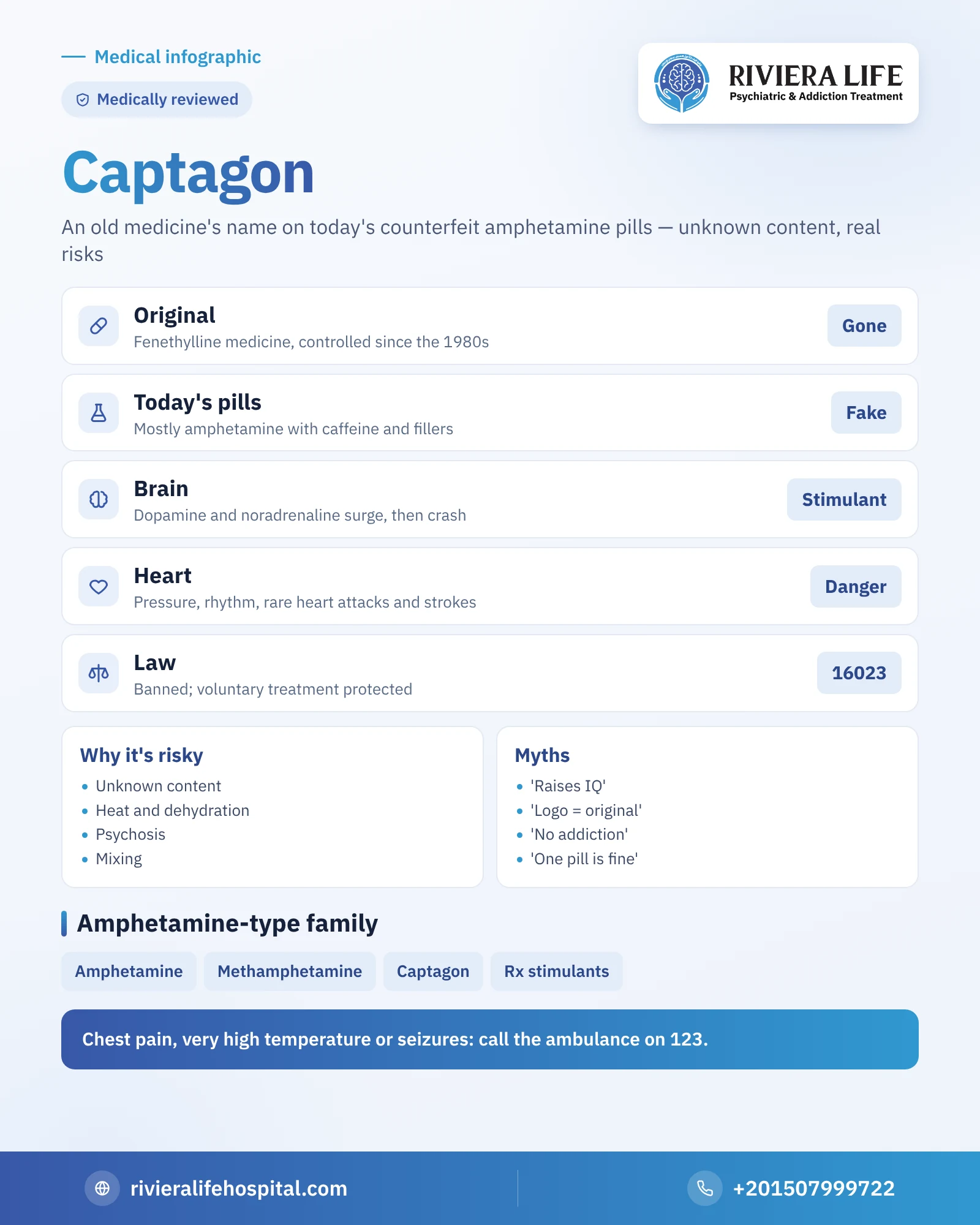
Captagon, also written “kabtagon”, was a stimulant medicine containing the substance fenethylline, which turns into amphetamine in the body; its medical use was then stopped and it was placed under international control from the 1980s. The pills circulating today under this name aren’t a medicine, but counterfeit tablets that usually contain amphetamine with caffeine and other substances. It is known in Egypt and the Gulf as “Abu Hilalain” (the two crescents), after the logo engraved on it, and it is a stimulant that strains the heart and brain and is banned in Egypt.
- Original substanceFenethylline
- Popular nameAbu Hilalain
- Today’s pillsCounterfeit, usually amphetamine
Captagon is the trade name of an old medicine whose production stopped decades ago, but it has remained alive on people’s tongues and in the illegal market. The pills sold today under this name aren’t that medicine, but counterfeit tablets that most likely contain amphetamine with caffeine and other fillers, and whoever swallows them doesn’t know precisely what is in them.
They are strikingly widespread in the Middle East and the Gulf, and reach Egypt under names such as “Abu Hilalain”. On this page we explain what captagon is, how it affects the brain, and why it is a real danger despite its common image as a pill “for staying up and focusing”, then link you to a separate article for each of its aspects.
What is captagon?
Captagon appeared in the early 1960s as a medicine containing the substance fenethylline, a stimulant made by linking a molecule of amphetamine to a molecule of theophylline, a chemical relative of caffeine. When fenethylline enters the body it splits into these two parts, so the amphetamine acts on the brain as a powerful stimulant, while the theophylline adds a mild stimulation.
The medicine was prescribed at the time for conditions such as attention-deficit hyperactivity disorder in children, narcolepsy and some cases of depression. Over the years it became clear that the risk of its misuse outweighed its benefit, so fenethylline was listed among internationally controlled substances around the mid-1980s, and its medical use stopped in most countries of the world.
The original captagon and the pills in circulation today
Here is the point many overlook: the word “captagon” on the street no longer means the original medicine. International reports that analyzed pills seized in the region in recent years found that most of them don’t contain fenethylline at all, but usually contain amphetamine mixed with caffeine, and sometimes other substances and fillers of unknown origin.
More dangerous is that the concentration of the active substance differs from one batch to another, and even from one pill to another in the same batch. Two tablets identical in shape and stamp may differ greatly in effect. That is why what the user calls “their usual pill” is in reality a new gamble every time.
Names of captagon in circulation
Captagon is well known in Egypt and a number of Arab countries as “Abu Hilalain”, after the logo engraved on many of the tablets, two facing letters that resemble two crescents. You may also hear names such as “the white one”, “staying-up pills” or “study pills”, and other local names spread in the Gulf countries that change from country to country and from one period to another. The presence of the logo itself means nothing about the pill’s content, as it is easily copied, and the real composition can only be known by testing. We gather the best-known of these names in the Kingdom in the guide to drug names circulating in Saudi Arabia.
The look of captagon and ways of using it
Captagon usually comes as small round tablets, white or tending towards beige or yellow, which may be concave on both faces and engraved with the familiar logo. Most users swallow the pill by mouth, which makes it seem “lighter” in their eyes than substances that are snorted or injected. Some may resort to crushing the tablets to inhale them or dissolve them, so the effect arrives faster and the risks to the heart intensify with it.
What does captagon do in the brain and body?
The amphetamine in the pills pushes nerve cells to release large amounts of dopamine and noradrenaline, and blocks their reuptake, so these two substances accumulate at the connection points between cells. Dopamine is linked to reward and motivation, and noradrenaline is linked to wakefulness and physical readiness. The result is a mix of effects:
- Wakefulness, energy and the disappearance of the sense of tiredness for long hours.
- Excess self-confidence, talkativeness and a temporary feeling of focus.
- Loss of appetite, thirst and a dry mouth.
- A racing heartbeat and raised blood pressure and body temperature.
- Dilated pupils, teeth grinding and tightening of the jaw muscles.
After the effect wears off, the body pays the price: severe exhaustion, low mood, tension, and an urgent craving for another pill “to finish the day”. With repetition the brain needs larger amounts to get the same feeling, its enjoyment of ordinary things decreases, and a cycle begins that is hard to get out of without help.
Does captagon have a medical use today?
No. Fenethylline is no longer dispensed in Egypt or in most countries of the world, and the pills circulating under the name captagon aren’t a medicine at all. The medicinal amphetamines available in some countries for treating attention-deficit hyperactivity disorder or narcolepsy are preparations of known concentration dispensed by prescription and under follow-up, and have nothing to do with tablets of unknown origin bought in secret. Someone who suffers poor concentration or chronic exhaustion begins treatment with a diagnosis of the cause of the problem, not with a pill from the market.
Why is captagon dangerous?
The image of captagon as a “light” pill for studying or night work hides multiple risks:
- Unknown content: no one knows the pill’s concentration or what has been mixed with it.
- The heart and vessels: raised blood pressure and an irregular pulse, and in a few but serious cases heart attacks and strokes, even in young people.
- Heat and dehydration: especially with long sleeplessness, physical effort and hot weather.
- Psychotic symptoms: paranoia, suspicion and hallucinations that may appear with high doses or long sleep deprivation.
- Mixing: many combine captagon with tramadol, pregabalin or alcohol to balance the effect, so the risks multiply.
- Dependence: repeated use leads to tolerance, intense craving and difficulty stopping.
You will find these risks detailed organ by organ in the article on the harms of captagon.
Captagon within the amphetamine-type stimulant family
Captagon belongs to the group of amphetamine-type stimulants, a family that includes amphetamine itself and methamphetamine, known as ice or shabu, alongside stimulant medicines with a specific medical use. These substances share raising dopamine and noradrenaline, and differ in strength, duration of effect and how fast they cause harm. Methamphetamine has a stronger effect on the brain and lasts longer, while the pills circulating under the name captagon may sometimes be weaker, but the variability of their content makes judging them in advance impossible. You can read the full picture of the family on the amphetamines page, and get to know its strongest member on the methamphetamine page.
In recent years the name captagon has become linked with Syria as a major center of its production, which is why the guide to addiction treatment in Syria explains the bodies available inside the country and the steps to begin.
Captagon and the law in Egypt
Egypt’s anti-narcotics law lists amphetamine and its derivatives among the banned substances, and punishes their possession and use, with the penalty becoming much harsher in cases of importing and trafficking. On the other hand, the law provides that no criminal case is brought against a user who comes forward of their own accord for treatment. This door is open to every family that hesitates out of fear of accountability. For any legal question specific to a particular case it is preferable to consult a lawyer, and the Fund for Drug Control and Treatment of Addiction also provides a free, confidential hotline on 16023.
The captagon guide: each aspect in a separate article
There are many questions about captagon, so we have answered each of them in a separate, detailed article:
- Captagon addiction symptoms: what the family sees in sleep, eating, mood and behavior, and when the matter becomes addiction.
- Causes of captagon addiction: why a student, driver or night worker starts, and why they continue.
- The harms of captagon: its effect on the heart, brain, kidneys, mind and daily life.
- Captagon withdrawal symptoms: the stages after the last pill, the duration of each stage, and when urgent intervention is needed.
- How long captagon stays in the body: how long it shows in urine, blood, saliva and hair, and how the result is read.
- Captagon addiction treatment: the steps of treatment, the role of medicines and psychotherapy, and how to choose a hospital.
- Captagon and sex: the truth about what is said about desire and delaying ejaculation, and what happens to performance in the long term.
Common myths about captagon
The myth: captagon raises intelligence and improves grades. The truth is that it prolongs staying up and gives a feeling of focus, but sleep deprivation weakens memory, and many students enter the exam exhausted or more tense than they should be.
The myth: the pill bearing the logo is the “original” and therefore guaranteed. The truth is that the logo is copied everywhere, and most seized pills don’t contain the original substance at all.
The myth: stimulants don’t cause addiction because there is no painful physical withdrawal. The truth is that dependence on stimulants may be psychological and behavioral at its core, but it is real and strong, and its withdrawal brings depression, exhaustion and an urgent craving that pushes towards going back.
The myth: one pill on special occasions does no harm. The truth is that the effect of a single pill on the heart can’t be predicted with changing content, especially in someone who has a heart problem they don’t know about.
Discovered that your son or a relative is using captagon?
Many families discover the matter during exam season, or after noticing that the son doesn’t sleep for days then sleeps a whole day. Don’t start by shouting or searching. Write down what you have noticed and its timing, choose a calm moment when he has slept well and isn’t under the influence, and talk about your worry for his health, not about shame.
Ask him what pushes him to it: study pressure, night work, or a desire to lose weight, as the reason determines part of the solution. Then ask for a specialized consultation even if he refuses at first, as the family also needs guidance. The list of signs in the article on captagon addiction symptoms helps you organize your observations before the conversation.
Signs of captagon poisoning
Call the ambulance on 123 immediately if any of these appear
A high dose of stimulants may harm the heart and brain within a short time, especially with heat or mixing with other substances.
- Chest pain or a feeling of heaviness on it, with violent irregular heartbeats
- A very high temperature with heavy sweating, or hot dry skin
- Seizures, an epileptic fit or loss of consciousness
- Severe agitation, hallucinations or paranoia that pushes towards violence or self-harm
- A sudden severe headache, weakness in half of the body or inability to speak clearly
Until the ambulance arrives, move the person to a quiet and relatively cool place, loosen their clothes, and stay close to them without arguing or violent restraint. Don’t give them sleeping pills or sedatives from home, or alcohol “to calm them”, as this may make things worse.
When should you ask for help?
If captagon use is repeated, or the person has come to need it to work or study, or suspicion and paranoia or episodes of depression appear after stopping, the time is right for a medical assessment. At Riviera Life in Sheikh Zayed, doctors in psychiatry and addiction treatment assess the case in complete confidentiality, and determine whether it needs admission or outpatient follow-up, with a program that includes the family. The first step begins with a free consultation, and you will find the full outline of the plan in the article on captagon addiction treatment.
Medical sources and referencesThe information in this article is based on reliable scientific sources
1NIDA — Prescription stimulants: how they work and the risks of misusenida.nih.gov2StatPearls — Amphetamine toxicity: symptoms and managementncbi.nlm.nih.gov3SAMHSA TIP 33 — How stimulants affect the brain and behaviorncbi.nlm.nih.gov4MedlinePlus — Amphetamine usemedlineplus.gov5WHO — Psychoactive substanceswho.int