Video games are an ordinary part of the day for millions of children, teenagers and adults in Egypt, from a quick match on the phone during the commute to an evening PlayStation session with friends. Most people who play have no problem at all; they find enjoyment, connection and mental challenge in it. But a small proportion lose control over gaming until it takes precedence over sleep, study, work and family, and here the World Health Organization recognizes a medical condition called “gaming disorder”. This page explains the difference between balanced use and addiction, how the family can set healthy limits, and when the matter needs a specialist assessment.
What are video games?
By video games we mean every game played on a screen: mobile phone games, consoles such as PlayStation, Xbox and Nintendo, computer games, and games that run inside the browser. Some are played alone without the internet, and many today are multiplayer online games, in which the player meets friends or strangers from other countries and talks with them by voice or text while playing.
A game is no longer a product bought once and then finished. Most popular games are free to download, and make their profits from in-game purchases: virtual coins, outfits for characters, a “battle pass” renewed every season, and random boxes whose contents the player doesn’t know before paying. This design makes the game almost endless, and it is one of the reasons doctors pay attention to it.
The most popular types of video games
Games differ in their nature and in their ability to take over time. Among the most popular types among young Egyptians:
- Battle royale and shooter games: such as PUBG Mobile, Free Fire and Call of Duty, built on short successive matches and team play.
- Sports games: such as the famous football games, very common in PlayStation shops and among friends.
- Multiplayer role-playing games: huge persistent worlds in which the player develops their character for months and is tied to a team or “clan”.
- Building and open-world games: such as Minecraft and Roblox, which attract younger children in particular.
- Strategy and puzzle games: based on planning and thinking; some are short and light.
This does not mean that a particular type “causes” addiction, but endless multiplayer games that reward daily attendance are more linked to difficulty stopping.
The benefits of video games when used in moderation
It is not fair to talk about games as pure evil. When they are kept to their natural size, they may give the player quick reactions and hand-eye coordination, practice in problem-solving and planning, space to connect with friends, and relief from stress after a long day. Some educational games help children learn languages and arithmetic. So the problem is not playing itself, but the place it occupies in life.
When does play turn into addiction?
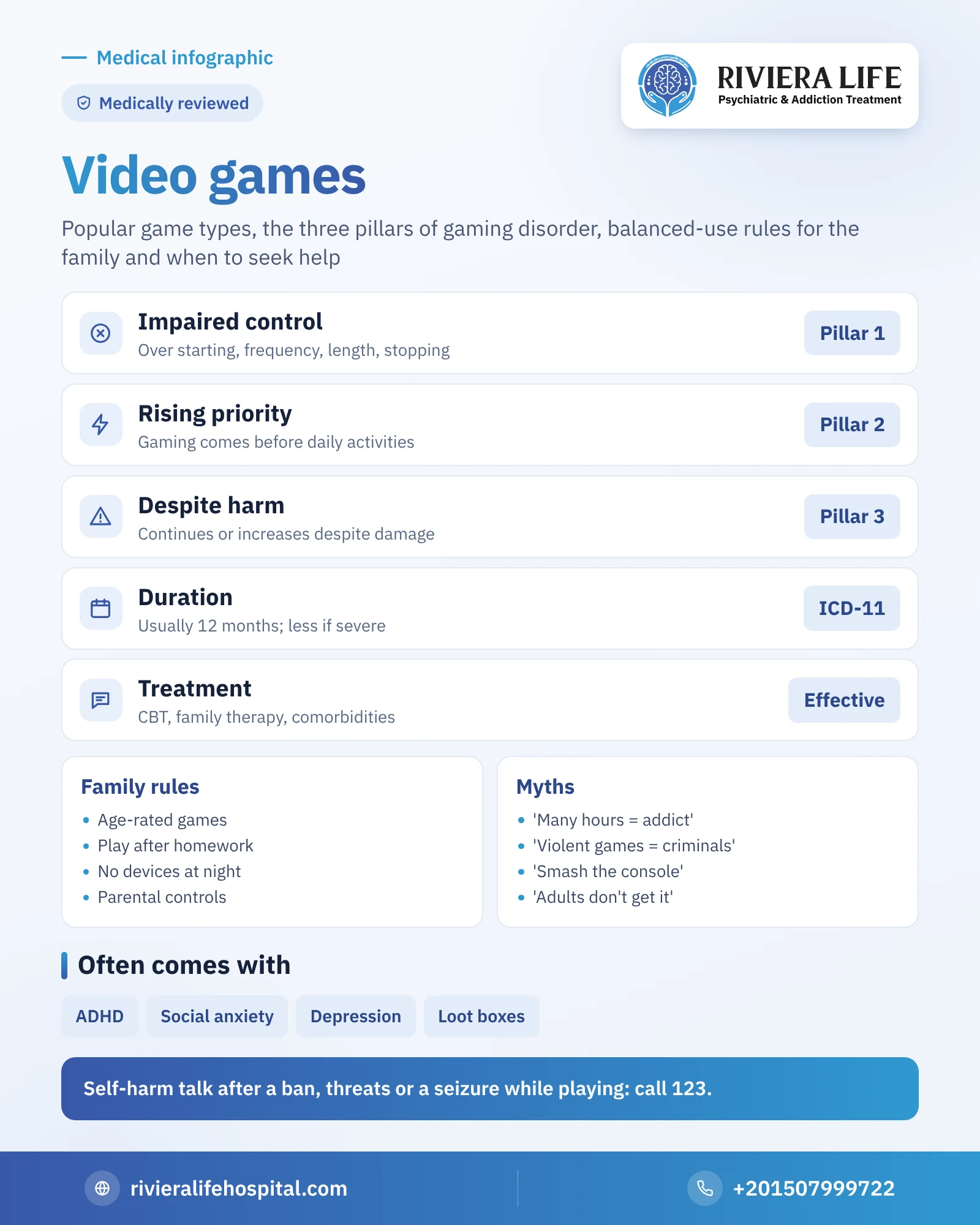
The World Health Organization included “gaming disorder” in the eleventh edition of the International Classification of Diseases, among disorders due to addictive behaviors alongside gambling disorder. The diagnosis rests on three pillars:
- Impaired control: over starting to play, how often, how long, and when to stop.
- Giving gaming increasing priority: until it comes before other interests and daily activities.
- Continuing despite consequences: or increasing play despite clear harm appearing.
It requires that this pattern cause noticeable impairment in personal, family, educational or occupational life, and that it usually last at least twelve months, though the period may be shorter if the symptoms are severe. The fifth edition of the American diagnostic manual, however, places “internet gaming disorder” among conditions that need further research, and proposes nine criteria. The conclusion is that the number of hours alone is not enough to judge; a teenager who plays three hours during the holidays, sleeps well and passes his studies is not like someone who plays two hours but lies and skips school for them.
Is gaming addiction common?
The World Health Organization stresses that gaming disorder affects only a small proportion of those who play. Estimates vary widely between studies because of different scales and ages, but they usually center on a proportion ranging from less than 1% to about 3% of the general population, rising among teenagers and young males. More important than the number is that each case is a family living with daily tension and a student losing a school year.
The main signs in brief
The signs usually begin with the mind being preoccupied with the game all the time, then follow one another: anger or intense irritability when asked to stop, failed attempts to cut down, lying about the time spent, staying up until dawn then sleeping during the day, falling grades, withdrawal from family and friends off the screen, and repeated spending on top-ups and in-game purchases. We detail these signs and how to tell them apart from ordinary enthusiasm in the article Symptoms of video game addiction.
Why do some people fall into addiction and not others?
There is no single cause. Factors in the person themselves, such as impulsivity, ADHD, social anxiety or depression, usually come together with factors in the environment such as loneliness, idleness, weak supervision and family conflicts, and then the game’s own design, with its unexpected rewards and daily tasks, completes the circle. We explain these factors in detail in the article Causes of video game addiction.
Balanced use: practical rules for the family
Prevention is much easier than treatment, and it starts with clear rules everyone agrees on before a problem appears:
- Choose games that suit the child’s age, and use the age rating printed on the game (such as PEGI).
- Give gaming a set time after homework and enough sleep, not before them.
- Keep devices out of the bedroom at night, and turn off screens about an hour before sleep.
- Enable parental control tools to limit time and prevent purchases without permission.
- Play with your child sometimes, and ask about their friends inside the game as you ask about their friends at school.
- Balance the day with physical activity, a real hobby and face-to-face meetings.
- Be a role model; a child who sees their parents on the phone all the time is hard to convince to stop.
The harms of excessive gaming
When gaming turns into addiction, its effects appear on sleep, concentration, weight, the eyes and the back, and on study, relationships and money, and it may come with depression or anxiety. We cover these harms and what can be repaired in the article The harms of video game addiction.
How is gaming addiction treated?
Treatment relies mainly on psychotherapy, the best known being cognitive behavioral therapy, which helps the player understand what drives them to play and build alternatives, with family therapy that reorganizes the rules at home instead of daily battles. The doctor treats any accompanying disorder such as depression, anxiety or ADHD, and may prescribe medicine for that disorder when needed, since there is no medicine specifically for gaming addiction itself. The details are in the article Treatment of video game addiction.
Games, gambling and accompanying disorders
Some mechanisms of modern games closely resemble gambling, especially random boxes in which the player pays money for an uncertain prize. That is why doctors pay attention to anyone who spends large sums on these boxes, because the road from them to gambling addiction is not far. Therapists also notice that gaming addiction often occurs together with social phobia, anxiety and depression, so the game becomes an escape from a confrontation the young person cannot manage in real life.
Common myths about video games
- “Everyone who plays a lot is an addict”: not true; the criterion is loss of control and harm, not the number of hours alone.
- “Violent games make criminals”: research does not prove a direct causal link between violent games and crime, but content unsuitable for the age remains unsuitable.
- “The solution is to smash the device”: sudden, forceful banning usually creates stubbornness, lying and secret play; a gradual plan is more effective.
- “It’s just laziness”: many addicts suffer from anxiety, depression or attention problems that deserve treatment, not blame.
- “Adults don’t get addicted to games”: addiction affects adults too, and may cost them their jobs and marriages.
The video games guide: each aspect in its own article
We have devoted a separate article to each question that concerns families and players:
- Symptoms of video game addiction: the behavioral, psychological and physical signs, and how to tell enthusiasm from addiction.
- Causes of video game addiction: the psychological, family and social factors and the design of the games themselves.
- The harms of video game addiction: its effect on health, sleep, study, relationships and money.
- Treatment of video game addiction: the steps of recovery, cognitive and family therapy, and the parents’ role.
Start here: a quick guide for parents
If you are worried about your son, don’t start by confiscating the phone in a moment of anger. Observe calmly for a full week: When does he play? How much does he sleep? How is he doing academically and socially? Then choose a calm time to talk, and start by asking about the game itself and what he likes about it before talking about the problem. Agree together on written rules, and apply them consistently. And if the attempts are met with violent anger or complete withdrawal, that is the right time to seek a psychological assessment.
When does it become an emergency?
Gaming addiction is rarely an emergency in itself, but some situations cannot wait:
Seek urgent help immediately if you see
Call the ambulance on 123 or go to the nearest emergency department, and do not leave the person alone.
- Talk of wanting to die or self-harm after being stopped from playing
- Threats to harm a family member, or repeated violent smashing
- Refusing food and sleep for days on end because of gaming
- A seizure while playing in front of the screen
- The child being blackmailed or threatened by a stranger they met inside a game
When should you seek help?
Seek an assessment when loss of control over gaming continues for months despite attempts, or study or work clearly decline, sleep is disrupted, the home turns into a daily battleground, or signs of depression and anxiety appear. At Riviera Life, consultant psychiatrists assess the case in complete confidentiality and put together a plan suited to the patient’s age and the family’s circumstances, with a family program and follow-up after improvement. The first consultation is free via +201507999722.
Medical sources and referencesThe information in this article is based on reliable scientific sources