Shadow isn’t a plant or hashish, as many who try it for the first time think, but dry herbs sprayed with manufactured chemicals that mimic the effect of hashish and far exceed it. Its English name fits its reality: a substance whose user doesn’t know what is inside it, and can’t predict what it will do to them each time.
It has been linked in emergency departments with seizures, agitation and loss of consciousness in young people who had no previous health problem. This page is your entry point to everything the Riviera Life team has written about shadow: what it is, its effect, and why it is more dangerous than it seems, then detailed links for each aspect of it.
What is shadow?
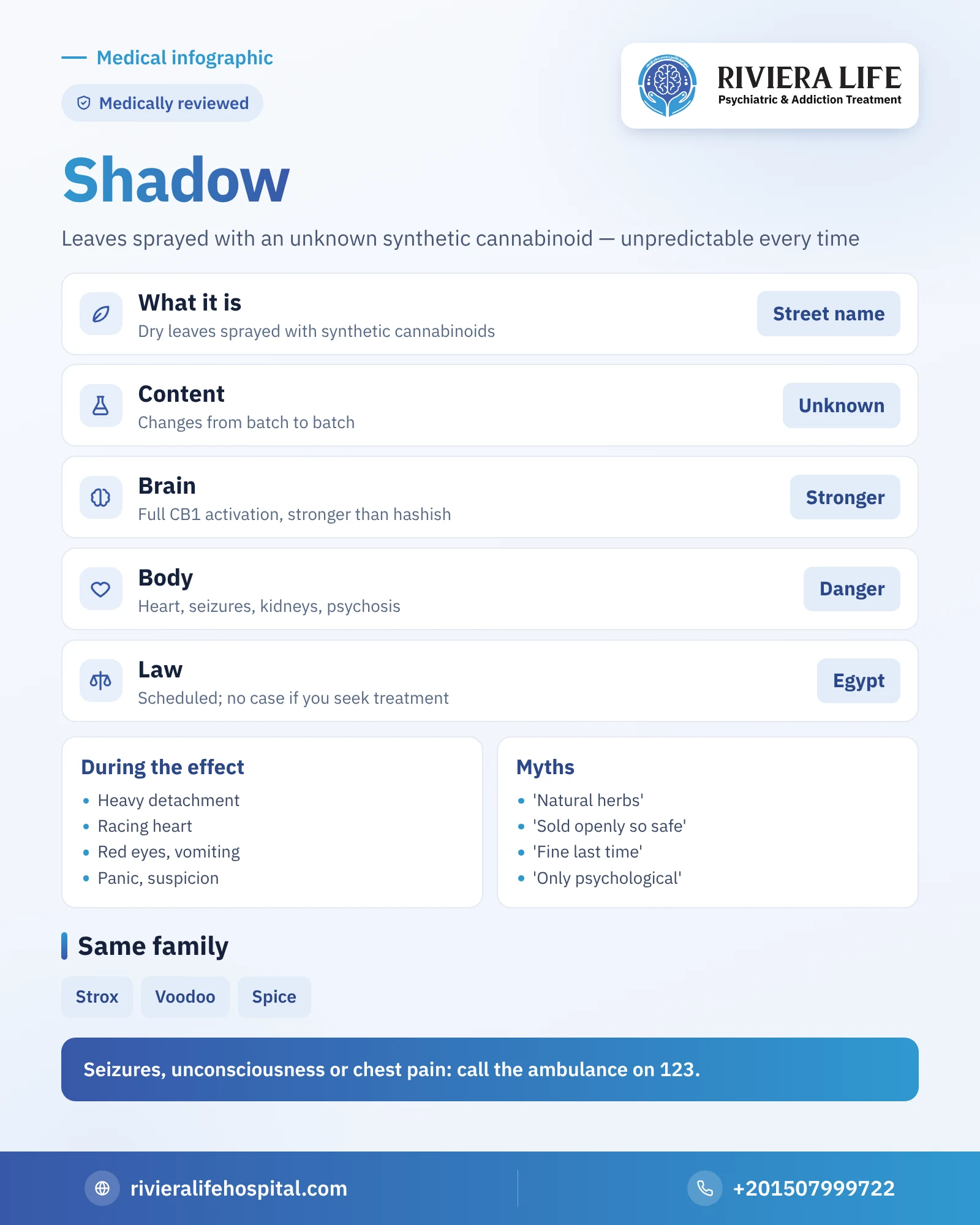
Shadow is a street trade name given to blends of dried plant leaves that have been sprayed or soaked in liquids containing substances called “synthetic cannabinoids”. These substances weren’t extracted from the cannabis plant at all, but were made in laboratories, and many of them bind to the same brain receptors that the active ingredient in hashish binds to, but much more strongly.
And the point the family should know before anything else: the name “shadow” doesn’t indicate a fixed formula. The chemical sprayed on the leaves may change from one batch to another and from one dealer to another, and its amount may differ within the same bag. That is why, most of the time, neither the user nor the seller knows exactly what they have in their hands.
Names of shadow circulating in Egypt
It is known among young people in Egypt as “shadow”, and in street talk it is classified within what they call “chemical” or “synthetic hashish”, broad names that also include strox, voodoo and spice. The difference between these names is usually a marketing difference in packaging and fame, not a scientific difference that can be relied on. A product may be sold as shadow when it is actually another blend, or the reverse, which is why it isn’t enough for a person to say “I took shadow” for the doctor to know what actually entered their body.
The look of shadow and ways of using it
Shadow usually appears as dry crumbled leaves resembling marjoram or shredded tobacco, and they may be pale green or brown, sold in small bags or ready-made rolls. The best-known ways of using it:
- Rolling it in a cigarette and smoking it, the most widespread method.
- Mixing it with tobacco or bango inside the same cigarette.
- Adding it to shisha in some gatherings.
The most dangerous thing about these methods is that they suggest familiarity: a cigarette like any cigarette. But the chemical isn’t distributed evenly on the leaves, so a few puffs from a saturated part may be enough to cause poisoning, while another part of the same bag passes with no noticeable effect.
What does shadow do in the brain and body?
In the brain there is a natural system called the endocannabinoid system, which takes part in regulating mood, memory, appetite, pain and sleep. This system works through receptors, the best known being the first cannabinoid receptor. The active substance in hashish activates these receptors partially, while many synthetic cannabinoids activate them fully and with doubled strength, which explains why the effect of shadow differs greatly from the effect of hashish. The effect begins within minutes of smoking and usually lasts a few hours, and among the most noticed things during it are:
- Heavy relaxation or detachment from the place, which some describe as “zoning out” or freezing.
- A clear racing of the heartbeat and raised blood pressure.
- Red eyes, dry mouth and nausea that may reach repeated vomiting.
- Severe anxiety, a panic attack or suspicion of others.
- In some cases: hallucinations, agitation, seizures or loss of consciousness.
Because the effect is relatively short, the user tends to repeat smoking at close intervals, so the brain gets used to it quickly and the need for larger amounts appears, then unpleasant symptoms appear on stopping. This is how the matter turns from an experiment into dependence in a time that may be shorter than the person expects.
Does shadow have any medical use?
No. Neither shadow nor the substances sprayed on it have any approved medical use in Egypt or elsewhere. It is true that some of these compounds were originally designed in research laboratories to study the cannabinoid system in the brain, but they were never approved as medicines, and then moved into the illegal market. Even the cannabis-derived medicines approved in some countries differ completely in their composition, doses and monitoring, and have nothing to do with what is sold on the street under the name shadow.
Why is shadow considered dangerous?
The danger of shadow accumulates from several causes that come together in a single bag:
- Unknown formula: the substance may change without announcement, and may be much stronger than the previous batch.
- Uneven distribution: the strength of a single cigarette can’t be predicted.
- Its effect on the heart and brain: cases of heart rhythm disturbance, heart attacks, strokes and seizures have been recorded in healthy young people.
- Psychotic symptoms: it may cause hallucinations and persecutory thoughts that sometimes continue after the effect wears off.
- The kidneys: synthetic cannabinoids have been linked to cases of acute kidney injury.
- Speed of dependence: closely spaced repetition raises the risk of addiction and withdrawal symptoms.
You will find the details of these harms on each organ in the article on the harms of shadow.
Shadow within the synthetic cannabinoid family
Shadow stands in a different zone from hashish and bango despite the similar popular name “synthetic hashish”. Hashish and bango come from the cannabis plant, and their effect is relatively well known even if harmful, while shadow comes from manufactured compounds that constantly change, and are known to have a stronger effect and to cause more acute poisoning and emergency admissions.
As for its relationship with strox, voodoo and spice, it is a relationship of members of one family: all are leaves sprayed with substances from the same class, and the difference between them is in the name and packaging more than in essence. That is why what applies to the danger of one usually applies to the others, and the wider picture can be seen on the chemical page.
Shadow and the law in Egypt
The Egyptian authorities have listed synthetic cannabinoids in the schedules of prohibited narcotic substances, and the anti-narcotics law punishes their possession, use and trafficking, with the penalty increasing in cases of trafficking. At the same time, the law distinguishes between someone caught in the act and someone who seeks treatment of their own will, as no criminal case is brought against a user who comes forward on their own for treatment. For legal questions specific to a particular case it is preferable to consult a lawyer, and the Fund for Drug Control and Treatment of Addiction also provides a free hotline on 16023.
The shadow guide: each aspect in a separate article
Each article below deals with one aspect of shadow in full explanation:
Symptoms of shadow addiction
What the family sees at home: changes in the face and eyes, behavior and mood, and when use becomes an addiction that needs assessment.
Causes of shadow addiction
Why some young people choose it in particular, the role of pressures, friends and psychological disorders, and the protective factors that reduce the risk.
The harms of shadow
Its effect on the heart, brain, kidneys, mental health, study and work, and when the situation becomes an emergency.
How long shadow stays in the body
Does it show up in an ordinary test? And which tests can detect it in urine, blood, hair and saliva.
Shadow withdrawal symptoms
When symptoms begin after stopping, how they progress day by day, and the signs that call for medical intervention.
Shadow addiction treatment
The stages of treatment from assessment to relapse prevention, the role of medicines and psychotherapy, and how to choose the right hospital.
Common myths about shadow
The myth: shadow is “natural herbs” so it is lighter than hashish. The truth is that the herbs are just a carrier, and what creates the effect is a synthetic substance that may be many times stronger than hashish.
The myth: as long as it is sold openly in some places it is safe or legal. The truth is that these substances are listed in the drug schedules, and the ease of obtaining something doesn’t mean it is safe.
The myth: someone who tried it once without a problem won’t have anything happen to them next time. The truth is that the changing formula and its varying concentration within the same bag make each time a new experiment with an unknown outcome.
The myth: addiction to shadow is only psychological and goes away with willpower. The truth is that repeated use changes the brain’s response, and causes unpleasant physical and psychological withdrawal, and structured treatment greatly raises the chances of success.
Discovered your son or relative is using shadow?
Perhaps you found a small bag with dry leaves in it, smelled a strange odor in the room, or saw him coming back with red eyes and an absent look. The first thing that helps here is postponing your reaction. Write down what you saw and when, and wait for a moment when he is fully alert, then start the conversation from worry about his health, not from accusation.
Ask him about what he is going through before asking what he is using. Avoid daily searches and threats of throwing him out, as they teach him to hide more than they push him towards treatment. And contact a specialized provider to assess the situation even if he refuses at first, as the family itself needs guidance. The details of the signs that deserve attention are in the article on shadow addiction symptoms.
Signs of shadow poisoning
Call the ambulance on 123 immediately if any of these appear
Poisoning by synthetic cannabinoids may develop within minutes, and waiting for the effect to wear off on its own isn't enough.
- Seizures or violent shaking of the body
- Loss of consciousness or no response to calling
- Chest pain or severe, rapid palpitations
- Violent agitation, hallucinations or behavior that threatens his safety or the safety of others
- A very high body temperature with sweating or confusion
- Difficulty breathing or repeated vomiting with drowsiness
Until the ambulance arrives, stay beside him in a quiet, dimly lit place, and talk to him in a low voice without arguing. If he loses consciousness and is breathing, put him on his side so he doesn’t choke if he vomits, keep hard objects away from him during a seizure and don’t put anything in his mouth. Don’t give him sedatives from home, coffee or water by force, and tell the ambulance team what he used if you know.
When should you ask for help?
If shadow use is repeated, if bouts of anxiety and suspicion appear after it, or if the person becomes tense and unable to sleep when they can’t find it, this is the time for medical assessment, not for waiting. At Riviera Life in Sheikh Zayed the consultants in psychiatry and addiction treatment examine the case in complete confidentiality, and determine whether it needs residence or outpatient follow-up, with a program in which the family takes part. The first consultation is free, and you will find the outlines of the plan in the article on shadow addiction treatment.
Medical sources and referencesThe information in this article is based on reliable scientific sources
1NIDA — Synthetic cannabinoids: what they are and how they affectnida.nih.gov2EUDA — Synthetic cannabinoids and spice products drug profileeuda.europa.eu3StatPearls — Cannabinoid toxicity, including synthetic compoundsncbi.nlm.nih.gov4Systematic review — Toxicity of synthetic cannabinoids in K2 and Spice productspmc.ncbi.nlm.nih.gov5WHO — Cannabis: terminology and acute and chronic health effectswho.int