People call it “the happy hormone”, but serotonin is much broader than this title. It is a neurotransmitter that carries messages between brain cells, and takes part in regulating mood, sleep, appetite, anxiety and impulsivity, while most of its quantity in the body works far from the brain, in the gut and blood. This page explains what serotonin is, how it is made and released, its relationship with depression and addiction and with other hormones such as cortisol and oxytocin, and what actually supports it, then leads you to a separate article on each of its aspects.
What is serotonin?
Serotonin is a small chemical whose scientific name is 5-hydroxytryptamine, abbreviated in medical books to 5-HT, and its chemical formula is C10H12N2O. It belongs to the “monoamine” family, which also includes dopamine and noradrenaline. The recurring question is: is it a hormone or a neurotransmitter? The answer is that it is both, depending on the location; inside the brain it works as a neurotransmitter carrying the signal from one cell to another across the synapse, and outside the brain it behaves like a local hormone regulating gut movement and blood vessel constriction and helping platelets clot.
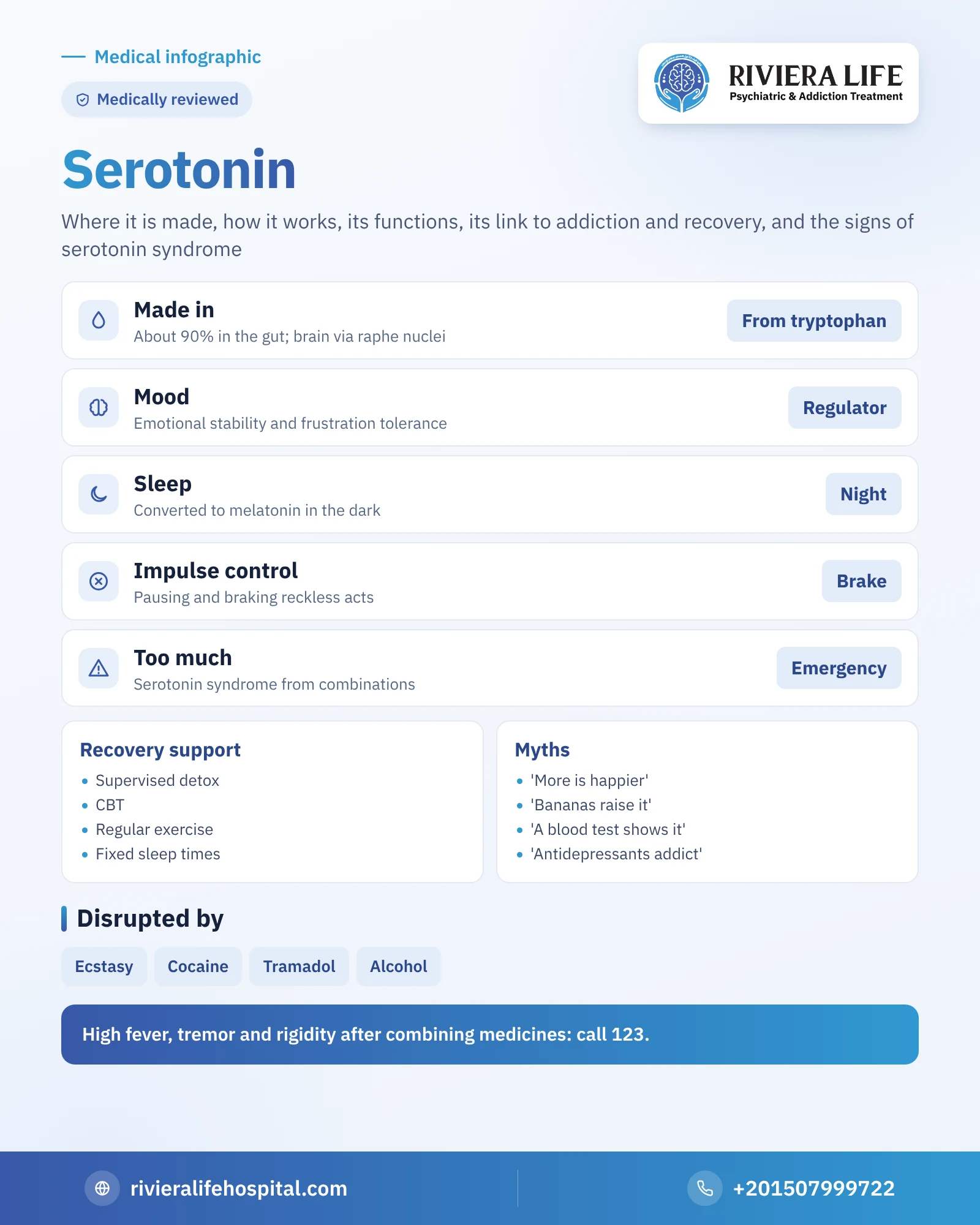
It is made from an essential amino acid called tryptophan, meaning the body does not make it itself but takes it from protein in food. Tryptophan is first converted into an intermediate substance, then into serotonin, with the help of specific enzymes. From serotonin itself the body later makes the hormone melatonin, responsible for the rhythm of sleep.
Where is serotonin made?
The surprise for many people is that the brain is not the biggest factory. Medical references indicate that roughly 90% of the body’s serotonin is made in special cells lining the gut, where it regulates its movement and secretions, then platelets carry part of it in the blood. Brain serotonin, by contrast, is made by a small group of nerve cells in the brainstem called the “raphe nuclei”, whose fibers extend to wide areas: the cerebral cortex, the limbic system responsible for emotions, and the sleep and appetite centers.
The important thing here is that gut and blood serotonin does not cross into the brain, because the blood-brain barrier prevents it. So food rich in serotonin itself does not directly lift your mood, and measuring it in the blood does not reflect what happens inside the brain.
How is serotonin released and how does it work?
Serotonin’s journey inside the brain passes through successive steps that can be simplified like this:
- Storage: after it is made, serotonin is kept inside small vesicles at the tip of the nerve cell.
- Release: when an electrical signal reaches the tip of the cell, calcium enters, so the vesicles fuse with the cell membrane and empty their contents into the synapse.
- Binding: serotonin binds to receptors on the next cell; these come in many types, about fourteen subtypes distributed across seven families, each with a different function.
- Reuptake: a special pump called the serotonin transporter pulls what remains back into the first cell for reuse, and this pump is the target of many antidepressants.
- Breakdown: the enzyme monoamine oxidase breaks down the excess into a substance called 5-HIAA, which leaves in the urine.
These steps explain why different medicines and drugs affect serotonin in different ways: some block reuptake, some push the cell to release its store all at once, and some bind directly to the receptors.
The functions of serotonin in the body
Serotonin does not handle a single function; it works like a “regulator” that softens the intensity of responses and keeps them balanced. Among the most important things it takes part in:
- Mood and emotions: it helps emotional stability and tolerating frustration.
- Sleep: it takes part in regulating the sleep-wake cycle, and it is the raw material for melatonin.
- Appetite and digestion: it gives the signal of fullness and regulates gut movement, and its excess release is linked to nausea.
- Impulse control: it is linked to the ability to pause and restrain reckless actions.
- Pain sensation: it takes part in the pathways that soften or amplify pain signals.
- Blood and vessels: it helps vessels constrict and blood clot at wounds.
- Bones and sexual function: it takes part, to a lesser degree, in bone density and in regulating desire and ejaculation.
Serotonin, mood and sleep
Serotonin has been linked to depression and anxiety for decades, because medicines that raise its concentration in the synapses help many patients. But science today is more cautious about saying that depression is simply a “serotonin deficiency”; recent reviews have not found strong evidence that its decrease alone causes depression, and it is more likely part of a wider network that includes genetics, stress, inflammation and brain circuits. This caveat comes up again in the article Symptoms of serotonin deficiency.
In sleep, however, the relationship is clearer: the activity of serotonin cells rises during wakefulness and calms during sleep, and in the evening the pineal gland converts part of it into melatonin in response to darkness. That is why disturbed sleep and weak exposure to daylight are linked to mood swings, and also why some serotonin medicines may cause insomnia or drowsiness at the start of use.
Serotonin, cortisol and oxytocin
Serotonin does not work alone. With cortisol, the stress hormone, the relationship runs both ways: serotonin takes part in activating the stress axis when the body faces danger, while chronic stress and high cortisol for long periods change the sensitivity of serotonin receptors, which is one of the proposed explanations for the link between chronic stress and depression. So it is not right to say simply that a rise in one lowers the other.
With oxytocin, the bonding hormone, research indicates that serotonin takes part in stimulating its release from the hypothalamus, and this overlap is believed to be among the reasons for the feeling of social closeness caused by ecstasy, which releases large amounts of serotonin followed by a rise in oxytocin.
Low and high serotonin in brief
There is no simple test that measures brain serotonin, so “serotonin deficiency” remains an approximate description of a group of symptoms such as persistent sadness, anxiety, irritability, disturbed sleep and an urgent craving for sweets, symptoms that have many causes determined by the doctor. You can find the evidence-based ways to support it, from light and exercise to diet, in the article How to increase serotonin.
An acute increase, however, is the more dangerous condition: the accumulation of serotonin from combining medicines or substances that raise it, such as tramadol with antidepressants, causes what is known as serotonin syndrome, an emergency that may threaten life.
Serotonin and addiction
Dopamine is famous for its role in the reward circuit, but serotonin is an important partner in the story. Many substances raise it temporarily or tamper with its balance: ecstasy pushes cells to empty their store all at once, bringing the feeling of warmth and closeness, followed by a drop in mood that may last days. Cocaine blocks its reuptake along with dopamine, tramadol raises it alongside its opioid effect, while alcohol and hash change its activity in less direct ways.
With repetition the brain adapts: the sensitivity of some receptors changes, and the person’s ability to feel contentment and calm without the substance decreases. Serotonin disruption is also linked to weak impulse control, which may make resisting craving harder, and it is believed to be among the reasons depression and anxiety are common among people newly in recovery.
What happens to serotonin during detox and recovery?
In the first weeks after stopping, many people in recovery go through mood swings, anxiety, insomnia and difficulty concentrating, and part of this is because the brain is trying to regain its chemical balance after the substance is gone. A precise date for the return of balance cannot be set; it differs according to the type of substance, the duration of use and the state of health, usually takes weeks to months, and improves gradually thanks to the brain’s plasticity and its ability to reshape itself.
The following help with this:
- Medical supervision during the detox stage, to treat symptoms and screen for depression and suicidal thoughts.
- Medicines determined by the doctor when needed, such as some antidepressants if accompanying depression is diagnosed.
- Cognitive behavioral therapy, which addresses the thinking patterns that feed substance use.
- Regular exercise, which improves mood and eases craving.
- Balanced food that contains protein, the source of tryptophan.
- Regular sleep at fixed times, because disturbed sleep is one of the strongest triggers of relapse.
Serotonin and mental illness
The serotonin system is linked to a number of mental disorders, not as a sole cause, but because medicines that affect it help in treating them. The most prominent are depression, anxiety of all types, and OCD, which usually needs higher doses and longer periods of serotonin medicines, as well as post-traumatic stress disorder and premenstrual dysphoric disorder. Particular serotonin receptors are also linked to hallucinations, as some hallucinogens such as LSD act on them directly.
Medicines that affect serotonin
Many medicine classes deal with serotonin, and the doctor alone determines what suits each patient:
- Selective serotonin reuptake inhibitors, the most widely used antidepressants.
- Serotonin and noradrenaline reuptake inhibitors.
- Tricyclic antidepressants, and monoamine oxidase inhibitors.
- Some migraine medicines, some anti-nausea medicines, and some painkillers such as tramadol.
- Some antipsychotics that block particular serotonin receptors.
Because these medicines interact, every doctor you visit must know the full list of what you take, including herbal supplements such as St John’s wort.
Common myths about serotonin
Myth: serotonin is “the happy hormone”, and the more you have the happier you are. The truth is that it is a regulator of balance, not a source of joy, and an acute rise causes dangerous poisoning, not happiness.
Myth: bananas and chocolate raise serotonin in the brain. The truth is that the serotonin in food does not cross into the brain; what matters is tryptophan within a complete diet, and its effect is limited.
Myth: a blood test reveals serotonin deficiency and diagnoses depression. The truth is that measuring it in the blood is used for other purposes, such as detecting rare types of tumors, and does not reflect what happens in the brain.
Myth: antidepressants “create” artificial serotonin and cause addiction. The truth is that they change how the brain deals with the serotonin already present, and do not cause addiction, but stopping them suddenly may cause unpleasant symptoms.
The serotonin guide: each aspect in its own article
We have devoted separate articles to the most important questions about serotonin:
- Symptoms of serotonin deficiency: the psychological and physical signs linked to it, the limits of what can be measured, and when to see a doctor.
- How to increase serotonin: light, exercise, sleep, food and supplements, with the level of scientific evidence for each method.
- Serotonin syndrome: the medicines and drugs that cause it, its signs, and when to call the ambulance immediately.
When do you need emergency care?
The emergency linked to serotonin is poisoning from an excess of it, which usually appears within hours of starting a new medicine, raising its dose, or combining two substances.
Call the ambulance on 123 immediately if you see
Especially after combining an antidepressant with tramadol, ecstasy or a new medicine.
- A very high temperature with heavy sweating
- Involuntary tremor or muscle twitching, and muscle rigidity
- A racing heart, clouded consciousness or severe agitation
- Seizures or loss of consciousness
When should you see a doctor?
Has sadness, anxiety or disturbed sleep stayed with you for more than two weeks? Are you thinking of supplements to raise serotonin while taking other medicines? Or do you notice, after recovering from addiction, a drop in mood that won’t go away? In all these cases the matter needs a medical assessment. Consultant psychiatrists and addiction specialists receive you at Riviera Life in Sheikh Zayed, a hospital licensed by the Ministry of Health, and examine your case in complete confidentiality, and the first consultation is free via +201507999722.
Medical sources and referencesThe information in this article is based on reliable scientific sources
1StatPearls — Physiology of serotonin: synthesis, functions and receptorsncbi.nlm.nih.gov2StatPearls — Serotonin syndrome: causes, symptoms and treatmentncbi.nlm.nih.gov3NHS — Selective serotonin reuptake inhibitor (SSRI) antidepressantsnhs.uk4NIMH — Depression: symptoms, causes and treatmentnimh.nih.gov5NIDA — Ecstasy and its effect on the brainnida.nih.gov