The short answer
Dopamine is a neurotransmitter, meaning a chemical messenger that carries signals between brain cells, and it has a limited hormonal role. Its most important functions are motivation and seeking reward, regulating movement and attention, and learning from experience. That is why it is popularly called the happy hormone, an inaccurate title, since it is the hormone of desire and pursuit more than the hormone of pleasure. Its disturbances are linked to Parkinson’s disease, ADHD and schizophrenia, and drugs and compulsive behaviors tamper with it in particular, which is why it sits at the heart of any discussion of addiction.
- Its natureA neurotransmitter with a limited hormonal role
- Its key functionsMotivation, movement and learning
- Its link to addictionDrugs tamper with its pathways
In popular articles dopamine is called the happy hormone, but this title both does it an injustice and misleads the reader. It is a chemical that carries messages between brain cells, and the most important thing it does is drive us to want things and pursue them, regulate movement and attention, and take part in learning from experience. Because drugs and some compulsive behaviors tamper with this substance in particular, dopamine has come to sit at the heart of any discussion of addiction. This page explains what dopamine is, how it is made and released, and its relationship with mood, addiction and mental illness, then leads you to a separate article on each of its aspects.
What is dopamine? A neurotransmitter or a hormone?
Dopamine is basically a neurotransmitter, meaning a chemical messenger that a nerve cell releases into the tiny gap separating it from another cell, called the synapse, where it binds to receptors on the opposite cell and changes its activity. It belongs to a chemical family called monoamines, and specifically to the catecholamine group, which also includes noradrenaline and adrenaline; in fact, the body makes these two substances from dopamine itself.
As for describing it as a hormone, that has a limited truth. Dopamine released by a part of the brain called the hypothalamus reaches the pituitary gland through short blood vessels and inhibits the release of the hormone prolactin, which is a hormonal role in the strict sense. Some is also made outside the brain, in the kidneys, the digestive system and the adrenal medulla, where it affects things such as sodium excretion and gut movement. But this peripheral dopamine does not cross into the brain, because a barrier separating the blood from brain tissue prevents it from passing.
How is dopamine made and how is it released?
From protein to dopamine
The story begins with an amino acid called phenylalanine, which we get from protein in food, and which the liver converts into another acid, tyrosine. Inside the nerve cell, an enzyme converts tyrosine into an intermediate substance known as levodopa, then a second enzyme converts levodopa into dopamine. The first step is the slowest, and it is the one that controls the speed of production, which is why eating more protein does not raise the level of dopamine in the brain, as is commonly claimed. This fact also explains why Parkinson’s patients are given levodopa itself rather than dopamine: it crosses into the brain and is then converted there.
Release, reuptake and breakdown
Dopamine is stored in small vesicles inside the tip of the nerve cell. When an electrical signal reaches this tip, channels open that let calcium in, so the vesicles fuse with the cell membrane and empty their contents into the synapse. Dopamine binds to five types of receptors numbered one to five, then its signal ends in two ways: a pump on the cell surface called the dopamine transporter, which pulls it back inside, and enzymes that break it down, the best known being monoamine oxidase. This detail is not a scientific luxury; cocaine, for example, disables that pump, amphetamines force it to work in reverse, and a number of antidepressant and Parkinson’s medicines act on the enzymes.
Where does dopamine work? Its four pathways and functions
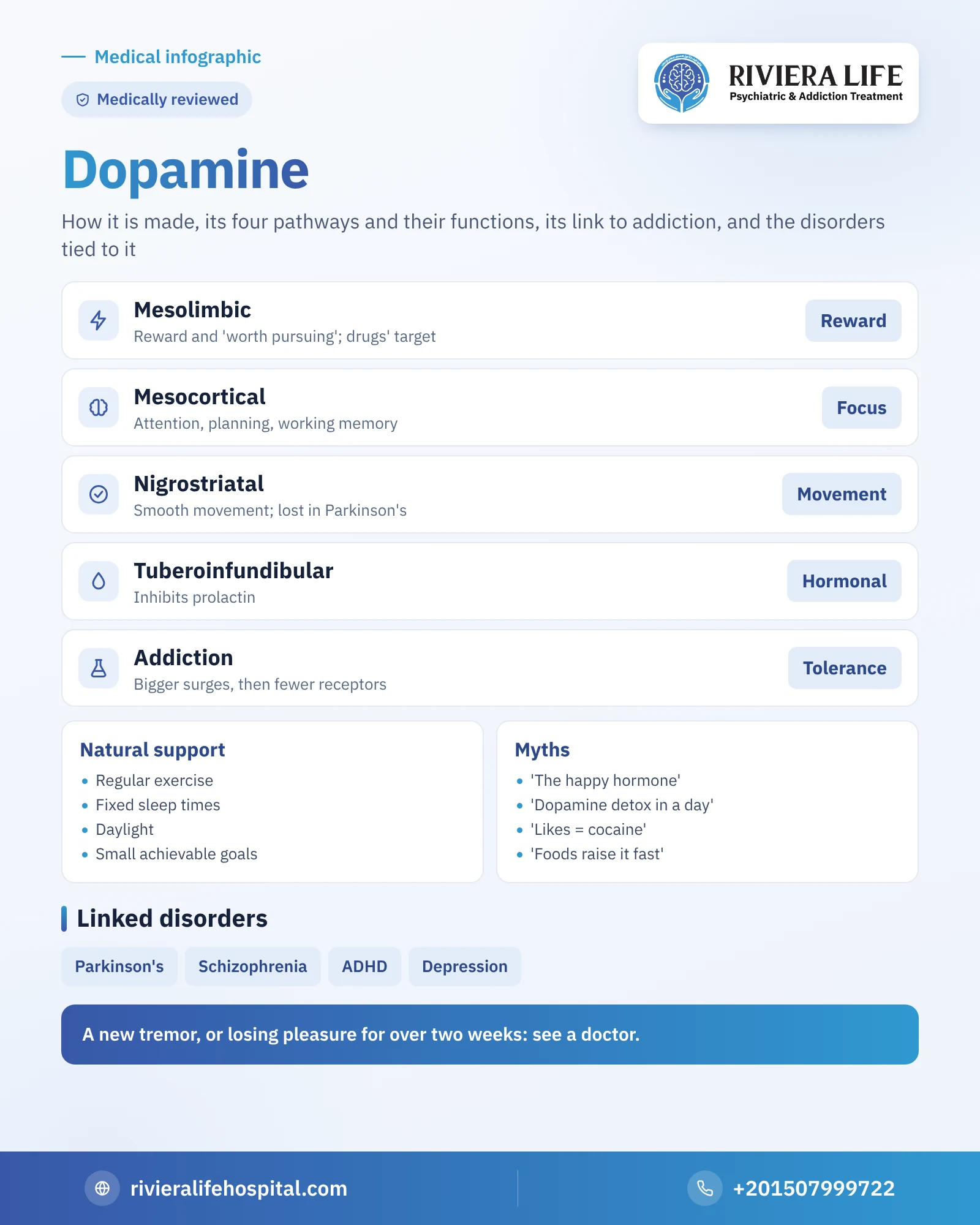
The cells that produce dopamine are clustered in small areas deep in the brain, the most important being the substantia nigra, the ventral tegmental area and the hypothalamus. From them extend four main pathways, each with a different task:
- The mesolimbic pathway: from the tegmental area to the emotion and reward centers, including the nucleus accumbens. It is responsible for the feeling that something is worth pursuing, and it is the pathway that drugs target.
- The mesocortical pathway: to the front of the brain; it supports attention, planning, working memory and decision-making.
- The nigrostriatal pathway: from the substantia nigra to the movement centers; it makes movement smooth and easy to start. The loss of its cells is what happens in Parkinson’s disease.
- The tuberoinfundibular pathway: from the hypothalamus to the pituitary gland; it inhibits prolactin, as mentioned above.
Dopamine, mood, sleep and behavior
Scientific research reveals a more precise picture than the idea of pleasure. Dopamine rises strongly when a reward comes that is better than we expected, stays steady when it comes as expected, and falls when our expectations are disappointed. In other words, it is a teaching signal telling the brain: pay attention, this is important, repeat it. That is why scientists distinguish between wanting something and enjoying it; dopamine is linked to wanting and motivation more than to the pleasure of enjoyment itself, in which other substances such as endorphins take part.
Dopamine also has a role in wakefulness; it is one of the substances that keep the brain alert, which is why stimulants cause insomnia, and sleep deprivation in turn affects dopamine signals. And dopamine does not work alone; there is a mutual interaction between it and serotonin, as serotonin seems to calm some aspects of the impulsivity that dopamine drives, and changing one with medicine may be reflected on the other. So reducing mood to a single substance is an oversimplification.
Low and high dopamine in brief
There is no medical diagnosis called “dopamine deficiency”, but weak signaling in certain pathways is linked to known conditions: slowness of movement and tremor in Parkinson’s, loss of motivation and ability to enjoy in some cases of depression, and attention difficulties in ADHD. The related signs and the limits of what we know about them are explained in the article Symptoms of dopamine deficiency. On the other side, increased dopamine activity in the limbic pathway is linked to psychotic symptoms such as hallucinations and delusions, which appear clearly with excessive stimulant use, and medicines that mimic dopamine may cause impulsive behaviors in some patients.
Dopamine and addiction
Almost all addictive substances raise dopamine in the reward pathway, some directly, such as cocaine and methamphetamine, and some indirectly, such as heroin and alcohol. The surge the substance creates is much larger and faster than that created by food or any natural activity, so the brain learns that this substance is more important than anything else.
The dopamine dysregulation hypothesis describes what happens next: with repetition, the brain reduces the number or sensitivity of dopamine receptors to protect itself from flooding, so the pleasure derived from the substance weakens and the person needs larger amounts, and ordinary sources of pleasure lose their appeal, while cues linked to the substance, such as a place, a person or a sound, become able on their own to ignite craving. The article Dopamine and addiction covers this mechanism in detail.
The good news is that brain-imaging studies have found that these changes partly improve with sustained abstinence, although this takes months and may extend beyond a year in long-term addiction. During that stage, many feel flat and lose their passion, which people call dopamine withdrawal. Therapeutic rehabilitation programs, with their behavioral therapy and building of healthy sources of reward, have also been shown to help the brain regain its balance and reduce relapse.
Dopamine and mental and neurological disorders
- Schizophrenia: increased dopamine activity in the limbic pathway is one of the oldest explanations of psychotic symptoms, and most antipsychotics work by blocking its receptors. Details are in the schizophrenia guide.
- Depression: weak dopamine signaling is linked to loss of pleasure and motivation, but it is one part of a complex picture. See the depression guide.
- Bipolar disorder: dopamine activity is believed to increase in manic episodes, which partly explains impulsivity and the reduced need for sleep.
- ADHD: dopamine and noradrenaline signaling differs in the circuits responsible for attention, and its stimulant medicines work by raising both.
- Parkinson’s disease: a gradual loss of the dopamine-producing cells in the substantia nigra, the clearest example of a real deficiency.
How can you support dopamine naturally?
The means with reasonable evidence are neither secret nor costly: regular physical activity, enough sleep at fixed times, exposure to daylight, balanced food, real social relationships, and small goals achieved one after another. These habits do not pump dopamine into the brain, but they keep a reward system working efficiently. As for the supplements that promise to raise it, their evidence is weak. The details and the level of evidence for each method are in the article How to increase dopamine.
Medicines that affect dopamine
Doctors deal with dopamine using medicines from different classes, each with a specific use decided by the doctor alone:
- Levodopa, dopamine-mimicking medicines and breakdown-enzyme inhibitors, to treat Parkinson’s and restless legs syndrome.
- Antipsychotics that block its receptors, to treat schizophrenia, mania and some other conditions.
- Medical stimulants, to treat ADHD.
- Some antidepressants that affect dopamine and noradrenaline together.
- Some anti-vomiting and anti-nausea medicines, and medicines that lower raised prolactin.
- Dopamine itself as an intravenous solution, used in intensive care to support blood pressure and the heart.
Can dopamine be measured with a test?
No blood or urine test measures dopamine in the brain or diagnoses depression or addiction. Catecholamines are measured in blood and urine, but for a completely different purpose, such as looking for rare tumors that release them. In certain cases, the neurologist orders a special nuclear scan that shows the dopamine transporter in the brain to help diagnose Parkinson’s. Anyone offering you a “dopamine test” to explain your mental state is selling you an illusion.
Common myths about dopamine
Myth: dopamine is the happy hormone. The truth is that it is closer to the substance of wanting, pursuit and learning, and that several substances take part in the feeling of satisfaction at the same time.
Myth: a “dopamine detox” resets the brain within a day or a week. The truth is that the brain does not empty of dopamine or fill up with it in this way. The useful idea in it is reducing compulsive distractions, which is a behavioral habit, not a chemical cleanse.
Myth: likes on social media do to the brain what cocaine does. It is true that apps exploit the reward system, but drugs create much stronger surges and deeper changes, and the absolute comparison between them is an exaggeration.
Myth: particular foods or pills raise dopamine instantly. The truth is that the body regulates its production precisely, and no food improves mood with a quick effect through dopamine.
The dopamine guide: each aspect in its own article
We have devoted an article to each common question about dopamine, answering it in depth:
- Dopamine and addiction: how drugs and compulsive behaviors hijack the reward system, why stopping is hard, and how treatment works.
- Symptoms of dopamine deficiency: the psychological and movement signs, their relationship with Parkinson’s, depression and ADHD, and when you need a doctor.
- How to increase dopamine: evidence-based natural methods, the truth about supplements, and what lies behind the dopamine-detox fad.
- Symptoms of dopamine withdrawal: what people mean by this term, the flatness and loss of passion a recovering person goes through, and how long it lasts.
When should you see a doctor?
Seek a medical assessment if you notice a tremor, slowness of movement or stiffness that increases over time, loss of pleasure and motivation lasting more than two weeks, attention problems that have disrupted your study or work since childhood, or if you use a substance or engage in a behavior that you can no longer stop. The doctor does not need to “measure dopamine” to help you, but to understand the symptoms and their causes. At Riviera Life, consultant psychiatrists and addiction specialists assess the case in complete confidentiality, and the first consultation is free via +201507999722.
Medical sources and referencesThe information in this article is based on reliable scientific sources
1NIDA — Drugs and the brain: the role of dopamine in reinforcement and addictionnida.nih.gov2StatPearls — Dopamine: mechanism of action and medical usencbi.nlm.nih.gov3MedlinePlus — Parkinson's disease and dopamine deficiencymedlineplus.gov4NIMH — Schizophrenia: symptoms and treatmentnimh.nih.gov5NIMH — Mental health medications and their classesnimh.nih.gov