The short answer
Addiction treatment is a medical and psychological plan that starts with an assessment determining the substance and the severity of dependence, then stopping the substance safely under a doctor's supervision, then weeks of psychological and medication-based rehabilitation, then follow-up extending for months after discharge. Addiction is a treatable condition, but it is managed as a chronic disease, so stopping inside the hospital isn't the end of the road. The substance, the psychological state and the home circumstances determine whether the plan starts with full residency or with outpatient follow-up.
- At least three monthsThe shortest duration linked to better results according to NIDA
- Four stagesAssessment, safe detox, rehabilitation, long follow-up
- A plan for each patientIt changes according to the substance and the accompanying psychological illness
Addiction treatment starts with a difficult decision that the family usually makes before the patient themselves, then turns into a plan with steps, appointments and clear responsibilities. On this page we explain what actually happens from the first call to the months after discharge, how long it takes, when follow-up from home is enough, why the road differs between someone who uses tramadol and someone who drinks alcohol, how confidentiality is protected and how to choose the place; then we put in your hands an organized index of the articles for each substance. This includes treating addiction to all types of drugs, alcohol and misused medicines, because the foundations on which drug addiction treatment rests apply to all substances, with differences in the details.
What is meant by treatment for drug addiction?
A mother from Mohandessin or from Tanta calls us and asks one question: "How many days does my son need to clean his body?" The question is understandable, but the body is the easiest part of the matter. The substance leaves the blood within days, but the urgent craving it has left in the brain, and the habits, company and places it has built, need much longer.
That is why serious addiction treatment works on several levels at the same time. The doctor deals with withdrawal and its complications, and treats the insomnia, depression or anxiety that usually appears after stopping, while the psychotherapist works on the thoughts and situations that come before use, and the patient learns how to act when the urgent craving to use intensifies. At the same time, the family repairs the way of dealing with each other at home. And if you want to understand addiction itself as a disease before talking about its treatment, start from the guide Addiction: its definition and stages.
The stages of treatment for drug addiction: from the first contact to follow-up
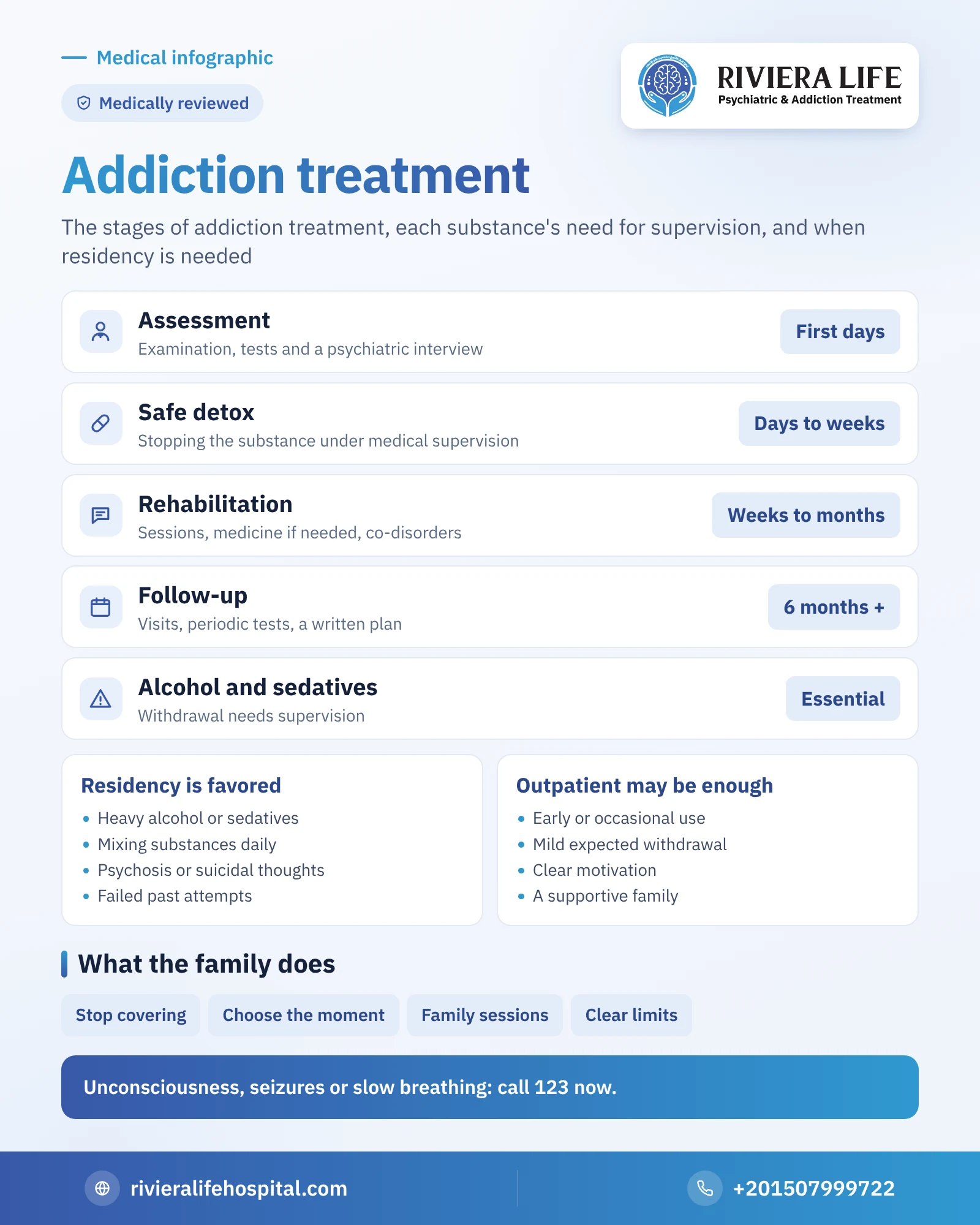
There is no single plan that suits everyone, and this is one of the clearest principles repeated by the American National Institute on Drug Abuse (NIDA). But good plans usually pass through the following stages, and two of them may overlap:
- 1AssessmentThe first days
A medical examination, tests and a detailed psychiatric interview: what the substance is, since when, whether the patient mixes more than one substance, and whether they have suicidal thoughts or chronic illnesses. From here the plan is written.
- 2Safe detoxDays to weeks
Stopping the substance or reducing it gradually according to its type, with medicines that ease the symptoms and prevent complications. The details of this stage for each substance are in the guide Drug withdrawal symptoms.
- 3RehabilitationWeeks to months
Individual and group sessions, the best known being cognitive behavioral therapy, with medicine that reduces craving for some substances, and treatment of any accompanying psychological disorder.
- 4Return and follow-upSix months or more
A gradual return to work or study, regular visits, periodic tests, and a written plan for what the patient and their family do if signs of a return appear.
The most common mistake we see is the family considering the second stage to be the whole treatment. The patient leaves after a week with their body's tolerance for the substance lowered, while the craving remains as it was, so the first dose after discharge becomes more dangerous than any dose before it. We explained this progression from the patient's own point of view in the article The stages of recovery from addiction.
How long does addiction treatment take?
The honest answer is that the duration is measured in months, not days. NIDA's principles indicate that most patients need at least three months of continuous treatment for use to decrease or stop clearly, and that staying in treatment long enough is one of the strongest predictors of the outcome. The distribution of these months, however, varies:
| The part of the plan | Usual duration | What lengthens it |
|---|---|---|
| Assessment and setting the plan | From a day to a few days | Physical or psychological illnesses that need additional tests |
| Safe detox | From days to about two weeks, longer with sedatives | Mixing substances, alcohol, benzodiazepines |
| Intensive rehabilitation | From four weeks to three months | Previous relapses, accompanying depression or psychosis |
| Follow-up after discharge | Six months to a year or more | An environment full of triggers or weak family support |
Short programs such as the twenty-eight days have their place in addiction treatment, but they are a beginning, not an end. The breakdown of each stage's duration by substance and case is in the guide The duration of addiction treatment. And you will find a comparison of each program's duration and what happens inside it in the section Addiction treatment programs.
Does an addict recover completely?
Many stop using and live long years without a substance, working, marrying and raising their children. But medicine places addiction in the category of chronic diseases, such as diabetes and high blood pressure. NIDA estimates that rates of returning to use fall between forty and sixty percent, close to relapse rates in those diseases. This means that a relapse, if it happens, calls for adjusting the plan, and doesn't mean the treatment failed or that the patient is hopeless.
That is why we prefer the word "recovery": a full life without a substance, with ongoing awareness of risky situations. And if you are asking about personality change after stopping, we answered frankly in the article Does an addict return to normal after treatment, and explained the recurring reasons for stumbling in Why treatment sometimes fails.
Residency in hospital or follow-up from home?
Choosing the form of addiction treatment is a medical decision made after the assessment, but it is useful to know the criteria the doctor relies on:
Favor full residency
- Dependence on alcohol, sedatives or opioids in large amounts
- Mixing more than one substance daily
- Psychosis, severe depression or suicidal thoughts
- Previous attempts to stop that ended quickly
- A home from which the substance or the company can't be kept away
Outpatient follow-up may be enough
- Intermittent use or use at its beginning
- Physically mild expected withdrawal
- Clear motivation in the patient themselves
- A family able to support and supervise
- Work or study that can be preserved
Between the two options there are intermediate levels such as half residency and the home plan under medical supervision. And a question keeps coming up: Can an addict stop on their own? That may succeed with some substances, but it is an uncalculated gamble with alcohol and sedatives.
Why does treatment differ with the substance?
The general framework is the same, but the danger of withdrawal and the existence of an approved medicine change a lot. This is a rough estimate of withdrawal's need for direct medical supervision:
Alcohol and sedativesSupervision essential
Opioids and tramadolSupervision preferred
Stimulants and iceClose psychological follow-up
Hash and bangoUsually outpatient
With opioids there are approved medicines that ease craving and protect against overdose. With alcohol, stopping suddenly may cause seizures or delirium, as we explain in Alcohol withdrawal symptoms. Ice, cocaine and captagon, however, have no approved medicine so far, so treatment relies on behavioral rehabilitation and treating the crash and depression. The names of the medicines and the role of each are explained in the section Addiction treatment medicines, and any of them is used only under a doctor's supervision.
Confidentiality and the law: what worries families?
Fear of "scandal" delays many families from addiction treatment for months, and during these months the amount doubles. Medical information is confidential, and it isn't supposed to reach a workplace, university or relatives without the patient's permission. Ask the place before admission who sees the file and how sick leave is written.
Many also ask about the position of Egyptian law on those who come forward for treatment voluntarily, and we have gathered that in the article The law and addicts in Egypt. Admitting someone who refuses, however, has specific medical and legal conditions that we explained in Treating an addict without their consent.
The family's role during and after treatment
In addiction treatment, the family notices first, persuades second, and protects after discharge. These are practical steps we ask of the family:
1
Stop covering up
Don't pay off drug debts and don't make up excuses for absence from work.
2
Choose the time to talk
Speak at a calm moment, in the language of worry for him, not the language of accusation.
3
Attend family sessions
The way of talking at home needs training just as the patient does.
4
Set declared limits
Clear rules on money and going out, with a door open for return.
5
Look after yourselves
The mother and the wife need psychological support too.
If you are still at the persuasion stage, start with the plan to help an addicted person and persuade them to get treatment, then read How to deal with the person in recovery after they return home.
Herbs and home remedies: which of them hold true?
What people pass around
- A herbal mixture that cleans the drug out of the body in days
- Locking the patient in a room until withdrawal "passes"
- A week away from friends is enough for addiction treatment
- Whoever relapses once will never stop
What medicine says
- Herbs may help with relaxation, but don't treat dependence, and some interact with medicines
- Withdrawal from alcohol and sedatives may cause seizures that need a doctor
- Rehabilitation and follow-up take months
- Relapse means reviewing the plan, not cancelling it
We have detailed what science says about the mixtures in circulation in the article Herbs and drug addiction treatment. And if the addiction is to a behavior such as gambling or games rather than a substance, its separate guide is Behavioral addiction.
The clinic or the hospital? And how to choose the place and the cost
The clinic offers assessment, follow-up visits and sessions, and suits mild cases or the period after discharge. The hospital provides residency and continuous medical and nursing supervision, and is required when withdrawal is dangerous or the accompanying psychological illness is severe. Many plans start in the hospital and then move to the clinic.
Before you choose, ask to see the license, ask who the doctor responsible for the case is, and whether there is a plan for the family and written follow-up. The complete list is in How to choose an addiction hospital. Prices are determined by the length of stay, the type of program and the tests, and we explained their components in The cost of addiction treatment in Egypt. Whoever is thinking of traveling will find comparisons of treatment in Turkey and Jordan, and the most important question there is: who follows up the patient after their return? And beware of any party that promises a guaranteed cure in days or prevents the patient from contacting their family. If you are comparing rehab centers now, we have set out the criteria for choosing an addiction rehab in Egypt and how we apply them to ourselves before others.
Situations that can't wait
Some situations go beyond the planning stage and need immediate action before any talk of programs or places:
Call the ambulance immediately
Call the ambulance on 123 if you notice any of these signs:
- Loss of consciousness, difficulty waking or severely slowed breathing
- Seizures while stopping alcohol or sedatives
- Violent agitation or hallucinations that expose him or others to harm
- Serious talk of suicide; you can also call the mental health hotline 16328
The signs of an overdose and how to act until help arrives are explained in the article Drug overdose.
How Riviera Life meets these standards in addiction treatment
- An official license: a hospital licensed by the Egyptian Ministry of Health in Sheikh Zayed, Giza.
- Fourteen years: of experience in psychiatry and treating substance dependence.
- Specialist consultants: in psychiatry and addiction treatment who follow the plan themselves.
- Round-the-clock supervision: medical and nursing care throughout the days of residency.
- Confidentiality, a family program and aftercare: with a free and confidential first consultation.
The addiction treatment article guide: by substance and decision stage
We have arranged the addiction treatment articles into sections so you can go directly to what concerns your case: the decision to start, then the place, then the substance, then what comes after discharge.
Before you start: the decision and the fears
8 articlesWhen to act, and the options when the patient refuses
- Why not wait until he hits rock bottom: signs that call for acting early.
- The patient's fears of entering treatment: eight common fears and the answer to them.
- Stopping without help: when it succeeds and when it becomes dangerous.
- Persuading your son to get treatment: a practical plan for the family.
- Compulsory treatment: when it is justified and how it is done legally.
- Addiction before Egyptian law: voluntary treatment and work tests.
- The truth about herbal treatment: limited benefits and the risks.
- Recovery at home: the conditions that make it safe.
The place, the cost and treatment outside Egypt
13 articlesInside or outside Egypt, paid or free
- Rehab prices in Egypt: what you are paying for.
- Free government treatment: the steps to start and what to expect.
- Treatment near Sheikh Zayed and October: residency and follow-up close to home.
- Cairo rehab centers: how to make sure of the license and safety.
- Gulf patients in Egypt: privacy and follow-up after returning.
- Online sessions: who they suit and their limits.
- Traveling to Turkey for treatment: what to ask before booking.
- Jordan's centers: the options and cost factors.
- Treatment in Lebanon: criteria that reduce the risk of relapse.
- Treatment inside Saudi Arabia: the Eradah complexes and voluntary treatment.
- Treatment in the Sultanate of Oman: the Muscat recovery center and its stages.
- A guide for Arab patients: links for each country and the treatment journey.
- Arabs in Europe and America: treatment in Arabic and the return plan.
Opioids and painkillers
7 articlesFrom heroin to tramadol and cough syrup
- The whole opioid family: stages, medicines and rehabilitation.
- Recovering from heroin: approved medicines and preventing relapse.
- Dependence on morphine: when it starts from a prescription.
- Stopping tramadol: the stages and the risk of seizures.
- Treating fentanyl addiction: supervised withdrawal and protection from overdose.
- Codeine and cough syrup: from withdrawal to treating the cause.
- Nalbuphine injections: virus testing and preventing a return.
Stimulants
6 articlesIce, cocaine, captagon and khat
- Ice or shabu: psychosis and the crash after stopping.
- Treating cocaine addiction: treatment in the absence of an approved medicine.
- Treating captagon addiction: the depression that follows stopping and its treatment.
- Treating amphetamine addiction: the stages of recovery and preventing relapse.
- Ecstasy pills: mood and memory during recovery.
- Treating khat addiction: breaking the habit of the daily session.
Hash and synthetic drugs
9 articlesCannabis, strox, voodoo, hallucinogens and glue
- Quitting hash: insomnia, anxiety and the length of recovery.
- Treating marijuana addiction: psychotherapy and the chances of recovery.
- Treating bango addiction: the stages and psychotherapy.
- Treating strox addiction: safe recovery and follow-up.
- Treating voodoo addiction: the duration and the family's role.
- Treating spice addiction: agitation and psychosis and managing them medically.
- Treating chemical addiction: a substance of unknown composition and its treatment plan.
- Hallucinogens: the bad trip, psychosis and psychotherapy.
- Glue and inhalants: the medical examination and the family's role.
Alcohol, sedatives and psychiatric medicines
9 articlesSubstances that need gradual withdrawal under a doctor's supervision
- Recovering from alcohol: dangerous withdrawal and preventing relapse.
- After the last glass: the body's changes week after week.
- Treating benzodiazepine addiction: why stopping is gradual.
- Xanax: safe withdrawal and treating the underlying anxiety.
- Rivotril: slow withdrawal and patients with panic and epilepsy.
- Treating pregabalin addiction: gradual reduction and the duration.
- Treating gabapentin addiction: when it comes with opioid use.
- The sleeping pill zolpidem: restoring natural sleep.
- Treating Parkinol addiction: assessment with the psychiatrist.
The family and after discharge
10 articlesCraving, relapse, marriage and children
- The stages of recovery: from early abstinence to growth.
- The reasons treatment stumbles: and how to avoid them.
- Bouts of longing for the substance: why they appear and how they pass.
- The person in recovery at home: the family's guide after discharge.
- Does the personality return as it was?: an honest answer for families.
- Regaining self-confidence: how it is built after recovery.
- When the father is an addict: the children's guide to protection.
- The addicted husband: the wife's steps for protection and treatment.
- Getting involved with a person in recovery: frank questions before the decision.
- Living with someone who drinks alcohol: from safety to treatment.
When should you seek help?
If use keeps happening despite promises, or withdrawal symptoms appear whenever the substance is absent, or money, work and relationships have started to collapse, the time is right now, not after "rock bottom". One call is enough to assess the case and explain the options without any commitment, and the first consultation is free and confidential. Contact the Riviera Life team on +201507999722.
Medical sources and referencesThe information in this article is based on reliable scientific sources