

The short answer
Addiction treatment programs are structured frameworks that determine where the patient receives treatment, at what intensity and with what method. They range from full residency in hospital to half residency and then outpatient or home follow-up, and to these are added method-based programs such as the twelve steps and Matrix, and programs for particular groups such as teenagers, those with an accompanying psychological disorder or repeated relapses. The medical assessment determines the starting point, and the patient moves between programs as their condition improves.
- No program for everyoneThe choice follows the assessment, not the advertisement
- Moving is expectedFrom the most intensive to the lighter, gradually
- Duration makes the differenceStaying in treatment long enough matters more than the type of place
Addiction treatment programs are what the family actually chooses when it decides to begin: residency or day attendance, a week or months, individual or group sessions. This page deals with addiction treatment programs specifically and doesn't re-explain the whole of treatment; it compares the available programs, shows who each suits and its usual duration, what distinguishes a good program, and the questions you should ask before signing any contract.
What are addiction treatment programs?
Imagine a young man of twenty who uses hash at weekends, and a man of forty-five who has drunk alcohol daily for ten years and trembles in the morning. It makes no sense for the two to enter the same program for the same length of time. This is where the idea of a program comes in: a treatment template with a place, an intensity, a duration and a method, chosen according to the severity of the case and its risks.
Addiction treatment programs differ in three dimensions you should pay attention to. The first dimension is place, meaning whether the patient sleeps in hospital or at home. The second is intensity, meaning the number of treatment hours per week. The third is method, meaning the way the sessions are built, such as cognitive behavioral therapy or support circles based on the steps. The complete picture of the stages of treatment from assessment to follow-up, however, belongs in the guide Addiction treatment.
Levels of care: a ladder from the most intensive to the lightest
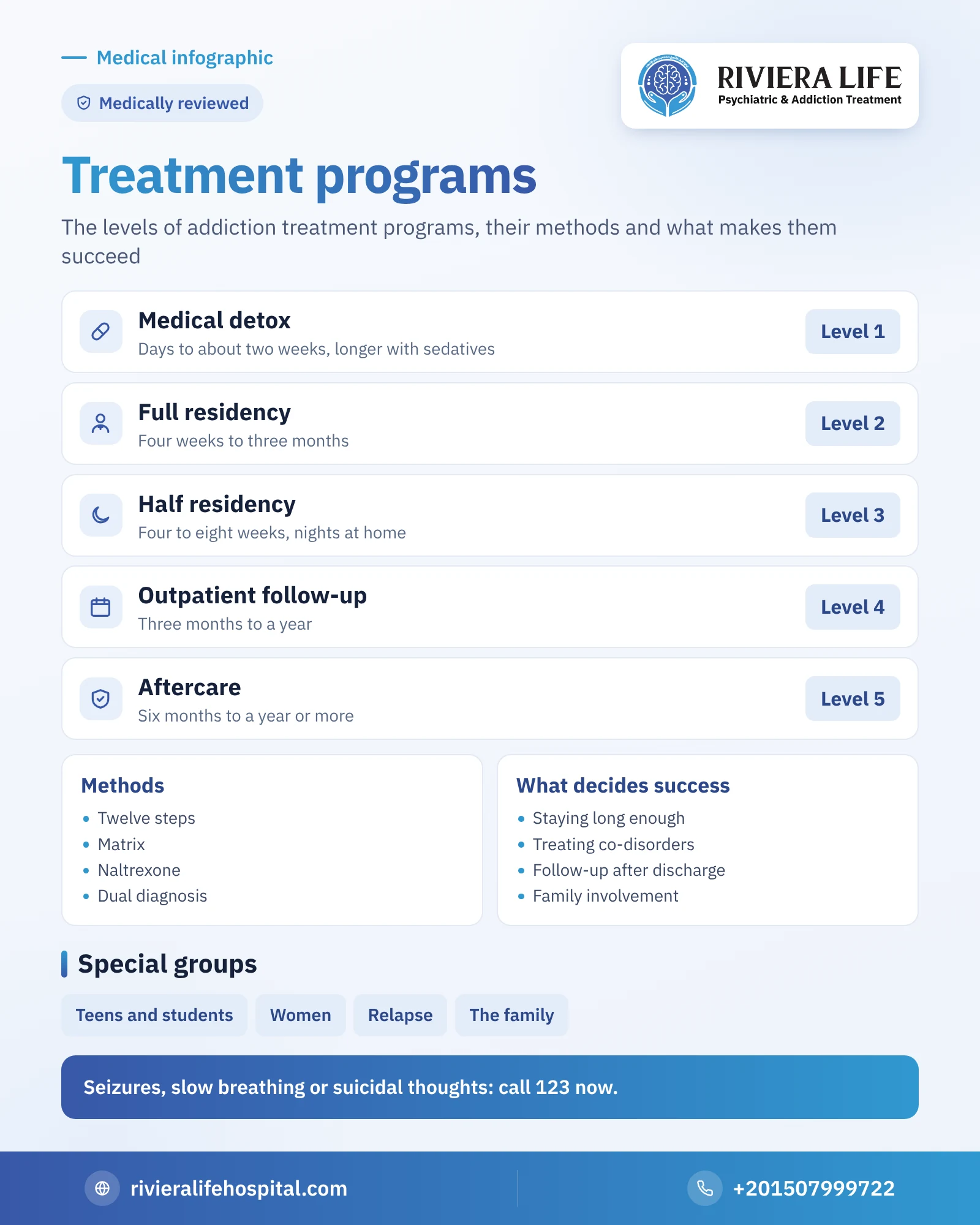
The best way to understand addiction treatment programs is to see them as the rungs of a ladder. The patient starts from the rung that suits the seriousness of their case, then goes down a rung as they stabilize:
- 1Detox under medical supervisionDays in hospital
A short stage to get through acute withdrawal safely, required especially with alcohol, sedatives and opioids.
- 2Full residencyWeeks
The patient lives in the hospital, and their day is divided between individual and group sessions, activities and regular sleep.
- 3Half residency or the day programWeeks
Long treatment hours by day, then sleeping at home, where the patient tests what they have learned.
- 4Outpatient or home follow-upMonths
Weekly sessions, doctor visits and tests, with a return to work or study.
- 5AftercareSix months or more
Less frequent meetings, support circles and a written plan for facing craving.
The ladder works in both directions, and this is one of the most important advantages of graded addiction treatment programs. If signs of relapse appear in outpatient follow-up, the team raises the intensity by one or two rungs, and doesn't consider that a failure.
The full residency program: who is it necessary for?
Full residency means the patient is completely away from the substance and from the company and places linked to it, under medical and nursing observation night and day. The doctor usually favors it in these cases:
- Severe dependence on alcohol, sedatives or opioids, where withdrawal may be dangerous, as we explain in Alcohol withdrawal symptoms.
- Using more than one substance at the same time.
- Psychosis, severe depression or suicidal thoughts.
- Previous outpatient treatment attempts that didn't hold.
- A home environment that doesn't allow keeping away from the substance.
The day inside residency follows a fixed schedule: waking at a set time, a morning group session, an individual meeting with the therapist, a medical review, physical activity, then an evening group session. This regularity itself is treatment for someone who has lived for months without a time for sleeping or eating. The details are in the article The full residency program.
Half residency, outpatient follow-up and the home plan
Not every case needs to sleep in the hospital, and some patients need a middle step after residency. Here is a quick comparison:
Half residency (the day program)
- Long treatment hours most days of the week
- Sleeping at home with the family
- Suits someone just out of residency
- Hard to combine with a full-time job
Outpatient or home follow-up
- Weekly sessions and scheduled medical visits
- The patient continues their work or study
- Suits lighter cases or the final stage
- Needs a cooperative family and periodic tests
The home program isn't "treatment at home" in the sense of locking the patient in a room. It is a plan set by a doctor, with visits, medication follow-up and written instructions for the family, and clear limits on what makes it unsafe. Read the details of half residency and the safe home plan in their articles.
Seven days or twenty-eight days: what to expect from short programs?
Many addiction treatment programs are marketed with specific numbers. The numbers are useful for organizing time, but it is important to know what each short program can achieve and what it can't:
Common inaccurate expectations
- A detox week ends the addiction
- Whoever has completed twenty-eight days doesn't need follow-up
- The shorter the program, the more successful it is
- The longest program suits every patient
What actually happens
- The first week only takes the patient through acute withdrawal
- The first month builds skills that need later practice
- NIDA links better results to staying in treatment for at least three months
- The duration is set by the case, not by the package
If a place offers you a short program, ask directly: what comes after the last day? If there is no written answer, the program is incomplete. We explained what happens day by day in the seven-day program, and discussed frankly whether the twenty-eight-day program is enough.
Method-based programs: the steps, Matrix and naltrexone
Besides place and duration, addiction treatment programs are distinguished by the method on which the sessions are built. The best known are three:
The twelve steps
An approach that arose with the Alcoholics Anonymous fellowships in the United States in the 1930s, then moved to drugs. It is based on admitting the problem, belonging to a group of recovering people, having a more senior recovering "sponsor", and attending regular meetings. Its great value is in continuity and support after discharge, and it works best when added to medical and psychological treatment, not as a substitute for it.
Matrix
An intensive outpatient model originally developed for users of stimulants such as cocaine and methamphetamine, which NIDA describes as a program lasting about sixteen weeks. It combines cognitive behavioral therapy, family education, group sessions for relapse prevention and regular tests, which is why it suits those addicted to ice and captagon, for whose addiction there is no approved medicine.
Medicine-supported programs
Such as the naltrexone program; naltrexone is a medicine that blocks opioid receptors so the substance loses its effect, and it is also used with alcohol to reduce craving. It only starts after a period free of opioids determined by the doctor, otherwise it causes sudden withdrawal. This program combines the medicine with sessions and follow-up, while the details of the medicines themselves belong in the section Addiction treatment medicines.
Dual diagnosis and programs for those who relapse
A large proportion of patients don't come with addiction alone. NIDA indicates that about half of those who suffer a psychological disorder will suffer a substance use disorder at some point in their lives, and vice versa. Depression, anxiety, bipolar disorder and attention deficit hyperactivity disorder are all common among addicts. If the addiction is treated and the depression is left, the patient usually returns to the substance to calm what wasn't treated. That is why addiction treatment programs aren't complete without a psychiatrist who assesses mood, sleep and anxiety from the first day, and the dual diagnosis program integrates the psychiatrist and the therapist into one plan. To understand the relationship between mood and use, read Depression and addiction.
Whoever has relapsed after previous treatment, however, needs a program that doesn't literally repeat what came before. The relapse program starts by analyzing what happened: when the signs began, what the trigger was, and what was missing from the plan. Then it builds a new plan that closes the gap. You will find useful reading in The reasons treatment stumbles.
Programs for groups that need special care
Not all addiction treatment programs are designed for the adult man; some groups need clear adjustments in the place, the schedule and the team.
Students and teenagers
The teenager's brain is still maturing, and their school and friends are part of the plan, not a side detail. The program here needs greater participation from the parents, consideration of exam dates, and separating the teenager from adults in group sessions. See the students and teenagers program and the article Teen addiction.
Women
Women often delay seeking treatment because of stigma or responsibility for children, and use is often linked to past trauma or to medicines that started with a prescription. The right program provides privacy, women-only group sessions and consideration of pregnancy and breastfeeding, as we explain in Women's addiction.
The family itself
The mother who stayed up for years waiting for her son, and the wife who paid off his debts, need treatment too. The family rehabilitation program teaches the family healthy limits, the language of conversation and the danger signs after discharge.
How long do addiction treatment programs last?
These are approximate durations for the best-known addiction treatment programs; they change with each case, and the figures announced in advertisements aren't a rule:
| The program | Usual duration | Usually suits |
|---|---|---|
| Detox under medical supervision | From days to about two weeks, longer with sedatives | Anyone with expected physical withdrawal |
| Full residency | From four weeks to three months | Severe or complex cases |
| Half residency | From four to eight weeks | A transitional stage after residency |
| Intensive outpatient Matrix | About sixteen weeks | Stimulant users |
| Outpatient follow-up | From three months to a year | Lighter cases and after discharge |
| Aftercare | Six months to a year or more | All those in recovery |
What matters is that the duration isn't counted as days of residency only. The sequence of successive addiction treatment programs is what produces the result, and the aftercare program is part of treatment, not an optional appendix.
What makes a program successful?
After fourteen years of working with families, we see that particular elements distinguish a program that holds from one that ends in a quick relapse. This is an estimate of the weight of each element:
Successful addiction treatment programs also share other details: that the plan is individual and reviewed periodically, that the patient learns to deal with bouts of craving to use with practical steps, and that the team is qualified in psychiatry, not just in supervision. To learn about the types of psychological sessions, see the guide Psychotherapy.
Questions to ask before enrolling in any program
Who assesses the case?
Ask that the assessment be done by a psychiatrist, not a receptionist.
What is the license?
Ask about the Ministry of Health license and ask to see it.
How is withdrawal managed?
Is there a doctor and nursing around the clock during withdrawal?
What is the method and schedule?
Ask for a full day's schedule and the number of individual sessions per week.
What comes after discharge?
Ask about the written follow-up plan and the family program.
And stay away from any place that promises a specific cure rate, prevents the patient from contacting their family, or refuses to explain what medicines are given. You will find the remaining selection criteria in How to choose an addiction hospital, and the price factors in The cost of addiction treatment in Egypt.
Signs that call for raising the level of care immediately
Sometimes the patient starts in an outpatient program and then the condition changes quickly. Don't wait for the weekly appointment in these situations:
Don't wait for the next session
Call the ambulance on 123 or go to the nearest emergency department if there appears:
- A seizure or severe confusion while stopping alcohol or sedatives
- Deep drowsiness or slow breathing after returning to opioid use
- Hallucinations or agitation that put the patient or others in danger
- Suicidal thoughts; you can also call the mental health hotline 16328
How Riviera Life meets these standards in addiction treatment programs
- A licensed hospital: by the Egyptian Ministry of Health, in Sheikh Zayed, Giza.
- Fourteen years: in psychiatry and addiction treatment.
- Specialist consultants: who assess the case and determine the suitable program.
- Constant supervision: medical and nursing care around the clock for residents.
- A family program and aftercare: with complete confidentiality and a free first consultation.
The addiction treatment programs article guide: by level, method and group
We have divided the articles of this section according to the question you are looking for: where the patient is treated, how long it lasts, with what method, and who the program was designed for.
By level of care
3 articlesFull residency, day program or home plan
- Full residency inside the hospital: who it suits and how the day passes inside it.
- Day treatment with sleeping at home: a middle step after residency.
- The home treatment plan under a doctor's supervision: the steps, safety conditions and the family's role.
By duration and stage
3 articlesFrom the first week to after discharge
- The detox week day by day: what happens and what the next step is.
- The month of intensive treatment: are twenty-eight days enough?
- Follow-up after discharge: the relapse prevention plan and the family's role.
By treatment method
3 articlesThe steps, Matrix and medicine support
- The twelve-step approach: the steps, traditions and meetings.
- The Matrix model: its components, stages and why it suits stimulants.
- Naltrexone-supported treatment: who it suits and how it goes.
For special cases and groups
4 articlesAccompanying mental illness, relapse, teenagers, family
- Treating addiction and mental illness together: why the plan must be one.
- Coming back after relapse: analyzing what happened and building a new plan.
- The program for school and university students: assessment, stages and the parents' role.
- Rehabilitating the patient's family: the stages and the role of each member of the household.
Before you choose
1 articleA checklist for any hospital or center
- Criteria for choosing a treatment place: questions to ask and warning signs.
When should you seek help?
If you are unsure between two programs, or don't know whether the case needs residency, the assessment is what settles the matter, not guessing. It is enough to describe to us the substance, the duration and what happened in previous attempts, and the consultant will suggest the suitable program in a free and confidential first consultation. Call us on +201507999722.