The short answer
The signs of drug use usually appear as clustered changes rather than a single sign: unusually tiny or wide pupils, red eyes, long nights awake followed by heavy sleep, changes in appetite and weight, isolation, lies and new friends, money disappearing from the house, and sharp mood swings. The details differ by substance, and some of these signs may have another psychological or physical cause. So suspicion needs calm observation for weeks and then a medical assessment, not an angry confrontation.
- A pattern, not a signWhat counts is changes clustering and persisting
- Eyes, sleep and moneyThe clearest things the family notices early
- Medical assessmentSettles the suspicion and rules out other causes
The signs of drug use are what parents, wives and friends see before the person with the problem admits to anything. They usually start with a small observation: a bedroom door closed more than usual, pocket money running out before the middle of the month, or red eyes said to be "from staying up". On this page we gather the signs that appear in the eyes, sleep, appetite, behavior, money and mood, compare them by type of substance, and explain what may look like drug use but isn't, the emergency signs, and what to do if you suspect. What the substance does inside the body at the moment of use, and how long it stays in a test, you will find in the section The effect of drugs.
What are the first signs of drug use the family notices?
The story rarely begins with a shocking scene. What mothers usually tell us is a feeling that their son "isn't himself anymore": he has started avoiding sitting with the family, takes his phone with him even to the bathroom, and answers the simplest question irritably. These beginnings prove nothing on their own, but when they come together with changes in sleep, money and friends, they become a pattern worth paying attention to.
The rule we advise when assessing the signs of drug use: don't base your judgment on a single sign, and don't ignore three or more signs that have lasted for weeks. Write down what you notice with dates, as this helps the doctor later more than any general impression.
The eyes reveal a lot: pupils, redness and the look
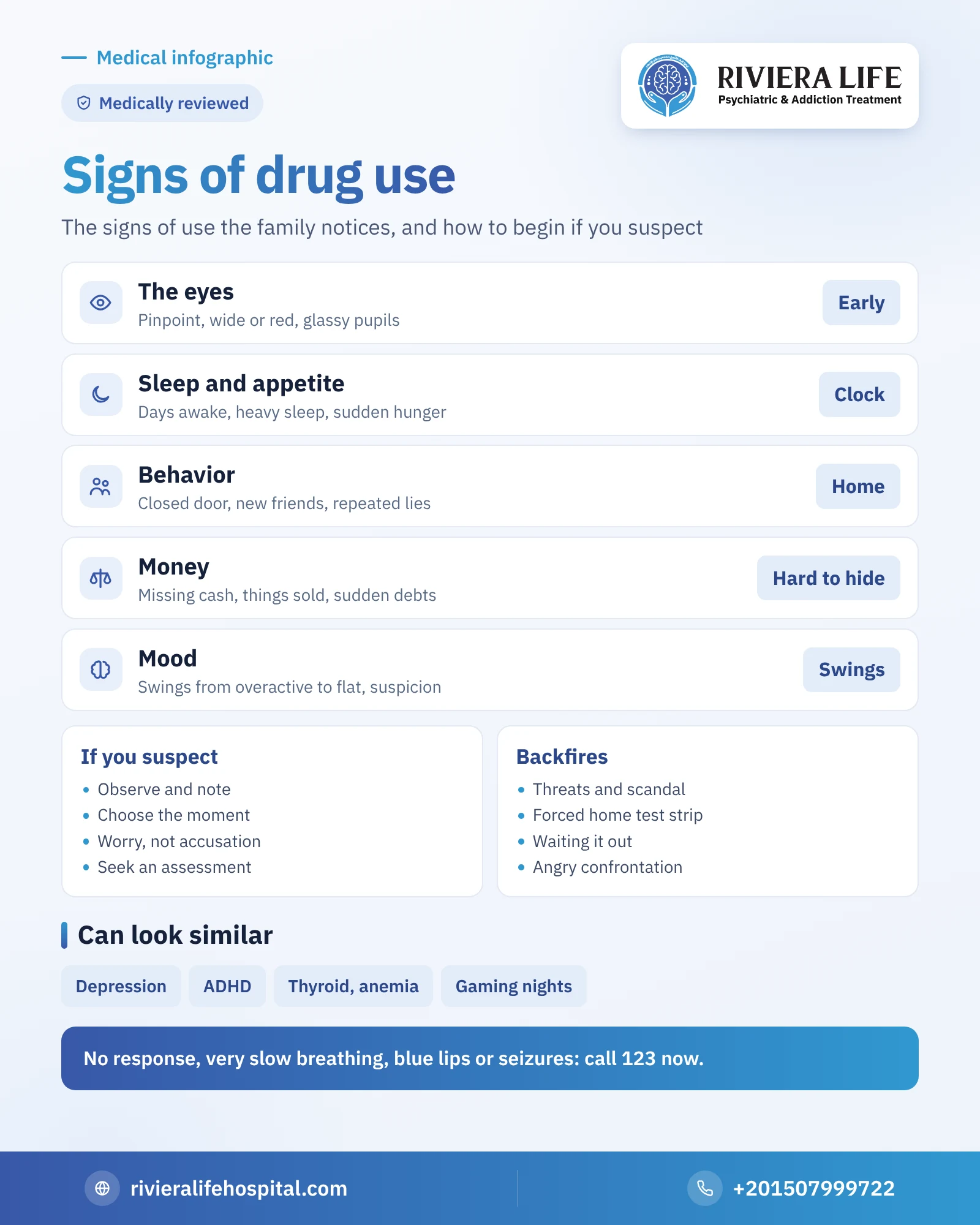
The eyes are one of the clearest places for signs of drug use, because many substances affect the muscles that control the size of the pupil:
- Pinpoint pupils, even in dim light: suggest opioids such as heroin and tramadol.
- Wide pupils, even in strong light: appear with stimulants such as captagon, shabu and cocaine, and with hallucinogens and ecstasy.
- Redness and a glassy look with slow eyelid movement: common with hash, bango and alcohol.
- A heavy, drowsy look and difficulty focusing the eyes: appear with sedatives and pregabalin.
Note that lighting, exhaustion and allergy also change how the eyes look, and some medical drops dilate the pupil; some are even misused, as the article Mydrapid eye drops and the risk of misuse explains. Frequent use of anti-redness drops for no clear reason may be an attempt to hide a sign.
Sleep, appetite and weight: the body changes its schedule
Substances tamper with the biological clock, which is why the signs of drug use appear clearly in sleeping and eating times. With stimulants, a person stays up two or three nights with striking energy, then falls into a long sleep that may last a whole day, and loses their appetite so their weight drops within weeks. With hash comes sudden hunger at strange times, especially at night, and a craving for sweets. With opioids and sedatives, a person nods off while sitting or in the middle of talking, then wakes up as if nothing happened.
Parents may also notice neglect of personal hygiene and clothes, or the opposite: heavy perfume and chewing gum that never leaves the mouth to hide a smell. Other physical signs appear in some, such as a constantly runny nose without a cold, small wounds from scratching, long-sleeved shirts in the height of summer, or bruises with no known cause. None of these means anything on its own, but they add to the picture.
Signs of drug use in behavior: home, school and work
At home
- A room closed for longer and exaggerated privacy.
- Going out late with no convincing explanation.
- New friends no one knows, and distance from old ones.
- Repeated lies about small details.
At school and work
- Absence, lateness and a sudden drop in grades.
- Sleeping in lectures or at work.
- Complaints from teachers or managers.
- Giving up a sport or a hobby he used to love.
New words often creep into his speech or messages, with meanings circulating among young people that the article The meanings of drug users' slang explains. And if the worry is about a teenage son, the article Signs of drug use in your son helps you tell them apart from ordinary adolescent swings.
Money and belongings: signs that are hard to hide
Money is one of the most truthful signs of drug use, because the substance needs continuous funding. The young man asks for extra pocket money with ever-new excuses, small sums disappear from his mother's bag, or things are sold from the house, such as an old phone or gold. You may find things in his room or car with no explanation: burnt aluminum foil, small bags, strips of pills without a prescription, or many lighters even though he doesn't smoke. Wives in particular notice unexplained withdrawals from the account or debts that suddenly appear.
Mood and mental state: swings are the headline
Among the psychological signs of drug use, the rapid swing between exaggerated activity and complete lethargy, or between laughing for no reason and an outburst of anger, is one of the things that most confuses the family. Over time, a general flatness and loss of interest in everything may appear, or anxiety and suspicion of others that reaches accusing them of watching him. This suspicion in particular is common with high-potency hash and stimulants, and the article Hash, suspicion and psychosis explains it. Parents also notice that the mood suddenly improves after a short outing, then worsens when he is late for something.
Signs of drug use by type of substance
This table summarizes the best-known signs for each family, and you can find each substance in detail on the types of drugs page and in the article guide at the bottom of the page:
| Family | Eyes | Body and sleep | Behavior and mood |
|---|---|---|---|
| Opioids (heroin, tramadol) | Pinpoint pupils | Broken nodding off, constipation, itching | Strange calm, then irritability when late |
| Stimulants (captagon, shabu, cocaine) | Wide pupils | Days awake, weight loss, sweating | Talkativeness and energy, then a crash and suspicion |
| Hash and bango | Redness and a glassy look | Sudden hunger and a smell on clothes | Laughter, slowness, forgetfulness and flatness |
| Synthetic cannabis (strox, voodoo) | A vacant look and redness | Stiffness, seizures or vomiting | Strange behavior and sudden agitation |
| Sedatives and pregabalin | A drowsy look | Staggering and a heavy tongue | Forgetting events and long sleep |
| Alcohol | Redness | Smell on the breath and staggering | Impulsiveness, swings and aggression |
| Hallucinogens and ketamine | Wide pupils or a vacant look | Numbness and impaired balance | Detachment from reality and fear |
Do the signs differ between a teenager, a husband and a father?
The signs of drug use are similar in essence, but where they appear first differs according to the person's age and role at home. In a teenager, the signs usually begin at school, with friends and with pocket money, and get mixed up with the swings of that age, which is why the article Teen addiction explains why they are more vulnerable. With a husband, the wife notices before anyone else: staying out late, a locked phone, irritability for no reason, a shortfall in household money, and a decline in intimacy. A father or senior employee, however, may keep his job for years while his health and his relationship with his children erode, and for him it often begins with a medicine prescribed for pain or insomnia that then gets out of control. In every case the question remains the same: has the person changed in a way their circumstances don't explain?
Signs that look like drug use but aren't
Before you accuse anyone, remember that many conditions give a picture closely resembling the signs of drug use. Depression changes sleep and appetite and causes isolation and flatness. ADHD may explain a decline in studies and impulsivity. Thyroid disease, anemia and diabetes cause exhaustion and changes in weight and mood. Staying up playing video games makes red eyes and upside-down sleep. Some allergy and cold medicines cause drowsiness, and bullying at school or a romantic problem may explain sudden withdrawal. Even grief over losing a loved one or exam pressure may change sleep, appetite and mood for weeks, without drugs having any role.
So the medical assessment doesn't aim only to "prove" drug use, but also to rule out these causes. And if the symptoms are basically psychological, the section Mental illness symptoms helps you understand them.
Signs of use, or signs of withdrawal?
Not everything the family sees among the signs of drug use is an effect of the substance itself; some of it is a sign of its absence. A person who seems ill, in pain and irritable when late for a certain appointment, then suddenly improves after a short outing, may be in withdrawal. This difference matters because it points to an existing physical dependence, and it has its own section, Drug withdrawal symptoms.
Emergency signs: when do you call the ambulance?
There are moments with no room for waiting or for fear of scandal, because the person's life is more important than any other consideration:
Call the ambulance on 123 immediately if you notice
These signs mean the body is in real danger right now:
- He doesn't respond to being called or shaken, or his breathing is very slow or accompanied by strange snoring
- Blue lips or nails, or very cold skin
- Chest pain, a high temperature with confusion, or seizures
- Severe agitation or hallucinations that make him a danger to himself, or talk of harming himself
Lay him on his side and don't leave him alone until help arrives, and keep any strip or box found near him. The article Dealing with an overdose explains the signs specific to each substance. For advice, you can call the hotline of the General Secretariat of Mental Health and Addiction Treatment on 16328.
You suspect someone is using: what do you do?
Discovering the signs of drug use is the beginning of the road, not its end, and the way you act in the first days may determine whether he accepts help or hides it more. These are steps many families have tried with us:
1
Observe and write down
Record the changes with their dates for two or three weeks, without searching or chasing.
2
Choose the moment
Talk when he is calm and sober, not in anger or after a late return.
3
Speak of worry, not accusation
Say "I'm worried about you because I noticed such-and-such" instead of "You're an addict".
4
Ask for a specialist assessment
A medical consultation settles the suspicion and rules out other causes.
5
Don't stay alone
Consult a specialist for yourself too, even if he refuses help.
What backfires
- Threatening to throw him out or expose him in front of relatives.
- Forcing him to take a home test strip and then judging him.
- Waiting in the hope that he will "grow up and come to his senses".
What opens the door to treatment
- A calm conversation focused on what you noticed.
- A confirmed laboratory test as part of a medical assessment.
- Early intervention before dependence deepens.
And remember that denial is part of the problem, not just evidence of deliberate lying, as the article How an addict thinks and why he denies explains. The home test strip has limits that the article Types of drug tests explains, and the step-by-step persuasion plan is in the article How to help an addict and persuade him to get treatment.
The signs of drug use article guide: the signs for each substance
Here we have gathered all the section's articles: general guides for the family first, then the signs of drug use arranged by substance family.
General guides for the family
5 articlesThe son, the husband, the home and appearance
- Is my son using?: signs that tell it apart from adolescence.
- What a wife notices in her husband: and how to make sure.
- The signs of a home with a user in it: and the first three days.
- How a user looks in the face and body: what changes and what doesn't indicate anything.
- A dictionary of drug users' slang: and how to deal with it.
Opioids and painkillers
4 articlesPinpoint pupils and drowsiness
- The signs of opioid addiction: the body, the mind and behavior.
- What a heroin user looks like: the physical and behavioral signs.
- Morphine misuse: what the family sees.
- The signs of tramadol: physical, psychological and behavioral.
Stimulants
8 articlesStaying up, weight loss and wide pupils
- The early signs of shabu and crystal: what the family sees.
- Captagon at home: and when to worry.
- The signs of amphetamine: and how it is diagnosed.
- Cocaine psychologically and physically: and how to recognize it.
- Recognizing a cocaine user: a practical guide to making sure.
- The most dangerous signs of flakka: physical and psychological.
- What reveals bouffa use: psychologically and physically.
- When khat becomes an addiction: signs the family sees.
Hash, bango and marijuana
6 articlesRed eyes, flatness and suspicion
- The signs of hash addiction: physical and psychological.
- The behavior of a hash user at home: what changes.
- What a hash user is averse to: and how to understand him.
- Suspicion in hash users: from anxiety to psychosis.
- The signs of marijuana: the body, behavior and the mind.
- Loss of control with bango: and how it is diagnosed.
Synthetic cannabis and mixtures
5 articlesStrange behavior and sudden agitation
- The signs of spice: physical, psychological and behavioral.
- Loss of control with strox: and how to discover it.
- What reveals voodoo use: and when to seek help.
- The signs of shadow at home: and when to seek an assessment.
- Chemical psychologically and physically: signs you need to understand.
Sedatives and nerve medicines
5 articlesStaggering, forgetfulness and long sleep
- The early signs of benzodiazepines: and when to seek help.
- Xanax misuse: before it gets worse.
- Pregabalin outside the prescription: what the family notices.
- The signs of Lyrolin and how they develop: from the start.
- Gabapentin at home: and how to recognize its signs.
Alcohol, party drugs and hallucinogens
5 articlesDrunkenness, parties and detachment from reality
- The early signs of alcohol addiction: before it gets complicated.
- The stages of drunkenness up to poisoning: and when to call the ambulance.
- Ecstasy on the night and after: the signs of the crash.
- The signs of ketamine: physical, psychological and behavioral.
- The paper drug during and after the effect: what not to ignore.
When should you seek help?
If signs of drug use have come together in the eyes, sleep, money and behavior and lasted for weeks, don't wait until you are sure yourself, because delay gives dependence time to deepen and increases the harms of drugs on the body and the home. In the addiction treatment section you can find what happens after diagnosis. At Riviera Life, licensed by the Egyptian Ministry of Health with fourteen years of experience, we sometimes receive the family before the patient, and we begin with a free, confidential consultation with a consultant in psychiatry and addiction treatment; call us on +201507999722.
Medical sources and referencesThe information in this article is based on reliable scientific sources