Bipolar disorder is a psychiatric condition in which a person’s life goes through clear episodes of a sharp rise in mood and energy, called mania or hypomania, and other episodes of deep depression, with periods in between in which they may return completely to normal. What is meant here isn’t a mood that changes between morning and evening, but shifts that last days or weeks and change sleep, thinking and behavior.
It is a chronic but treatable disorder, and many people with it live stable, productive lives when it is diagnosed early and they stick to a treatment plan. This page is your entry point to everything the Riviera Life team publishes about the disorder: its definition, types, symptoms, causes and treatment, with links to detailed articles on each aspect.
What is bipolar disorder?
The old name of this disorder was “manic depression”, a name that describes its two poles precisely. At one pole is a manic episode: energy that doesn’t calm down, little sleep without accompanying tiredness, racing thoughts, exaggerated confidence and reckless decisions. At the other pole is a depressive episode: sadness or a heavy emptiness, loss of pleasure, exhaustion, and sometimes thoughts of death. The person doesn’t have to go through both poles to the same degree; some patients spend most of the years of their illness in depression, with only short episodes of elevation, most of which pass without anyone noticing.
Modern diagnostic manuals, such as the American DSM-5 and the eleventh revision of the International Classification of Diseases, classify this disorder among mood disorders, and separate it from ordinary depression for an important practical reason: its treatment is different. A patient treated as if they had depression only may receive a medicine that makes their condition more unstable.
How common is bipolar disorder?
The World Health Organization estimates that about 0.4% of the world’s population live with bipolar disorder, that is, tens of millions of people. It affects men and women in similar proportions, though the picture differs slightly, as women tend to have more depressive episodes. The symptoms usually begin in late adolescence or the early twenties, and may appear at a younger or older age. The correct diagnosis is delayed for years in many, because the first episode is in most cases a depressive one, so the person is diagnosed with depression and no one notices the periods of elevation until later.
Types of bipolar disorder
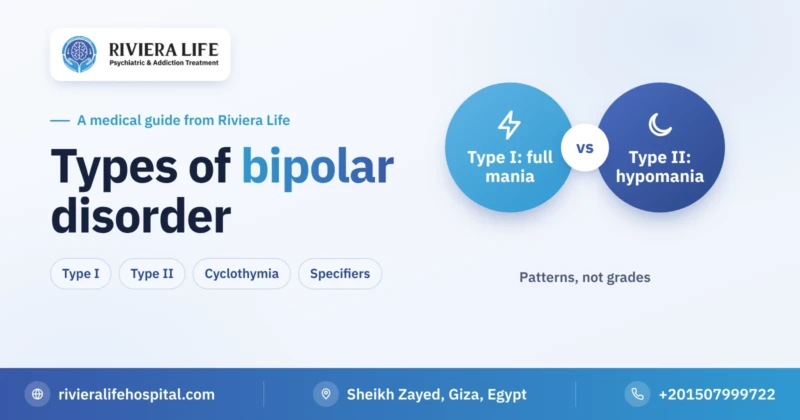
Knowing the type isn’t an academic detail, as it determines the form of treatment and the duration of follow-up. Doctors distinguish between three main types, and what separates them is the severity and duration of the elevation episode:
Type I
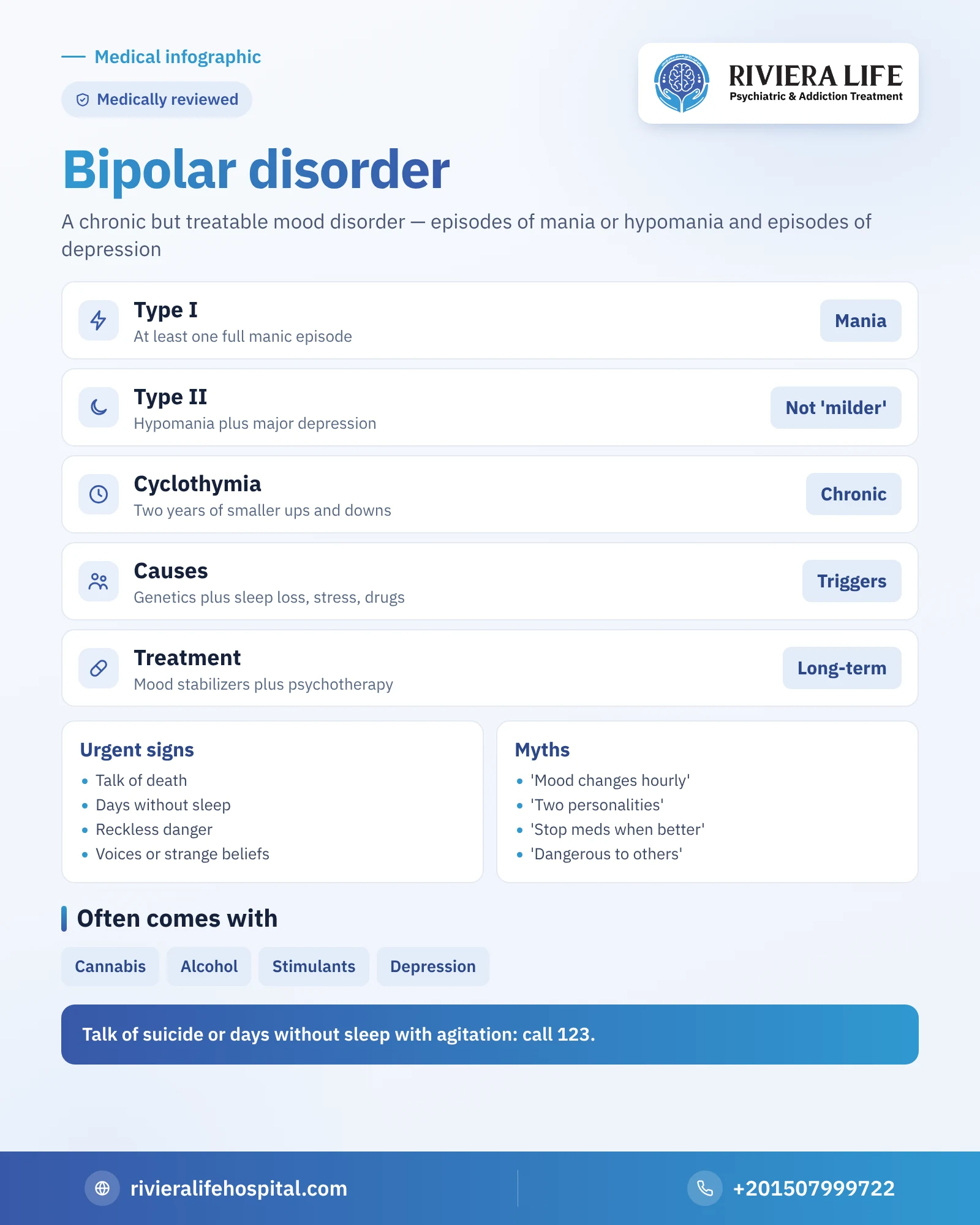
The occurrence of a single full manic episode is enough to diagnose it, lasting at least a week for most of the day, or less if it is so severe that the patient needed hospital admission. The manic episode here clearly disrupts work and relationships, and may be accompanied by psychotic symptoms such as the person believing they have a mission or supernatural abilities. Most patients with this type also go through depressive episodes, but these aren’t a condition for the diagnosis.
Type II
It combines at least one major depressive episode and at least one hypomanic episode, without any episode reaching full mania. Hypomania usually lasts four days or more, and those around notice it as a clear change in the person, but it doesn’t severely disrupt their life and isn’t accompanied by psychosis. It is a mistake to describe this type as “the milder one”, as the depression in it is usually recurrent and long, and places a heavy burden on the patient’s life.
Cyclothymia
A disorder in which mood swings for at least two years in adults, and one year in children and adolescents, between periods of elevation and lowering, none of which becomes complete enough to be a manic or depressive episode in the diagnostic sense. The person seems “changeable” or “moody” to people, while they are living an exhausting fluctuation in which they rarely know stability for long. In some patients it may develop into type I or type II over time.
Other forms and additional specifiers
The disorder is sometimes diagnosed as resulting from a substance or medicine, such as a manic episode that appears with stimulants or cortisone, or as resulting from a medical condition such as some thyroid disorders. The doctor also adds specifiers that help in choosing treatment, the most important being:
- Rapid cycling: four or more episodes within a single year.
- Mixed features: symptoms of mania and depression coming together in the same episode.
- Psychotic features: delusions or hallucinations during the episode.
- Peripartum onset: an episode that begins during pregnancy or in the weeks after birth.
- Seasonal pattern: episodes linked to certain seasons of the year.
The main symptoms in brief
In mania or hypomania there is excess energy and less need for sleep, rapid speech that is hard to interrupt, jumping from one idea to another, uncalculated spending or adventures, and irritability when contradicted. In depression the scene turns over: withdrawal, slowness, oversleeping or insomnia, and a feeling of guilt and worthlessness. The precise details, the early signs that precede an episode, and the difference between ordinary mood swings and the disorder are in the article on the symptoms of bipolar disorder. And because low episodes closely resemble ordinary depression, it is also useful to look at the depression guide to understand the difference.
Why does bipolar disorder happen?
There is no single cause. Genetics plays a large role, as the risk of developing it is higher in the first-degree relatives of an affected person, even though most of these relatives never develop it. Added to this is a difference in the functioning of the brain circuits responsible for regulating emotion and sleep, and then come the triggers: lack of sleep, major stress, drug use and some medicines. We explain these factors in detail in the article on the causes of bipolar disorder.
How is the disorder diagnosed?
There is no blood test or scan that reveals bipolar disorder. The diagnosis is made by a psychiatrist or psychologist after a detailed interview in which they ask about previous episodes and their duration, and about sleep, energy and family history. Most medical teams ask to hear the account of a family member, because the patient themselves may not see a problem in the periods of elevation, but remember them as their best days. The doctor usually requests tests to rule out other causes, such as a thyroid disorder or the effect of a drug. They may need to monitor mood for several weeks before settling the diagnosis, and this is care, not delay.
An overview of treatment
Treatment rests on two pillars: medicines that stabilize mood and prevent the return of episodes, such as lithium, some antiepileptics and modern antipsychotics, and psychotherapy that helps the patient understand their disorder, regulate their sleep and recognize its early warnings. Doctors deal cautiously with antidepressants alone, because they may push some patients towards mania. Treatment is usually long-term, and its aim isn’t to put out a single episode but to prevent the ones after it. The stages and options are detailed in the article on the treatment of bipolar disorder.
Bipolar disorder and addiction: dual diagnosis
Bipolar disorder co-occurs with substance use at a much higher rate than in the general population. Some patients drink alcohol or use hashish to calm insomnia and tension during an elevated episode, or to escape the heaviness of depression, so the temporary solution turns into a second problem. The relationship works in both directions: cannabis is linked to an earlier onset and more episodes in those who are predisposed, stimulants such as cocaine and captagon may provoke a state that closely resembles mania, while alcohol increases depression and impulsivity. That is why a patient with both needs a single plan that treats them together in the same place, not treatment of one while waiting on the other.
Living with bipolar disorder and the family’s role
Stability is possible, and the patient builds it from small habits repeated every day: a fixed time for sleeping and waking, sticking to the medicine even on good days, recording mood daily in a notebook or a simple app, and staying away from alcohol and drugs. The family’s role is to learn, not to watch.
When parents know how an episode begins in their son in particular, such as his sleep decreasing and his talk of big projects increasing, they can intervene early and calmly. It is useful for the family to agree with the patient, during a period of stability, on a written plan: which signs call for contacting the doctor, who keeps the bank cards if signs of reckless spending appear, and when hospital admission is the right decision.
The harms of bipolar disorder when treatment is abandoned
Bipolar disorder is a chronic illness that can be controlled, but the real harm comes when episodes recur without regular treatment. Each untreated episode may leave its mark on money, work and home, even after mood has calmed.
The harms appear in several areas:
- In mania: excessive spending, borrowing and reckless decisions at work or in marriage, lack of sleep that exhausts the body, and quarrels that spoil relationships.
- In depression: dropping out of work and study, withdrawal from the family, loss of hope, and it may be accompanied by a risk of self-harm.
- In the long term: episodes recurring at a faster pace, greater difficulty controlling them, and effects on employment and professional standing.
- With drugs: some patients resort to alcohol or stimulants to adjust their mood, so their disorder increases.
The family protects the patient by knowing the early warnings, such as a sudden decrease in sleep, talkativeness and unusual spending. And if any talk of self-harm appears, urgent medical intervention is necessary.
The article on the treatment of bipolar disorder explains how regular treatment prevents these harms, and how to deal with a bipolar patient offers practical guidance for the family.
Common myths about bipolar disorder
The myth: someone whose mood changes several times a day has bipolar disorder. The truth is that episodes of this disorder extend over days and weeks. Rapid fluctuation within hours in response to a situation or relationship may be part of other conditions such as borderline personality disorder, or of ordinary human nature.
The myth: bipolar means the person has two personalities. The truth is that the disorder concerns mood and energy, and has nothing to do with multiple personalities or schizophrenia.
The myth: if the patient improves, there is no need to continue the medicine. The truth is that improvement is usually the fruit of the medicine itself, and stopping it suddenly is among the best-known causes of relapse, especially with lithium.
The myth: a bipolar patient is a danger to those around them. The truth is that most people with it aren’t violent, and they are more likely to be harmed themselves than to harm others.
The bipolar disorder guide: each aspect in a separate article
Each aspect of bipolar disorder has an article detailing it alone, so choose the one that answers your question:
- Symptoms of bipolar disorder: signs of mania, hypomania and depression, the early warnings, and when to ask for an assessment.
- Causes of bipolar disorder: genetics, the brain, sleep, stress, and the drugs and medicines that may unmask the disorder.
- Treatment of bipolar disorder: mood stabilizers, psychotherapy, hospital admission and the relapse prevention plan.
- Depression: a separate guide that helps you understand low episodes and what distinguishes them from unipolar depression.
- The difference between bipolar disorder and borderline personality disorder: a clear comparison
Diagnosis here needs a psychiatrist, but the bipolar test helps you recall previous elevated episodes that many overlook when talking about depression alone.
Signs that call for urgent intervention
Seek urgent help immediately if any of these appear
Call the ambulance on 123 or go to the nearest emergency department, and don't leave the person alone until help arrives.
- Talk about death, a wish to end their life, or saying goodbye to people in an unusual way
- An attempt to harm themselves or searching for a means to do so
- Almost complete absence of sleep for several days with escalating agitation
- Reckless behavior that threatens their life or the lives of others, such as driving at insane speed
- Voices they hear or strange beliefs that push them to dangerous acts
- Aggression or an explicit threat to others
- Refusing food and drink, or a complete inability to care for themselves in severe depression
If a person declares suicidal thoughts, don’t ignore what they say or consider it an exaggeration, and ask them calmly and clearly about how they are, as asking directly doesn’t plant the idea but opens the door to help. Move accumulated medicines and sharp tools away from them, and stay with them until a specialist reaches them.
When should you ask for help?
Ask for a psychiatric assessment if you or a member of your family have repeated periods in which the need for sleep decreases and thoughts and decisions speed up, or if someone has been treated for depression more than once without stable improvement, or signs of elevation have appeared after starting an antidepressant. Early diagnosis saves years of floundering. At Riviera Life, the consultant psychiatrists carry out the assessment in complete confidentiality, the first consultation is free, and the plan can begin with outpatient follow-up or with admission under round-the-clock medical supervision, according to the needs of the case.
Medical sources and referencesThe information in this article is based on reliable scientific sources