The short answer
Withdrawal symptoms are what the body and mind feel when a substance the brain had become used to disappears or its amount suddenly drops. They usually appear within hours to three days of last use, intensify in the first days, then their acute stage usually calms within one or two weeks, while insomnia and low mood may last for weeks. The most dangerous is withdrawal from alcohol and sedatives, because it may cause seizures; opioid withdrawal is painful and exhausting, and with stimulants and hash the psychological side dominates.
- Varying timingShort-acting substances bring faster, more violent withdrawal
- The danger differsAlcohol and sedatives need medical supervision from day one
- A long tailInsomnia and distress may last weeks after the pain is gone
Drug withdrawal symptoms are the reason many families in Egypt postpone the step of treatment for months, fearing the sight of a son writhing in his bed or a husband who neither sleeps nor eats. On this page we explain what happens in the body almost hour by hour, compare the different substances, and set out the signs that can't wait, then guide you to the detailed article for each substance separately.
What are drug withdrawal symptoms, and what happens inside the brain?
Imagine a scale with one of its pans weighed down by an external weight for months. To keep the scale level, the brain added a counterweight to the other pan: it reduced the production of some neurotransmitters, and changed the number and sensitivity of receptors. This is what doctors call tolerance, and its result is that the substance has become part of "normal". If the external weight is suddenly lifted, the scale tips violently the other way.
That is why withdrawal symptoms usually come as the opposite of the substance's effect. Someone who used a sedative becomes tense and agitated, someone who used an opioid painkiller feels pain in every joint, and someone used to a stimulant falls into lethargy and heavy sadness. The DSM-5 diagnostic manual classifies withdrawal as a sign of physical dependence, but it alone is not enough to diagnose addiction; a patient taking a prescribed painkiller for a long time may go through withdrawal without being an addict. The article The difference between physical dependence and psychological addiction explains this point, which confuses many families.
The stages of drug withdrawal symptoms, from the first hours to months
Not all cases follow one schedule, but most pass through four successive stations whose lengths differ according to the substance, the duration of use and the health of the body.
- 1Early warningFrom hours to two days
Anxiety, yawning, sweating, an urgent craving for the substance, and difficulty sleeping. Many go back to using at exactly this moment, thinking what is coming is worse than they can bear.
- 2The peakUsually between the second and fourth day
The physical symptoms reach their worst: pain, diarrhea and vomiting with opioids, tremor and a racing pulse with alcohol and sedatives, and a collapse in energy with stimulants.
- 3The gradual declineThe end of the first week and after
The pain recedes and appetite returns, but sleep stays broken, mood unstable and the body tired.
- 4The extended stageWeeks, and may reach months
Waves of insomnia, little enjoyment and poor concentration come and go; this is the most dangerous period for relapse, because the person thinks they are "done".
Signs of the body and signs of the mind: what do withdrawal symptoms look like?
The family notices the physical symptoms easily, but the psychological ones are sometimes dismissed as "nerves" or "being spoiled", even though they are usually what drives a return to the substance.
What shows on the body
- Heavy sweating and chills despite mild weather
- Trembling hands and a racing heart
- Runny nose, watery eyes and dilated pupils
- Abdominal cramps and nausea or diarrhea
- Pain in the muscles, bones and back
- Changes in appetite and weight
What shows in the mind and behavior
- Anxiety, tension and tightness in the chest for no clear reason
- Quick temper and quarrels over the smallest things
- Heavy sadness and loss of enjoyment in anything
- Insomnia, or long sleep with nightmares
- Intense craving for the substance and constant thinking about it
- Confused concentration and memory
Urgent craving in particular needs special understanding, because it may return suddenly weeks after stopping on seeing a place or person linked to use; we explain its nature in the article Drug craving and how to resist it. And if you are still at the stage of suspicion and no one has admitted to using yet, it is better to start from The signs of drug use the family notices.
Drug withdrawal symptoms by type of substance
The body doesn't deal with the absence of heroin the way it deals with the absence of hash. So we group the substances into related families, and each substance has a separate article with its own timeline.
Opioids and strong painkillers
These include heroin, morphine, tramadol and codeine. Their withdrawal starts with a runny nose and yawning, then pain, diarrhea and chills escalate, and patients describe it as "a severe flu that never ends". It rarely threatens life by itself, but dehydration and continuous vomiting need treatment. The article Opioid withdrawal and its stages details the full picture, and the article The stages of tramadol withdrawal covers the substance most widespread among young people in Egypt.
Alcohol, sedatives and nerve medicines
This is where the greatest danger lies. Alcohol and benzodiazepines such as Xanax and Rivotril, as well as pregabalin (Lyrica) and gabapentin, calm the nervous system, so their sudden absence becomes excessive excitation that may reach seizures. Read Alcohol withdrawal and delirium tremens before any attempt to stop, and likewise Benzodiazepine withdrawal and why it is delayed.
Stimulants
Ice (shabu), captagon, cocaine and amphetamine leave behind something like a "switching off": sleep lasting long hours, hunger, and deep dejection that may be accompanied by suicidal thoughts in the first days. The physical symptoms are relatively mild, but the psychological crash needs real monitoring, and you can find its details in the article How many days ice withdrawal lasts.
Hash and synthetic cannabinoids
DSM-5 recognizes cannabis withdrawal: irritability, insomnia, disturbing dreams and poor appetite that begin within days and usually calm within two weeks. Strox, voodoo, shadow and spice, however, are synthetic substances whose composition is not precisely known, and their withdrawal is more severe and may bring agitation or psychotic symptoms, as in Strox withdrawal symptoms.
Ketamine and hallucinogens
They don't usually cause clear physical withdrawal, but depression, anxiety and flashbacks of the experience may continue after stopping, as the article After stopping the paper drug explains.
A comparison table: when does withdrawal start, and when does it calm?
The following figures are estimates for the acute stage, and may be longer with long use or mixing substances.
| Substance family | Onset of symptoms | Peak | Acute stage | Level of danger |
|---|---|---|---|---|
| Short-acting opioids (heroin, morphine) | Within hours to a day | Days two and three | About a week | Painful, rarely life-threatening |
| Tramadol | Within about a day | The first days | One to two weeks | Moderate, with a possibility of seizures |
| Alcohol | Within hours of the last drink | Days two to four | About a week | High: seizures and delirium |
| Benzodiazepines | From a day to several days depending on the type | Sometimes delayed | Weeks | High: seizures |
| Stimulants | Within hours (the crash) | The first days | One to two weeks | Psychological: depression and suicidal thoughts |
| Hash | One to three days | The end of the first week | About two weeks | Mild to moderate |
The most dangerous withdrawal cases and the emergency signs
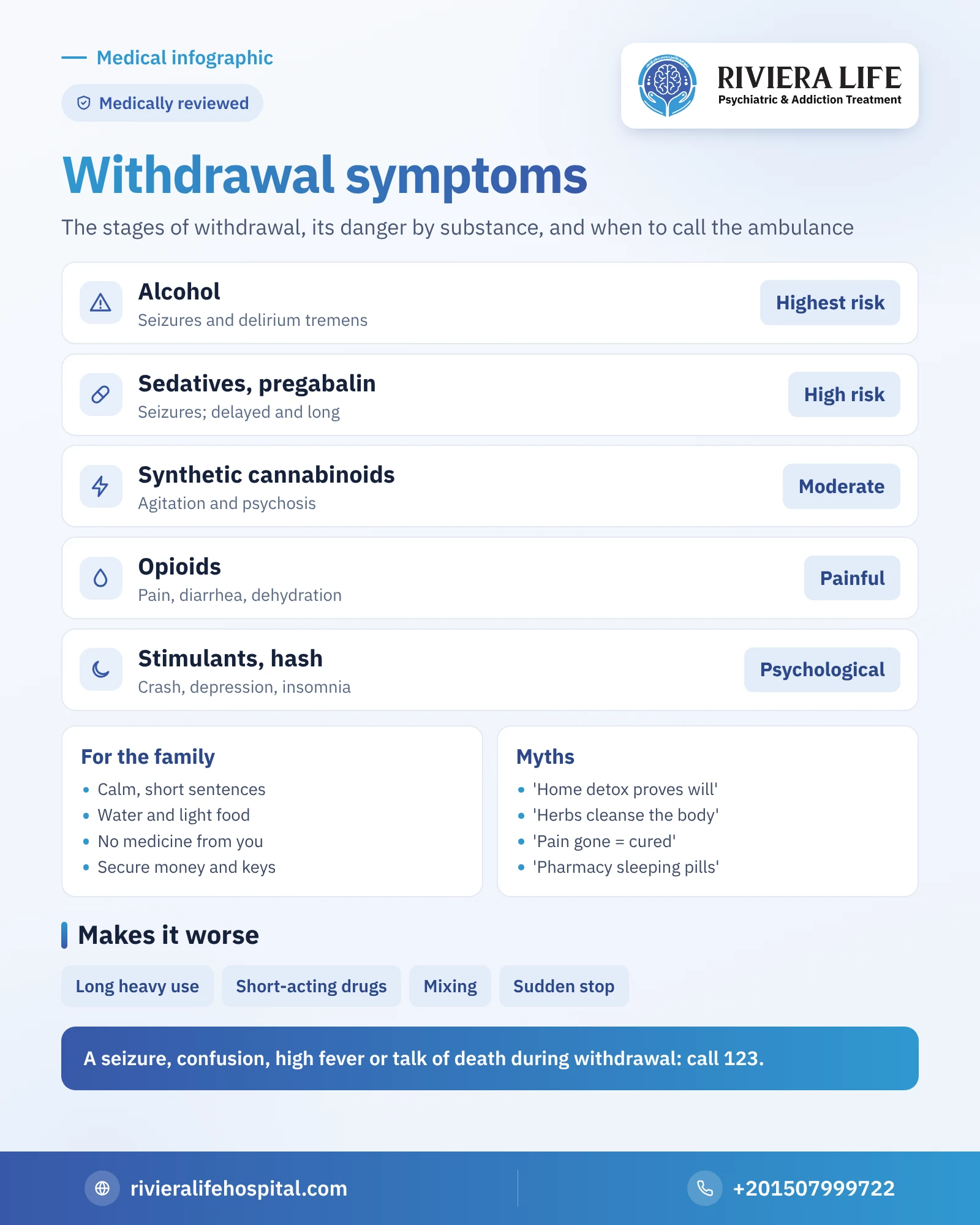
Not all cases carry equal danger. The following scale compares the likelihood of serious physical complications if stopping happens suddenly and without medical follow-up.
AlcoholSeizures and delirium
Sedatives and pregabalinSeizures
Synthetic cannabinoidsAgitation and psychosis
OpioidsDehydration and pain
StimulantsAcute depression
HashInsomnia and irritability
And there is a danger that doesn't appear in any table: loss of tolerance. After days of stopping, the body's tolerance of the substance falls, so if the person goes back to the same old amount, they may suffer a fatal overdose, which is common with heroin in particular.
Call an ambulance immediately if any of these signs appear
Call the ambulance on 123, or the hotline of the General Secretariat of Mental Health and Addiction Treatment on 16328, and don't leave the patient alone:
- A seizure or loss of consciousness, even for seconds
- Severe confusion, hallucinations, or not recognizing the place and people
- A high temperature with violent tremor and heavy sweating
- Continuous vomiting or diarrhea that prevents drinking fluids
- Chest pain or shortness of breath
- Talk of death or self-harm
And if suicidal thoughts appear in the days of the crash after stimulants or sedatives, read the article Dealing with suicidal thoughts and act immediately.
How long do the symptoms last? And why do some last for months?
When a doctor is asked how long drug withdrawal symptoms last, they usually answer that the body heals faster than the brain. Diarrhea, sweating and tremor usually disappear within days, but the chemistry of reward needs longer to regain its balance. That is why many recovering people go through what are known as post-acute withdrawal symptoms: disturbed sleep, tiredness without exertion, extra sensitivity to stress, and a feeling that life is dull.
This flatness has a medical name, anhedonia, and it is expected and temporary in most cases, improving gradually with regular sleep, movement and psychotherapy. What matters is that the patient and their family know it is a normal stage of healing, not evidence that "the drug was the only source of happiness". You can find a wider picture of what recovers first and what lags behind in the article When the body and brain return to normal after quitting.
What increases the severity of withdrawal or prolongs it?
- The length and intensity of use: someone who used a substance daily for years is completely different from someone who used it on weekends.
- A short-acting substance: substances that leave the body quickly bring early, violent withdrawal, while long-acting ones bring delayed, longer withdrawal.
- Mixing more than one substance: combining tramadol with sedatives or alcohol makes the picture tangled and harder to predict, as we explain in The dangers of mixing drugs.
- Stopping suddenly after large amounts: especially with alcohol and sedatives.
- Accompanying physical or psychological illnesses: such as liver or heart disease, or previous depression and anxiety.
- Previous withdrawal attempts: repeated stopping and returning with alcohol makes each later withdrawal more severe in many cases.
Withdrawal at home or under medical supervision?
Many ask: "Can he lock himself in his room for a week and be done?" The answer depends on the substance and the condition, and there are circulating ideas that need correcting.
Common but wrong ideas
- Withdrawing at home proves strength of will
- Herbs and warm drinks are enough to cleanse the body
- If the physical pain is over, the addiction is over
- A sleeping pill from the pharmacy eases the first days
What medicine says
- Alcohol and sedatives need a medical assessment before stopping
- No herb treats withdrawal or prevents seizures
- Craving and relapse continue after the pain is gone
- Mixing medicines without a doctor may cause serious poisoning
Mild withdrawal, such as stopping hash in a physically healthy person, may suit outpatient follow-up with a doctor. Moderate and severe cases, however, are safest in a seven-day detox program in an equipped place. The article Can an addict stop alone? discusses this decision in more detail.
How do doctors manage drug withdrawal symptoms?
Managing withdrawal medically doesn't mean "putting the patient to sleep" until the days pass, but a plan that changes day by day according to the symptoms that appear.
1
A comprehensive assessment
The doctor asks about the substances used, their duration and the last use, examines the heart, liver and vital signs, and orders tests when needed.
2
A safety plan
The right medicines are set to prevent seizures or ease opioid pain, and fluids, nutrition and vitamins are adjusted.
3
Round-the-clock follow-up
Nursing measures vital signs and records the severity of symptoms on validated scales, and the doctor adjusts the plan according to the results.
4
Preparing for psychotherapy
As the body calms, the conversation about the reasons for use and preventing relapse begins, because withdrawal is the start of treatment, not its end.
Among the medicines used under a doctor's supervision: benzodiazepines in a calculated plan for alcohol withdrawal, with thiamine, and clonidine or buprenorphine in opioid withdrawal. We deliberately don't mention doses here, because setting them depends on the examination. The details of each medicine and how it works belong in the section Addiction treatment medications. And after detox ends, the real work begins within the full addiction treatment plan.
The family's role during the days of withdrawal
In the hard days, the patient is irritable and may say hurtful things, or try to convince you that he "just needs something small to sleep". Here it helps to remember that it is the drug withdrawal symptoms talking, not the person you know.
- Speak calmly in short sentences, and postpone any reproach or accounting until his condition stabilizes.
- Provide water, light food and a quiet, dimly lit place.
- Don't give him any medicine yourself, and don't negotiate "cutting down" the substance instead of stopping under supervision.
- Keep money, keys and means of getting the substance away from him, without humiliation or a public search.
- Take care of yourself too, because the family's exhaustion weakens its ability to support.
The family later takes part in the family rehabilitation program to learn how to support without protecting the drug use, and the article Dealing with a recovering addict offers advice for the following months.
How Riviera Life meets these standards in the detox stage
- A hospital licensed by the Egyptian Ministry of Health, with fourteen years of experience in psychiatry and addiction treatment.
- Consultants in psychiatry and addiction treatment who set the withdrawal plan after assessing each case.
- Round-the-clock medical and nursing supervision for inpatients.
- Complete confidentiality, a family program, and follow-up after discharge.
- A free, confidential first consultation to determine the most suitable place for your situation.
The drug withdrawal symptoms article guide: each substance has its own timeline
Here we have gathered all the section's articles by substance family. Start with the substance that concerns you, and in each article you will find the timing of onset and peak and the signs that call for a doctor.
Opioids and painkillers
6 articlesPain, diarrhea and insomnia that peak in the first days
- The general picture of opioid withdrawal: the stages shared by opioid painkillers and ways of dealing with them safely.
- What happens after giving up heroin: the first days, the danger signs and the risk of overdose on return.
- The timeline of morphine withdrawal: when symptoms start and when they end.
- Stopping tramadol: the stages of withdrawal and why it may differ from other opioids.
- Codeine and cough syrup withdrawal: what distinguishes dependence on cough medicines.
- Giving up nalbuphine: the timeline and precipitated withdrawal.
Alcohol, sedatives and nerve medicines
9 articlesThe most dangerous class because of possible seizures on sudden stopping
- Abstaining from alcohol: the danger signs and delirium tremens.
- Giving up benzodiazepines: why withdrawal is delayed and when the doctor worries.
- After stopping Xanax: time stages and expected duration.
- Rivotril withdrawal: delayed onset and long duration.
- Stopping pregabalin: the stages and the risks of sudden stopping.
- Giving up Lyrolin: when symptoms start and how they are managed.
- Gabapentin withdrawal: the risk of seizures and extended symptoms.
- Giving up Parkinol: cholinergic rebound and what calls for concern.
- The nights after Night Calm: rebound insomnia and how to get past it.
Stimulants
7 articlesA collapse in energy and depression that needs monitoring
- Giving up ice and shabu: how many days the crash lasts and when to worry.
- Stopping captagon: the stages and when a doctor is needed.
- Cocaine withdrawal: the onset, the duration and ways of coping.
- Giving up amphetamine: the stages and when to seek help.
- After ecstasy: mood after stopping.
- Flakka withdrawal: its stages and duration.
- Giving up khat: depression, nightmares and how to get past them.
Hash and cannabis
3 articlesIrritability, insomnia and poor appetite for about two weeks
- After giving up hash: the duration and when symptoms become worrying.
- Marijuana withdrawal: the onset, the duration and ways through.
- Stopping bango: how long symptoms last and how to deal with them.
Synthetic cannabinoids and mixtures
6 articlesUnknown composition and a withdrawal that may bring agitation
- Giving up strox: the onset, the duration and when it becomes dangerous.
- Voodoo withdrawal: the signs of stopping and when to seek help.
- After shadow: the stages and ways of coping.
- Stopping spice: the duration and when you need a doctor.
- Chemical withdrawal: the danger signs and the expected duration.
- Giving up bouffa: the stages, the duration and the danger signs.
Hallucinogens and after recovery
5 articlesExtended psychological effects and the body returning to normal
- Ketamine withdrawal: the timeline and how it is treated.
- After the paper drug: flashbacks and when to worry.
- So-called dopamine withdrawal: what happens after stopping and how long it lasts.
- The map of brain and body recovery: when functions return to normal after quitting.
- Recovery after giving up hash: the stages of sleep, concentration and appetite returning.
When should you seek help?
Don't wait for symptoms to appear before deciding. If use is daily, or the substances include alcohol, sedatives or pregabalin, or a previous attempt to stop has failed, a medical assessment before the first step saves a great deal of pain and danger. And if withdrawal has already begun and seizures or confusion have appeared, call the ambulance on 123 immediately. To arrange a free, confidential first consultation with the Riviera Life team, call us on +201507999722.
Medical sources and referencesThe information in this article is based on reliable scientific sources