Schizophrenia is a chronic mental disorder that changes the way a person thinks and perceives what is around them; they may hear voices that others do not hear, become convinced of ideas no one else shares, or gradually lose their desire to talk, work and meet people. It is an illness that can be treated and controlled, not a sentence of isolation or “madness” as films and folk tales portray it.
This page brings together the full picture: what schizophrenia is, who it affects, how it is diagnosed and treated, and the family’s role, then directs you to a detailed article on each aspect. The diagnosis itself is made only by a psychiatrist after a direct assessment, so the purpose here is for you to understand, not to diagnose yourself or others.
What is schizophrenia?
Schizophrenia is one of the psychotic disorders, meaning those in which a person’s contact with reality weakens for varying periods. Three groups of changes overlap in it: new experiences that were not there before, such as hallucinations and delusions; abilities that were there and then faded, such as emotional expression and the drive to work; and difficulties with concentration, memory and organizing thoughts. The illness rarely appears overnight; in most cases, months of withdrawal and decline precede it before the psychotic symptoms become clear.
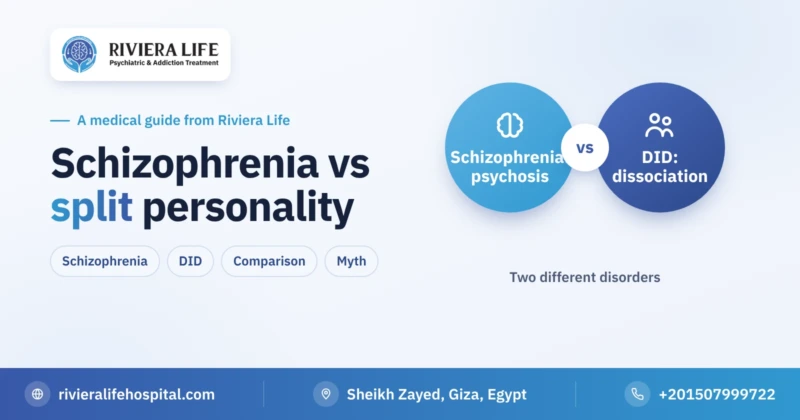
The common name itself is the source of an old misunderstanding. The phrase “split personality” suggests that the patient carries two personalities that take turns, and that describes a completely different disorder, dissociative identity disorder. Schizophrenia, by contrast, refers to a breakdown in harmony between thinking, perception and emotion, not the division of a person into two people.
How common is schizophrenia?
The World Health Organization estimates that roughly one in every 300 people worldwide lives with schizophrenia, and medical references state that the lifetime risk is close to 1%. The illness usually begins between the late teens and the early thirties. In men, onset comes slightly earlier, usually in the early twenties, and in women in the late twenties, with a second, smaller peak for them after the mid-forties. Onset in childhood before the age of thirteen is rare.
There is a reassuring side to the numbers too: the same organization states that at least a third of people with schizophrenia can recover completely, and that many others stabilize and live productive lives with the right treatment and support.
Types of schizophrenia: from the old names to the psychosis spectrum
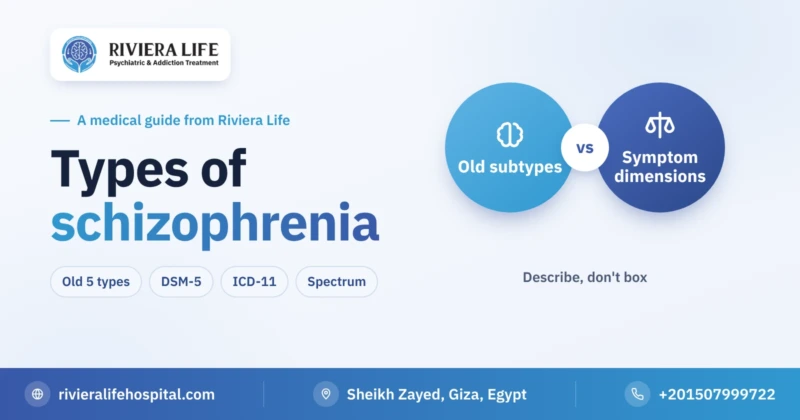
You may have heard of “paranoid schizophrenia” or “catatonic schizophrenia”. These are the names of subtypes that medical classifications used for decades, then the American Diagnostic and Statistical Manual abolished them in its fifth edition in 2013, and the eleventh edition of the International Classification of Diseases followed the same approach. The reason is that the same patient would move from one “type” to another over time, and these names did not help much in predicting the course of the illness or choosing its treatment.
Today, doctors describe each patient according to the severity of each group of symptoms they have, and place schizophrenia within what is known as the schizophrenia spectrum and other psychotic disorders, a spectrum that includes closely related disorders that differ in their duration and makeup, such as brief psychotic disorder, schizophreniform disorder and schizoaffective disorder. We explain the old types, the modern classification and the differences between them in the article Types of schizophrenia.
The main symptoms in brief
Doctors divide the symptoms of schizophrenia into three groups:
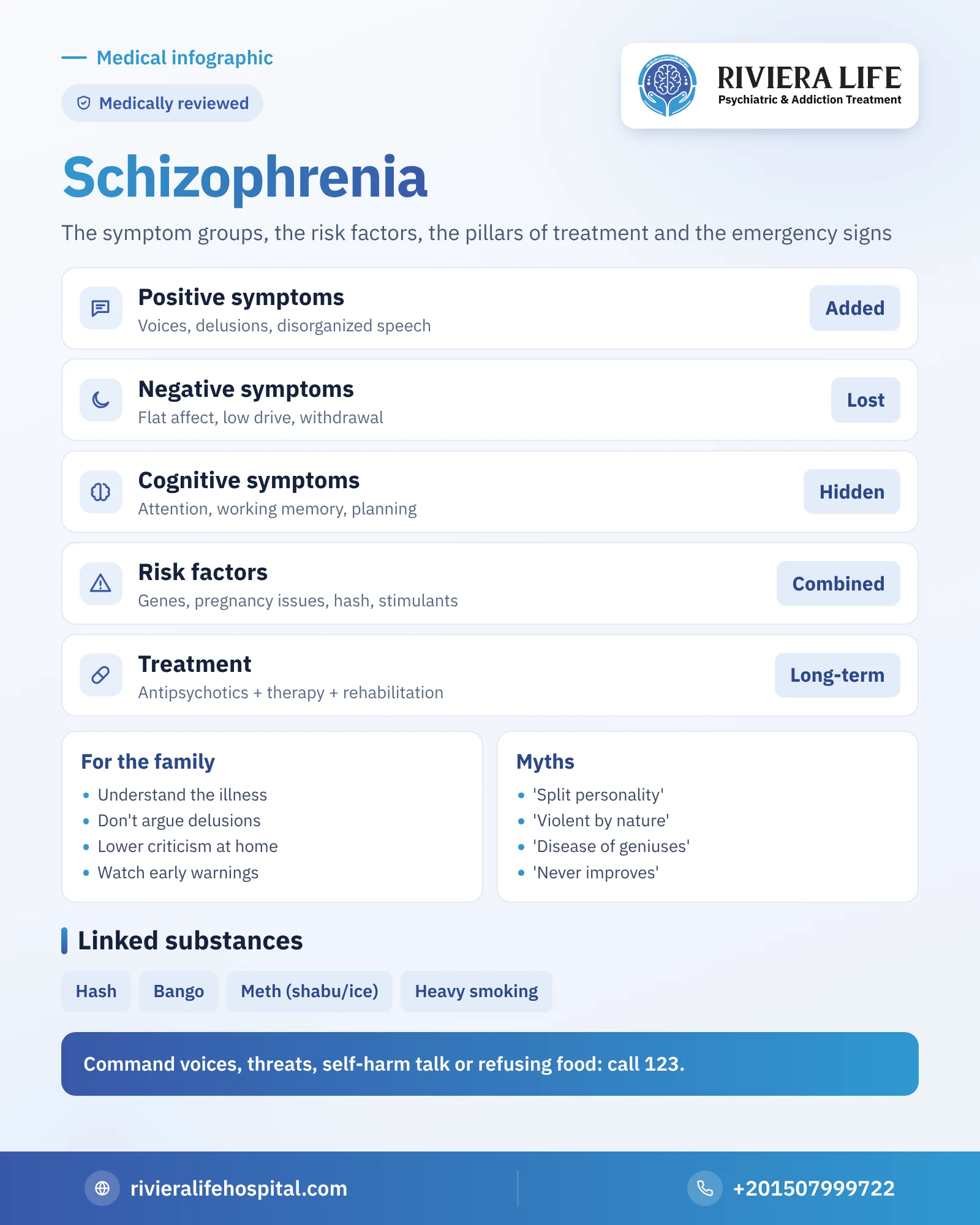
- Positive symptoms: additions to ordinary experience, such as hearing voices that comment on the person’s actions or give them orders; delusions, meaning firm, unrealistic beliefs such as certainty of being followed or that the television is sending them special messages; and disorganized speech that is hard to follow.
- Negative symptoms: a loss of what was there, such as a flat face and voice, little speech, low drive, withdrawal from people and neglect of self-care.
- Cognitive symptoms: weak attention and working memory and difficulty planning and making decisions; they are less noticeable but strongly affect study and work.
Many families do not notice the hallucinations first; they notice a son who shuts himself in his room, whose grades decline, whose sleep turns upside down, and who becomes very suspicious of those around him. The details of this early stage, with a checklist to help you decide when to seek an assessment, are in the article Symptoms of schizophrenia. And because hallucinations can accompany many conditions other than schizophrenia, the hallucinations guide will also help you.
The causes of schizophrenia in brief
There is no single cause of schizophrenia. The closest picture current science offers is that it arises from a genetic predisposition shared by many genes, each with a small effect, that meets factors affecting brain development before and after birth, and then stresses and triggers in adolescence and youth. Among the most prominent risk factors: having an affected first-degree relative, complications of pregnancy and childbirth, early and heavy use of hash, stimulant use, and severe adversity in childhood. The illness is linked to dysregulation of neurotransmitters, most importantly dopamine and glutamate. We weigh each of these factors carefully in the article Causes of schizophrenia.
Most importantly, we should know what is not a cause: schizophrenia is not created by wrong parenting from the mother or father, nor by a weakness of will or faith. These ideas load the family with guilt it does not deserve, and delay going to the doctor.
How is schizophrenia diagnosed?
No blood test or scan proves schizophrenia. Diagnosis relies on a detailed psychiatric interview with the patient and the family, following the symptoms over time, and matching them to specific medical criteria. Among the most important of these criteria is that signs of the disorder last at least six months, including an active period of clear psychotic symptoms, accompanied by a noticeable decline in work, study, relationships or self-care.
A key part of diagnosis is ruling out what resembles schizophrenia: drug use, some medicines, physical illnesses such as epilepsy, thyroid disorders and brain infections, and mood disorders that may come with psychotic symptoms, such as bipolar disorder and severe depression. That is why the doctor usually orders blood tests and a drug screen, and may order a brain scan or an EEG depending on the case, not to prove schizophrenia but to rule out other conditions.
Treatment of schizophrenia: an overview
Treating schizophrenia is a long-term plan, not a medicine taken for a few weeks and then stopped. Its first pillar is antipsychotics, medicines that relieve hallucinations and delusions and reduce the chance of relapse, available as daily tablets or as long-acting injections given every few weeks. Alongside them come psychological and social interventions: cognitive behavioral therapy for psychosis, family intervention, social skills training, and rehabilitation for returning to study or work. The patient may need hospital admission during acute episodes or when there is a danger to them or to others. The stages, the medicine classes and their side effects, the relapse-prevention plan and the criteria for choosing a hospital are explained in the article Treatment of schizophrenia.
There is a rule doctors agree on: the earlier treatment begins after the first episode, the better the chances of stability. The longer psychosis remains untreated, the worse the outcomes, and the delay is usually caused by shame or trying non-medical solutions first.
Schizophrenia and addiction: a common dual diagnosis
The relationship between schizophrenia and drugs runs in two directions. In the first direction, regular use of hash, especially high-potency types and in adolescence, raises the risk of psychosis and schizophrenia in those who carry the predisposition, and brings its onset earlier. Stimulants such as methamphetamine, known on the street as shabu or ice, can cause an acute psychotic episode with hallucinations and suspicion even in people with no previous psychiatric history. In the second direction, some people with schizophrenia turn to drugs, alcohol or heavy smoking to calm anxiety, symptoms or the side effects of medicine, entering a cycle that increases relapse and weakens commitment to treatment.
That is why the doctor always asks about substance use when assessing any case of psychosis, and treats both disorders together in one plan when they occur together. You can find details of the substances most linked to psychosis on the pages hash, bango and methamphetamine.
The harms of schizophrenia
Schizophrenia is a treatable illness, but leaving it without follow-up leaves an effect that accumulates with each episode. The earlier treatment begins and the more regularly it is followed, the smaller the losses.
- Daily life: difficulty continuing study or a job because of weak drive and concentration, and a decline in caring for oneself and the home.
- Relationships: isolation, strained family relationships, and difficulty making or keeping friends.
- Physical health: patients generally suffer more from heart disease, diabetes and smoking than others, and studies indicate that average life expectancy is slightly shorter; part of this is linked to lifestyle and to the effects of some medicines that the doctor monitors.
- Substance use: the spread of smoking, hash and stimulants among patients increases symptoms and raises the chance of relapse.
- Danger to oneself: the risks of self-harm rise in some patients, especially early in the illness, with depression, or when stopping medicine.
- Repeated hospital admissions: relapses resulting from stopping treatment are the most common reason for returning to inpatient care.
Most of these harms are not inevitable; regular follow-up and a relapse-prevention plan reduce them greatly. See Schizophrenia treatment and the relapse-prevention plan, and if signs of danger to the patient or others appear, call the ambulance on 123. You can find the danger of substance use in detail in Schizophrenia and addiction.
Living with schizophrenia and the family’s role
Many people with schizophrenia are able to study, work, marry and live a stable life, especially with commitment to treatment and follow-up. The family here is not just a companion but an active partner in the plan. Among the things that help it most:
- Understanding the illness, so it knows that lethargy and saying little are symptoms of it, not laziness or stubbornness.
- Not arguing about delusions; trying to prove the belief wrong usually raises the patient’s tension, and it is more useful to acknowledge their feelings without confirming the idea.
- Reducing criticism and emotional outbursts at home, because a charged atmosphere is linked to more relapse.
- Watching for early warning signs such as disturbed sleep and growing suspicion, and contacting the doctor as soon as they appear.
- Taking care of itself too, because caring for someone with a chronic illness is exhausting and needs support.
Is schizophrenia a disease of geniuses?
Films and books repeat the image of the genius who sees what others cannot because of their illness. This image is appealing, but it does not reflect the reality of most patients.
The truth is that schizophrenia does not create extraordinary intelligence; it usually weakens attention, working memory and the organization of thoughts. An outstanding or creative person may sometimes appear in its medical history, but these are striking exceptions, not the rule, and their achievement was mostly made despite the illness, not because of it.
The confusion comes from a limited scientific basis: some studies have shown a weak link between creative traits and the presence of a genetic predisposition to psychosis in patients’ relatives. This does not mean that a person with the illness is creative, nor that a creative person is at risk of schizophrenia.
This myth does practical harm: it may push the family to postpone treatment while waiting for a “talent”, or to interpret their son’s change as genius, so precious months of early treatment are lost. What is needed is to ask practical questions: have his sleep, concentration and speech changed? See Symptoms of schizophrenia and the early signs, and learn about The causes of schizophrenia and its risk factors.
Common myths about schizophrenia
Myth: a person with schizophrenia is violent and dangerous by nature. Fact: most people with it are not violent, and they are more likely to be victims of violence than to commit it. The risk rises in specific circumstances, most notably untreated psychosis and accompanying substance use.
Myth: schizophrenia means a split personality. Fact: this is a confusion with dissociative identity disorder, which is a different disorder.
Myth: schizophrenia medicines sedate the patient and erase their personality. Fact: some may cause drowsiness or slowness at first, but the doctor aims for the lowest effective dose, and the medicine can be adjusted or changed if its side effects weigh on the patient’s life.
Myth: what happens to the patient is possession or sorcery, and its treatment lies outside medicine. Fact: the family may draw on prayer and spiritual support as it wishes, but schizophrenia is a medical disorder with a treatment, and postponing the doctor in search of other explanations prolongs the period of untreated psychosis, and that alone harms the patient.
Myth: someone who develops schizophrenia will never improve. Fact: the course of the illness varies; many stabilize and return to their work, and some recover completely.
The schizophrenia guide: each aspect in its own article
We have devoted a separate article to each major question about schizophrenia, answering it in depth without repetition:
- Symptoms of schizophrenia: the early and psychotic signs as the family sees them, and a checklist that tells you when to seek an assessment.
- Causes of schizophrenia: genetics, brain chemistry, pregnancy and childhood factors and drugs, and the real weight of each factor.
- Types of schizophrenia: the old types and why they were abolished, and how doctors classify the psychosis spectrum today.
- Treatment of schizophrenia: antipsychotics, psychotherapy and rehabilitation, when hospital admission is needed, and the relapse-prevention plan.
Psychosis with danger: an emergency
Some psychotic episodes cannot wait until the clinic appointment, especially if they come with a danger to the patient or to those around them.
Seek urgent help immediately if you see
Call the ambulance on 123 or go to the nearest emergency department, and do not leave the person alone in these situations.
- Talk of self-harm or ending life
- Voices ordering them to harm themselves or others, and they seem to be responding to them
- Threats or violent behavior toward others
- Complete refusal of food and drink, or total inability to care for themselves
- Catatonia, with stopping moving and speaking for a long time
- A high temperature with severe muscle rigidity or clouded consciousness after starting a psychiatric medicine
Speak calmly and in short sentences, avoid cornering or holding them as much as possible, and remove sharp tools and medicines from the place. You can also call the hotline of the General Secretariat of Mental Health and Addiction Treatment on 16328 or 0220816831 for guidance.
When should you seek help?
Don’t wait for the picture to be complete. If you notice withdrawal and decline that persist for weeks, strange new ideas the person clings to, or talk of voices, an early psychiatric assessment is the right step even if the cause turns out to be something else. At Riviera Life in Sheikh Zayed, consultant psychiatrists carry out the assessment in complete confidentiality, the first consultation is free, and you can reach us around the clock on +201507999722.
Medical sources and referencesThe information in this article is based on reliable scientific sources
1WHO — World Health Organization fact sheet on schizophreniawho.int2NIMH — Schizophrenia: symptoms, risk factors and treatmentnimh.nih.gov3NHS — Schizophrenia: overviewnhs.uk4StatPearls — Schizophrenia: epidemiology, diagnosis and managementncbi.nlm.nih.gov5APA — What is schizophrenia? (American Psychiatric Association)psychiatry.org