For many people, tramadol starts as a strip in the kitchen drawer: a painkiller a doctor prescribed after a tooth extraction or a back injury, or a tablet a colleague at the workshop handed over “to get through the shift”. Months later, that tablet may have become a condition for waking up, working and sleeping. Tramadol is a genuine opioid medicine with a legitimate medical use, but in Egypt it is one of the most misused substances, and it carries two dangers most users don’t know about: seizures and serotonin syndrome. This page explains what tramadol is, how it works and why it turns into an addiction, and then leads you to a separate article on each aspect of it.
What is tramadol?
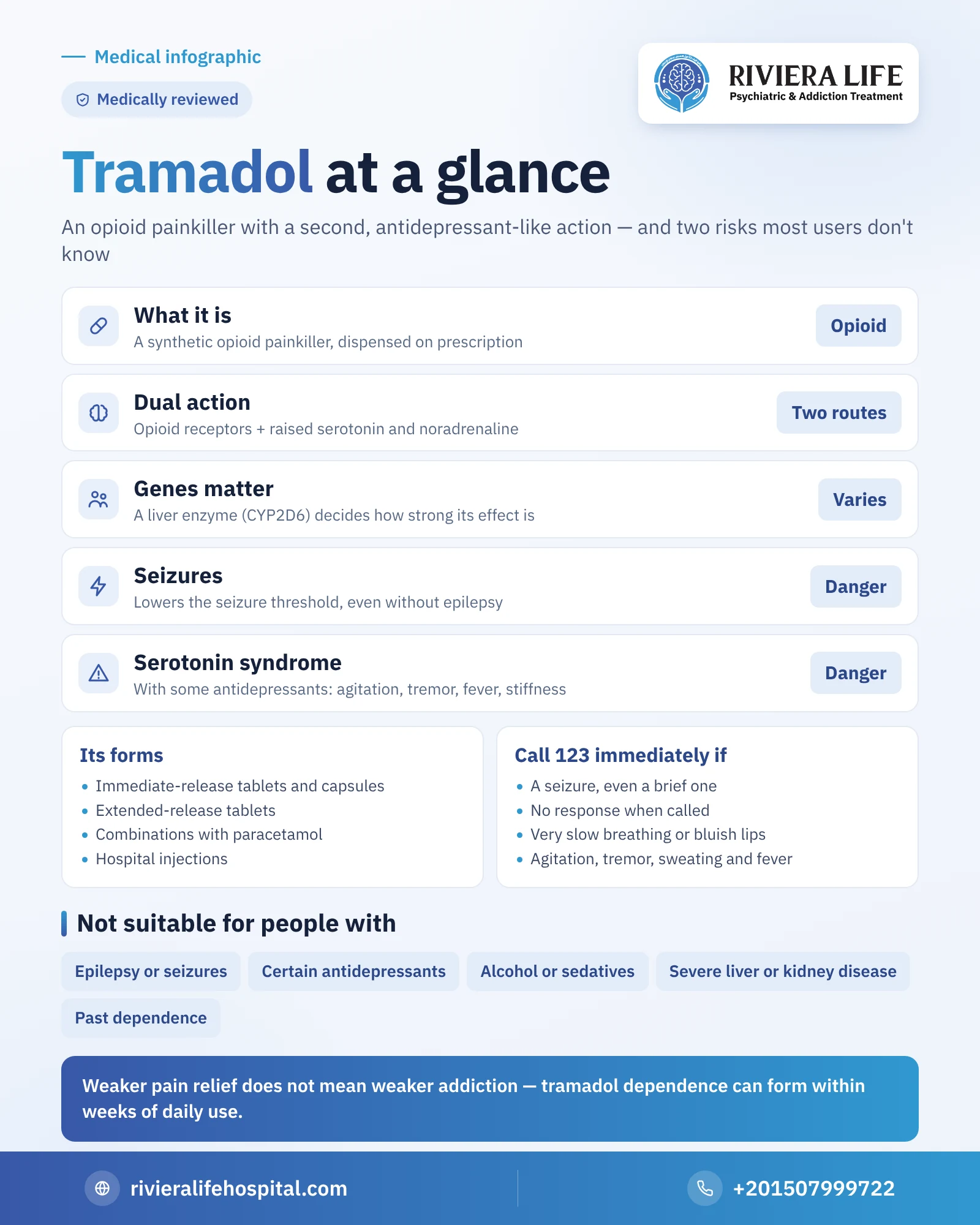
Tramadol is a synthetic painkiller from the opioid family, dispensed on prescription to relieve moderate to relatively severe pain. What sets it apart from most members of its family is that it works in two ways at once: part of its effect comes from binding to opioid receptors, and another part comes from blocking the reuptake of two chemicals in the brain, serotonin and noradrenaline — a mechanism similar to that of some antidepressants.
Most of its opioid effect does not come from tramadol itself but from a substance the liver converts it into through an enzyme called CYP2D6. The activity of this enzyme varies genetically from person to person: some people convert the medicine slowly and feel only a weak effect, while others convert it very quickly, so the active substance builds up in their bodies and the risk of poisoning rises. That is why two people can take the same amount with very different results.
The names tramadol goes by in Egypt
On the Egyptian street, tramadol is mostly known by its generic name, or by brand names that have become common such as “Tamol” and “Tramundin”, and the tablets are sometimes referred to by their color or by the number printed on them. The bigger problem is that a large share of what is sold outside pharmacies is smuggled or counterfeit tablets whose real strength, and whatever has been added to them, no one knows. The name printed on the strip guarantees nothing, and a tablet described as “ordinary tramadol” may carry far more than the person taking it expects. Its internationally known brand names also include “Tramal” and “Contramal”, all of which contain the same active substance. To compare these names with the original substance, see our articles on tramadol vs Tamol and tramadol vs Tramundin.
Forms of tramadol and how it is taken
Medical tramadol comes in several forms, each with a different speed of action:
- Immediate-release tablets and capsules, whose effect begins within about an hour.
- Extended-release tablets that release tramadol gradually over many hours.
- Tablets that combine tramadol with paracetamol in a single formulation.
- Injections used in hospitals under direct supervision.
Misuse usually means swallowing tablets in amounts beyond the prescription, repeating them throughout the day, or mixing them with other substances such as pregabalin, alcohol and hashish. Breaking or dissolving extended-release tablets cancels their slow-release property, so the whole amount enters the body at once — one of the fastest routes to poisoning.
What does tramadol do to the brain and body?
Thanks to its dual mechanism, tramadol produces a strange mix of effects: calm and pain relief resembling the effect of opioids, together with activity and a feeling of energy that comes from raised noradrenaline and serotonin. This mix is the secret of its spread among laborers, drivers and students; many people take it not to sleep but to be able to work longer hours. Its usual effects include:
- Pain relief and a temporary improvement in mood.
- A feeling of energy, boldness and talkativeness in some users.
- Nausea, dizziness, constipation, dry mouth and sweating.
- Drowsiness and slow breathing, especially with large amounts or when mixed with sedatives.
- A lower seizure threshold in the brain, making fits more likely.
With repeated use the brain gets used to the substance, so its effect weakens and the person needs a larger amount, and then unpleasant symptoms appear when a dose is late. At this point the tablet has changed from a way to keep going into a way to avoid collapse.
The medical use of tramadol
Tramadol has a legitimate place in medicine: doctors prescribe it for pain after operations and injuries, and for some chronic pain when simple painkillers are not enough. It is meant to be used at the lowest effective dose for the shortest possible time, with regular review by the doctor. Medical supervision here is not a formality: the doctor reviews the other medicines the patient takes, especially antidepressants, and asks about any history of seizures and liver or kidney disease — all of which change the decision to prescribe. Anyone who needs relief for ongoing pain without entering the opioid cycle will find options to discuss with their doctor in our article on the strongest alternative to tramadol by type of pain.
Tramadol’s effect: when does it start, and how long does it last?
Tramadol works in two ways at once: it binds to pain receptors in the brain, and at the same time it raises serotonin and noradrenaline. With ordinary tablets the effect usually begins within about an hour, peaks after two or three hours, and then lasts a few hours before fading.
Extended-release tablets are designed to release the substance slowly over half a day or more. Crushing or chewing them empties the dose all at once — one of the most dangerous practices, because it multiplies the risk of slow breathing and seizures.
People do not all respond to the medicine in the same way:
- The liver converts tramadol into a substance that is stronger at relieving pain, and the speed of this conversion varies genetically from person to person, so the effect and the risks differ between people.
- Liver and kidney disease and older age keep the medicine in the body for longer.
- Combining it with antidepressants, alcohol or sedatives changes its effect and increases the risks.
Anyone who notices that the effect has become shorter, or that they need more for it to show, has entered the stage of tolerance — one of the signs that dependence is beginning. The details of the tablets in circulation are in our article on tramadol types, and you will find what concerns how long the substance shows up in tests in how long tramadol stays in your system.
What tramadol is used for, and who it doesn’t suit
Tramadol is a painkiller prescribed for moderate to severe pain when simpler painkillers are not enough, such as pain after surgery or fractures, or some chronic pain where the doctor judges it is needed. The doctor prescribes it for as short a time as possible and reassesses regularly. It is not a treatment for insomnia, fatigue or sexual weakness — purposes that have spread among users with no medical basis at all.
There are people for whom doctors avoid tramadol or warn strongly against it:
- People with a history of epilepsy or seizures.
- People taking certain antidepressants, because of the risk of serotonin syndrome.
- People who drink alcohol or take sedatives or other opioids.
- People with severe liver or kidney impairment.
- Pregnant and breastfeeding women, except on the doctor’s judgment, and young children.
- Anyone who has previously been dependent on a drug.
If you have been prescribed a strong painkiller and any of these applies to you, ask your doctor about suitable alternatives. You will find a range of options by type of pain in our article on the strongest alternative to tramadol, and tramadol vs codeine explains where it sits among the other opioid painkillers.
Why is tramadol considered dangerous?
Many people believe tramadol is a “mild painkiller” because it comes from the pharmacy. But its danger comes from several directions at once:
- Seizures: epileptic fits can happen even in people who have never had one, and the risk rises with large amounts and with certain antidepressants.
- Serotonin syndrome: a build-up of serotonin when it is mixed with medicines that affect it, showing as agitation, tremor, a high temperature and muscle stiffness.
- Depressed breathing: this increases sharply when it is mixed with pregabalin, sedatives or alcohol.
- Addiction: dependence can form within weeks of daily use, and its withdrawal is physically and psychologically unpleasant.
- Counterfeit tablets: an unknown strength makes every dose a gamble.
The full details of what it does to the liver, kidneys, brain and social life are in our article on the harmful effects of tramadol.
Tramadol within the opioid family
Tramadol belongs to a family that includes morphine, codeine, methadone and heroin, all of which act on the same opioid receptors. Tramadol is classed among the weakest members of the family at relieving pain, but weaker pain relief does not mean weaker addiction. Its serotonin-affecting side also adds risks that the other opioids don’t carry to the same degree, such as seizures and serotonin syndrome. That is why anyone who thinks that moving from tramadol to another opioid, or the reverse, is “cutting down” is mistaken. You can see the full picture of this family on our opioids page, and the differences between tramadol and a substance often mixed with it in our article on pregabalin vs tramadol.
Cases of tramadol misuse recur in several Arab countries, and for families in Libya in particular, our guide to addiction treatment in Libya explains the public services available and what the law says about voluntary treatment.
Tramadol and the law in Egypt
Because its misuse is so widespread, tramadol has been listed in Egypt’s schedules of narcotic substances, so it is dispensed only on prescription under specific regulations. Possessing, selling or trading it without a medical basis exposes a person to criminal liability, and the penalty is heavier for trafficking. On the other hand, the law allows someone who comes forward on their own to ask for treatment to receive it without criminal proceedings being brought against them for use. For questions about a particular case it is best to ask a specialist lawyer, and the Fund for Drug Control and Treatment of Addiction offers a free hotline on 16023.
Our tramadol guide: every aspect in its own article
We have spread the subject of tramadol across several articles, each dealing with a specific question:
- Tramadol addiction symptoms: the physical, psychological and behavioral changes a family may notice.
- Tramadol withdrawal symptoms: when they start, when they peak, and the unusual symptoms it brings.
- Tramadol addiction treatment: assessment, detox, medication, rehabilitation and relapse prevention.
- The causes of tramadol addiction: why a painkiller turns into an addiction, and who is most at risk.
- The harmful effects of tramadol: its effect on the brain, liver, kidneys and heart, and overdose.
- How long tramadol stays in your system: how long it can be detected in urine, blood, saliva or hair tests.
- The strongest alternative to tramadol: safe pain-relief options by type of pain, to discuss with your doctor.
- Tramadol vs Tramundin: the active substance, the way it is released and the risk of dependence.
- Tramadol vs Tamol: what is really sold under this name and why it is more dangerous.
- Pregabalin vs tramadol: a comparison of two substances often mixed in Egypt.
- Red vs white tramadol: color, effect and risks
- Tramadol vs codeine: effects, risks and which is better
- Tramadol vs Viagra: erections, ejaculation and the risks of combining them
- Tramadol vs morphine: effects, harms and which is stronger
- Tramadol vs hashish: harms, addiction and the risks of mixing them
- Tramadol and sex: the truth about delayed ejaculation
- Medications for tramadol addiction: the medicines a doctor uses to treat tramadol addiction
Common myths about tramadol
The myth: tramadol is a medicine, not a drug, so it doesn’t cause addiction. The truth: being a medicine doesn’t change its opioid nature, and dependence on it is medically documented even in patients who started it on a correct prescription.
The myth: tramadol makes sex last longer and makes a man stronger. The truth: the delayed ejaculation some people notice is a temporary side effect, followed with continued use by weaker desire and disturbed hormones and erections.
The myth: someone who takes it only for work is not an addict. The truth: the motive doesn’t change what happens in the brain; someone who can’t work without it is already dependent on it.
The myth: stopping it is easy because it is a weak painkiller. The truth: its withdrawal can include severe anxiety, panic attacks and symptoms unusual for opioids, and it sometimes needs medical supervision.
Found out that someone close to you is taking tramadol?
Start from observation, not accusation. Write down what you see: empty blister packs, changed sleeping times, irritability when money runs out, and repeated complaints of headaches and sweating in the morning. Then choose a calm moment when the person is in their normal state, talk about your worry for their health, and mention seizures and the danger of mixing specifically — information many people don’t know. Don’t cut off their money suddenly without a plan, and don’t try to end the matter by hiding the tablets, because stopping suddenly after long use can be exhausting and push them to look for a worse source. And ask for a medical consultation for the family itself, even before they are convinced they need treatment.
Signs of tramadol poisoning
Call an ambulance immediately (123 in Egypt) if you see
Tramadol poisoning can combine seizures with depressed breathing, especially when it is mixed with pregabalin, sedatives or alcohol.
- Seizures or an epileptic fit, even if it stops quickly
- Severe drowsiness or no response when called
- Very slow or irregular breathing, or bluish lips
- Agitation, tremor and heavy sweating with a high temperature
- A very fast heartbeat or muscle stiffness
Until the ambulance arrives, place the person on their side if they are unconscious but breathing, and move hard objects away from them during a seizure without putting anything in their mouth, and don’t try to rouse them with cold water or any other substance. Keep the strip or the pack to show the medical team, as knowing exactly what they took saves precious time.
When should you ask for help?
If tramadol is being taken daily without a prescription, in larger amounts than the doctor prescribed, or the person can’t work or sleep without it, the time for a medical assessment is now, not later. The earlier treatment starts, the easier the withdrawal and the fewer the complications. At Riviera Life the situation is assessed by a team of consultants in psychiatry and addiction treatment in complete confidence, and they set a plan that fits the pattern of use, whether tramadol alone or together with other substances.
Medical sources and referencesThe information in this article is based on reliable scientific sources