Every person goes through heavy days in which they lose the desire to talk or go out, and then they pass. Depression is something different: a medical condition in which mood stays low, or pleasure is absent from almost everything, for at least two weeks, with its effects extending to sleep, appetite, concentration, work and relationships. The reassuring news is that depression is among the psychiatric disorders most responsive to treatment, and that most of those who receive appropriate treatment improve clearly. This page is your entry point to everything the Riviera Life team publishes about depression: its definition, prevalence, types, symptoms, causes and treatment, with a link to a separate article on each aspect.
What is depression?
Depression in its best-known form is called by doctors “major depressive disorder”, a mood disorder that changes the way a person feels, thinks and behaves at the same time. It isn’t a weakness of personality, a lack of faith, or “being spoiled” as is sometimes said, and it isn’t a decision the patient makes to stay sad. It is a condition in which brain functions, life circumstances and patterns of thinking all play a part, and it needs assessment and treatment like any other illness.
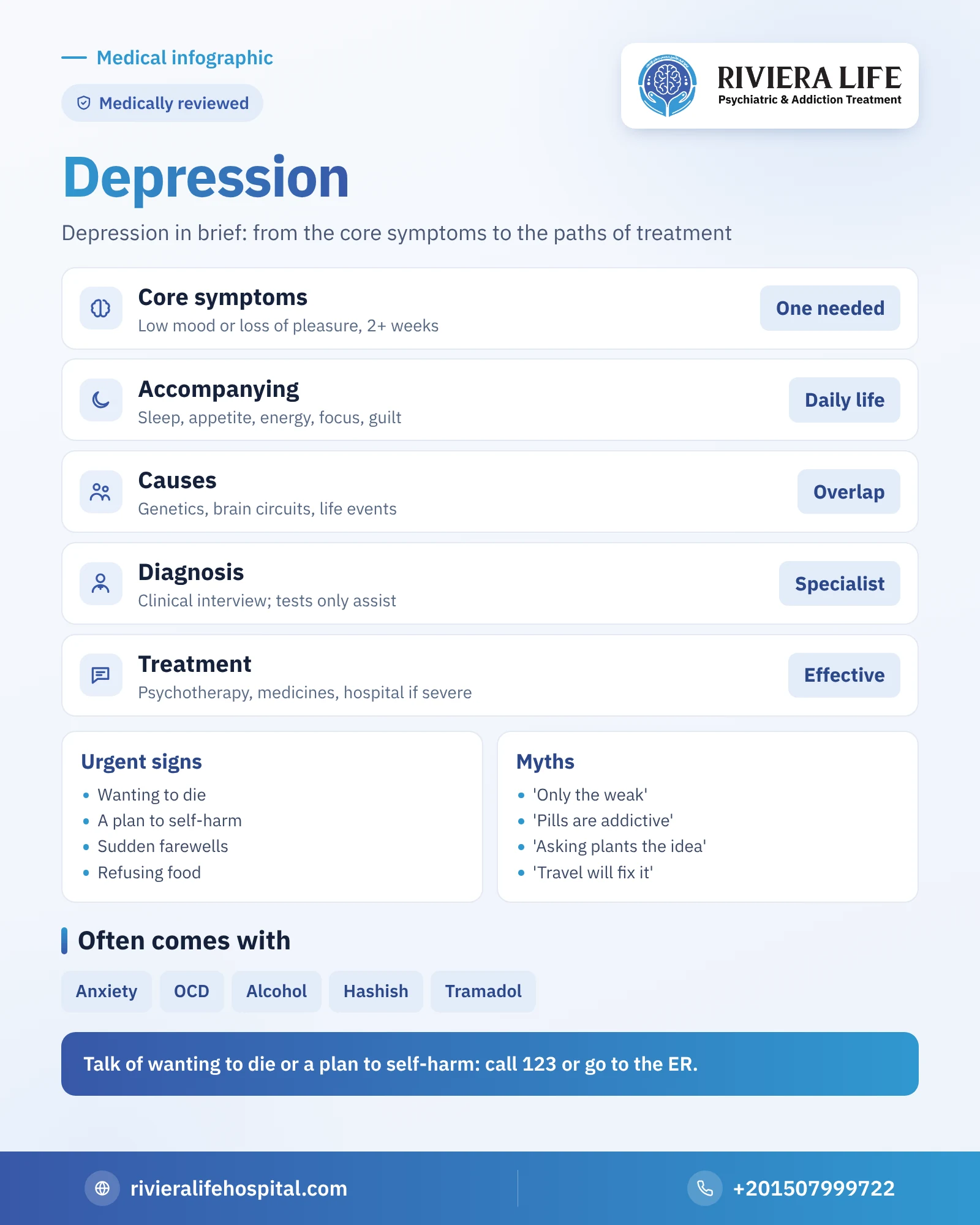
Sadness alone isn’t enough for the diagnosis. The doctor looks for two central symptoms, at least one of which must be present: low mood most of the day and most days, or a clear loss of interest and pleasure in what used to make the person happy. Then they check for other accompanying symptoms, that the picture has continued for at least two weeks, and that it disrupts the person’s daily life in a tangible way.
Normal sadness or depression?
Sadness after a loss or disappointment is a sound human response. It comes in waves, interspersed with moments of laughter and good memories, and the person’s self-respect usually remains with it. Depression, however, tends to be a fixed gray cloud that good news doesn’t penetrate, and is often accompanied by a feeling of worthlessness or guilt out of proportion to reality. The two may overlap; deep grief after the death of a loved one may turn into depression that needs treatment, especially if it lasts a long time or paralyzes the person’s ability to do the simplest tasks.
How common is depression?
Depression is among the most common psychiatric disorders in the world. The World Health Organization estimates that about 5% of adults suffer from it, that is, hundreds of millions of people, and that it is about one and a half times more common in women than in men. It can appear at any age, from adolescence to old age, and it also affects a not insignificant proportion of women during pregnancy or after birth. Despite this, many patients don’t receive any treatment, even in rich countries, and the reason is usually stigma, or not realizing that what they are going through is an illness with a treatment.
Types of depression in brief
The word “depression” is an umbrella that covers more than one diagnosis. The best known is major depression, which comes in the form of episodes, and persistent depression or dysthymia, which is milder in intensity but extends for two years or more. There are patterns linked to a particular timing, such as peripartum depression and seasonal depression, and others known by their features, such as depression with psychotic symptoms or with severe anxiety. It is essential to distinguish all this from depressive episodes in bipolar disorder, because their treatment is different. The full details are in the article on types of depression.
The main symptoms of depression
The picture differs from person to person, but what recurs most is:
- Persistent sadness, emptiness or distress most of the day.
- Loss of pleasure and interest in hobbies and people.
- A change in sleep, whether insomnia or sleeping longer than usual.
- A change in appetite and weight, up or down.
- Constant exhaustion and slowness, or on the contrary tension and restlessness.
- Difficulty concentrating and making the simplest decisions.
- A feeling of worthlessness or exaggerated guilt.
- Repeated thoughts of death or of self-harm.
Depression often hides behind physical complaints: headaches, back and joint pain, and digestive disorders for which doctors find no clear organic cause. We have explained the psychological, physical and behavioral signs, and when you need a doctor, in the article on the symptoms of depression.
Why does depression happen?
There is no single cause that explains every case. What science knows is that depression results from an overlap of several factors: a genetic predisposition that raises susceptibility, changes in the brain circuits responsible for mood, reward and dealing with stress, harsh life events such as loss, divorce and unemployment, chronic physical illness, some medicines, and the use of alcohol and drugs. The common idea that depression is simply a “serotonin deficiency” is a simplification that doctors no longer rely on as a sufficient explanation. The details of these factors are in the article on the causes of depression.
How is depression diagnosed?
Diagnosis is the responsibility of the psychiatrist or clinical psychologist, and relies mainly on a detailed interview in which they ask about the symptoms, their duration and their effect, and about family history and the medicines and substances used. The doctor may use standardized questionnaires to measure severity and follow it, but they are aids that don’t diagnose on their own, and the same goes for tests widespread on the internet.
They may request blood tests to rule out physical causes resembling depression, such as an underactive thyroid or anemia. Among the most important things they ask about are previous episodes of excess activity and little sleep without tiredness, because they may indicate bipolar disorder. There is as yet no blood test or scan that proves or rules out depression.
The harms of depression when left untreated
Depression isn’t limited to sadness; it creeps into every aspect of life if it lasts. It is often considered a weakness of personality, so asking for help is delayed for years.
- The body: disturbed sleep and appetite, constant exhaustion, unexplained pain, declining immunity and worsening chronic illnesses.
- Thinking: slowness, weak concentration and forgetfulness, and negative thoughts about oneself and the future.
- Work and study: declining performance, absence and lost opportunities.
- Relationships: withdrawal from family and friends and emotional coldness, which those around may take for neglect.
- Safety: thoughts of death or self-harm may appear, a danger sign that calls for urgent help.
Some patients may also resort to alcohol, hashish or tramadol to ease the pain, so the depression gets worse. And untreated depression may return after a temporary improvement in a more severe form.
The good news is that medicinal and psychological treatment eases these effects in most patients. The article on the symptoms of depression details the danger signs, and you will find the role of treatment in the treatment of depression.
Before visiting the doctor, the depression self-test gives you an initial picture of the severity of symptoms over the last two weeks, and the final word remains with the clinical assessment.
Treatment of depression: an overview
Treatment is determined according to severity. In mild cases, structured psychotherapy with adjustments to sleep and activity and close follow-up may be enough. In moderate and severe cases the doctor usually combines psychotherapy and antidepressant medicines, which are multiple categories from which what suits each patient is chosen. Very severe cases, or those accompanied by suicidal thoughts or psychotic symptoms, or that haven’t responded to several attempts, may need hospital admission and advanced options such as electrical brain-rhythm regulation sessions under anesthesia. The full plan is in the article on the treatment of depression, and how the medicine is chosen in the article on the best medicine for depression and anxiety.
Depression and addiction: dual diagnosis
The relationship between depression and addiction runs in both directions. Some patients resort to a substance that numbs psychological pain, such as alcohol, hashish or tramadol, so they feel relief for hours, then the depression returns heavier. On the other hand, chronic use, and periods of withdrawal in particular, cause clear depressive symptoms that may last for weeks. Treating one side and leaving the other makes relapse almost certain, which is why this patient needs a team that treats both disorders together. Depression also often comes together with anxiety and with obsessive-compulsive disorder.
Vitamin D, tryptophan and depression: what does the evidence say?
There is much talk of supplements that treat depression, the best known being vitamin D and tryptophan. The truth is that the link exists but it isn’t a substitute treatment for the doctor.
Vitamin D: a low level is common among those with depression, but studies haven’t settled whether it causes depression or accompanies it because of going out and moving less. Correcting a deficiency confirmed by testing is useful for health in general, but it is no substitute for treating the depression itself.
Tryptophan: an amino acid from which the body makes serotonin, found in eggs, dairy and nuts. However, taking it in food doesn’t lift the mood of someone with depression in a way that can be relied on as a treatment. Tryptophan or 5-HTP supplements are dangerous for someone taking antidepressants, because they may cause serotonin syndrome.
- Check your vitamin D level before taking a supplement, and don’t start one without a test.
- Tell your doctor about every supplement you take.
- Don’t stop your antidepressant thinking a supplement is enough.
The article on how to increase serotonin naturally explains what the evidence actually supports, and serotonin syndrome warns of the danger signs.
Living with depression and the family’s role
Recovery from depression doesn’t happen in the clinic alone, but in the details of the day. It helps the patient to keep fixed times for sleeping and waking, to move a little every day even with a short walk, to divide big tasks into small steps, and to stay away from alcohol and unprescribed sedatives. The family’s role is to believe that the illness is real, to avoid phrases such as “snap out of it” and “others have bigger problems”, and to encourage treatment and help with sticking to it without stifling guardianship. It is natural for the companion to become tired themselves, so it is fine for them to ask for support for themselves too.
Common myths about depression
The myth: depression only affects the weak. The truth is that it affects the strong, the successful, the religious and those with responsibilities, and has nothing to do with strength of personality.
The myth: depression medicines cause addiction and change the personality. The truth is that antidepressants don’t cause the euphoria or intense craving that characterize addiction, though stopping them suddenly may cause troublesome symptoms, which is why they are reduced gradually under the doctor’s supervision.
The myth: talking to a depressed person about suicide may plant the idea in their head. The truth is that a calm, direct question doesn’t increase the risk, but opens a door to help and makes the patient feel that someone sees them.
The myth: depression goes away on its own if the person travels, marries or changes their job. The truth is that changing circumstances may sometimes help, but it doesn’t treat moderate or severe depression, and delaying treatment prolongs the episode and raises the likelihood of it recurring.
The depression guide: each aspect in a separate article
We have gathered the details of each aspect in a special article that answers a single question in depth:
- Symptoms of depression: the psychological, physical and behavioral signs, how they differ in adolescents and older adults, and when you need a doctor.
- Causes of depression: genetics, the brain, hormones, illnesses, medicines, life stresses and protective factors.
- Types of depression: medical classifications, degrees of severity and special patterns, explained simply.
- Treatment of depression: psychotherapy and medicine, when the patient needs hospital, and how relapse is prevented.
- The best medicine for depression and anxiety: how the doctor chooses between categories of medicines, and why self-treatment is dangerous.
- The difference between Supranil and Anafranil: the shared active substance and the real differences between the two trade names.
- Premarital depression: when anxiety is normal, and when it needs a specialized assessment.
- OCD and depression: the relationship between the two disorders, the difference between them, and how they are treated together.
Signs that call for urgent help
Seek urgent help immediately if any of these appear
In these situations don’t wait for an ordinary appointment: call the ambulance on 123 or go to the nearest emergency department.
- Talk of wanting to die or of having become a burden on others
- Making a plan to self-harm or looking for a means to do so
- Suddenly saying goodbye to family or giving away personal belongings
- A sudden, unexplained calm after a period of severe depression
- An almost complete refusal of food and drink, or inability to care for oneself
- Hearing voices or strange beliefs appearing with depression
Until help arrives, don’t leave the person alone, move sharp tools and accumulated medicines in the house out of their reach, and ask them calmly what they are thinking about and listen without blame or lectures. You can also contact the hotline of the General Secretariat of Mental Health and Addiction Treatment of the Ministry of Health on 16328 or 0220816831.
When should you ask for help?
If low mood or the absence of pleasure continues for more than two weeks and has started to affect your work, studies or home, this is a suitable time for a specialized assessment, even if the symptoms seem bearable. The earlier treatment begins, the shorter the episode and the better the chances of it not recurring. At Riviera Life, the consultant psychiatrists assess the case in complete confidentiality, and put in place a plan that suits it, whether follow-up in the clinic or admission under round-the-clock medical supervision, and the first consultation is free.
Medical sources and referencesThe information in this article is based on reliable scientific sources