The short answer
Masturbation (in Arabic al-‘ada al-sirriya, or istimna’) is a person sexually stimulating themselves without a partner, a behavior most men and women know at some stage. In itself it does not cause blindness, infertility or hair loss as rumors claim. Medically, what counts is not the number of times but the ability to control it: if stopping has become difficult, or the practice has taken from sleep, work and the marital relationship, or intense distress repeatedly follows it, it has turned into a compulsive pattern that is treated psychologically with good results.
- Another medical nameIstimna’
- The medical criterionLoss of control, not frequency
- If it becomes compulsiveTreated with cognitive behavioral therapy
Masturbation is a self-directed sexual behavior that most people know at some stage of their lives, men and women alike. In itself it does not cause blindness, infertility or hair loss as rumors claim, but in some people it can turn into a compulsive pattern that eats up time, weighs the mind down with guilt and anxiety, and affects the marital relationship. This page explains, in calm medical language, what masturbation is, how the body responds to it, and when it becomes a problem that needs help, then leads you to a separate article for each question: the harms, the causes, the treatment, and what concerns wives.
What is masturbation?
Masturbation is a person sexually stimulating themselves without a partner. Doctors use the word “istimna'” with the same meaning; they are two names for one thing. It should be distinguished from sexual desire itself: desire is a natural internal feeling driven by hormones, emotions and thoughts, while masturbation is an act the person chooses as a response to that desire or to other feelings such as stress and boredom. This distinction matters, because someone trying to give up the habit does not need to “kill” their desire, but to regain their own decision about how to deal with it.
What happens in the body during masturbation?
The sexual response is almost the same whether it happens with a partner or without, and doctors describe it in successive stages involving the nervous system, the circulation, the muscles and the hormones.
1. Desire and arousal
The signal starts in the brain, blood flow to the pelvic area increases, the pulse rises and breathing speeds up slightly. These are temporary changes the body goes through in many non-sexual situations too, such as emotion or exertion.
2. Continued response
The previous changes hold for a period that varies from person to person and from time to time, depending on tiredness, focus and mood, and there is no specific “normal time” for it.
3. Orgasm, then relaxation
The response usually ends with orgasm, then the pulse and breathing return to their usual rate, and many feel relaxed or sleepy because of passing hormonal and nervous changes. That is why some people notice they fall asleep easily afterwards, and this does not mean the body has “lost” something that needs replacing.
Masturbation in men
In men there are three processes that are linked but scientifically separate: erection, which depends on nerves and blood flow; orgasm, which is a sensation that happens in the brain; and ejaculation, which is a muscular contraction that releases semen. One may sometimes happen without the other, which explains why some men complain of a problem in one aspect and not the others. Sperm production is constantly renewed, so frequent ejaculation does not lead to “running out” of a store or to infertility, as is rumored.
Masturbation in women
A woman’s sexual response is more varied, and is strongly affected by emotions, psychological comfort, fatigue, the menstrual cycle and medicines. There is no single “correct” pattern for it. Many women feel more embarrassed than men to talk about this subject, so their fears about virginity, fertility and the period grow, while the medical answers to most of them are reassuring. We cover these fears in detail in the article The harms of masturbation.
Girls and women have questions of their own, about the hymen, the period and discharge, which we answer in a separate guide: Masturbation in girls and women.
How often is masturbation normal?
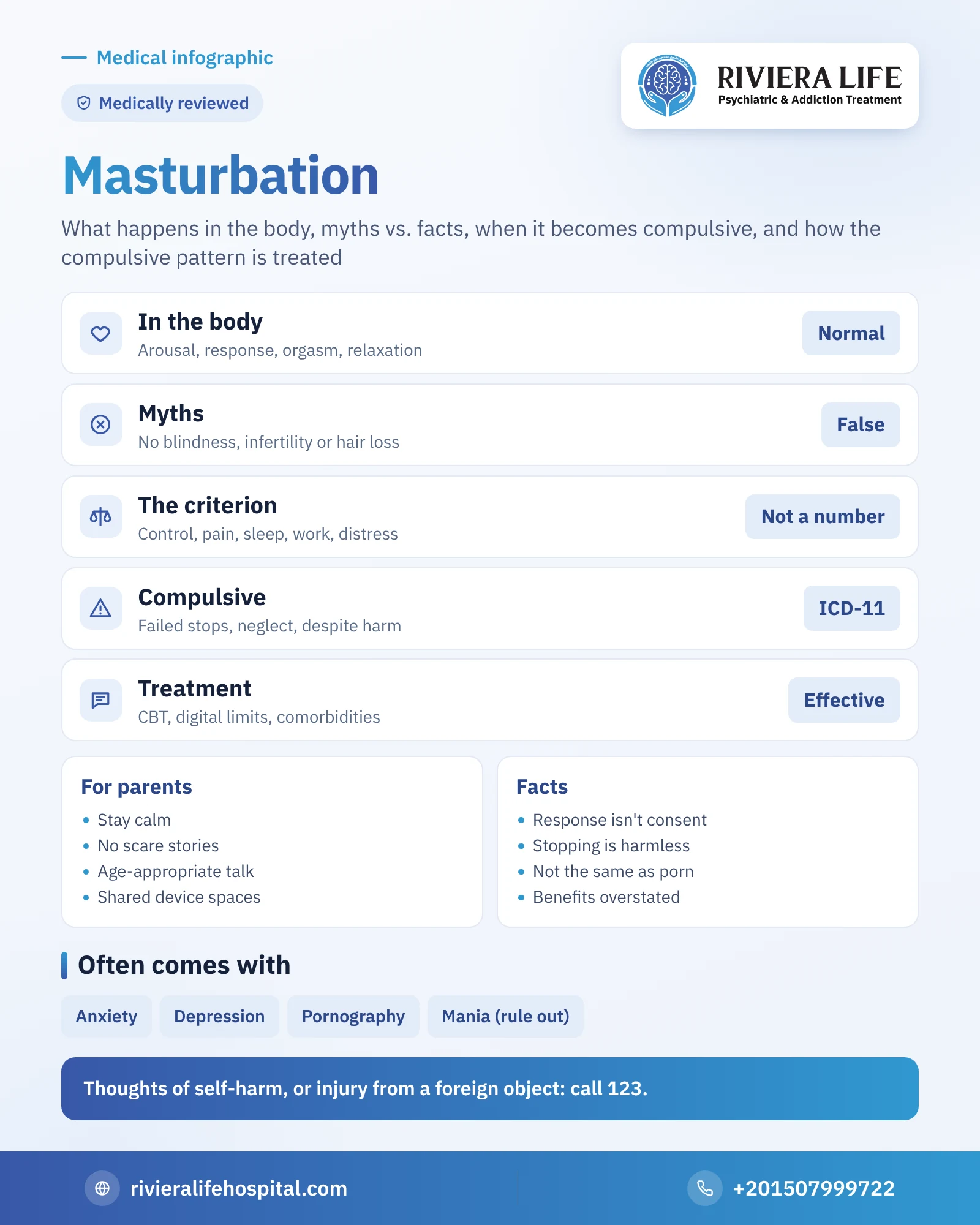
There is no number that suits everyone. Some people never do it and some do it often, and both may be within normal limits. What decides the matter medically is not the number but four questions: Can you postpone it or stop when you decide? Does it cause you pain or irritation? Does it take time from your sleep, work, study or family? Do you repeatedly feel intense distress afterwards? If the answer is “yes” to more than one question, the matter deserves a pause.
Why does the rate change over time?
Sexual desire changes with age, general health, sleep, stress, marital status and some medicines such as antidepressants. So a rise or fall in the rate for a while is not a sign of illness in itself. But a sudden, severe, unusual increase, especially with little sleep and impulsive spending or speech, may be a sign of a medical or psychological condition that needs assessment.
What is the difference between masturbation and wet dreams?
A wet dream is ejaculation that happens during sleep involuntarily; it is common in teenagers and young men especially, and usually decreases with age or with regular marital relations. Masturbation, by contrast, is a conscious behavior that happens while awake. A wet dream does not indicate illness, needs no treatment, and has nothing to do with sexual weakness.
Facts that correct common ideas
- A physical response does not mean consent: the body may respond automatically to a stimulus without the person wanting or agreeing to it. Consent is a conscious decision that cannot be inferred from a physical reaction.
- Duration is not a measure of sexual ability: how long or short the time is during solo practice does not accurately predict what happens with a partner, because the marital relationship is affected by emotions, communication and anxiety.
- The benefits are limited and sometimes exaggerated: some may feel temporary relaxation or better sleep, but presenting it as a treatment for stress or insomnia is not accurate.
- Masturbation is not pornography: they are two separate behaviors that sometimes come together, and each has its own problems, as we explain in the pornography addiction guide.
- Giving it up does no harm: not doing it at all is completely normal, and causes no dangerous congestion or illness.
When does a voluntary behavior turn into a compulsive pattern?
The fifth edition of the American diagnostic manual does not recognize a standalone diagnosis called “masturbation addiction”. But the eleventh edition of the International Classification of Diseases, issued by the World Health Organization, includes a diagnosis called “compulsive sexual behavior disorder”, describing a persistent pattern of failure to control intense sexual impulses over a long period, about six months or more, with the behavior continuing despite its consequences and despite repeated attempts to reduce it. Masturbation may be part of this pattern in some people.
The signs the doctor looks at: repeated attempts to stop that fail, practice that lasts longer than planned, neglect of sleep, study, work or family duties, continuing despite pain or irritation, using it as the only way to escape anxiety or sadness, then a feeling of relief followed by greater distress. Doctors stress that guilt alone is not enough for a diagnosis; some people do it rarely but suffer a great conflict with their values, and they too deserve to be listened to and helped, even if the plan differs.
Why is it hard for some people to stop?
Psychological and behavioral factors overlap: anxiety, loneliness and depression, boredom and staying up late, easy access to sexual content via the phone, and the brain getting used to a quick, guaranteed reward. With repetition, the behavior becomes linked to specific times and places, so it becomes closer to an automatic reaction. You can find a detailed explanation of this cycle in the article Causes of masturbation addiction.
The harms in brief
Real harm is linked to the excessive or compulsive pattern or to a rough method, not to the practice itself. Among the most important things doctors see: skin irritation and swelling from intense friction, difficulties with ejaculation or orgasm with a partner in some who got used to a very particular method, unrealistic expectations linked to pornography, anxiety, guilt and isolation, lost hours of sleep and productivity, and tension in the marital relationship. Inserting foreign objects may cause injuries that need emergency care.
How is the compulsive pattern treated?
Treatment is basically psychological. It starts with an assessment that rules out conditions that explain a sudden increase, then relies on cognitive behavioral therapy to understand triggers and change the response to them, techniques for controlling the digital environment, and practice in accepting the urge without automatically giving in to it, together with treating accompanying anxiety or depression. The doctor may prescribe medicine in selected cases only, depending on the accompanying disorder. The article Treatment of masturbation addiction sets out the full plan step by step.
Masturbation and dual diagnosis
Compulsive behavior is often the visible face of a deeper problem. A person suffering from depression or anxiety may turn to it to calm themselves, and sexual desire may become unusually intense in manic episodes within bipolar disorder. Some stimulant substances such as methamphetamine and cocaine also noticeably raise sexual impulsivity, and this usually settles after stopping use. Treating these conditions together is what prevents going round the same cycle.
Values, religion and inner conflict
In our societies, many hold a religious or moral position on masturbation, and that is their right. A good therapist neither mocks these values nor imposes them, but helps the person live in a way consistent with them without drowning in the cycle of guilt and despair that often pushes them to repeat it. Despair after each slip is fuel for the next slip, while calm understanding and a clear plan break the cycle.
The masturbation guide: each aspect in its own article
We have devoted an article to each question, answering it in depth:
- The harms of masturbation: the medical facts for men, women and teenagers, what is myth, and the signs that call for a doctor or emergency care.
- Causes of masturbation addiction: the psychological, behavioral and medical factors that make the practice repeat and hard to give up.
- Treatment of masturbation addiction: cognitive behavioral therapy, the daily plan, the role of medicines, and dealing with slips.
- Why a wife turns to masturbation: understanding the reasons within marriage, how spouses can talk without accusation, and when counseling is needed.
For parents: start here
If you discover that your teenage son or daughter masturbates, stay calm first. Harsh punishment and scaring them with imaginary diseases create more secrecy and deeper guilt, and do not change the behavior. Talk in age-appropriate language about the natural changes of puberty, about the family’s values, and about the risks of pornographic content and strangers online, and keep the phone and computer in shared spaces at night. Seek a psychological assessment if you notice severe isolation, a clear decline at school, persistent sadness, or exposure to inappropriate content or contact with adults.
When should you seek help?
Seek a specialist assessment if you have tried to stop many times without success, or the practice has started stealing your sleep, work and study, causing repeated pain, affecting your marriage, or if distress and guilt are pushing you toward despair. If you have thoughts of harming yourself, call the ambulance on 123 or go to the nearest emergency department immediately. At Riviera Life, consultant psychiatrists assess the case in complete confidentiality and without judgment, and put together a plan that suits the person and their values. The first consultation is free via +201507999722.
Medical sources and referencesThe information in this article is based on reliable scientific sources