Benzodiazepines are a family of sedative medicines dispensed by prescription to treat anxiety, panic attacks, insomnia and seizures, and among the best known are Xanax, Rivotril and Valium. They are useful medicines when used for a short period and under follow-up, but continuing on them for consecutive weeks may be enough for dependence to appear, and stopping suddenly after that may cause dangerous seizures. Their greatest danger appears when they are mixed with alcohol, opioids or pregabalin, as breathing may slow until it stops. This page is your entry point to everything the Riviera Life team writes about benzodiazepines: what they are, how they work, and why they are hard to leave, followed by detailed links for every aspect.
The best-known medicines of this family in Egypt have separate guides explaining the use and effects of each medicine, including Rivotril (clonazepam) and Xanax (alprazolam).
What are benzodiazepines?
The name “benzodiazepines” is a chemical description of the shape of the molecule shared by the members of this family, and doctors and pharmacists often shorten it to “benzo”. The first medicine of them appeared in the late 1950s, followed by diazepam in the 1960s, and they quickly became among the most prescribed medicines in the world because they seemed safer than old sedatives such as barbiturates. This relative safety is real if they are taken alone and at the prescribed dose, but it created a false impression that they are simple “nerve pills” that can be taken without limit.
The family includes dozens of substances that are similar in the way they work and differ in the speed, duration and strength of their effect. Some begin to act within minutes and wear off within hours, and some remain in the body for days. This difference isn’t just a scientific detail, but largely determines how quickly dependence appears, how severe withdrawal is, and how long the medicine shows up in testing.
Names of benzodiazepines circulating in Egypt
Most people know these medicines by their trade names more than their scientific names. Among the best known in Egypt are: Xanax (alprazolam), Rivotril (clonazepam), Valium (diazepam), Lexotanil and Calmepam (bromazepam), Ativan (lorazepam), and Dormicum (midazolam), which is mostly used inside hospitals before operations and endoscopies. Rivotril has a common street nickname, “Abu Saliba” (the one with the cross), after the intersecting lines on the tablet. In everyday speech they are called “nerve pills” or “sedatives”, or they come under the word “barsham”, which is applied to misused tablets in general. Because smuggled and counterfeit tablets spread in the informal market, a tablet may carry the name of a well-known medicine while containing another substance or a completely different strength, which only testing reveals.
Their forms and ways of use
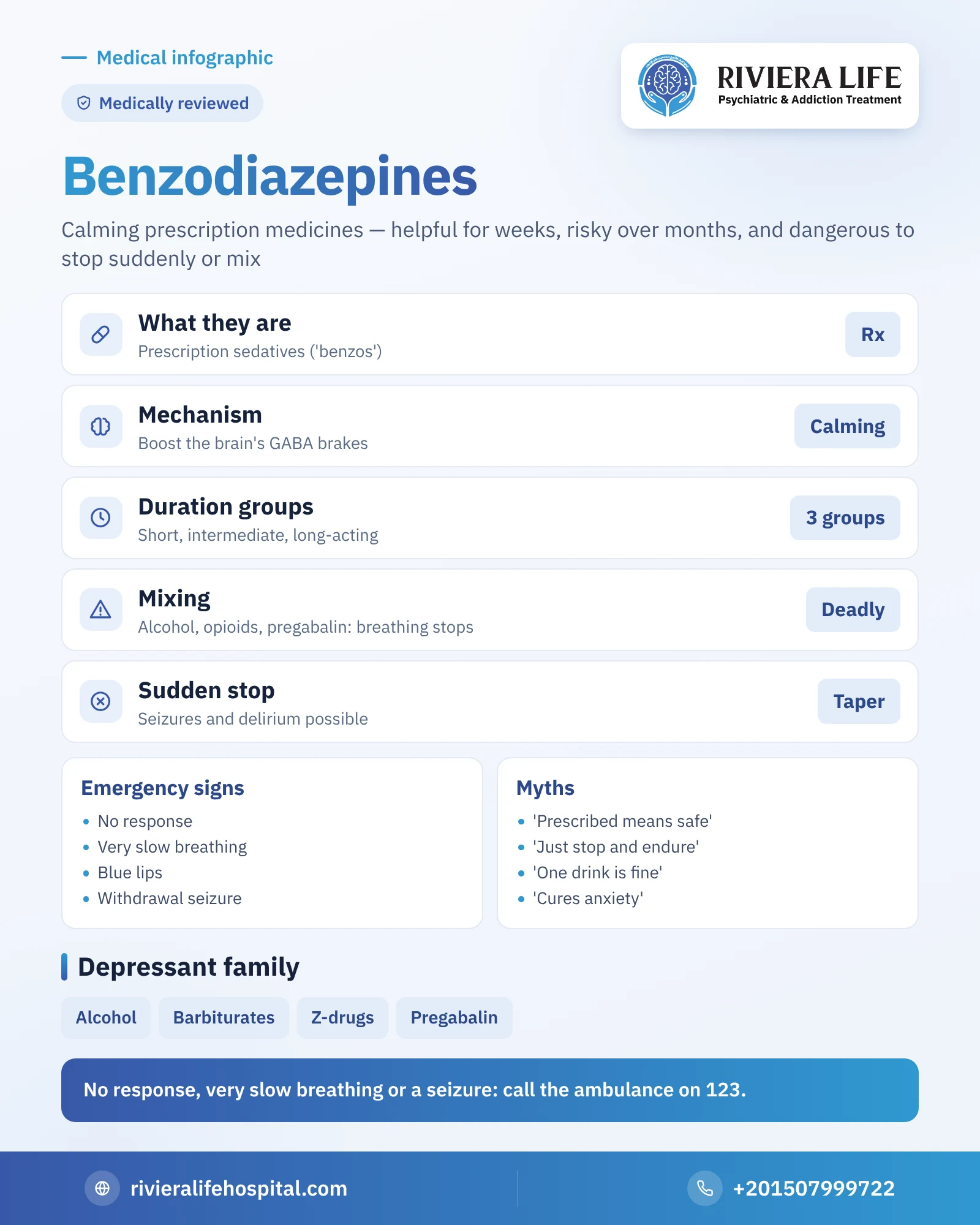
Benzodiazepines mostly come as tablets that are swallowed, and some are available as drops or injections used inside hospitals for emergencies such as continuous epileptic seizures. Doctors divide them according to the duration of their effect into three approximate groups:
| Group | Examples | What distinguishes it |
|---|---|---|
| Short-acting | Triazolam and midazolam | A fast effect that wears off within hours, and withdrawal that begins early |
| Intermediate-acting | Alprazolam, lorazepam and clonazepam | The most widespread in prescriptions and in misuse |
| Long-acting | Diazepam and chlordiazepoxide | Remain in the body for days, and are often used in gradual tapering plans |
Some who misuse them resort to crushing the tablets, taking several tablets at once, or mixing them with other substances to strengthen the effect. All of these methods raise the risk of overdose, especially when the person has taken an opioid painkiller or drunk alcohol beforehand.
What do benzodiazepines do in the brain and body?
In the brain there is a natural chemical called “GABA” that works as a brake on nerve activity, calming excess signals and helping with relaxation and sleep. Benzodiazepines don’t replace this substance, but bind to a special site on its receptors, making each molecule of GABA more effective. The result is a wide calming that covers the brain and muscles together:
- A reduction in anxiety and tension within a short time.
- Drowsiness and easier falling asleep.
- Muscle relaxation and a decline in seizures.
- Slow reactions and weakened balance and coordination.
- Gaps in memory, so the person may not remember what they did or said after taking the medicine.
With daily use the brain adapts to these extra brakes, reducing its sensitivity to them. The person needs a larger amount to get the same calm, and the anxiety or insomnia problem comes back stronger than it was if the tablet is late. This adaptation is what makes stopping suddenly dangerous: the brain that got used to the brakes suddenly loses them, so its nerve activity runs loose and may reach a seizure.
The medical use of benzodiazepines
These medicines have a legitimate and important place in medicine. Doctors prescribe them to treat acute anxiety and panic attacks, for severe insomnia for short periods, to stop emergency epileptic seizures, to manage alcohol withdrawal inside the hospital, to relax muscles, and for sedation before some operations and endoscopies. But modern medical guidelines generally recommend that their use be short, within two to four weeks in most cases, with a clear plan for gradual stopping, and that anxiety and insomnia be treated in the long term by other means that don’t cause dependence. Any change in the dose or stopping of the medicine is a decision the doctor makes, not the patient alone.
Why are benzodiazepines dangerous?
Their danger doesn’t come from their apparent strength, but from their calm. They seem safe, are dispensed from the pharmacy, and don’t cause the loud euphoria people expect from “drugs”, which is why attention to the problem comes late:
- Dependence may form after weeks of regular use, even at the prescribed dose.
- Withdrawal from them is among the few types of withdrawal that may threaten life, because of seizures and delirium.
- Mixing them with alcohol, opioids, tramadol or pregabalin multiplies respiratory depression, the best-known cause of the deaths linked to them.
- They weaken attention and balance, so car accidents, falls and fractures rise, especially in older adults.
- In some people they may cause paradoxical reactions such as agitation, impulsivity and loss of inhibition.
Benzodiazepines within the sedative family
Benzodiazepines belong to a wider group of nervous-system depressant substances, which includes alcohol, barbiturates and the modern sleeping medicines close to them in effect. Other substances widespread in Egypt, such as pregabalin, meet them in some of their effects despite its different mechanism. The common factor is sedation and respiratory depression in excess, which is why combining two substances from this group doesn’t add to the danger but multiplies it. Benzodiazepine withdrawal closely resembles alcohol withdrawal in the possibility of seizures and delirium, which explains why both need medical supervision. Xanax, the best-known member of the family, has its own guide starting from the article on Xanax addiction.
Benzodiazepines and the law in Egypt
Benzodiazepines in Egypt are subject to the system of controlled medicines, so they are only dispensed by medical prescription according to the controls of the schedules set by the health authorities, and selling, possessing or trafficking them outside this framework is treated as a violation punishable by law. On the other hand, the law deals flexibly with someone who comes forward on their own seeking treatment. For any legal question concerning a specific case it is preferable to consult a specialized lawyer, and the Fund for Drug Control and Treatment of Addiction provides a free hotline on 16023.
Sedatives and hypnotics: where do benzodiazepines fall?
People confuse sedatives and hypnotics, and the truth is that the difference is in the purpose more than in the substance. A sedative is prescribed to ease anxiety during the day, and a hypnotic is prescribed to help sleep at night, and the same substance may perform both functions depending on the dose and the time it is taken.
- Benzodiazepines: used as both sedatives and hypnotics, and the best known in Egypt.
- Sleeping medicines from outside the family: such as zolpidem, which resemble them in effect and in the risk of dependence.
- Barbiturates: the older, more dangerous generation, which benzodiazepines replaced, as the article on barbiturates: history and uses explains.
Many think a “hypnotic” is lighter than a “sedative” and doesn’t cause addiction. But dependence on sleeping pills is common when they are used for weeks without a plan, especially in older adults, and we have detailed it in sleeping pill addiction.
For a practical distinction: if you are taking a medicine that makes you drowsy during the day or makes you forget the events of the previous night, this is a signal to review it with the doctor, not to continue, even if the name on the box says “hypnotic” or “mild sedative”.
The safe rule is that any medicine that calms or puts you to sleep isn’t started or stopped without a doctor, and isn’t combined with alcohol or another depressant substance.
Other types of benzodiazepines and how they are classified
Besides the names known in pharmacies, there are other types whose use differs according to how long they stay in the body, and this classification matters to the doctor when choosing the medicine and when reducing it.
- Short-acting: such as midazolam, used in anesthesia and medical procedures, and temazepam for sleep.
- Intermediate-acting: such as oxazepam and nitrazepam.
- Long-acting: such as chlordiazepoxide, used medically in alcohol withdrawal, and clobazam for epilepsy.
The shorter the effect, the greater the risk of acute withdrawal on stopping, which is why it is sometimes replaced with a longer-acting type before being reduced gradually.
Classifying the type doesn’t mean the danger disappears with the longer-acting ones; they all cause tolerance and dependence with prolonged use, and all of them have their risks aggravated with alcohol or opioids.
The danger of a type isn’t measured by its trade name. Clonazepam, which circulates under several names, is clarified by the difference between Apetryl and Amotril, and the non-medical types in circulation are detailed in the articles on Valium addiction treatment and Rivotril addiction. Roche pills (flunitrazepam) have a separate article, Roche pills and the risk of memory loss.
The benzodiazepines guide: each aspect in a separate article
Benzodiazepines raise many questions, so we have given each question a separate article that explains it in detail:
- Benzodiazepine addiction symptoms: the signs the family sees, and when the prescribed medicine turns into addiction.
- Benzodiazepine withdrawal symptoms: when they begin, how long they last, and why stopping suddenly is forbidden.
- Benzodiazepine addiction treatment: assessment, gradual tapering, psychotherapy and the duration of each stage.
- Causes of benzodiazepine addiction: how it starts with a prescription, and who is most at risk.
- The harms of benzodiazepines: their effect on memory, mood, breathing and daily life.
- How long benzodiazepines stay in the body: how long urine, blood, saliva and hair tests detect them.
- Xanax addiction: what makes alprazolam in particular quick to cause dependence.
- Xanax addiction symptoms: the signs specific to Xanax misuse.
- Xanax withdrawal symptoms: the stages of withdrawal, its duration and its danger.
- Xanax addiction treatment: the treatment and rehabilitation plan, safely.
- Rivotril (clonazepam) addiction: Rivotril (clonazepam) addiction: the signs and the difference from Xanax
- Rivotril withdrawal symptoms: Rivotril withdrawal symptoms and why they are delayed
- Rivotril addiction treatment: treating Rivotril addiction with slow tapering
- Valium (diazepam) addiction treatment: treating Valium addiction and the danger of combining it with alcohol
Common myths about benzodiazepines
The myth: as long as the doctor prescribed it, I can’t become addicted to it. The truth is that physical dependence may happen at the prescribed dose itself if the duration is long, which is why a good prescription sets the duration of use and the stopping plan from the beginning.
The myth: it is enough to stop suddenly and endure a few hard days. The truth is that stopping suddenly after regular use may cause seizures or delirium, and the safe way is gradual reduction under medical supervision.
The myth: a sedative tablet with a glass of alcohol or a painkiller tablet does no harm. The truth is that this particular combination is behind many cases of breathing stopping, even in people who didn’t exceed their usual amounts.
The myth: benzos cure anxiety for good. The truth is that they calm the symptoms temporarily, and with long use they may make anxiety worse between doses. The lasting treatment of anxiety goes through psychotherapy and medicines that don’t cause dependence.
Suspect someone close to you is misusing sedatives?
Many families discover the problem by chance: empty strips in a desk drawer, prescriptions from more than one doctor, or unexplained drowsiness in the middle of the day. The first rule here is to stop yourself from the reaction that seems logical: don’t suddenly hide the tablets or get rid of them, because sudden discontinuation may be more dangerous than temporarily continuing.
Record what you have noticed, talk with them at a calm time about your worry for their health, not about your disappointment, and suggest visiting a psychiatrist to review all their medicines. And if they mix the sedative with alcohol or painkillers, this alone is reason enough to hurry the assessment. You will find the signs in detail in the article on benzodiazepine addiction symptoms.
Emergencies that can’t wait
Call the ambulance on 123 immediately if any of these appear
Whether after a large dose or mixing with another substance, or while stopping the medicine.
- Deep drowsiness and no response to being called or to firm touch
- Weak, extremely slow or irregular breathing, or unusual snoring
- Bluish lips or fingertips
- A seizure during or after stopping the medicine
- Severe confusion, hallucinations or not knowing the place and time
Until the ambulance arrives, put the person on their side if they are unconscious and breathing, move hard objects away from them if they have a seizure without putting anything in their mouth, and don’t give them any medicine or drink to wake them. And take the strips of the medicines they took with you, as knowing the mixed substances saves the medical team precious time.
When should you ask for help?
If use of the sedative has gone beyond the period the doctor set, or the person has started increasing the dose themselves, seeking prescriptions from more than one place, or can’t sleep or leave the house without it, this is a suitable time for an assessment. Stopping benzodiazepines is possible and safe when done with a gradual plan set by a specialist, and fraught with risk when done by a sudden decision. At Riviera Life, a team of consultants in psychiatry and addiction treatment reviews the case in complete confidentiality, and determines whether the tapering needs admission under round-the-clock supervision or can be done with outpatient follow-up.
Medical sources and referencesThe information in this article is based on reliable scientific sources
1StatPearls — Benzodiazepines (NCBI Bookshelf)ncbi.nlm.nih.gov2StatPearls — Benzodiazepine Toxicity (NCBI Bookshelf)ncbi.nlm.nih.gov3NIDA — Prescription CNS Depressants DrugFactsnida.nih.gov4MedlinePlus — Diazepam: warnings on dependence, withdrawal and mixingmedlineplus.gov5WHO — Withdrawal Management (NCBI Bookshelf)ncbi.nlm.nih.gov