The short answer
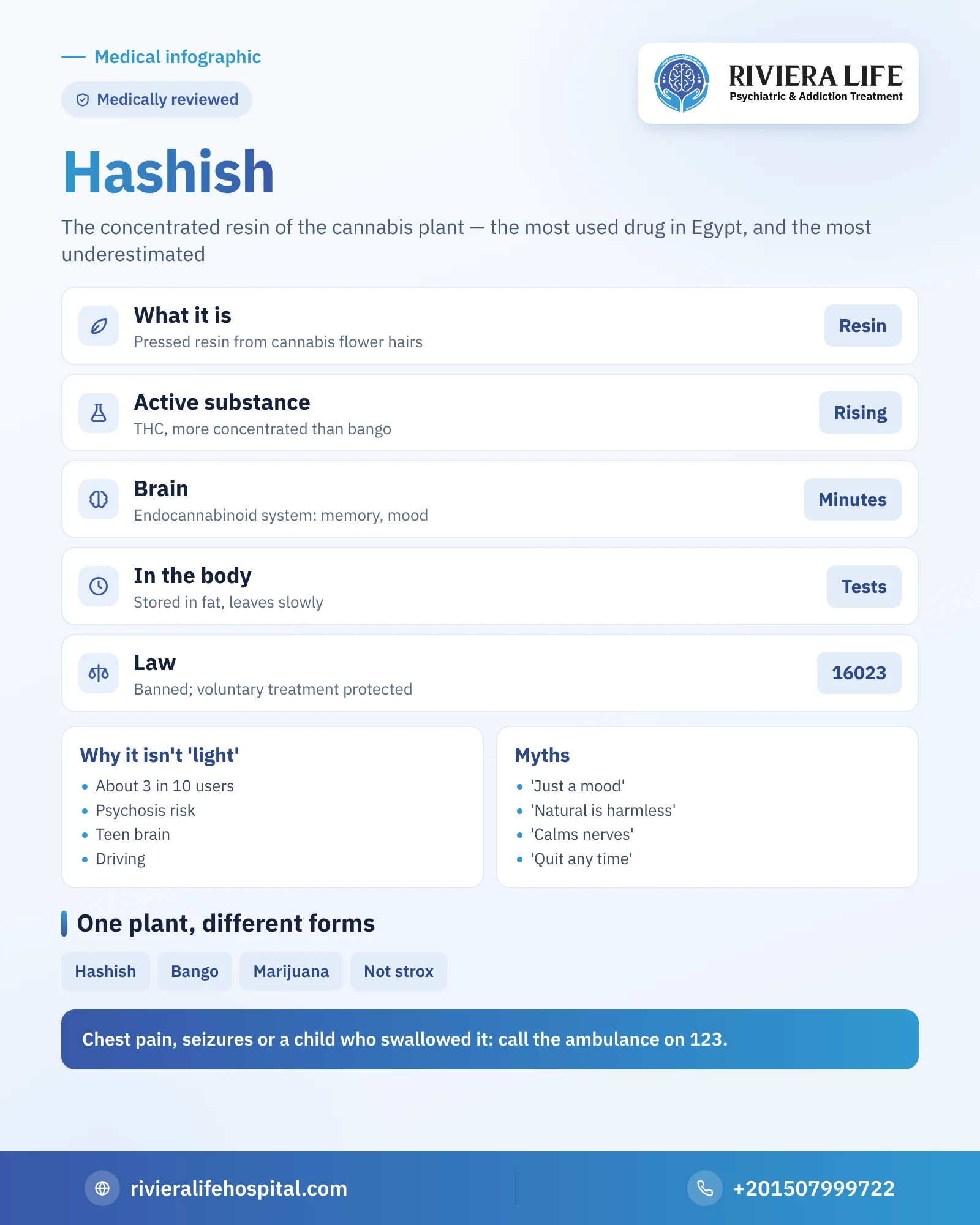
Hashish is the gummy substance secreted by the tiny hairs on the flowers of the cannabis plant, collected and pressed into pieces whose color ranges from light brown to black. Its active substance is tetrahydrocannabinol (THC), its concentration is much higher than bango, and it has risen in recent decades. Its types on the market are hard pressed pieces, a soft dark paste, and powders of unknown composition. It isn’t a “light drug”: it causes addiction in a proportion of users, is linked to anxiety and psychosis, and Egyptian law punishes its possession and use.
- Active substanceTHC
- Difference from bangoConcentrated resin, not leaves
- Does it cause addiction?Yes, in a proportion of users
Hashish is the most used drug in Egypt, and also the most underestimated. Many deal with it as if it were a passing “mood” at a gathering of friends, not a substance that changes the chemistry of the brain and may end in real addiction. Hashish is originally the sticky resin extracted from the cannabis plant, pressed into dark pieces, and the concentration of the active substance in it is usually higher than in the leaves of the plant itself. This page is the entry point to everything the Riviera Life team publishes about hashish: what it is, how it affects you, and why some people become addicted to it, followed by detailed links for every aspect from symptoms to treatment.
What is hashish?
The cannabis plant produces tiny shiny hairs on its female flowers that secrete a gummy substance, and this substance carries the highest concentration of active compounds in the whole plant. When these secretions are collected and pressed with heat or pressure, they turn into a cohesive lump whose color ranges from light brown to black, and this lump is hashish.
The compound responsible for the psychological effect is called tetrahydrocannabinol, abbreviated worldwide as (THC). Besides it, the resin contains other compounds, the best known being cannabidiol (CBD), which doesn’t cause euphoria. What distinguishes hashish from other forms of cannabis is concentration: a small piece of it carries as much active substance as a much larger amount of dried leaves, and this concentration has clearly risen in recent decades with changing methods of cultivation and production.
Names of hashish circulating in Egypt
The word “hashish” itself is the best known, but the Egyptian street has invented a whole dictionary around it. Parents sometimes hear it called “el-keif”, “el-mazag” (the mood) or “el-haga” (the thing), and its amounts are described with names such as “el-sobaa” (the finger) and “el-tarba” according to the size of the piece. The word “goza” is used to refer to the traditional device it is smoked with, and “rolled cigarette” or “laff” for cigarettes in which it is mixed with tobacco. Outside Egypt the names change; in the Maghreb, for example, it is known as “zatla”. Knowing these words doesn’t mean that whoever repeats them is using, as some have become part of the language of films and songs, but they help the family understand what it hears on the phone or reads in their children’s messages.
Forms of hashish and ways of using it
Hashish appears on the illegal market in more than one form:
- Hard pressed pieces, brown or dark, that crumble when heated, the most widespread form in Egypt.
- A soft, sticky paste tending towards black, shaped with the fingers.
- Light-colored powders or pieces sold under different names, whose composition is hard to know.
The most common methods of use in Egypt are smoking after heating a small piece and mixing it with cigarette tobacco then rolling it, or smoking it in the goza and shisha. In some circles eating is widespread, by adding hashish to sweets or drinks, a deceptive method because the effect is delayed an hour or more then comes strong and long, so the person repeats the amount thinking it didn’t work. Also, mixing it with tobacco means that a hashish user is usually exposed to the harms of nicotine and smoke together.
What does hashish do in the brain and body?
The brain has a natural network of receptors called the endocannabinoid system, which takes part in regulating memory, mood, appetite, sleep and the sensation of pain. The compound (THC) resembles in structure the substances that activate these receptors, but does so more strongly and for longer, so its effects appear within minutes of smoking:
- Relaxation, euphoria and laughter without a clear reason in some, and sudden anxiety or fear in others.
- A distorted sense of time and distances, and slow reactions.
- Weakness in short-term memory and concentration throughout the period of the effect.
- Red eyes, dry mouth and a noticeable increase in appetite.
- A faster heartbeat, which may be accompanied by dizziness on standing.
With repetition the number of active receptors decreases and their response weakens, so the person needs a larger amount for the same effect, and begins to feel distress, insomnia and irritability when they stop. This adaptation is the first seed of dependence. Because the substance dissolves in fats and is stored in them, it leaves the body slowly, which explains why its trace remains in tests longer than many other drugs.
Does hashish have any medical use?
The hashish circulating on the street isn’t a medicine and isn’t dispensed by prescription in Egypt. What is used medically in some countries is specific compounds, extracted or synthesized, at known doses, for particular conditions such as the severe nausea that accompanies chemotherapy or rare epileptic seizures in children. This difference is essential: a medicine’s concentration and purity are known and it is given under follow-up, while no one knows what is in a piece of hashish, how much active substance it carries, or what has been mixed with it. That is why talk of “the medical benefits of hashish” doesn’t justify using it in any way.
Why isn’t hashish a “light drug”?
It is true that hashish rarely causes direct death by overdose as happens with opioids, but the absence of this risk doesn’t make it safe. Its danger comes from other directions:
- Dependence: data from the US Centers for Disease Control and Prevention indicate that roughly three in ten users meet the criteria for cannabis use disorder.
- The mind: heavy use, especially at a young age and with high-concentration types, is linked to a higher risk of psychotic episodes and schizophrenia.
- Age: the brain continues to mature until the mid-twenties, and early onset doubles the risk of addiction and affects learning and memory.
- The road: driving under its influence slows reactions and weakens the judgment of distances.
- Life: decline in studies and work, loss of motivation and isolation are among the things families complain of most.
Types of hashish: how is it classified and what changes from one type to another?
Someone searching for the types of hashish usually wants to know one thing: are some of them lighter than others? The classifications circulating among sellers are based on color, texture and claimed origin, and have no medical basis. Medicine looks at only two criteria: the proportion of the active substance (tetrahydrocannabinol, abbreviated THC), and the foreign substances added to the piece.
These are the most common ways of classification and what they actually mean:
- By manufacture: traditional pressed resin, and cannabis concentrates such as oils and waxes, the latter of which may carry several times the active substance found in ordinary hashish.
- By claimed origin: names such as “Moroccan” and “Lebanese” work as a street brand, and neither buyer nor family can verify them.
- By color and smell: they don’t indicate purity, as a poor piece is colored and perfumed to resemble the more expensive one.
- By adulteration: pieces mixed with wax, henna or plant residues, and sometimes ground medicinal substances unknown to the user.
The practical conclusion is that none of them can be described as safe. A piece that seems weak may be stronger than its owner thinks, and one that seems pure may carry impurities that strain the lungs. You will find the comparison between hashish and its two relatives in the article on the difference between hashish and marijuana, and the article on the harms of hashish to the brain, heart and body explains what awaits the user whatever the type.
Hashish, bango and marijuana: one plant, different forms
The three names are often mixed up, because they all come from the cannabis plant. The difference is in the part used and the method of preparation. Hashish is the pressed resin, usually the most concentrated of the three. Bango is the Egyptian name for the plant’s dried leaves and flowers in their coarse form, and it is usually weaker in concentration and cheaper.
Marijuana is the international name for the dried flowers, and may be applied to high-concentration varieties coming from outside Egypt. Despite the different forms the principle remains the same: the same active substance, the same receptors, and the same risk of addiction. What is called synthetic cannabis, such as strox and spice, differs from all of this; these are synthetic chemicals that are much stronger and more dangerous, and have nothing to do with the plant except in name.
Hashish and the law in Egypt
In Egyptian law hashish is a banned narcotic substance, and the anti-narcotics law punishes its possession, use and trafficking, with the penalty becoming harsher the more the incident leans towards trafficking. The social spread of hashish changes nothing in its legal status, a fact many young people overlook. On the other hand, the law protects someone who comes forward on their own seeking treatment, as no criminal case is brought against a user who seeks treatment of their own accord. The Fund for Drug Control and Treatment of Addiction provides a free, confidential hotline on 16023, and for any legal question concerning a specific case it is preferable to consult a specialized lawyer.
The hashish guide: each aspect in a separate article
In the following articles you will find a detailed answer to each question about hashish separately:
Hashish addiction symptoms
The physical, psychological and behavioral signs the family notices, and the difference between a passing experiment and addiction.
Causes of hashish addiction
Why “smoking with friends” turns into dependence in some people and not others, and what the risk factors are.
The harms of hashish
Its effect on the brain, memory, heart, lungs, mental health and working life.
Hashish withdrawal symptoms
What happens after stopping, when the symptoms begin and end, and when medical intervention is needed.
How long hashish stays in the body
How long it shows in urine, blood, saliva and hair tests, and why the duration differs from person to person.
Hashish addiction treatment
The stages of treatment, proven psychological therapies, the expected duration and how to choose a hospital.
How to deal with a hashish addict
Practical steps for the family to start the conversation and convince him to get treatment without confrontation.
The behavior of a hashish user
The daily changes in behavior and habits that reveal use.
What does a hashish user hate?
Why he rejects advice and supervision, and how to understand his reactions.
The hashish addict and suspicion
The suspicion and paranoia linked to use, and when they are a sign of a psychiatric disorder.
Hashish and sex
Its effect on desire, performance and fertility in men and women.
When does the body return to normal after quitting hashish?
The stages of physical and mental recovery after stopping, and what improves first.
Widespread myths about hashish in Egypt
The myth: hashish isn’t a drug, “it’s just a mood” and everyone smokes it. The truth is that the spread of something doesn’t change its nature. Hashish is a substance that affects the brain, a considerable proportion of those who use it regularly become addicted to it, and the law treats it as a drug.
The myth: hashish is a natural plant, and what is natural doesn’t harm. The truth is that many toxins are natural, and the high concentration of the active substance in the resin is what makes its effect strong, in addition to the possibility of it being adulterated with other substances.
The myth: hashish calms the nerves and treats anxiety and insomnia. The truth is that it may ease tension temporarily, but repeated use increases anxiety and insomnia in the longer term, and sometimes hides a psychiatric disorder that needs real treatment.
The myth: someone who smokes hashish can quit whenever they want because it “doesn’t cause addiction”. The truth is that withdrawal really happens, with insomnia, irritability and loss of appetite, and these symptoms in particular are what bring many back to the cigarette.
The myth: hashish improves sexual performance. The truth is that research links chronic use with problems in desire, performance and fertility, and the details are in the article on hashish and sex.
Found out your son smokes hashish? Start here
Many families discover the matter from a strange smell in the room, a rolled piece in a trouser pocket, or a message on the phone. The first reaction is usually anger or shock, and this is understandable, but what you do in the following days matters more than the first moment. Don’t start with threats or by exposing the matter in front of relatives, and don’t assume that “just a cigarette” doesn’t deserve attention.
Write down what you have noticed and its dates, choose a calm time when your son is fully conscious, and talk about your worry for his health and future, not about what people will say. Ask him about the pressures he is going through, as many start looking to escape from something. Then ask for a specialized assessment even if he refuses at first, as the family itself needs guidance. You will find detailed steps in the guide on how to deal with a hashish addict.
When does a hashish user need the emergency room?
Emergencies with hashish are fewer than with others, but they happen, especially with large amounts, eating it, or mixing it with alcohol and pills, or when there is heart disease.
Call the ambulance on 123 immediately if any of these appear
These signs aren’t treated by waiting for the effect to wear off.
- Chest pain or severe palpitations that don’t calm down
- Hallucinations or severe suspicion with aggressive behavior or an attempt at self-harm
- Seizures or loss of consciousness
- Repeated vomiting that doesn’t stop, with signs of dehydration
- A child who swallowed a piece of hashish or food containing it
- Slow breathing or deep drowsiness after mixing with alcohol or sedatives
Until the ambulance arrives, stay beside the person in a quiet, dimly lit place, talk to them in a low, reassuring voice, and don’t try to restrain them except to stop them hurting themselves. And if they lose consciousness while breathing, put them on their side.
When should you ask for help?
If hashish has become daily, or sleep has become impossible without it, or attempts to stop have failed, or irritability, suspicion and withdrawal from life have appeared, it is time for a medical assessment. Treating hashish addiction relies mainly on structured psychotherapy and addressing the accompanying anxiety and depression, and succeeds more the earlier it begins. At Riviera Life, the hospital licensed by the Ministry of Health in Sheikh Zayed, the consultants in psychiatry and addiction treatment assess each case in complete confidentiality, and the first consultation is free on +201507999722.
Medical sources and referencesThe information in this article is based on reliable scientific sources