The short answer
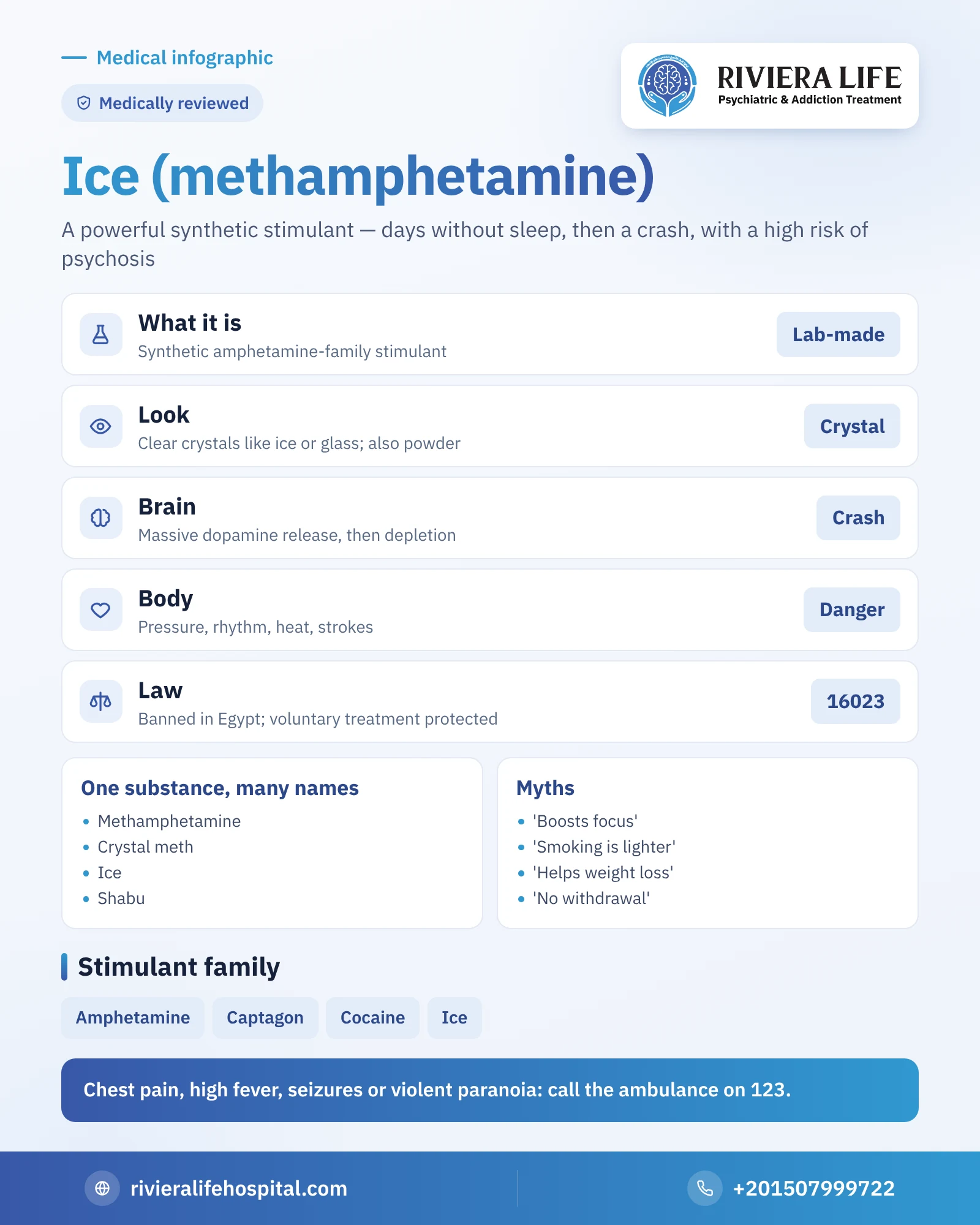
Ice, shabu and crystal meth are names for a single substance, methamphetamine, a powerful nervous-system stimulant that is manufactured chemically in illegal labs and isn’t extracted from any plant. It belongs to the amphetamine family, but crosses into the brain faster and stays longer, so its effect is stronger and longer than many stimulants. It usually appears as clear crystals resembling ice or glass that are smoked, and is linked to binges of staying awake for days followed by a crash, and to psychosis. It is banned in Egypt, and no preparation of it is dispensed.
- Scientific nameMethamphetamine
- Street namesIce, shabu, crystal
- Common formCrystals resembling ice
Questions about this substance reach us under different names: a mother asking about “ice”, a brother from the Gulf asking about “shabu”, a young man who read about “crystal meth” in a foreign series, and a doctor writing “methamphetamine” in the report. The truth is that the four names point to a single substance, a powerful synthetic stimulant that raises dopamine in the brain to levels it doesn’t know under natural conditions, then leaves it exhausted.
This page is the entry point to everything the Riviera Life team publishes about ice: what it is, why it has so many names, what it does to the brain and heart, and why it leads quickly to psychosis and addiction, followed by detailed links for every aspect from symptoms to treatment.
What is ice (methamphetamine)?
Ice is the common name for the substance methamphetamine, a central nervous system stimulant manufactured chemically in illegal labs, and not extracted from any plant. It belongs to the amphetamine family, and differs from amphetamine itself by the addition of a small chemical group that makes it cross into the brain faster and stay there longer. That is why its effect is stronger and longer than many other stimulants; a single effect may continue for long hours, while the effect of cocaine, for example, wears off within a much shorter time.
Because the substance is made in secret labs from available chemicals, no one knows precisely what is in the bag the user buys: not the degree of purity, not the remaining solvents, and not the substances added to increase the weight. This alone makes every dose a gamble.
Are ice, shabu and crystal meth the same substance?
Yes. The difference is in the name, not in the basic composition. Each name came from a different context:
- Methamphetamine: the scientific name of the substance, which is what is written in medical reports and confirmatory test results.
- Crystal meth: the short international name for the crystalline form of methamphetamine, which spread in Arabic through the media and foreign films.
- Ice: the English word for frozen water, describing the clear crystalline form that resembles pieces of ice or broken glass, which is the form usually smoked.
- Shabu: a street name of Asian origin, which spread in Southeast Asia, then reached the Gulf and from there Egypt.
Names of ice in Egypt and the Gulf
In Egypt the names “ice” and “crystal” dominate, “shabu” is used increasingly, and it may sometimes be described as “snow” or “glass” in reference to its crystalline form. In Saudi Arabia, Kuwait, the UAE and the rest of the Gulf countries “shabu” clearly dominates, and “ice” and “crystal” are also used. The important thing is that the family knows that the multitude of names doesn’t mean a difference in danger, and that the dealer may use a new name to sell the same substance as “lighter”.
It should also be pointed out that “strox” is an entirely different substance from the synthetic cannabinoid category, and that the “captagon” tablets in circulation usually contain amphetamine, not ice, even though they are from the same family. For the rest of the nicknames widespread among young people in the Kingdom, see drug names in Saudi Arabia and what they refer to.
Forms of ice and ways of using it
Methamphetamine appears on the illegal market in more than one form:
- Clear or bluish-white crystals resembling ice or glass, the form known as ice or crystal.
- A white or yellowish powder, usually less pure.
- Small colored tablets combining methamphetamine with caffeine, widespread in Asia under the name “yaba”.
The best-known method for ice is smoking, by heating the crystals in a glass device and inhaling the smoke, so it reaches the brain within seconds. It is also used by snorting, swallowing or injecting. The faster the method delivers the substance to the brain, the stronger the rush, the harder the fall after it, and the higher the desire to repeat. From here comes the “binge” pattern common with shabu: repeated use for days without sleep or food, then a long crash.
What does shabu do in the brain and body?
Methamphetamine enters nerve cells and forces them to empty their store of dopamine, along with noradrenaline and serotonin, then blocks the reuptake of these substances. The result is a wave of dopamine much higher than natural rewards such as food or success produce. This translates into:
- Strong euphoria, excessive self-confidence, rapid speech and excess activity.
- Long sleeplessness and loss of appetite that may continue for days.
- A racing heartbeat, raised blood pressure and body temperature, and dilated pupils.
- Repetitive purposeless movements, teeth grinding and tension of the jaw muscles.
- With large doses or long sleeplessness: suspicion, paranoia and hallucinations that may reach full psychosis.
With repetition the brain loses its ability to enjoy ordinary things, and imaging studies point to a decline in the dopamine system in long-term users, which may partially improve after months of stopping. This is what explains the depression and emptiness that push many to go back.
Does methamphetamine have a medical use?
In the United States there is a licensed medicine containing methamphetamine hydrochloride, prescribed in very limited cases of attention-deficit hyperactivity disorder at small, calculated doses, and it is rarely used. In Egypt, no preparation of methamphetamine is dispensed. The difference between the medicine and the ice in circulation is big: the first is a tablet with a known dose and guaranteed purity taken by mouth under supervision, and the second is crystals of unknown composition smoked or injected in much larger amounts.
Why is crystal meth among the most dangerous drugs?
- Psychosis: among the drugs most linked to episodes of paranoia, hallucinations and violence, and the psychosis may sometimes continue after stopping.
- The heart and vessels: raised blood pressure, rhythm disturbance, heart attacks and strokes, even in young people.
- Temperature: body temperature may rise to a degree that damages the muscles and kidneys.
- Rapid dependence: the strong euphoria is followed by a psychologically painful crash, so use is repeated quickly.
- The effect on life: sleeplessness, dropping out of work and study, debts and risky sexual behavior.
The details of these harms on each organ are in the article on the harms of ice.
Ice within the stimulant family
Methamphetamine belongs to the category of stimulants that includes amphetamine, cocaine and captagon. They all resemble each other in raising dopamine and noradrenaline, and in the symptoms of sleeplessness, activity and loss of appetite, and differ in the speed, duration and strength of the effect. Ice is the longest-acting of them and the strongest in its effect on the brain when compared with amphetamine at the same amount. To get to know the full picture of this family see the amphetamines page, for the detailed differences the article on the difference between methamphetamine and amphetamine, and for a wider comparison the cocaine and captagon pages.
Ice and the law in Egypt
Egypt’s anti-narcotics law lists methamphetamine among the banned narcotic substances, and punishes its possession, use, import and trafficking, with the penalty becoming harsher the more possession is linked to trafficking. On the other hand, no criminal case is brought against a user who comes forward on their own seeking treatment. This point reassures many families who hesitate out of fear of the consequences. For any inquiry about a specific case it is advisable to ask a specialized lawyer, and the Fund for Drug Control and Treatment of Addiction also provides a free, confidential hotline on 16023.
On 16 February 2026 the Supreme Constitutional Court ruled in case No. 33 of judicial year 47 that the decisions of the head of the Egyptian Drug Authority amending the narcotics schedules were unconstitutional, including decision No. 600 of 2023 that moved methamphetamine to a section with a harsher penalty, because the narcotics law gives the power to amend the schedules to the Minister of Health. After the ruling, talk spread saying that “ice and shabu are no longer drugs”, and this is incorrect; the ruling concerns the body competent to amend the schedules and the degree of severity, not making the substance permissible, and methamphetamine remained a criminalized narcotic substance. The following day the Minister of Health issued decision No. 44 of 2026 replacing the schedules annexed to the narcotics law. As for the effect of the ruling on previous cases or those pending before the courts, it is a matter for a lawyer to assess in each specific case.
The ice guide: each aspect in a separate article
We have divided the questions about ice into separate articles, each dealing with one of them at length:
- Ice addiction symptoms: the signs the family sees in the body, behavior and mood.
- Ice withdrawal symptoms: the stages of the crash after stopping, how many days they last, and when you need a doctor.
- How long ice stays in the body: how long shabu shows in urine, blood and hair, and the causes of a false result.
- The harms of ice: what crystal does to the heart, brain, teeth, skin and life.
- Causes of ice addiction: why some people fall into it faster than others, and the risk factors.
- Ice addiction treatment: the stages of treatment, medicines and behavioral therapy, and how to choose a hospital.
- Ice and sex: why it is linked to desire at first and then to weak performance and the risks of infection.
- How to deal with an ice addict: the family’s guide to dialogue, boundaries and acting in episodes of violence and psychosis.
- The difference between methamphetamine and amphetamine: the similarities and differences, and which is more dangerous.
Common myths about ice and shabu
The myth: ice increases focus and helps with studying or long work. The truth: it may give temporary wakefulness, but it destroys sleep and weakens memory and attention with repetition, and usually ends in a crash that wastes whole days.
The myth: smoking is lighter than injecting and doesn’t cause addiction. The truth: smoking crystal delivers it to the brain at a speed close to injecting, and it is the method most linked to rapid addiction.
The myth: shabu helps with slimming. The truth: the weight loss here is a sign of malnutrition and exhaustion, and comes with damage to the teeth and muscles and heart disturbance.
The myth: there is no withdrawal from ice, so it can be stopped easily. The truth: the withdrawal isn’t physically painful like opioids, but it brings deep depression and an intense craving that may continue for weeks, and this is what most often brings the person back to using.
Discovered someone close to you is using ice?
Start with calm, not with an explosion, especially if the person is under the influence or after days of sleeplessness, as here they are more prone to paranoia and irritability. Record the changes you have noticed with their dates, and choose a time to talk when they have slept and eaten. Talk about your fear for them, and avoid showy searching and threats. And if you notice pathological suspicion or talk about people watching them, don’t argue with their ideas, but ask for an urgent medical assessment. You will find detailed steps in the guide on how to deal with an ice addict.
Signs of ice poisoning and emergencies
Call the ambulance on 123 immediately if any of these appear
Stimulant poisoning may develop within hours, and waiting for the person to calm down on their own may cost them their life.
- Pressure or pain in the chest, or strong palpitations with a disturbed rhythm
- A severe rise in body temperature with hot skin and sweating or dryness
- Seizures or loss of consciousness
- Severe agitation, hallucinations, or threats to harm oneself or others
- Paralysis or weakness that suddenly appears in half of the body, or stumbling, incomprehensible speech
Until the ambulance arrives, move the person away from heat and noise, loosen their clothes, and talk to them in a calm voice without cornering or restraining them by force unless there is a direct danger. Don’t give them sleeping pills, alcohol or any other substance to calm them.
When should you ask for help?
Don’t wait for psychosis to appear or for work and study to collapse. Any repeated use of ice, binges of staying awake for days, or unusual suspicion and irritability deserves an early assessment. At Riviera Life, doctors specialized in psychiatry and addiction treatment assess the case confidentially and put in place a plan that suits it, between admission and outpatient follow-up, with a special program for the family.
Medical sources and referencesThe information in this article is based on reliable scientific sources
1NIDA — Methamphetamine: effects, risks and treatmentnida.nih.gov2MedlinePlus — Methamphetaminemedlineplus.gov3StatPearls — Methamphetamine: pharmacology, effects and complicationsncbi.nlm.nih.gov4StatPearls — Methamphetamine toxicityncbi.nlm.nih.gov5SAMHSA TIP 33 — How stimulants affect the brain and behaviorncbi.nlm.nih.gov