The short answer
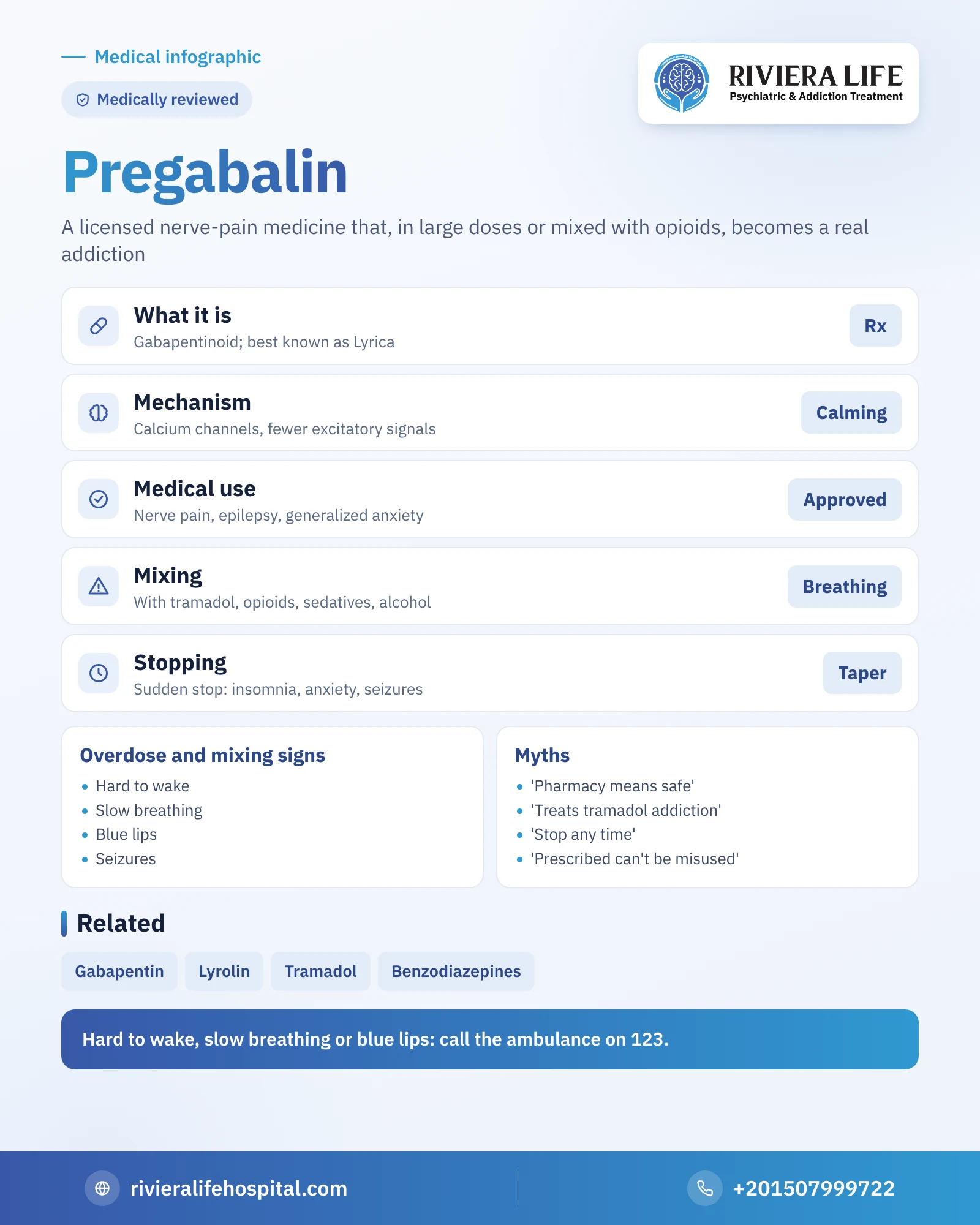
Pregabalin isn’t a drug in origin, but a licensed medicine known as “Lyrica” that is dispensed for nerve pain, some types of epilepsy and generalized anxiety disorder. But it is misused at large doses in search of a high, or mixed with tramadol and opioids, so it turns into a real addiction that may be accompanied by difficult withdrawal. That is why the health authorities in Egypt have subjected it to strict restrictions, so it is only dispensed with a medical prescription, and possessing or selling it outside this framework may expose a person to accountability.
- Is it a drug?A licensed medicine that is misused
- Best-known trade nameLyrica
- Dispensing in EgyptBy prescription, under strict controls
Pregabalin is a real medicine that doctors prescribe every day for nerve pain, epilepsy and generalized anxiety disorder, and this is exactly what makes it confusing for families. The strip a mother finds in her son’s drawer may be a sound prescription, or it may be the beginning of a dependence that is silently widening.
In Egypt its use outside medical supervision has spread widely, often with tramadol, hashish or sedatives, until it has become one of the medicines whose addiction cases are most often received at addiction treatment hospitals. This page is your entry point to everything the Riviera Life team has written about pregabalin: what it is, how it works, why it is misused, and when it becomes dangerous, followed by links to detailed articles covering each aspect separately.
What is pregabalin?
Pregabalin is a synthetic medicinal substance belonging to a group called “gabapentinoids”, the same group gabapentin belongs to. Its molecule was originally designed to resemble the neurotransmitter “GABA”, which is responsible for calming the activity of the nervous system, but the paradox is that it doesn’t act on GABA receptors themselves as many think. It binds to a tiny part of the calcium channels in nerve cells, reducing the amount of excitatory signals released by overactive nerves.
The medicine was launched on global markets in the middle of the first decade of this millennium under its best-known trade name, “Lyrica”, and after that many local trade names appeared containing the same active substance. It is usually dispensed as capsules, and sometimes as a syrup, and it hardly passes through the liver, but leaves the body unchanged in the urine, a piece of information we will need when talking about the kidneys and testing.
Is pregabalin a drug?
Pregabalin is a licensed medicine and not a banned drug like heroin or hashish, and it is dispensed by medical prescription for nerve pain, some types of epilepsy and generalized anxiety disorder. But in Egypt it is a medicine subject to strict dispensing restrictions after its misuse widened, so selling or possessing it outside a prescription may expose a person to accountability, as we explain in the section on pregabalin and the law in Egypt.
Medically, it can cause dependence and addiction when used in large amounts or mixed with tramadol and sedatives. A higher strength, such as 300 milligram capsules, doesn’t change the nature of the medicine, but it raises the risk when misused.
Names of pregabalin circulating in Egypt
Most people know it as “Lyrica”, after the original brand, until the name came to be applied to any capsule containing the substance. One of its best-known local trade names is “Lyrolin”, and it has a separate page on our site, the Lyrolin guide. Among its other local names is “Kemirica”. On the street the name is sometimes shortened to “el-prega”, or it is referred to by the capsule color and the strength written on the strip. The multiplicity of names isn’t a linguistic detail; a person may take two trade brands in one day without realizing they are doubling the same substance.
Forms of pregabalin and ways of misusing it
The usual medical form is a capsule swallowed at a dose the doctor sets. The pattern of misuse differs in several forms:
- Taking amounts far beyond what is prescribed, or repeating them during the day in search of a feeling of high and lightness.
- Getting it without a prescription, or from more than one doctor and pharmacy, or from another person.
- Mixing it with tramadol, opioids, hashish, alcohol or sedatives to strengthen their effect.
- Using it to ease withdrawal symptoms from another substance, so it turns from a “helper” into a second addiction.
Some users think pregabalin is lighter than drugs because it is sold in pharmacies. But the amount, the method and the mixing are what create the danger, not the place of purchase.
In the Gulf countries, smuggled capsules sold under the name “Indian Lyrica” are widespread; this is pregabalin of unknown origin and dose circulating outside any drug control, and we explain its reality and how it differs from the original medicine in the article on Indian Lyrica.
What does pregabalin do in the brain and body?
When pregabalin binds to calcium channels in the nerves, the amount of excitatory transmitters released, such as glutamate and noradrenaline, decreases. At therapeutic doses this translates into calmer nerve pain, a decline in tension and a reduced likelihood of seizures. But at large doses a different picture appears:
- A feeling of elation and relaxation that some users liken to the effect of alcohol.
- Dizziness, unsteady walking and slurred speech.
- Drowsiness, slowed thinking and weakened concentration and short-term memory.
- Blurred or double vision.
- Respiratory depression, especially when mixed with opioids or sedatives.
With repeated use of large amounts, the nervous system adapts to the presence of the medicine, so the person needs a higher amount for the same feeling, and stopping suddenly becomes troublesome and sometimes dangerous. Here physical dependence begins, and if it is accompanied by loss of control and continuing despite the harm, the matter becomes addiction in the medical sense.
The legitimate medical use of pregabalin
Pregabalin has a firm place in medicine, and it is unfair to describe it as a “drug” in all circumstances. It is approved for treating nerve pain resulting from diabetes, shingles or spinal cord injuries, as an add-on treatment for some types of partial seizures, and for generalized anxiety disorder in a number of countries, and it is also used in some countries for fibromyalgia pain.
A patient who takes it on prescription with follow-up rarely turns to addiction, though they may need gradual tapering on stopping. The real difference between treatment and misuse lies in three things: who set the amount, for what purpose, and whether there is follow-up. You will find the details of its relationship with anxiety in the article on pregabalin and anxiety.
The effect of pregabalin: when does it start and how long does it last?
Pregabalin is absorbed from the intestines quickly, and its concentration in the blood peaks about one to two hours after taking it. Its half-life in the body is about six hours in someone whose kidneys work normally, because the kidneys are what eliminate it. This explains why the patient feels drowsy and dizzy in the first hours in particular.
Two types of effect must be distinguished:
- The therapeutic effect: improvement in nerve pain or anxiety doesn’t appear after a single tablet, but usually needs days of regular use, and sometimes two weeks.
- The immediate effect: relaxation, dizziness and a heavy tongue appear quickly, which is what tempts some people to seek the “feeling” rather than the treatment.
The duration differs from person to person according to kidney function, age and other medicines. In someone with weak kidneys the medicine stays in the body longer, so the side effects become more severe and last longer. That is why no one should adjust the medicine themselves based on how they feel its effect.
If your question is about how long the substance stays in tests, the details are in the article on how long pregabalin stays in the body, and for the unwanted effects read the serious harms of pregabalin to body and mind.
Why does pregabalin become dangerous?
The danger of pregabalin comes together from several sources, no single one of which is enough on its own to explain it:
- Mixing: the most dangerous thing about it is that it multiplies respiratory depression when combined with opioids such as tramadol, heroin and methadone, or with sedatives and alcohol.
- Withdrawal: stopping suddenly after heavy use may cause insomnia and acute anxiety, and may reach seizures.
- A misleading reputation: because it is a medicine, people are late in admitting the problem and the family is late in asking for help.
- The effect on driving and work: dizziness and slow reactions raise the risk of accidents, a risk that exists even at doses lower than the user imagines.
- Mental state: antiepileptic medicines in general, including pregabalin, have been linked to a rare increase in suicidal thoughts that calls for monitoring.
Pregabalin within its medicine family
Pregabalin’s closest relative is gabapentin, which works by the same mechanism but whose absorption is slower and less regular, while pregabalin is absorbed quickly and almost completely, which makes its effect appear faster and more attractive to those who misuse it. The article on pregabalin and gabapentin explains the differences in detail. In terms of its effect on the nervous system, pregabalin stands close to sedatives, which is why it resembles benzodiazepines and alcohol in the risk of mixing, despite the different mechanism. Its relationship with tramadol is one of “companionship” on the Egyptian street more than scientific similarity, and you will find the full comparison in the difference between pregabalin and tramadol.
Pregabalin and the law in Egypt
Pregabalin isn’t a completely banned substance like heroin, as it is a licensed medicine. But the health authorities in Egypt have subjected it to strict dispensing restrictions after its misuse widened, so it is only dispensed with a medical prescription according to specific controls, and possessing or selling it outside this framework may expose a person to accountability. On the other hand, voluntarily seeking treatment remains a safe path, as Egyptian law generally distinguishes between someone who is caught and someone who comes forward on their own for treatment. For any legal question concerning a specific case it is best to consult a lawyer, and you can also contact the hotline of the Fund for Drug Control and Treatment of Addiction on 16023.
The pregabalin guide: each aspect in a separate article
We have divided the discussion of pregabalin into articles, each answering a single question without repeating the others:
Pregabalin addiction symptoms
The signs the family notices in walking, speech, sleep and behavior, and when use goes beyond the limits of the prescription.
Pregabalin withdrawal symptoms
The timeline of what follows the last dose, and why stopping suddenly is a danger that may reach seizures.
Pregabalin addiction treatment
The stages of treatment from assessment and gradual tapering to psychotherapy and relapse prevention, and how to choose a hospital.
How long pregabalin stays in the body
Does it show in a routine test? And its detection time in urine, blood, hair and saliva.
The harms of pregabalin
Its effect on the brain, eyes, weight, heart and breathing, and the serious effects that call for the doctor.
Indian Lyrica
The reality of the smuggled capsules widespread in the Gulf, how they differ from the original Lyrica, and the law’s position on them.
Causes of pregabalin addiction
Twelve factors that explain why a prescribed medicine turns into an addiction in some people and not others.
Pregabalin and gabapentin
The difference in mechanism, absorption, use and risk of misuse between the two medicines.
Pregabalin and pregnancy
What medicine knows about its effect on the fetus, and what a pregnant woman taking it should do.
The difference between pregabalin and captagon
A sedative versus a stimulant, and why combining them carries doubled risks.
The difference between pregabalin and tramadol
Which is stronger and which is more dangerous, and why they often come together in addiction cases in Egypt.
Pregabalin and alcohol
Why combining them is a danger to breathing and consciousness, and whether there is a safe amount.
Pregabalin and anxiety
When the doctor prescribes it for anxiety, and how dependence on it turns into a new source of anxiety.
Pregabalin and blood pressure
Does it raise or lower blood pressure, and what does a patient with high blood pressure need to know.
Lyrolin
A separate guide to one of the best-known trade names for pregabalin in Egypt, with its symptoms, harms and treatment.
Common myths about pregabalin
The myth: as long as it is dispensed from the pharmacy, it doesn’t cause addiction. The truth is that dependence on it is scientifically established, and that addiction is linked to the amount and the purpose of use, not to the source of the medicine.
The myth: pregabalin treats tramadol or heroin addiction. The truth is that using it without supervision to ease withdrawal often adds a second addiction, and raises the risk of respiratory depression on returning to the opioid.
The myth: it can be stopped suddenly because it isn’t a drug. The truth is that stopping suddenly after long or heavy use may cause severe symptoms, including seizures, which is why it is withdrawn gradually under medical supervision.
The myth: someone who takes it on prescription can’t misuse it. The truth is that some patients raise the amount on their own when the effect decreases, and this is a sign that deserves a review with the doctor, not hiding it.
Discovered someone close to you is misusing pregabalin?
Start with a simple question many overlook: do they have a prescription? If they do, the first step is a calm conversation with the treating doctor about what you have noticed. If they don’t, write down what you have seen: the number of strips, changes in walking and speech, sleeping at unusual times, and requests for money. Don’t confiscate all the medicine suddenly or force them to stop in one day, as sudden withdrawal may be dangerous for them. Choose a time when they are lucid, talk about your worry, not about shame, then ask for a specialized medical assessment even if they hesitate at first. The article on pregabalin addiction symptoms helps you organize your observations before the conversation.
Signs of pregabalin poisoning and the danger of mixing
Call the ambulance on 123 immediately if any of these appear
The greatest danger comes when pregabalin is mixed with tramadol, opioids, sedatives or alcohol.
- Severe drowsiness that makes it hard to wake the person
- Slow, weak or irregular breathing
- Bluish lips or extremities
- Seizures or involuntary movements
- Severe confusion, hallucinations or loss of consciousness
Until the ambulance arrives, don’t leave the person alone, and if they are unconscious and breathing, put them on their side. Tell the paramedics everything you know they took, and keep the empty strips because they save precious time in the emergency room.
When should you ask for help?
Ask for a specialized assessment if pregabalin has come to be taken without a prescription, in a higher amount than prescribed, or with other substances, or if an attempt to stop has failed because of insomnia and anxiety. An early assessment makes the withdrawal shorter and safer. At Riviera Life, a team of consultants in psychiatry and addiction treatment carries out this assessment in complete confidentiality, then determines whether the case needs admission under round-the-clock supervision or outpatient follow-up, involving the family from the start.
Medical sources and referencesThe information in this article is based on reliable scientific sources