The short answer
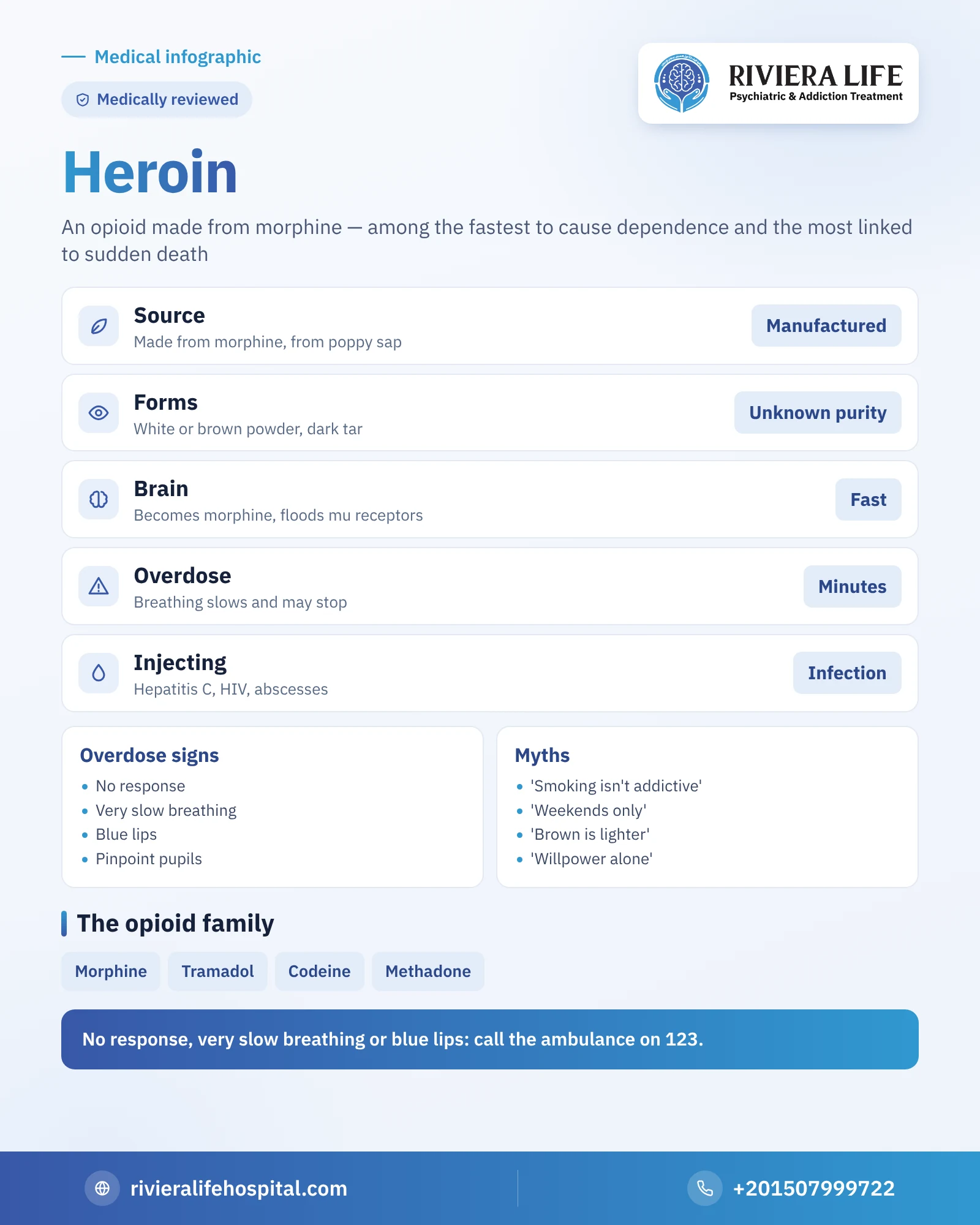
Heroin, which some spell “herowin”, is an opioid substance made chemically from morphine extracted from opium, that is, from the sap of the poppy plant, so it isn’t a plant but a manufactured product. Its scientific name is diacetylmorphine, and it is known in Egypt as “el-bodra” (the powder). It appears as a white or brown powder, and is used by injecting, smoking or snorting, and all methods lead to addiction. Its greatest danger is an overdose that slows breathing until it stops, and it is banned in Egypt without any medical use.
- Popular name“The powder”
- SourceMade from morphine
- Greatest dangerOverdose and breathing stopping
Few drugs carry heroin’s reputation, and few deserve it to the same degree. It is among the substances fastest at causing dependence, and the most linked to sudden death from overdose. Even so, many people, including the families of users, know nothing about it beyond its colloquial name, “the powder”. This page is the entry point to everything the Riviera Life team publishes about heroin: what it is, where it comes from, what it does to the brain, and why it is hard to stop, followed by detailed links to each of its aspects, from symptoms to treatment.
Some spell its name “herowin”.
What is heroin?
Heroin is an opioid substance made chemically from morphine, and morphine itself is extracted from opium, the milky sap collected from the pod of the poppy plant. That is, heroin isn’t a plant or a natural sap, but the product of a manufacturing process that adds two chemical groups to the morphine molecule, making it dissolve in fats more easily, so it crosses into the brain much faster than morphine itself. Its scientific name is diacetylmorphine.
The world first came to know heroin in the late nineteenth century, when it was launched as a cough medicine and an alternative thought to be safer than morphine. Within a few years the opposite became clear, as it turned out to cause more severe and faster addiction, so its medical use was gradually banned until today it is prohibited in most countries of the world, including Egypt, and isn’t dispensed on any prescription.
Names of heroin circulating in Egypt
The best-known name for heroin on the Egyptian street is “el-bodra” (the powder), after its powdered form. You may also hear names according to color, such as white or brown powder, and in some areas the word “el-bisa” is applied to cheap mixes of unknown composition sold as heroin. The problem is that the word “powder” doesn’t identify a particular substance, as it may sometimes be used to refer to cocaine or other powders. That is why the name alone can’t be relied on to know what the person actually took, which is what medical assessment and testing reveal.
Forms of heroin and ways of using it
The form of heroin differs according to how it is manufactured and how much foreign material is added to it:
- A fine white powder, usually the purest and most expensive.
- A brown or gray powder, less pure and usually containing impurities and cutting agents.
- A dark, sticky or hard substance resembling tar, widespread in certain regions of the world.
Heroin is used by injecting into a vein, by smoking and inhaling the smoke rising when it is heated, or by snorting through the nose. Some users believe smoking or snorting is “lighter” than injecting, and this belief is wrong. It is true that injecting adds the risks of infection and vein damage, but all methods lead to addiction, and all may end in an overdose.
More dangerous than its form is what can’t be seen in it. The heroin circulating on the illegal market has an unknown real concentration, and may be mixed with other substances, including synthetic opioids much stronger than it, such as fentanyl in some countries. This means the same amount may be relatively safe one time and deadly the next.
What does heroin do in the brain and body?
As soon as it reaches the brain heroin turns into morphine, binding to a type of receptor called the “mu” opioid receptor. These receptors are naturally responsible for easing pain and the feeling of comfort, and usually respond to small amounts of substances the body itself releases. Heroin floods them with an amount the body doesn’t know in normal conditions, so a chain of effects occurs:
- A fast rush of euphoria and warmth within seconds or minutes, depending on the method of use.
- Heaviness in the limbs, dry mouth and flushed skin.
- A state of drowsiness, swinging between wakefulness and dozing for several hours.
- Slowed thinking and severe narrowing of the pupils.
- And the most dangerous: depression of the breathing center in the brainstem, so breathing slows and may stop.
With repetition the brain adapts to this large amount, so its response to it decreases, and the person needs higher doses to get the same effect, which is called tolerance. At the same time their sense of pleasure in ordinary things decreases, because the brain’s reward system has become used to a much stronger stimulus. Here use gradually shifts from seeking euphoria to trying to avoid the pain and distress that appear when the substance is absent.
Does heroin have any medical use?
In Egypt and most Arab countries there is no medical use for heroin, and it isn’t dispensed on prescription. But the picture differs in a limited number of countries. In the United Kingdom, the pure pharmaceutical form of the substance, called diamorphine, is used inside hospitals to relieve severe pain such as that of heart attacks or advanced cases of cancer.
Some European countries also run strictly controlled treatment programs in which the substance is given to a limited number of patients for whom other treatments haven’t worked. This use doesn’t mean the substance is safe; it is done at calculated doses, with known purity and under direct medical supervision, three things that are never available in the heroin circulating on the street.
The “powder” drug: is every “powder” heroin?
Parents hear the word “powder” in calls and messages and assume it is heroin. The assumption is sometimes close to correct, but it isn’t guaranteed. The word describes the form of the substance, a fine powder, and doesn’t identify its type. Under this one name there may be heroin, cocaine or a mix of unknown composition.
The importance of this distinction shows in three points:
- A difference in danger: heroin is a depressant that slows breathing, while cocaine is a stimulant that strains the heart, and each needs different emergency care in poisoning.
- Adulteration: the powder sold on the illegal market is usually mixed with other substances, some of which may be much stronger than heroin itself.
- Mixing substances: some users combine more than one powder in a single session, so the symptoms are hard to read.
That is why the family shouldn’t try to identify the substance by guessing. It is better to describe to the doctor what you have noticed, and for a medical assessment and test to be carried out that actually identifies the substance. If the doubt is between heroin and cocaine, the article on the difference between cocaine and heroin explains how the signs of each differ, and the article on heroin addiction symptoms details what the family can notice.
Why is heroin among the most dangerous drugs?
Heroin’s danger doesn’t come from a single reason, but from several reasons coming together in a single substance:
- Speed of dependence: signs of physical dependence may appear after a few weeks of regular use.
- Overdose: the gap between the dose the person is used to and the dose that depresses breathing may be narrow, especially when the purity of the substance is unknown or it is mixed with sedatives or alcohol.
- Difficult withdrawal: withdrawal symptoms are physically and psychologically painful, and are among the strongest reasons for going back to using.
- Infection: sharing injecting equipment transmits hepatitis C and HIV, and causes abscesses and infections of the heart.
- The social impact: use consumes money, time and relationships, and is often linked to legal problems and losing work.
Heroin within the opioid family
Heroin belongs to a large family that includes medicines with a legitimate medical use, such as morphine, tramadol, codeine and methadone, as well as illegal substances. What unites them all is that they act on the same opioid receptors, so they resemble each other in their ability to relieve pain and in the risk of dependence and overdose, and differ in their strength and the speed and duration of their effect. Heroin is among the fastest of them to reach the brain and the shortest-acting, which is why it is used several times a day and its withdrawal symptoms appear quickly. You can see the full picture of this family on the opioids page, and the differences between heroin and a stimulant such as cocaine in the article on the difference between cocaine and heroin.
Heroin and the law in Egypt
Egypt’s anti-narcotics law classifies heroin among the banned narcotic substances, and punishes its possession, use and trafficking with severe penalties that increase with trafficking. On the other hand, the law distinguishes between someone who is caught and someone who seeks treatment on their own, as no criminal case is brought against a user who comes forward of their own accord for treatment. This point matters to many families who postpone asking for help out of fear of the legal consequences. For any legal inquiry specific to a particular case it is preferable to consult a specialized lawyer, and the Fund for Drug Control and Treatment of Addiction also provides a free, confidential hotline on 16023.
The heroin guide: each aspect in a separate article
In the following links we have gathered the details of each aspect of heroin, so that each article answers a single question in depth without repetition:
Heroin addiction symptoms
The physical, behavioral and psychological signs the family may notice, and when use counts as addiction according to medical criteria.
Heroin withdrawal symptoms
What happens after the last dose, when the symptoms begin and peak, and the danger signs that call for the emergency room.
Heroin addiction treatment
The stages of treatment from assessment and detox to approved medicines, psychotherapy and relapse prevention.
Causes of heroin addiction
Why some people become addicted faster than others, and the role of genetics, trauma, psychiatric disorders and opioid painkillers.
The harms of heroin
What heroin does to the heart, lungs, liver and brain in the short and long term, and the harms of injecting and mixing.
How long heroin stays in the body
How long heroin shows in urine, blood, saliva and hair tests, and what affects the result.
How to deal with a heroin addict
A practical guide for the family: how to start the conversation, what helps, and what makes things worse.
Heroin and sex
The effect of heroin on desire, performance, fertility and hormones, and what improves after stopping.
Opioids in numbers
World Health Organization data indicate that about 600,000 deaths around the world in 2019 were linked to drug use, and that nearly 80% of them were linked to opioids, including heroin. About a quarter of these opioid-related deaths were directly caused by overdose. These figures explain why doctors treat any heroin use as a case that deserves rapid intervention, and why modern treatment programs focus first on protecting the patient’s life, then on long-term recovery.
Common myths about heroin
The myth: smoking or snorting heroin doesn’t cause addiction; only injecting is dangerous. The truth is that the method of use changes the speed of the effect and some of the risks, but it doesn’t prevent dependence or overdose.
The myth: someone who only uses at weekends won’t become addicted. The truth is that intermittent use may be more dangerous in terms of overdose, because tolerance falls between the times, so the person keeps using the same amount with a body that can no longer tolerate it.
The myth: brown or “natural” heroin is lighter than white. The truth is that the color reflects the method of manufacture and the impurities, and doesn’t indicate safety. In fact the impurities themselves may add new harms.
The myth: an addict can stop whenever they want if they have strong willpower. The truth is that opioid addiction is a medical condition that changes the functions of the brain, and the best results are achieved with organized treatment that combines medicine and psychological support, not with willpower alone.
Discovered someone close to you is using heroin?
The first thing you need at this moment is calm, not a sharp confrontation. Start by gathering your observations precisely: what you saw, when, and what changes have come over their behavior. Choose a time when the person is conscious and not under the influence of the substance, and talk about your worry for them, not about your shame at them.
Avoid threats, constant searching and cutting off pocket money suddenly without a plan, because they often push towards hiding rather than treatment. Then contact a medical provider to assess the case, even before the person themselves agrees, as the family needs support and guidance too. You will find detailed steps for this stage in the guide on how to deal with a heroin addict.
Signs of a heroin overdose
Call the ambulance on 123 immediately if you notice
An overdose is an emergency that threatens life within minutes, so don’t wait for the person to come round on their own.
- No response to being called or to firm touch
- Extremely slow or irregular breaths, or unusual snoring
- Bluish lips or fingertips
- Very narrow pupils, like a pinpoint
- Cold skin and a pale face
Until the ambulance arrives, try to keep the person awake and talk to them, and if they are unconscious but breathing, put them on their side so they don’t choke if they vomit. Don’t put them in cold water or give them any other substance to wake them. If naloxone is available with a medical team or the ambulance, it is the medicine that temporarily reverses the effect of opioids, but it is no substitute for taking the patient to hospital.
When should you ask for help?
Any heroin use, even if it seems small or intermittent, deserves an early medical assessment. The earlier treatment starts before dependence deepens, the better the chances of recovery and the fewer the complications. At Riviera Life, a team specialized in psychiatry and addiction treatment assesses the case in complete confidentiality, and puts in place a plan that suits it, whether full admission or outpatient follow-up.
Medical sources and referencesThe information in this article is based on reliable scientific sources
1NIDA — Research report on heroin: its nature, effect and treatmentnida.nih.gov2WHO — Opioid overdose fact sheet (deaths, danger signs and naloxone)who.int3MedlinePlus — Heroin use and its symptomsmedlineplus.gov4NHS — Help with heroin addictionnhs.uk5StatPearls — Heroin toxicity: mechanism, signs and managementncbi.nlm.nih.gov