Anxiety in itself is not an illness; it is an alarm system that protects us, raising our attention before an exam, a job interview or crossing a busy road. The problem begins when this alarm goes off with no fire: fear out of proportion to the situation, or that lasts for weeks and months, or that drives the person to avoid places and people until their life narrows.
Then doctors talk about “anxiety disorders”, the most widespread mental disorders in the world, and among those that respond best to treatment. This page is your gateway to everything the Riviera Life team publishes about anxiety: what it is, its types, its symptoms and causes in brief, how it is diagnosed and treated, then links to detailed articles on each aspect.
What is anxiety? And when does it become a disorder?
Anxiety is a natural response in which the mind and body take part together when danger or something uncertain is expected. The heart speeds up slightly, the muscles tense, and the mind becomes busy with possible scenarios. This response is useful when it is temporary and linked to a clear cause, and it calms down when the cause goes away.
The difference between normal anxiety and an anxiety disorder
Doctors consider that anxiety has gone beyond its normal limits when several features come together: that it is much stronger than the situation calls for, that it lasts a long time, often six months or more in some types, and that it causes clear distress or disrupts study, work or relationships. A student who gets tense the night before an exam, then sleeps and performs well, is experiencing normal anxiety. But a student who misses the whole exam because just thinking about it makes her tremble and feel sick, and does so time after time, needs a specialist assessment.
How common are anxiety disorders?
The World Health Organization estimates that anxiety disorders affected about 470 million people around the world in 2023, nearly 6% of the world’s population, making them the most common mental disorders. They affect women more than men, and in many cases their symptoms begin in childhood or adolescence. Strikingly, only roughly one in every four people with them receives treatment, despite effective treatments being available. In Egypt and the Arab world, stigma widens this gap, and many people move for years between cardiologists and internists looking for the cause of palpitations or shortness of breath, without it occurring to them that anxiety is the root.
Types of anxiety disorders
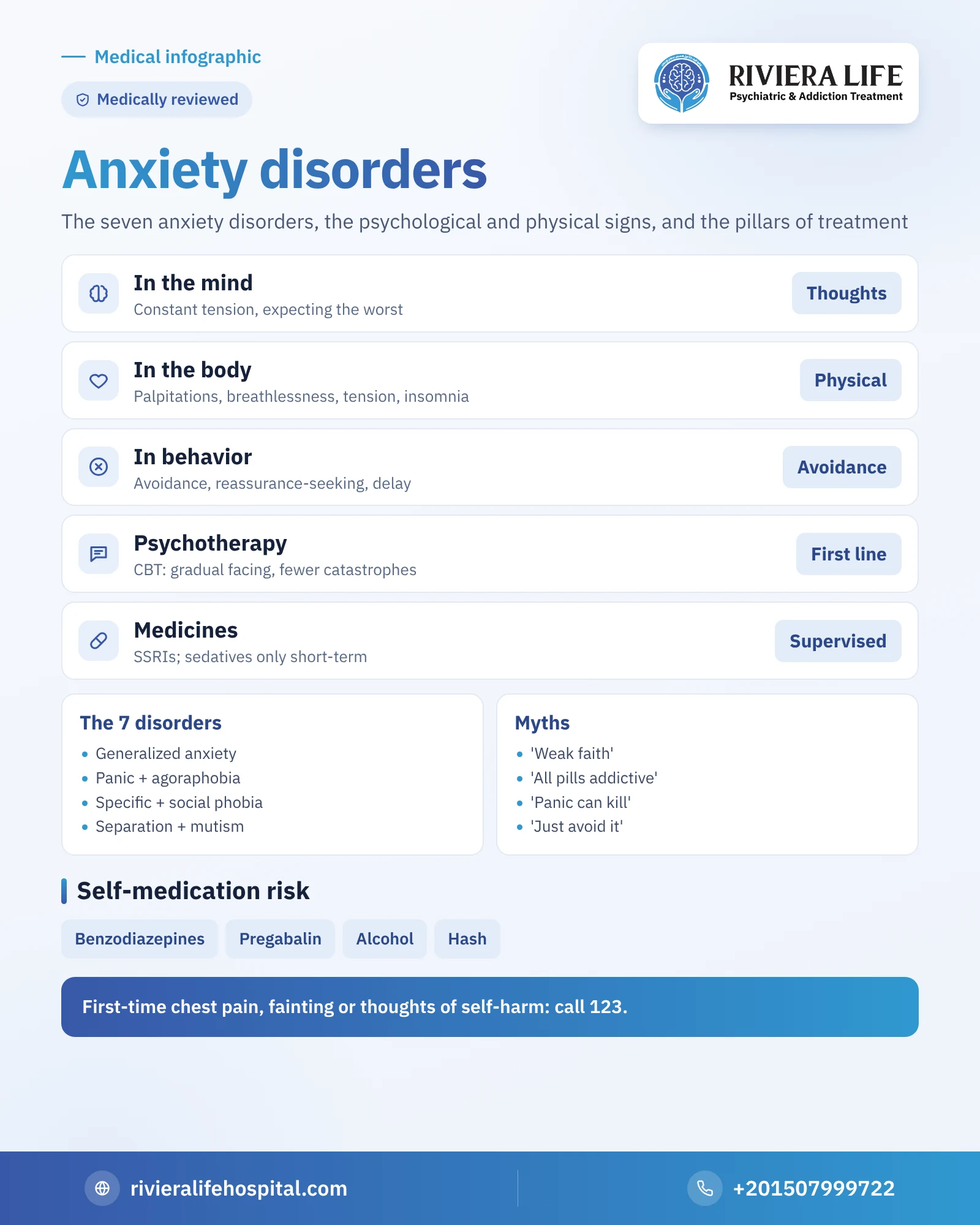
The American diagnostic manual and the International Classification of Diseases place seven main disorders under this umbrella, each with a different focus:
- Generalized anxiety disorder: persistent worry about multiple everyday matters that is hard to stop.
- Panic disorder: sudden, intense attacks of fear followed by fear of them happening again.
- Agoraphobia: avoiding places that are hard to get out of or to call for help in.
- Specific phobia: intense fear of a particular thing, such as heights, injections or animals.
- Social phobia: fear of evaluation and embarrassment in front of others.
- Separation anxiety: excessive fear of being away from the people the person is attached to.
- Selective mutism: a child’s inability to speak in particular situations despite being able to at home.
Anxiety may also appear because of a substance, a medicine or a physical illness. Obsessive-compulsive disorder and post-traumatic stress disorder were once part of this group, then each got a chapter of its own. The details and the fine differences are in the article Types of anxiety.
The main symptoms in brief
Anxiety appears on three overlapping levels. In the mind: constant tension, expecting the worst and difficulty concentrating. In the body: palpitations, shortness of breath, muscle tension, stomach upset and insomnia. In behavior: avoiding worrying situations, repeatedly seeking reassurance, and procrastination. Many patients first come with a purely physical complaint, such as chest pain or irritable bowel, and the tests are normal. The full list, the signs in children, and when you need a consultation are in the article Symptoms of anxiety.
Why does anxiety happen? A quick look
There is no single cause. An anxiety disorder takes shape from the interaction of a genetic predisposition, a sensitive temperament since childhood, and an easily triggered alarm system in the brain, with stress and life experiences. Physical illnesses such as an overactive thyroid, or substances such as caffeine and stimulants, may contribute. Then comes what makes anxiety last: avoidance, which brings relief in the moment and entrenches fear in the long run. We have explained this cycle in detail in the article Causes of anxiety.
How is an anxiety disorder diagnosed?
Diagnosis is the job of a psychiatrist or psychologist, and a symptom list on the internet does not settle it. It begins with a detailed interview about the nature of the fear, its duration, what triggers it and its effect on daily life, and validated scales may be used to estimate severity. The doctor takes care to rule out physical causes, so they may order a thyroid test or an ECG depending on the symptoms, and ask about caffeine, medicines and any drugs. They also look for accompanying disorders, the best known being depression, because their presence changes the treatment plan.
If you aren’t sure whether what you are going through goes beyond everyday stress, the free anxiety test gives an initial indication that you can show to the psychiatrist.
Treatment of anxiety: an overview
The reassuring news is that anxiety disorders are among the mental disorders that respond best to treatment. Treatment rests on two pillars that may be used together or separately:
- Psychotherapy, led by cognitive behavioral therapy, which teaches the patient to face their fears gradually and to adjust their catastrophic thoughts.
- Medicines, the best known being antidepressants from the serotonin reuptake inhibitor class; the doctor determines the right class and how long to continue.
Sedatives from the benzodiazepine family, however, have a limited and temporary role because of the risk of dependence. The articles Treatment of anxiety, The best medication for depression and anxiety and Pregabalin and anxiety explain these options in detail.
Anxiety and addiction: dual diagnosis
The relationship between anxiety and addiction runs in both directions. Many people with anxiety look for quick calm, so they turn to benzodiazepines without supervision, to pregabalin in doses outside the prescription, or to alcohol and hash. The relief is temporary, then anxiety returns stronger as the effect wears off, so the dose is repeated and dependence begins. In the opposite direction, withdrawal from sedatives and alcohol, and stimulant use, cause acute anxiety and panic attacks. That is why a patient who has both needs integrated treatment that deals with both disorders together in the same plan, not treatment of one and postponing the other.
Living with anxiety and the family’s role
Many families love their patient and so fall into the trap of “overprotection”: the mother who goes to the government office in place of her son, and the husband who answers the same questions every night to reassure his wife. This eases the tension for the night, but it entrenches the message that the situation really is dangerous. The most useful support is to acknowledge the person’s feelings without mocking them, to encourage them in the small steps they agree on with their therapist, and to celebrate progress however small. The patient themselves benefits greatly from regular sleep, daily movement and less caffeine; these do not treat the disorder on their own, but they lower the level of alarm in the body.
The harms of anxiety when it continues untreated
Mild, temporary anxiety does no harm, but anxiety that continues for months without assessment leaves its mark on the body, work and relationships together. The painful part is that many people live with it for years, thinking this is just their nature.
These are the most prominent effects that patients and their families notice:
- On the body: chronic muscle tension and headaches, disturbed sleep, palpitations, digestive problems such as irritable bowel, and fatigue that rest does not relieve.
- On concentration: absent-mindedness, distraction and forgetfulness, because the mind is busy expecting danger.
- On behavior: growing avoidance of places and situations, so the circle of life gradually narrows.
- On relationships: irritability, tension and repeated questions seeking reassurance, which tire the other person.
Chronic anxiety may turn into depression, or push the person to “calm” themselves with alcohol, sedatives or tramadol, adding a bigger problem. Panic attacks may also repeat and trap the patient in a fear of fear itself.
The good news is that these effects usually recede with the right treatment. Learn about the symptoms in the article Symptoms of anxiety, and about the options for improvement in Treatment of anxiety.
Common myths about anxiety
Myth: anxiety is a weakness of character or a lack of faith. The truth is that it is a disorder with a biological and psychological basis, affecting successful and strong people, and it has nothing to do with a person’s worth.
Myth: all anxiety medicines cause addiction. The truth is that the antidepressants used in treatment do not cause addiction, although stopping them suddenly may cause unpleasant symptoms; the risk of dependence is linked mainly to sedatives.
Myth: a panic attack can kill the person having it. The truth is that the attack is terrifying but does not harm a healthy heart; even so, any new chest pain must be checked medically before attributing it to anxiety.
Myth: it is best to avoid what worries you. The truth is that avoidance is the fuel that feeds anxiety, and successful treatment is based on gradual, planned facing.
The anxiety guide: each aspect in its own article
If anxiety is on your mind, each article below gives an in-depth answer to a particular question, so choose what you are looking for:
- Symptoms of anxiety: the psychological, physical and behavioral signs, the signs of a panic attack, and when you need an assessment.
- Causes of anxiety: genetics, the brain, temperament, experiences and physical illnesses, and why fear persists.
- Types of anxiety: the seven main disorders, the differences between them, and how the doctor tells them apart.
- Treatment of anxiety: types of psychotherapy, medicine classes, the length of treatment and when hospital admission is needed.
- The best medication for depression and anxiety: how the doctor chooses the right medicine when the two disorders occur together.
- Pregabalin and anxiety: when it is used in treating anxiety, the limits of its role, and the risk of misuse.
- Excessive irritability in women: hormonal and psychological causes and treatment
When does anxiety become an emergency?
Most anxiety attacks pass without physical danger, but there are situations in which waiting is not right, either because the symptoms may have a physical cause, or because the psychological distress has reached a level that threatens safety:
Seek urgent help immediately if you see
Call the ambulance on 123 or go to the nearest emergency department, and don’t assume it is just anxiety.
- Chest pain for the first time, or pain spreading to the arm or jaw
- Severe shortness of breath, fainting or sudden confusion
- Thoughts of self-harm or ending life
- Repeated panic attacks during withdrawal from sedatives or alcohol
- Total inability to eat, drink or get out of bed for several days
The General Secretariat of Mental Health and Addiction Treatment in Egypt also offers support and advice to people suffering from anxiety through its hotline on 16328 and 0220816831.
When should you seek help?
If anxiety takes hours out of your day, or has made you avoid work, going out or sleeping away from home, or you have started relying on a sedative or a substance to calm down, this is a good time for a consultation, and there is no need to wait for the worst. At Riviera Life, a team of consultant psychiatrists assesses the case in complete confidentiality and puts together a plan that suits it, whether psychotherapy sessions and outpatient follow-up, or an intensive program when anxiety comes with severe depression or dependence on a substance. The first consultation is free.
Medical sources and referencesThe information in this article is based on reliable scientific sources