After a violent car accident, a sudden loss or a situation in which a person felt their life was threatened, it is natural for sleep to be disturbed and for the film of what happened to replay in the mind for days or weeks. Most people regain their balance gradually with time and the support of those around them. But in some, the memory doesn’t calm down; it remains present as if the event never ended, and the body turns into a guard that never sleeps, and here we are talking about post-traumatic stress disorder.
This is what doctors call “post-traumatic stress disorder”, a well-known psychiatric disorder that is largely treatable. On this page we explain what it is, its forms from acute stress to complex trauma, and how it is diagnosed and treated, with links to detailed articles on each aspect.
What is post-traumatic stress disorder?
Post-traumatic stress disorder is a psychiatric condition that may appear after exposure to a traumatic event, that is, an event involving a real threat to life, serious injury or violence, whether it happened to the person themselves, they witnessed it happen to someone else, or they learned that it befell someone close to them. This includes accidents, disasters, wars and assaults, and also experiences less visible to people, such as staying for days in intensive care or a difficult birth that nearly took the life of the mother or child. It may also affect those exposed to the details of trauma by virtue of their work, such as paramedics, firefighters and emergency workers.
What distinguishes the disorder isn’t the harshness of the event alone, but the way the memory is stored. Instead of becoming a painful memory of the past, it remains “alive”, intruding on the present, and the nervous system stays in a state of alert as if the danger still exists. For the doctor to speak of a disorder rather than a natural reaction, the symptoms must last more than a month and cause clear distress or disrupt work, study or relationships.
How common is it?
The World Health Organization estimates that about 70% of people will go through a potentially traumatic event during their lives, but only a minority of them, roughly 5.6% of those exposed, develop post-traumatic stress disorder, and that nearly 3.9% of the world’s population have had it at some stage of their lives.
Women are more prone to it than men, and its rate rises greatly among those who have lived through wars or conflicts. Reassuringly, a fair proportion of those affected recover within the first year, and effective treatments are available, although many in developing countries don’t seek them because of stigma or because they don’t know that what they suffer from has a name and a treatment.
Forms of trauma disorders: from acute stress to complex trauma
Knowing these forms benefits the family and the patient together, because it determines the timing of follow-up and the type of treatment. Medical references classify reactions to trauma along a spectrum, with a person’s position on it determined by the timing and duration of the symptoms and the nature of the trauma itself.
The normal reaction to a traumatic event
In the first hours and days a person may feel dazed, cry repeatedly, or suffer insomnia or distraction. The International Classification of Diseases (ICD-11) considers this a normal “acute stress reaction”, not a disorder, and expects it to ease within a few days or weeks, especially if the person finds safety and support.
Acute stress disorder
The American diagnostic manual (DSM-5) describes it when severe symptoms resembling those of PTSD appear, lasting from three days to a month after the event. The person may feel detached from themselves or that what is around them isn’t real, with repeated reliving of the event, avoidance and tension. Not every case of acute stress turns into PTSD, but it is a sign that deserves follow-up, and early psychological intervention at this stage may reduce the likelihood of it continuing.
Post-traumatic stress disorder
When the symptoms exceed a full month and disrupt life. It may begin immediately after the event, or be delayed for months, and sometimes appears years later when a new situation recalls the old one, which is called “delayed onset”. The American manual also describes a pattern in which symptoms of detachment from self and reality dominate, and a pattern specific to children under six.
Complex post-traumatic stress disorder
The International Classification (ICD-11) added it as a separate diagnosis. It is usually linked to long or repeated trauma that is hard to escape, such as prolonged abuse in childhood or continuous domestic violence. The person carries the core symptoms of the disorder, and three dimensions are added: severe difficulty regulating emotions, a fixed negative view of the self such as feeling shame or worthlessness, and difficulty trusting and building and maintaining relationships. Some of its presentations may resemble borderline personality disorder, and distinguishing between them is the task of the specialist doctor.
| Condition | When it appears and how long it lasts | What distinguishes it most |
|---|---|---|
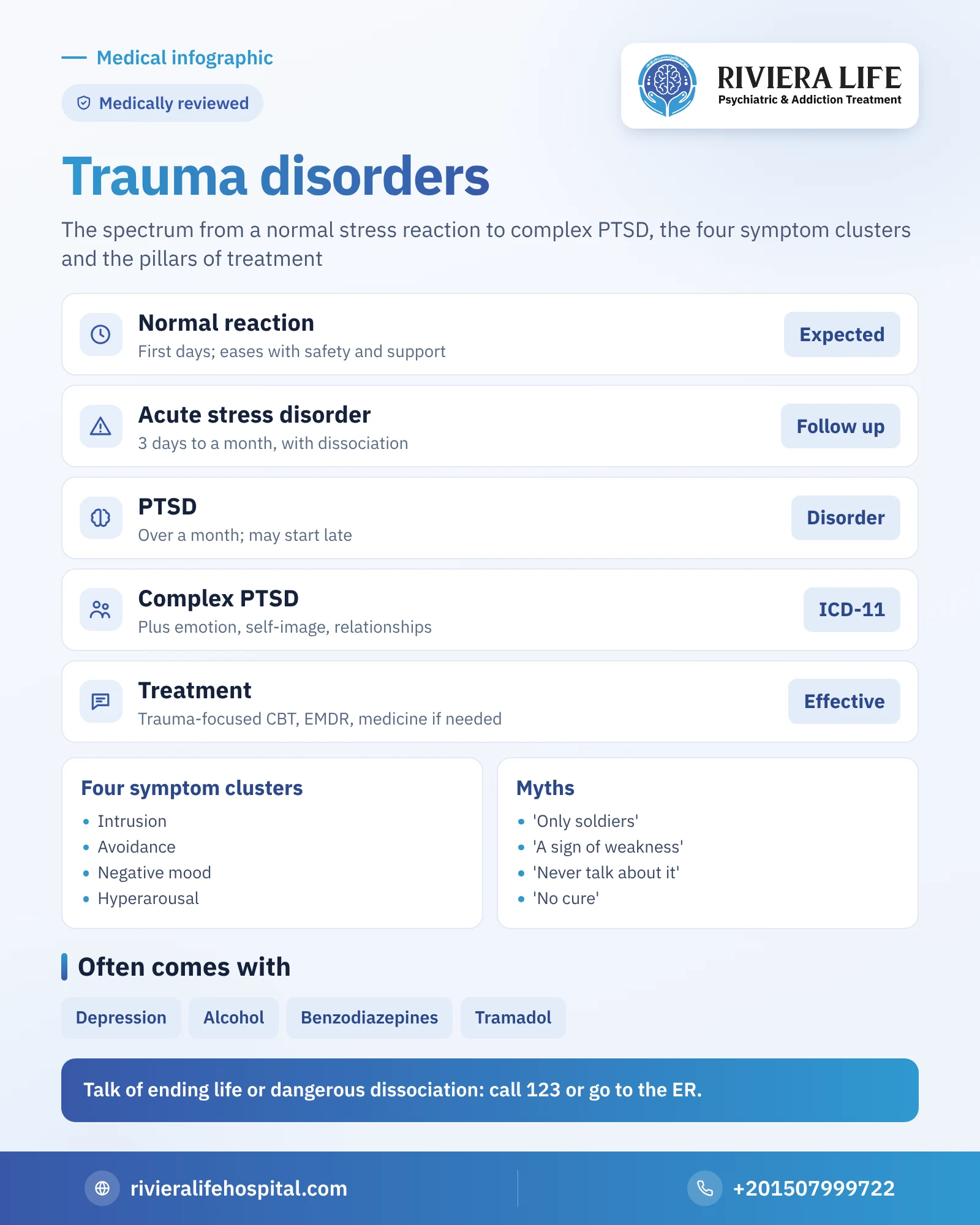
| Normal stress reaction | The first days, easing gradually | Understandable distress that improves with safety and support |
| Acute stress disorder | From 3 days to a month after the event | Severe symptoms with detachment from self or reality |
| Post-traumatic stress disorder | More than a month, and its appearance may be delayed | Reliving the event, avoidance and constant alertness |
| Complex trauma | Usually after long or repeated trauma | The above, with disturbed emotions, self-image and relationships |
The main symptoms in brief
The symptoms are organized into four clusters: memories that intrude on the mind, nightmares and moments in which the person feels as if they are living the event again; avoidance of places, people and conversations linked to it; negative changes in thoughts and mood such as guilt, blame and emotional numbness; and then hyperarousal, which shows in being startled by the slightest sound, quick anger and disturbed sleep. Physical complaints such as headaches and stomach pain without an organic cause may come to the fore. The full list, the signs in children, and what parents notice are in the article on the symptoms of post-traumatic stress disorder.
Why do some people develop it and not others?
Two people come out of the same accident; one recovers within weeks and the other remains a prisoner of the memory for years. This is due to the interaction of several factors: the nature of the event, its duration and any injury that accompanied it, the person’s history of previous trauma or psychiatric disorders, a biological predisposition in the brain’s fear and stress systems, and then what happens after the trauma, the most important being the presence or absence of social support. We have detailed these factors in the article on the causes of post-traumatic stress disorder.
How is post-traumatic stress disorder diagnosed?
Diagnosis is the domain of the psychiatrist or clinical psychologist, and an online test doesn’t settle it. It relies on an interview in which the specialist asks about the symptoms, their onset, duration and effect on life, without asking for painful details to be recounted before the patient is ready. Approved scales may be used to estimate severity. The doctor also looks for what often accompanies the disorder: depression, anxiety disorders and substance use, and rules out organic causes such as a head injury if the event was an accident.
The PTSD test helps you organize the symptoms into the four clusters the doctor usually asks about: intrusion, avoidance, mood change and hypervigilance.
Treatment of post-traumatic stress disorder: an overview
Trauma-focused psychotherapy is the first option in international guidelines, and among its best-known forms are trauma-focused cognitive behavioral therapy and eye movement desensitization and reprocessing (EMDR). This treatment helps the patient deal with the memory in a safe environment until it loses its ability to control them. The doctor may add a medicine from the antidepressants, especially if the symptoms are severe or accompanied by depression. Sedatives aren’t recommended as a treatment for the disorder. The details are in the article on the treatment of post-traumatic stress disorder.
Trauma and addiction: dual diagnosis
One of the most dangerous courses of the disorder is when the sufferer seeks sleep without nightmares or calm without memories in a drug. Alcohol and sedatives in particular seem a quick solution: they numb the alertness and silence the mind for a night. But the body gets used to them, so the amount increases, then the symptoms return doubled as the effect wears off and with withdrawal.
That is why the disorder is linked to higher rates of alcohol addiction and misuse of benzodiazepines, and in Egypt we also see those who resort to tramadol or hashish for the same purpose. Treating one of the two disorders and leaving the other rarely succeeds; stopping the substance reveals the full symptoms of the trauma, and untreated trauma pushes towards relapse. The solution is a single plan that deals with both together.
Living with post-traumatic stress disorder and the family’s role
Many families notice that their son or father “changed” after the accident: he became irritable or withdrawn, or refuses to ride in a car, without linking that to the trauma. The first thing the sufferer needs is to feel safe, not to be pressured to tell what happened, and not to hear that he must “forget and move on”. Useful support is to be present and ready to listen when he wants to talk, to keep a stable daily routine, to learn what triggers his symptoms so you don’t surprise him with it, and to encourage him to seek treatment without threats. The family itself may become exhausted, so it is fine to ask for support for yourselves too.
The harms of post-traumatic stress disorder
The effects of post-traumatic stress disorder don’t stop at painful memories. When the body remains in a constant state of alert without treatment, the consequences extend to sleep, health, relationships and work, and the sufferer often discovers their extent late.
- Sleep and the body: nightmares, chronic insomnia, exhaustion, headaches, muscle pain and palpitations, in addition to the link between long-term stress and heart and blood pressure problems.
- Mood: depression, anxiety and panic attacks are common with the disorder, along with a feeling of emotional numbness, guilt or shame.
- Relationships: withdrawal from family, quick irritability and loss of trust, so the partner or children feel they are walking on fragile ground.
- Work and study: poor concentration and avoidance of places or situations linked to the event, which may end in leaving the job or studies.
- Substance use: some sufferers resort to alcohol, sedatives or drugs to silence the symptoms, so the problem of addiction piles on top of the trauma.
- Risk of self-harm: thoughts of death rise in some sufferers, especially with depression or substance use.
The better news is that most of these harms recede with appropriate treatment, so waiting “until time passes” doesn’t help. And if thoughts of ending life appear, call the ambulance on 123 or go to the nearest emergency department. To know the signs that usually recur, read the symptoms of post-traumatic stress disorder, and for what helps recovery, read the treatment of post-traumatic stress disorder.
Common myths about post-traumatic stress disorder
The myth: the disorder only affects soldiers. The truth is that it may affect any person after a road accident, a serious illness, a sudden loss or violence, including children.
The myth: someone who develops it is a weak person. The truth is that the disorder is linked to the nature of the event and to biological and social factors, and doesn’t indicate weakness of personality or faith.
The myth: it is better never to talk about the event. The truth is that constant avoidance keeps the memory alive, and treatment helps face it gradually and safely, but at the patient’s pace and under a specialist’s supervision.
The myth: if the symptoms don’t appear immediately, they won’t appear. The truth is that the onset may be delayed by months or years.
The myth: there is no treatment for it and the memory will hurt forever. The truth is that trauma-focused treatments achieve clear improvement in a large proportion of patients.
The post-traumatic stress disorder guide: each aspect in a separate article
Choose the article that answers your question:
- Symptoms of post-traumatic stress disorder: the four symptom clusters, the physical signs, what appears in children, and when you need an assessment.
- Causes of post-traumatic stress disorder: what happens in the brain, the risk factors before, during and after the event, and the protective factors.
- Treatment of post-traumatic stress disorder: trauma-focused psychotherapies, categories of medicines, when hospital admission is needed, and how to choose a place of treatment.
When does the situation become an emergency?
Distress in some sufferers may reach a level that threatens their safety or the safety of those around them, especially with accompanying depression or use of alcohol or sedatives:
Seek urgent help immediately if any of these appear
Call the ambulance on 123 or go to the nearest emergency department, and don’t leave the person alone.
- Talk of ending their life, self-harm or an unusual farewell
- An episode of detachment from reality in which the person behaves in a way that puts them in danger
- Violent fits of anger that threaten the safety of the sufferer or their family
- Confusion, severe drowsiness or slowed breathing after alcohol or sedatives
- Severe tremor, seizures or hallucinations on suddenly stopping alcohol or sedatives
For advice and support in dealing with the effects of trauma, the hotline of the General Secretariat of Mental Health and Addiction Treatment in Egypt is available on 16328 and 0220816831.
When should you ask for help?
If more than a month has passed since the event and the memory still intrudes on your day, or you have started avoiding roads, places and people, or your sleep, mood and relationships have changed, or you have started relying on a substance to sleep, this is a suitable time for a consultation. And you don’t have to wait a month if the symptoms have been severe from the start. At Riviera Life, the consultant psychiatrists assess the case in complete confidentiality, and put in place a plan that suits it, from outpatient sessions to an inpatient program with round-the-clock supervision when trauma is accompanied by addiction or severe depression. The first consultation is free on +201507999722.
Medical sources and referencesThe information in this article is based on reliable scientific sources