If the brain were a speeding car, GABA would be the brake pedal. This neurotransmitter lowers the activity of nerve cells and stops them from over-firing, helping you calm down and sleep and protecting the brain from seizures. It is on this system specifically that many substances people use to relax act, such as alcohol and sedatives from the benzodiazepine family, which is why GABA is linked to anxiety, insomnia, addiction and dangerous withdrawal all at once. On this page we explain what GABA is, how it works, and its relationship with mood, sleep and drugs, with links to detailed articles.
What is GABA?
GABA is an abbreviation of a long scientific name, “gamma-aminobutyric acid” (GABA), and it is the main inhibitory neurotransmitter in the brain and spinal cord. Inhibitory means that when a nerve cell sends it to its neighbor, it reduces the likelihood that the latter will fire a new signal. GABA works in constant balance with its opposite partner, glutamate, the most important excitatory transmitter. Glutamate pushes and GABA brakes, and nervous health means keeping the two in balanced scales.
GABA is a neurotransmitter, not a hormone. That is, it works locally in the tiny space between two cells within a fraction of a second, unlike cortisol, which flows in the blood and affects all the body’s organs.
Where is GABA made and how does it work?
Nerve cells make GABA from glutamate itself, with the help of a special enzyme that needs vitamin B6 to work. This is a nice paradox: the brakes are made from the accelerator’s material. After it is released, GABA binds to two main types of receptors:
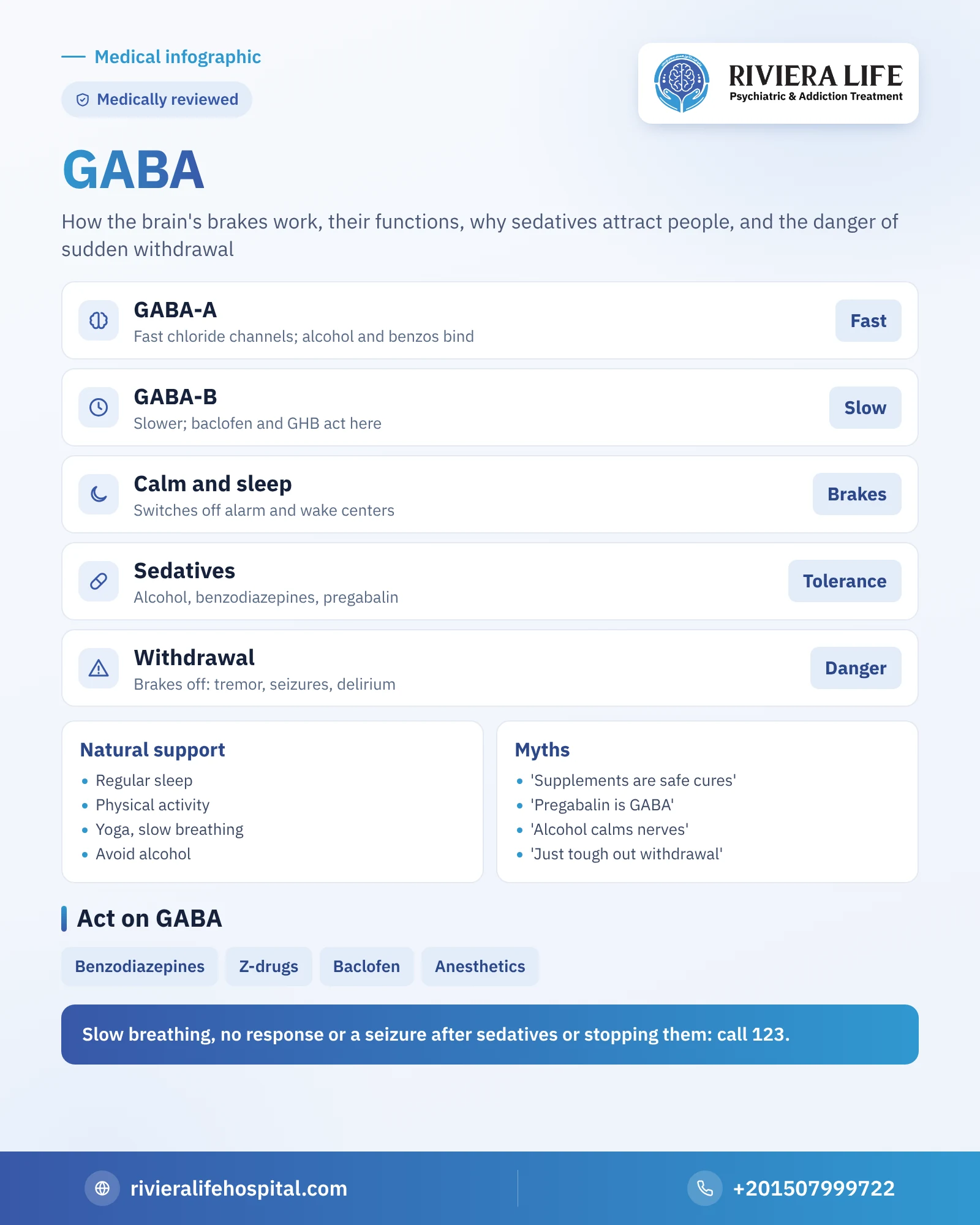
- “GABA-A” receptors: fast channels that open the door to chloride ions, calming the cell within fractions of a second. They are the target that alcohol, benzodiazepines, barbiturates and many anesthetics attach to, each at a different site on the receptor.
- “GABA-B” receptors: slower and longer-acting, working through a chain of signals inside the cell. The muscle-relaxant baclofen acts on them, as does GHB, known in some countries as a party drug.
After doing its job, GABA is reabsorbed into the cells and broken down, and some epilepsy medicines work by slowing this breakdown or reabsorption to keep it around longer.
The main functions of GABA
- Calming excitation: it stops nerve signals from amplifying and spreading, which is what protects the brain from epileptic seizures.
- Anxiety and fear: it balances the activity of the brain’s alarm circuits, including the amygdala.
- Sleep: cells that release GABA in certain brain areas become active before sleep and gradually switch off the wakefulness centers.
- Movement and muscles: it regulates muscle tone and coordination of movement, which is why medicines that act on it relax muscles.
- Memory formation and learning: it helps determine which signals are kept and which are discarded, which is why strong sedatives cause temporary forgetfulness.
GABA, mood and sleep
Many people with anxiety disorders and insomnia notice that their mind “won’t stop”. Brain-imaging studies and spinal fluid analyses have observed that GABA system activity may be lower in some patients with anxiety, depression and sleep disorders, but the results are not consistent between studies, and no blood test reveals a “GABA deficiency” for a doctor to diagnose a mental condition with. So the phrase “anxiety is caused by a lack of GABA” is an oversimplification; it is more accurate to say GABA is part of a network that includes serotonin, noradrenaline and stress hormones. The details are in the article GABA and anxiety.
When the balance is disrupted: low and high GABA
Weak functioning of the GABA system shows as excessive excitation: tension, insomnia and muscle spasms, and in severe cases epileptic seizures. We see this clearly in withdrawal from alcohol and sedatives, when external support the brain had grown used to is suddenly removed. There are also very rare genetic diseases that affect GABA enzymes and appear in childhood.
An excess, however, usually does not come from the body itself, but from substances that amplify GABA’s effect: severe drowsiness, slow speech and thinking, staggering and forgetfulness, then, at large doses or when mixing more than one substance, suppression of breathing that can be fatal.
GABA and addiction: why do “sedatives” attract people?
Substances that strengthen GABA’s effect give a quick feeling of relaxation and relief from anxiety, and this is exactly what makes them tempting for someone living under pressure or suffering from insomnia. Among the most important are alcohol, benzodiazepines such as Xanax, the older barbiturates, and GHB. As for pregabalin and gabapentin, their names are derived from GABA and they resemble it in structure, but they do not act on its receptors directly; they calm the release of excitatory transmitters by another route, yet they share its calming effect and its risk of misuse.
With repeated use the brain adapts: it reduces the sensitivity of GABA receptors and raises glutamate activity to compensate. So you need a larger amount for the same effect, and when you stop suddenly, the accelerator stays pressed with no brakes. This is where the insomnia, tremor and severe anxiety of withdrawal come from, and in difficult cases seizures and delirium. A full explanation of this mechanism and its treatment is in the article GABA and addiction.
GABA and mental and neurological disorders
Researchers are studying the role of GABA in a number of disorders: anxiety disorders, insomnia and depression, some symptoms of schizophrenia, and epilepsy, which is the clearest example of an imbalance between excitation and inhibition. Among relatively new medicines is one derived from a natural hormone that acts on GABA receptors and has been approved in some countries to treat postnatal depression, reflecting growing interest in this pathway, but this does not mean that every depression is caused by GABA.
Symptoms of GABA deficiency: what is actually attributed to it?
There is no standalone list of symptoms called “GABA deficiency” that a doctor diagnoses with a single test. What is seen in the clinic are signs of excessive excitation in the nervous system, of which GABA may or may not be one cause.
- Inner tension and anxiety that is hard to calm.
- Insomnia, or light sleep broken by any sound.
- Muscle tension, tremor and involuntary twitches.
- Irritability and discomfort with noise and crowds.
- In severe cases only: seizures and epileptic fits.
The first symptoms are shared by dozens of causes, including lack of sleep, too much coffee, an overactive thyroid and anxiety disorders. So it is not right to conclude from insomnia alone that you have a GABA deficiency.
The clearest medical picture of a drop in this system’s activity appears on suddenly stopping alcohol or sedatives, and here the symptoms become dangerous and call for medical supervision, as the article GABA, addiction and the danger of withdrawal explains. The relationship between anxiety and this transmitter’s activity is in GABA and anxiety: is it a lack of the brain’s brakes?.
And if these symptoms continue for weeks without a clear cause, the logical step is a medical assessment that looks for the cause, not a dietary supplement bought on the strength of an article or an advertisement.
Can GABA be measured with a test?
Many people ask about a “GABA test” after reading a post about its deficiency. The truth is that GABA in the blood does not reflect what happens inside the brain, because the blood-brain barrier separates them. Researchers can estimate it inside the brain with a special type of magnetic resonance spectroscopy, but it is a research tool not used to diagnose anxiety or depression in the clinic. So the doctor relies on the interview, the symptoms and the medical history, not on the neurotransmitter tests that are sometimes offered commercially.
How can you support the GABA system naturally?
You can’t “charge” GABA with a pill, but some habits may help the calming system work more efficiently, with varying strength of evidence:
- Regular sleep: the strongest and clearest means in its effect on nervous stability and mood.
- Physical activity: small studies have shown a rise in markers of GABA in the brain after exercise, and the effect of exercise on anxiety is established regardless of the mechanism.
- Yoga and slow breathing: limited imaging studies have observed a rise in GABA after yoga sessions; the evidence is preliminary but encouraging.
- Staying away from alcohol and non-prescribed sedatives: because they weaken the system in the long run despite the temporary relief.
As for the GABA supplements sold in pharmacies and online stores, it is not known for certain how much of them crosses into the brain, and the evidence for their benefit in anxiety and sleep is weak. Don’t start them without consulting, especially if you take psychiatric or sedative medicines.
Medicines that affect GABA
These are classes only, and the decision always belongs to the doctor:
- Benzodiazepines: they strengthen GABA’s effect on “GABA-A” receptors, and are used for short periods in acute anxiety, seizures and alcohol detox.
- “Z-class” sleeping pills such as zolpidem: they act on the same receptor in a more selective way.
- Some epilepsy medicines: they raise GABA or slow its breakdown.
- Baclofen: it acts on “GABA-B” receptors and relaxes spastic muscles.
- General anesthetics: a number of them work through GABA receptors.
Each of these medicines may cause physical dependence if used for a long time, and should not be stopped suddenly.
Common myths about GABA
Myth: the natural GABA in supplements is completely safe and treats anxiety. The truth is that its benefit is not proven, and the word “natural” does not mean safe with all medicines.
Myth: pregabalin is GABA itself. The truth is that the similarity is only in name and structure, its mechanism of action is different, and the risk of dependence on it is real.
Myth: alcohol relaxes the nerves. The truth is that it relaxes them for hours and then leaves them more tense, and with continued use it becomes the source of the anxiety itself.
Myth: someone stopping sedatives just needs to tough it out for a few days. The truth is that stopping suddenly after long use may cause seizures, and reduction must be gradual under medical supervision.
The GABA guide: each aspect in its own article
- GABA and anxiety: is anxiety a lack of GABA? And how anxiety medicines and psychotherapy act on the brain’s brakes.
- GABA and addiction: alcohol, sedatives and pregabalin, why their withdrawal is dangerous, and how it is treated safely.
- Melatonin and sleep: how the body clock cooperates with the brain’s brakes for you to sleep.
- Dopamine: the transmitter of reward and motivation, and the other side of the addiction story.
When does it become an emergency?
The two most dangerous moments in the world of GABA are an overdose of sedative substances, especially when mixed together or with opioids, and sudden withdrawal from alcohol or benzodiazepines after long use.
Call the ambulance on 123 immediately if you see
After taking sedatives or alcohol, or within days of suddenly stopping them:
- Very slow or irregular breathing, or unusual snoring
- No response to being called or shaken
- Blue lips or nails
- A seizure
- Severe confusion or hallucinations with tremor, sweating and fever
When should you see a doctor?
Seek an assessment if anxiety or insomnia has become a fixed part of your life for more than a few weeks, or if you find yourself needing a drink or a sedative pill every night to sleep, or have increased the amount without a prescription, or feel tremor and tension when you delay it. These are signs that the braking system has come to rely on outside help. At Riviera Life, consultant psychiatrists and addiction specialists assess your case in complete confidentiality, and put together a safe withdrawal plan under round-the-clock medical supervision if needed, and the first consultation is free on +201507999722.
Medical sources and referencesThe information in this article is based on reliable scientific sources