The short answer
Riviera Life is a private psychiatric hospital licensed by the Ministry of Health and Population (license no. 1427), located in Sheikh Zayed west of Greater Cairo, admitting psychiatric patients for inpatient care whether or not the illness is accompanied by substance use: severe depression, manic episodes in bipolar disorder, psychosis and schizophrenia, and severe obsessive-compulsive disorder. It has a psychiatric wing separate from the addiction wing, with private rooms, and offers full inpatient care, day programs and outpatient clinics, medication and individual and group psychotherapy, and electroconvulsive therapy and magnetic stimulation when needed, with emergency admission around the clock in line with the Mental Health Care Law.
- LocationSheikh Zayed, Greater Cairo
- AdmissionAround the clock, all week
- Psychiatric wingSeparate from addiction, with private rooms
When a family looks for a psychiatric hospital, it usually isn’t looking for information, but for a safe place for someone it loves at their hardest moment: a son who stopped eating and talking weeks ago, a mother who has started hearing voices, or a brother who hasn’t slept for three nights and talks about million-pound projects. On this page we explain clearly what psychiatric care at Riviera Life offers, who needs inpatient care, how admission happens, and which patient rights the law protects, so you can judge for yourself whether this is the psychiatric hospital in Egypt that suits your relative’s condition.
When does a patient need a psychiatric hospital in Egypt rather than a clinic?
Most psychiatric disorders are treated in the clinic. However, staying in hospital becomes safer for the patient and their family in certain situations, including:
- Serious thoughts of suicide or an attempt that has already happened.
- Psychosis that makes the patient act on hallucinations or suspicions that put them or others in danger.
- A manic episode with continuous sleeplessness, reckless spending or aggression.
- Severe depression in which eating, drinking or self-care has stopped.
- Repeated failure of clinic follow-up, or a medication plan needing a radical change that requires daily observation.
- Psychiatric illness combined with substance use that makes the condition too difficult to manage at home.
If you aren’t sure the condition needs a doctor at all, start with when do you need a psychiatrist? And for addiction cases specifically, the details of the drug addiction treatment plan are explained in its own guide.
The psychiatric conditions we admit for inpatient care
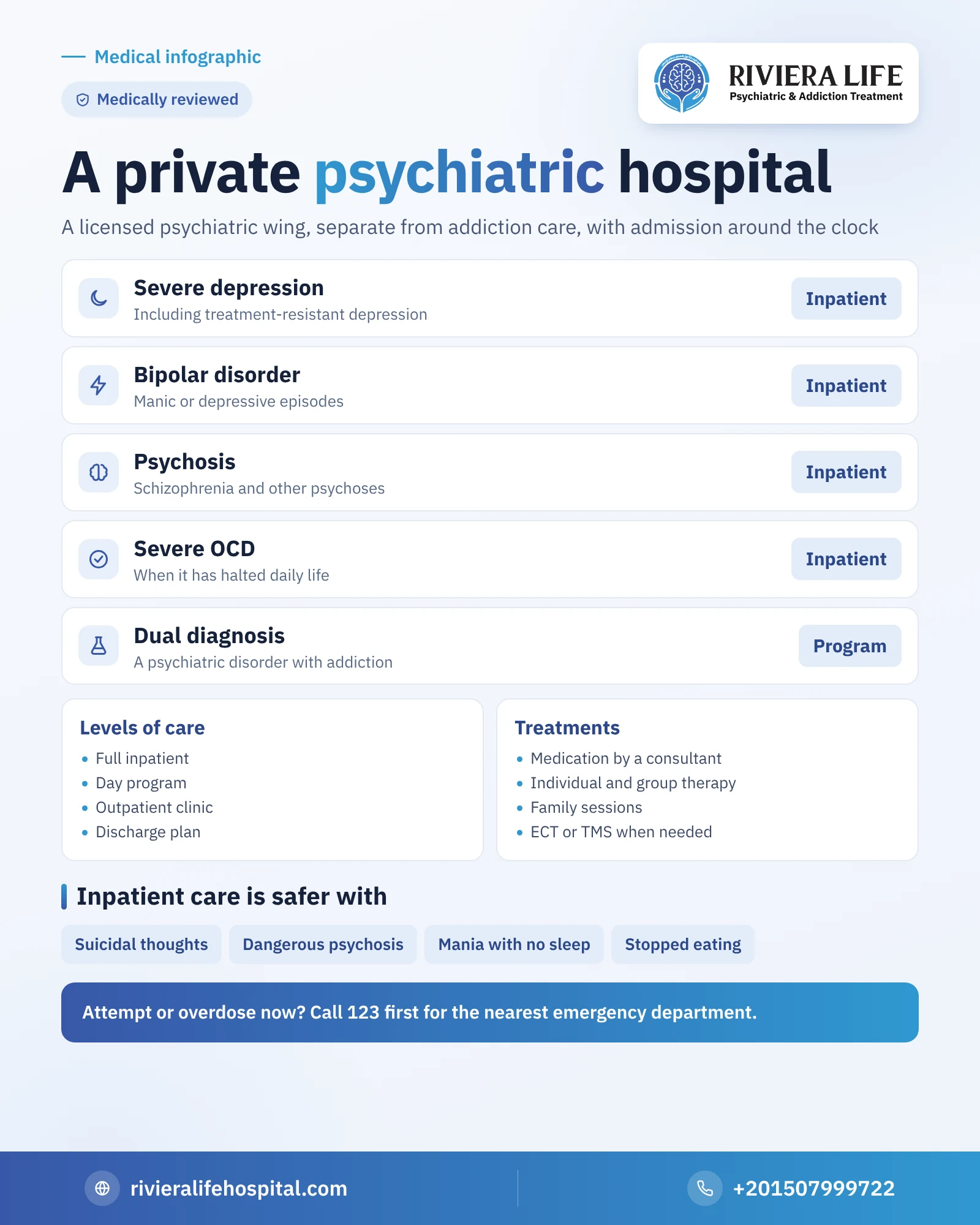
- Severe depression and treatment-resistant depression.
- Bipolar disorder in manic or depressive episodes.
- Schizophrenia and psychosis of all types.
- Severe obsessive-compulsive disorder that has halted daily life.
- Dual cases in which a psychiatric disorder is combined with addiction, within the dual diagnosis program.
A psychiatric clinic for treating depression: what happens inside the hospital?
Many look for a psychiatric clinic to treat depression when things reach a dead end: medicines tried without improvement, or talk of death that is no longer passing. Inpatient care here isn’t isolation, but a focused period with clear goals:
- Safety first: an environment prepared to prevent self-harm, and round-the-clock nursing observation.
- Reassessment: reviewing the diagnosis, as some of what seems to be ordinary depression turns out to be an episode of bipolar disorder or linked to a physical cause or a substance the patient uses.
- Adjusting medication under daily observation that allows it to be modified quickly and safely.
- Individual and group psychotherapy from the first days, not after discharge.
- Electroconvulsive therapy or magnetic stimulation sessions when the doctor decides the case needs them, such as severe depression that hasn’t responded to medicines.
- A discharge plan that sets out follow-up in the clinic or day program, and the family’s role in the first weeks.
You will find the details of medication and psychotherapy for depression in general in depression treatment.
Levels of care: from full inpatient care to the clinic
| Level | Who is it suitable for? | What the day looks like |
|---|---|---|
| Full inpatient care | Acute cases or those unsafe at home | A stay in the psychiatric wing with constant medical and nursing supervision |
| Day program | Those who have improved and need an intensive program without staying overnight | A treatment program by day and returning home in the evening |
| Outpatient clinic | Stable cases and follow-up after discharge | Regular visits to the doctor and psychotherapy sessions |
Treatments available in the psychiatry department
- Medication, set and followed up by a consultant psychiatrist.
- Individual psychotherapy using proven methods, such as cognitive behavioral therapy.
- Group therapy, in which the patient learns from others’ experiences and breaks their feeling of loneliness.
- Family sessions to understand the illness and how to deal with it after discharge.
- Electroconvulsive therapy under full anesthesia and supervised by an anesthesiologist, in cases that call for it.
- Transcranial magnetic stimulation as an option in some cases of depression that haven’t responded to medicines.
A separate psychiatric wing and private rooms
A patient with depression or psychosis lives in the psychiatric wing, separate from the addiction treatment wing, because the needs of each differ in calm, observation and the daily program. Private rooms are available that preserve privacy, which matters a great deal to many families who fear the news of the illness becoming known.
Emergency admission and involuntary admission under Egyptian law
We admit acute psychiatric cases around the clock, such as a suicide attempt after its physical condition has stabilized, severe agitation, or psychosis that puts the patient or others in danger. Admission is, as a rule, with the patient’s consent. But if they refuse while in a condition that poses a serious danger to themselves or others, the Mental Health Care Law No. 71 of 2009 and its amendments regulate involuntary admission with specific safeguards, the most important being assessment by a psychiatrist, notification of the mental health oversight authorities, the right of the patient and their family to appeal, with periodic review of the case and ending the involuntary status as soon as its cause has gone. We explain each step to the family before it is taken.
Note: if there is a suicide attempt or a medication overdose right now, call an ambulance on 123 first, as the priority is saving life in the nearest public emergency department.
How does admission happen?
- Contact us by phone or WhatsApp, and tell us what you can about the case.
- The doctor sets an urgent assessment appointment or arranges immediate admission if the case is an emergency.
- After the assessment, we agree with you on the appropriate level of care and treatment plan.
- Admission begins, and we stay in contact with the family throughout the stay, with the patient’s permission.
A private or a public psychiatric hospital?
Egypt has public mental health hospitals that provide an important service at low cost, and private hospitals. The difference you pay for in private hospitals is usually in privacy and single rooms, the number of doctor hours available to the patient, and regular psychotherapy and family therapy alongside medication. What determines the cost and how to read a price quote are explained in psychiatric clinic prices in Egypt, and the criteria for choosing between hospitals in how to choose a psychiatric hospital in Egypt.
A psychiatric clinic in Greater Cairo: the location in Sheikh Zayed
The hospital is located in the Riviera Gardens compound, next to the SODIC compound in Sheikh Zayed, Giza Governorate, west of Greater Cairo, and serves patients from Cairo, Giza and the governorates, and from outside Egypt. The calm and the green spaces around the place are part of the treatment environment.
How can Riviera Life help you?
If someone you love is going through a psychiatric crisis, don’t wait for it to get worse. Talk with our team to assess the case and decide whether it needs inpatient care or outpatient follow-up. The first consultation is free and confidential on +201507999722.
Read also
- Choosing a psychiatric hospital in Egypt: the criteria
- Psychiatric clinic prices in Egypt
- The dual diagnosis program
- Psychological tests
Questions many people ask
Yes, the hospital admits cases of severe depression, bipolar disorder, psychosis and severe obsessive-compulsive disorder for inpatient care in a psychiatric wing separate from the addiction wing.
Voluntary admission is the rule, but if the patient's condition poses a serious danger to themselves or others, involuntary admission is applied under the safeguards of the Mental Health Care Law, with a medical assessment and a right of appeal.