Shopping addiction is when the desire to buy turns into an impulse that is hard to resist, repeating despite debts, regret and conflicts, and unrelated to a real need for what is bought. It is not yet considered a standalone diagnosis by name in official medical manuals, but psychiatrists know it well as “compulsive buying”, and treat it with methods of proven effectiveness. With the spread of shopping apps and zero-down-payment installment plans in Egypt, access to buying has become easier than ever. This page gathers what you need to know: what it is, who it affects, how it differs from ordinary love of shopping, and when to seek help.
What is shopping addiction?
Doctors describe compulsive buying as an excessive preoccupation with shopping and repeated, hard-to-control buying that causes distress or clear problems with money, work or relationships. What matters here is that the real pleasure is not in the thing bought, but in the moment of buying itself: searching, choosing and pressing the “complete order” button. After that comes brief relief, then regret or guilt, and the purchases often stay in their bags or boxes unused, or are hidden from the family.
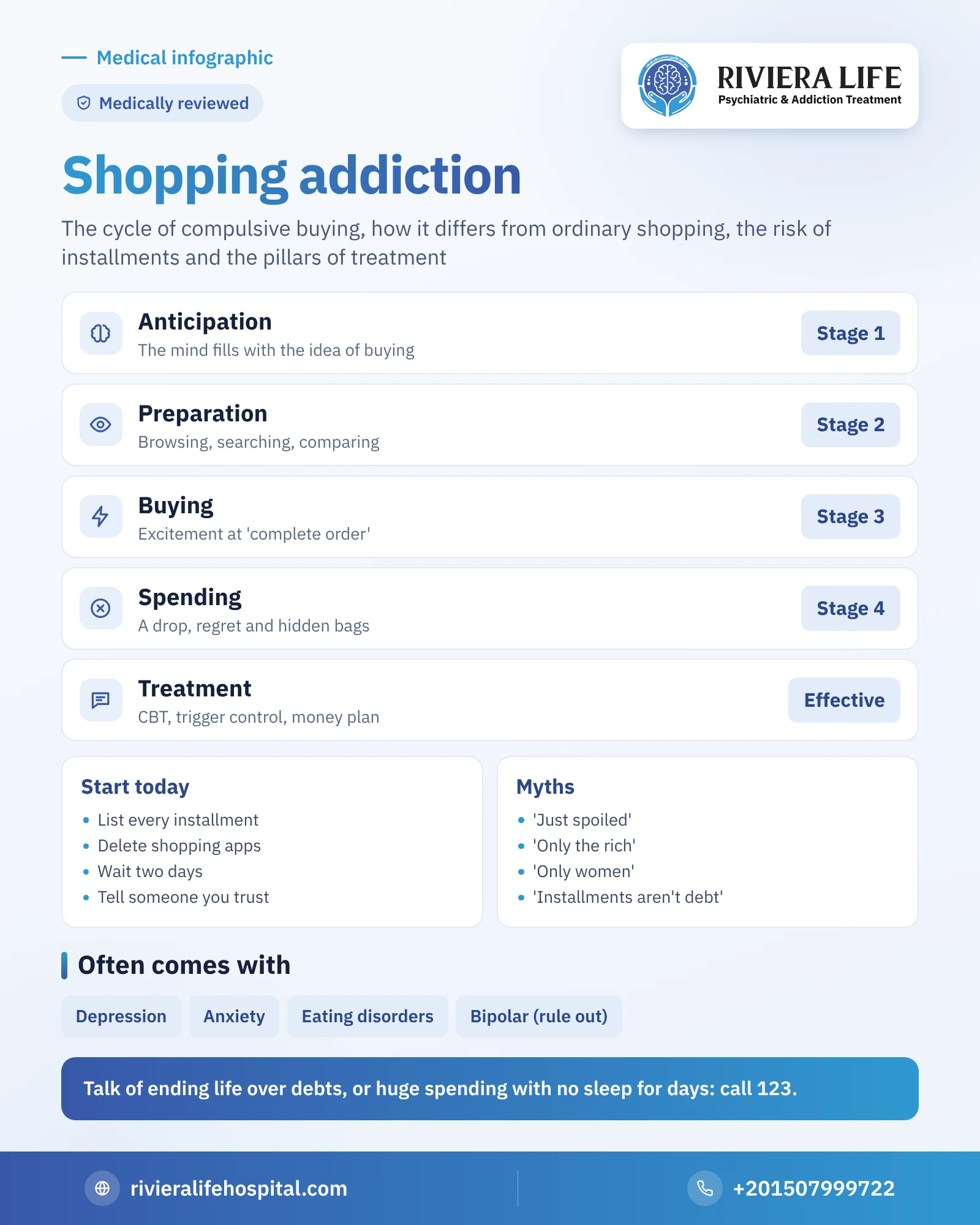
Researchers describe this cycle in four successive stages: anticipation that fills the mind with the idea of buying, then preparation by browsing and searching, then the buying itself with the excitement that comes with it, then the spending, which is followed by a drop and regret. As the cycle repeats, the person learns that buying is their fastest way to change their mood.
Is it a recognized illness?
The precise answer: it is recognized as a real clinical problem, but it is not a standalone diagnosis with its own name in the fifth edition of the American diagnostic manual. The eleventh edition of the International Classification of Diseases, however, allows it to be recorded under “other specified impulse control disorders”. There is a wide scientific debate about setting specific criteria for it, and a team of international experts has proposed diagnostic criteria for it. What matters to the patient is that their suffering is real and treatment is available, regardless of the official name.
How common is it?
Some international estimates indicate that roughly 5% of adults may meet the features of compulsive buying, with wide variation between studies depending on the scale used and the country. It usually begins in the late teens or early twenties, when a young person gets their first income or first card. Most treated cases appear among women, but researchers believe that men are also affected and hide it as a “collecting hobby” or an interest in devices, electronics and cars.
Ordinary shopping or compulsive buying?
We all sometimes buy things we don’t need, and are pleased by a good offer in the sales season. The difference shows up in simple questions:
| Ordinary shopping | Compulsive buying |
|---|---|
| Usually buys what they need or what they planned | Buys impulsively and without planning |
| Sticks to their budget most of the time | Repeatedly exceeds their financial means |
| Enjoys things after buying them | Things lose their value right after buying |
| Doesn’t hide their purchases | Hides bags and receipts and lies to the family |
| Can stop if they decide to | Goes back to buying despite promises to themselves |
The main symptoms in brief
Among the most prominent signs: repeated thinking about buying, buying similar or unused things, buying to improve mood after a bad day, intense regret afterwards, hiding purchases or installments, accumulating debts or installments they cannot pay, and failed attempts to stop. We detail these signs and when they deserve an assessment in the article Symptoms of shopping addiction.
Why does it happen?
A psychological predisposition, such as impulsivity, low self-esteem or difficulty regulating emotions, usually comes together with a mood state such as sadness, anxiety or loneliness, and then comes an environment that makes buying easy: precisely targeted ads, limited-time offers, and instant installments with a single tap. The full details are in the article Causes of shopping addiction.
Online shopping and installments in Egypt
The picture of shopping addiction has changed a great deal in recent years. The patient no longer needs to go to a mall; the apps are open on the phone day and night, the card is saved, and the order arrives at the door with the option of paying on delivery. Consumer finance companies and “buy now, pay later” apps that spread purchases over months, sometimes with no down payment, have spread in Egypt, alongside selling pages on social media and live-streamed offers.
These services in themselves are useful tools for many people, but they are dangerous for someone with a tendency toward compulsive buying, because they hide the real price: the small monthly installment seems simple, until the installments of dozens of purchases pile up at the same time. Therapists notice that some patients do not know exactly how much their monthly installments are until they sit down to calculate them for the first time in the clinic.
Shopping addiction and accompanying mental disorders
Compulsive buying rarely comes alone. It often occurs together with depression and anxiety disorders, with eating disorders and substance use, and with some personality disorders. It is very important to distinguish it from manic episodes in bipolar disorder, in which the patient spends huge sums during a specific period accompanied by excessive activity, little sleep and grandiose ideas; this is a completely different condition in its treatment. It also differs from hoarding disorder, whose main problem is difficulty getting rid of things, not buying them.
The harms of compulsive buying
The most obvious harm is financial: accumulated debts and installments, late payment of rent and bills, borrowing from family and friends, and it may reach legal problems with finance companies. But the harm does not stop at money. The person lives in a cycle of guilt, anxiety and shame, and their depression may deepen. Marriage is shaken when hidden debts are discovered, and relations with family and colleagues they borrowed from become strained. Homes sometimes fill with things that were never used, which themselves become a daily reminder of the problem. Constant preoccupation with shopping affects concentration at work and the time set aside for family and hobbies.
How is it treated?
The most studied treatment is cognitive behavioral therapy, individually or in groups, to which trigger control and money management with the help of the family or a financial adviser are added, along with treatment of accompanying depression or anxiety. There is no approved medicine for shopping addiction itself, and the doctor may prescribe medicine for an accompanying disorder if there is one. We detail the steps of treatment in the article Treatment of shopping addiction.
The family’s role
The family discovering the size of the debts is often a shocking moment, followed by accusations and anger. But blame alone pushes the patient toward more hiding. It is more useful for the family to separate protecting the money from condemning the person: to sit with them to list the commitments, agree on a realistic repayment plan, help them close harmful accounts and apps, and encourage them to get treatment. At the same time, the family has the right to protect its budget, for example by temporarily separating joint accounts, without this turning into punishment or humiliation.
Common myths about shopping addiction
- “It’s just being spoiled or wasteful”: many people with it suffer real distress and regret, and try to stop but can’t.
- “It only affects the rich”: it affects different income levels, and its harm is greater for those with a limited income.
- “It only affects women”: men are affected too, and in them it may take the form of buying devices, accessories and cars.
- “The solution is to take their card away”: controlling money is an important step, but it does not treat the drive, and the buying may move to installments or borrowing.
- “Installments aren’t debt”: every installment is a real financial commitment, and their accumulation is one of the most common forms of harm today.
Start here: first steps you can take today
Before the doctor’s appointment, there are simple steps that reduce the harm immediately: gather all your installments and debts on a single sheet to see the full picture, delete shopping apps from your phone and erase saved cards, turn off offer notifications, and apply a rule of waiting two days before any unnecessary purchase. And choose someone you trust to tell what is happening, because secrecy feeds the problem. These steps do not replace treatment, but they give you room to breathe.
The shopping addiction guide: each aspect in its own article
- Symptoms of shopping addiction: the psychological, behavioral and financial signs of compulsive buying, and self-assessment questions.
- Causes of shopping addiction: why the urge to buy repeats, and the role of mood, personality, advertising and installments.
- Treatment of shopping addiction: cognitive behavioral therapy, money management, the family’s role and when a bigger intervention is needed.
When does it become an emergency?
In some cases debts may lead to unbearable psychological pressure, or sudden spending may reveal a manic episode. Don’t wait in these situations:
Seek urgent help immediately if you see
Call the ambulance on 123 or go to the nearest emergency department, and do not leave the person alone.
- Talk of death or ending life because of debts or scandal
- Severe despair and a feeling of being a burden on the family with no way out
- Sudden huge spending with little sleep for days, excessive activity and unrealistic ideas
- Threats of self-harm after the family discovers the debts
When should you seek help?
If impulsive buying repeats despite your promises to yourself, or installments and debts have started to pressure your budget, or you have started hiding your purchases from your family, or you feel ongoing distress or guilt after shopping, this is a good time for an assessment. At Riviera Life, consultant psychiatrists assess the case in complete confidentiality, look for accompanying depression, anxiety or mood disorder, then put together a psychological and practical treatment plan that involves the family when needed. The first consultation is free via +201507999722.
Medical sources and referencesThe information in this article is based on reliable scientific sources
1World Psychiatry — A review of compulsive buying disorder (Black, 2007)pmc.ncbi.nlm.nih.gov2Proposed diagnostic criteria for compulsive buying-shopping disorder: an expert consensus (Delphi) studypubmed.ncbi.nlm.nih.gov3A systematic review and evidence-based recommendations for the treatment of compulsive buying-shopping disorderncbi.nlm.nih.gov4NHS — How to cope with financial worries and their effect on mental healthnhs.uk5NIMH — Bipolar disordernimh.nih.gov