Shopping addiction treatment rests on psychotherapy first, the most studied being cognitive behavioral therapy individually or in groups, with practical steps to control money and reduce triggers, and treatment of depression, anxiety or a mood disorder if present. There is no approved medicine for compulsive buying itself, but the doctor may prescribe a medicine for an accompanying disorder. The goal isn’t to stop buying completely, which is impossible, but to regain control: to buy what you need and can afford, and to find other ways to calm your feelings. This article explains the steps, the family’s role, and how to choose a place of treatment.
Can shopping addiction be treated?
Yes. Research reviews indicate that cognitive behavioral therapy, especially in the form of therapy groups, reduces buying episodes, spending and the accompanying distress in many patients. Improvement is gradual, needing weeks and months, and slips may happen in the seasons or at times of pressure. Whoever deals with a slip as a chance to understand what happened, not as a total failure, keeps the progress.
The first step: an honest assessment
Treatment starts with a session in which the patient talks with the psychiatrist about the buying pattern: when it started, what they buy, at what times, the feelings that precede and follow it, and the size of current debts and installments. At the same time the doctor looks for disorders that may be behind the buying, most importantly depression, anxiety and manic episodes in bipolar disorder, in addition to eating disorders and substance use. This assessment determines the shape of the plan; treating someone who buys during a manic episode is completely different from treating someone who buys to escape loneliness. You can review the signs before the visit in the article on shopping addiction symptoms.
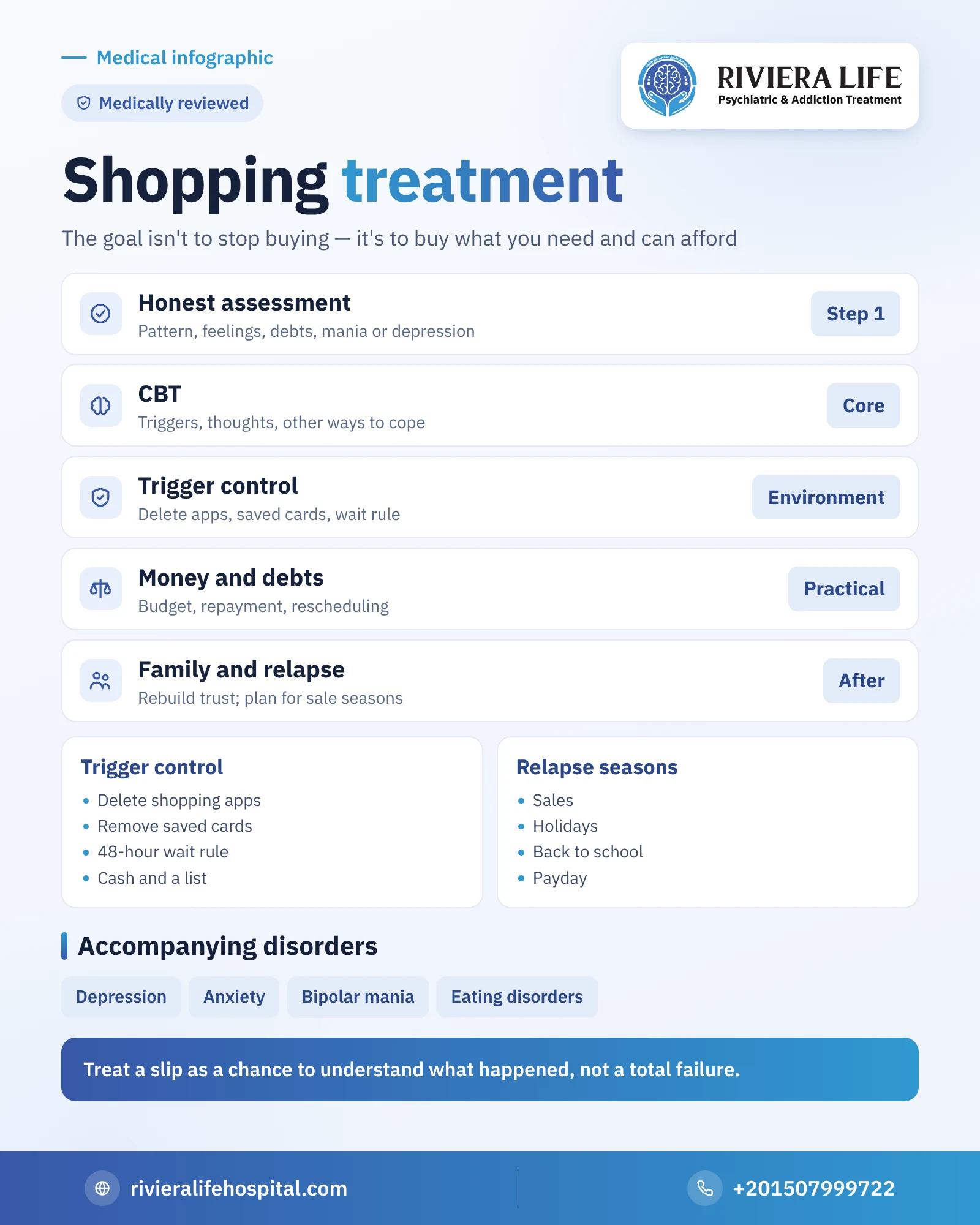
Cognitive behavioral therapy
The therapist works with the patient on three areas:
Understanding triggers
The patient records in a notebook or app every urge to buy: the time, the place, the mood, and what happened before it. After two weeks clear patterns appear: buying after a tense call, at night, or on payday.
Changing thoughts
They learn to notice the thoughts that justify buying, such as “it’s an offer that won’t come again” or “I’ll be better when I own this”, and to discuss them with realistic questions: do I really need it? Where will I put it? How will I feel after a week?
Alternatives for dealing with feelings
Instead of buying being the only means of improving mood, the patient practices other means: walking, contacting someone close, breathing exercises, and hobbies that give a sense of achievement. They learn that the urge is like a wave that rises then falls if they don’t respond to it immediately.
Controlling triggers: changing the environment
Will works better when temptations are fewer. Among the practical steps the patient agrees on with their therapist:
- Deleting shopping apps from the phone, and unsubscribing from offer messages and notifications.
- Removing saved cards from stores and the browser.
- Closing or temporarily suspending instant installment accounts and not opening new ones.
- The waiting rule: no buying anything non-essential before at least two days have passed.
- A written shopping list before going out, and a set amount of cash instead of the card.
- Unfollowing pages and influencers that stir the urge to buy.
Organizing money and paying off debts
Psychotherapy alone doesn’t succeed if debts keep pressing on the patient and returning them to the circle of anxiety. That is why the plan includes a full count of all installments and debts, a realistic monthly budget, and a repayment plan that starts with the most urgent obligations. It may help to contact finance providers to reschedule installments, or to use a reliable financial adviser. The patient may agree with someone they trust to share monitoring of the account for a temporary period, provided that this is support, not guardianship.
Group therapy and support groups
Therapy groups are among the most studied forms of cognitive behavioral therapy in compulsive buying. In them the patient discovers they aren’t alone, learns from others’ experiences, and feels committed to the group. In some countries there are also self-help groups for those suffering from debt and compulsive spending, which can be a useful complement to specialized treatment.
Treating accompanying disorders and medicines
There is no approved medicine for treating shopping addiction itself, and the results of trials of antidepressants on it have been mixed. But treating the accompanying disorder changes the picture a great deal. If the patient suffers from depression or anxiety, the doctor may decide on an antidepressant with targeted psychotherapy, and you will find the details in the article on depression treatment. And if it turns out that the spending is part of manic episodes, treating bipolar disorder with mood stabilizers becomes the priority. Choosing the medicine and its duration is a decision taken by the doctor alone after assessment.
The role of the family and partner
The family is an essential partner in recovery, provided it stays away from daily interrogation and humiliation. Family therapy or couples sessions help to:
- Talk frankly about debts without shouting, and agree on a shared financial plan.
- Set clear limits to protect the household budget, such as separating accounts temporarily.
- Rebuild trust step by step, with a calm periodic review of expenses.
- Pay attention to emotional reasons, such as loneliness or disagreements, that may have pushed towards buying.
- Encourage shared activities that don’t revolve around buying.
Relapse prevention
Relapse usually recurs in sale seasons, holidays and the start of the school year, or after great psychological pressure, or when the salary arrives. The patient sets a written plan with their therapist for these times: whom to call when the urge intensifies, what the alternative activities are, and how to deal with offers. Follow-up sessions at spaced intervals after the program ends help. To understand what feeds relapse in the first place, see the article on the causes of shopping addiction.
The right hospital for shopping addiction treatment: how to choose
The right hospital for shopping addiction treatment is the one that provides what this patient specifically needs: structured psychotherapy targeting the buying cycle, the ability to diagnose the depression, anxiety and manic episodes that may hide behind the spending, and practical help in controlling money and involving the family. Before you decide, ask:
- Does the team offer structured cognitive behavioral therapy for compulsive buying, individually or in groups?
- Does it have consultant psychiatrists able to distinguish compulsive buying from manic episodes and depression?
- Does the plan include practical steps to control triggers and organize debts and installments?
- Does the program include sessions for the family or partner to rebuild trust?
- Does the team deal seriously and with suitable supervision with suicidal thoughts or despair resulting from debts?
- Is there follow-up after the program to prevent relapse in the seasons and at times of pressure?
And beware of any place that promises you to get rid of shopping addiction in days or with a guaranteed cure rate.
How Riviera Life meets these standards in shopping addiction treatment
Here is how these criteria are met at Riviera Life:
- Government accreditation: the Ministry of Health has licensed Riviera Life as a hospital for psychiatry and addiction.
- Specialist consultants: the consultant psychiatrists distinguish compulsive buying from mood disorders and treat each with what suits it.
- An individual behavioral treatment plan: targets each patient’s buying triggers and sets practical steps to control them.
- A program for the family: sessions that help the partner and family support the patient and protect the household budget without blame.
- Round-the-clock medical supervision: for cases accompanied by severe depression, dangerous thoughts or manic episodes.
- Experience extending fourteen years: during which thousands of cases have recovered from psychiatric disorders and addiction.
- Complete confidentiality: details of debts and family problems are kept at every stage.
- Aftercare: follow-up after the program to prepare for spending seasons and times of pressure.
If compulsive buying has exhausted you, start with a free first consultation; our number +201507999722 is available day and night, and the hospital is in Sheikh Zayed, Giza.
More from the shopping addiction guide
- Shopping addiction: the complete guide
- Shopping addiction symptoms
- The causes of shopping addiction
- Depression: the complete guide
Questions many people ask
There is no approved medicine for compulsive buying itself, and the doctor may prescribe a medicine for an accompanying disorder such as depression, anxiety or bipolar disorder if its diagnosis is confirmed.
Cognitive behavioral therapy, especially in therapy groups, is the most studied, and its effect increases with trigger control, organizing money and involving the family.
It differs according to severity and accompanying disorders, but the psychological program usually extends from several weeks to months, followed by spaced-out follow-up to prevent relapse in the seasons.
A temporary arrangement to monitor the account with someone you trust may help, provided it is by your agreement and as support, not guardianship, and accompanied by treatment of the psychological motives for buying.
Look for structured CBT for compulsive buying, consultant psychiatrists who can tell it apart from mania and depression, practical debt planning and a family program. Riviera Life in Sheikh Zayed meets these criteria.