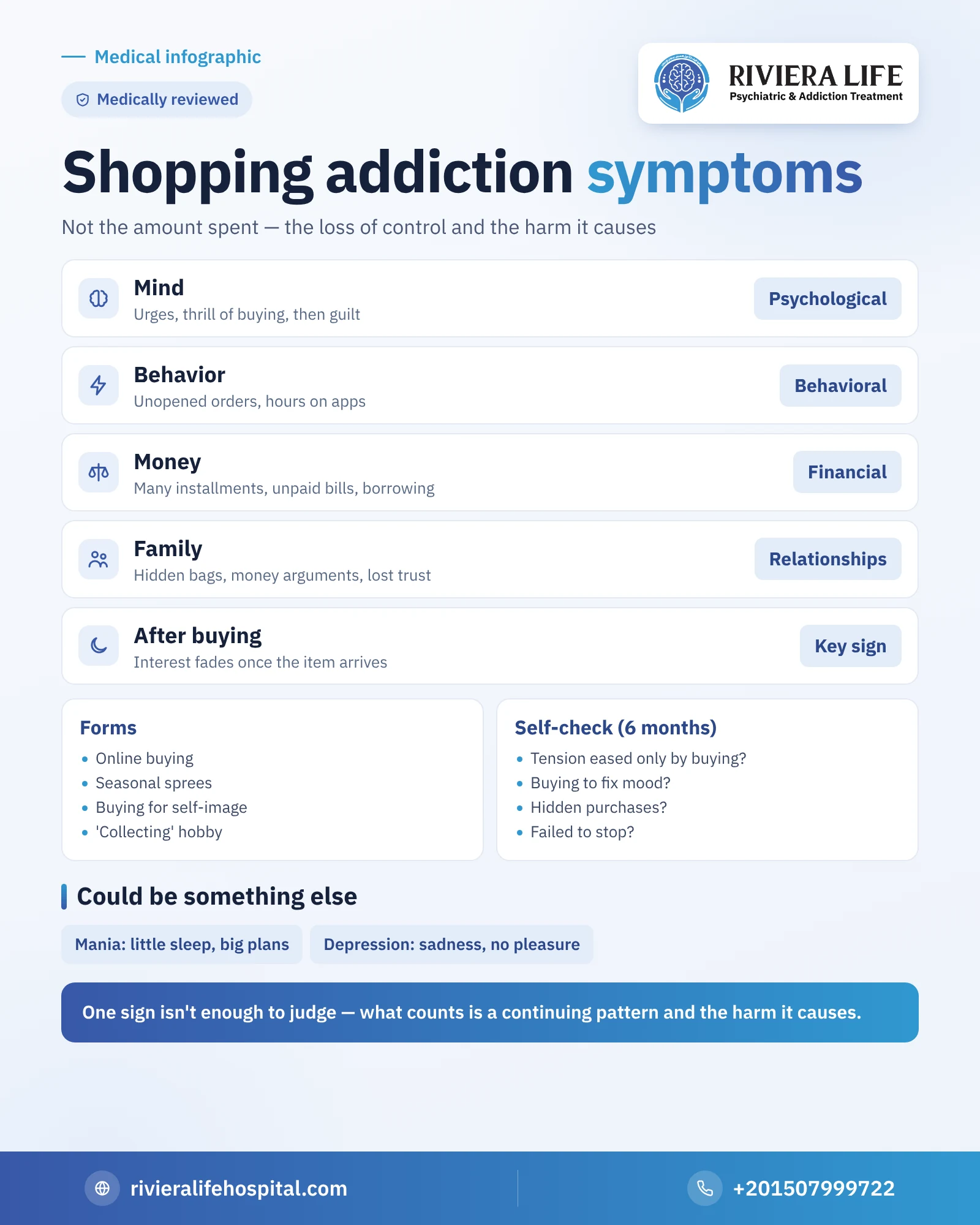
Shopping addiction symptoms revolve around losing control over buying: a recurring urgent desire, buying that exceeds need and financial ability, then quick regret followed by new buying. The signs appear in thoughts and feelings, in behavior and money, and in the relationship with the family. One sign isn’t enough to judge; what counts is the continuation of the pattern and the harm it causes. This article helps you distinguish compulsive buying from ordinary love of shopping, offers questions for self-assessment, and explains when you need specialist help.
When does shopping become a problem?
There is no specific amount that separates ordinary from compulsive shopping. A well-off person who spends a lot on what they love without distress or debts isn’t ill, while another person may suffer from compulsive buying while buying cheap things, but buys them without stopping, hides them and borrows for them. The real question: do you control the buying or does it control you? And does it cause you distress or problems with money, work or relationships?
Psychological signs: what goes on in the mind
- Repeated thinking about buying, apps and offers even during work or while sitting with the family.
- A sudden urgent desire to buy that is hard to postpone, like a tension that only calms when the order is completed.
- Excitement and relief at the moment of buying greater than the joy in the thing itself.
- Regret, guilt or shame hours or days after buying.
- Repeated justifications: “it had a big discount”, “I’ll need it later”, “I deserve a reward”.
- A feeling of emptiness or distress on days without buying.
Behavioral signs
Behavior reveals what the person may hide in words. Among the common signs:
- Buying many similar things, such as dozens of pieces of the same type or different colors of the same product.
- Piles of unopened orders, or clothes still with their tags in the wardrobe.
- Browsing shopping apps for hours, especially at night before sleep.
- Following live streams of sales pages and constantly waiting for offers.
- Buying after an argument, a tiring work day or a feeling of loneliness.
- Returning purchases and then immediately buying others, in an endless circle.
Financial signs
Money is where the harm shows clearly. Pay attention if you notice:
- Several ongoing installments at the same time through installment apps and consumer finance companies.
- Using one credit card to pay off another, or repeatedly reaching the maximum limit.
- Delays in paying rent, bills or basic expenses because of purchases.
- Borrowing from family or friends or joining savings circles (“gameya”) to cover installments.
- Not knowing the total monthly commitments precisely, and avoiding looking at the account statement.
Signs in relationships and the family
The family often discovers the matter late. The affected person hides bags in the car or with a friend, has orders delivered to work, removes price tags, and understates the price of what they bought when asked. Over time marital arguments about money recur, and trust is shaken when unknown debts appear. The person may withdraw from occasions out of shame or because they have nothing to spend after purchases have drained their income.
What happens after buying?
One of the clearest things that distinguishes compulsive buying is what comes after it. A person who buys out of need uses what they bought and enjoys it, while the affected person usually loses interest in the thing as soon as it arrives. They may leave it in its bag, quickly give it to someone else, return it to buy something else instead, or forget it completely. The joy is replaced by a feeling of heaviness and guilt, and sometimes self-disgust. This difference between the enthusiasm before buying and the indifference after it is an important sign the doctor picks up in the interview.
Different forms of compulsive buying
Online buying
The fastest-spreading form today, distinguished by easy access night and day and the absence of any friction that slows the decision. One finger and a saved card are enough.
Seasonal buying
Some affected people’s spending explodes in major sale seasons or before Eid, Ramadan and the start of school, then calms relatively for the rest of the year.
Buying for self-image
A focus on clothes, cosmetics and brands, in search of acceptance or social status, often linked to comparison on social media.
“The collecting hobby”
A form more common among men: electronic devices, watches, equipment and car accessories, presented as an interest rather than a problem.
What does the picture look like in reality?
Imagine an employee in her thirties who comes home from a tiring job and opens a shopping app “just to look”. An hour later she finds in the cart a bag, a set of cookware and three items of clothing, and chooses installments over six months because the installment is “small”. In the morning she feels a tightness, and when the order arrives she hides it in the car’s trunk. At the end of the month she discovers that the total of her installments is close to half her salary, so she feels severe distress, and that same night she opens the app again. This repetition, not the buying in itself, is the essence of the problem.
Signs in teenagers and young people
Compulsive buying may start early. Parents notice successive orders arriving at the house in the son’s or daughter’s name, transactions on a parent’s card saved on the phone, selling personal belongings to buy others, or an exaggerated preoccupation with brands and comparing oneself with influencers. The matter deserves a calm conversation if it is accompanied by sadness, isolation or a decline in studies, because buying may be a cover for a deeper psychological problem.
Questions for self-assessment
Answer honestly about the last six months. These questions aren’t a diagnosis, but they draw the picture:
- Do you often buy things you don’t need or don’t use?
- Do you feel a tension that only calms with buying?
- Do you buy to improve your mood when you are sad, anxious or lonely?
- Do you feel guilt or shame after shopping?
- Have you hidden purchases or installments from your family?
- Have you promised yourself to stop and failed more than once?
- Has buying caused you debts or problems with your family or at work?
If you find yourself answering yes to several questions, it is better to talk with a doctor or psychologist, as only they can assess the condition and determine the diagnosis.
When is spending a sign of another disorder?
Excessive spending isn’t always compulsive buying. If it came in a specific period with little sleep without tiredness, excessive activity, fast speech, and ideas of grandeur or unrealistic plans, it may be a sign of a manic episode, whose details you will find in the article on bipolar disorder symptoms. And if buying is linked to deep sadness, loss of pleasure and tiredness, depression may be the main driver. Distinguishing between these conditions matters because their treatment differs, and the factors that feed compulsive buying are explained in the article on the causes of shopping addiction.
When do you seek help?
Seek an assessment if the pattern has continued for months despite your attempts, or if debts or installments you can’t pay have accumulated, or the matter has started to threaten your marriage or work, or if you feel severe despair because of the financial situation. And if thoughts of death or self-harm appear, call an ambulance on 123 or go to the nearest emergency department immediately. The steps of treatment itself you will find in the article on shopping addiction treatment.
At Riviera Life the psychiatry consultants carry out a confidential assessment that looks for compulsive buying and what may accompany it of depression, anxiety or mood disorder, without judgment or blame, and the first consultation is free.
More from the shopping addiction guide
- Shopping addiction: the complete guide
- Causes of shopping addiction
- Shopping addiction treatment
- Anxiety disorders: the complete guide
- Kleptomania: how it differs from ordinary theft, its symptoms and treatment
Questions many people ask
Not necessarily. Occasionally buying unnecessary things is common. It becomes worrying when it recurs despite attempts to stop and causes debts, distress or hiding from the family.
Because in compulsive buying, purchasing relieves tension temporarily and then leaves behind anxiety about money and shame at losing control. This quick shift from excitement to regret is an important sign.
Several installments at the same time without knowing their total or being unable to pay them may be a sign of out-of-control buying, especially if combined with hiding them from the family.
You may notice many unused orders, hidden bills or bags, sudden debts, and a change in mood around shopping. It is best to talk calmly and encourage assessment instead of accusing.
A psychiatrist or psychologist assesses it through a detailed interview, and also looks for depression, anxiety or manic episodes that may explain the excessive spending.