Melatonin is the hormone of darkness. A small gland deep in the brain releases it when the light fades in the evening, telling the body that night has begun and that bedtime is approaching. It is not a sleeping pill in the usual sense, but closer to a time alarm that sets the body’s biological clock. That is why late nights, screens, night work and travel across time zones disrupt it, as do alcohol and drug use and withdrawal. On this page we explain what melatonin is, how it works, its relationship with sleep, mood and addiction, and what you should know before using its supplements.
What is melatonin?
Melatonin is a hormone, not a neurotransmitter. It is released into the blood and reaches all parts of the body, binding to special receptors in the brain and other organs. The body makes it from the amino acid tryptophan found in food, through an important intermediate station, serotonin. In other words, part of the serotonin linked to mood by day is converted in the pineal gland into melatonin at night.
The pineal gland is about the size of a grain of rice and sits in the middle of the brain. Melatonin is also produced in amounts in other organs such as the gut, but its role there is different and still under study.
How does the body know that night has come?
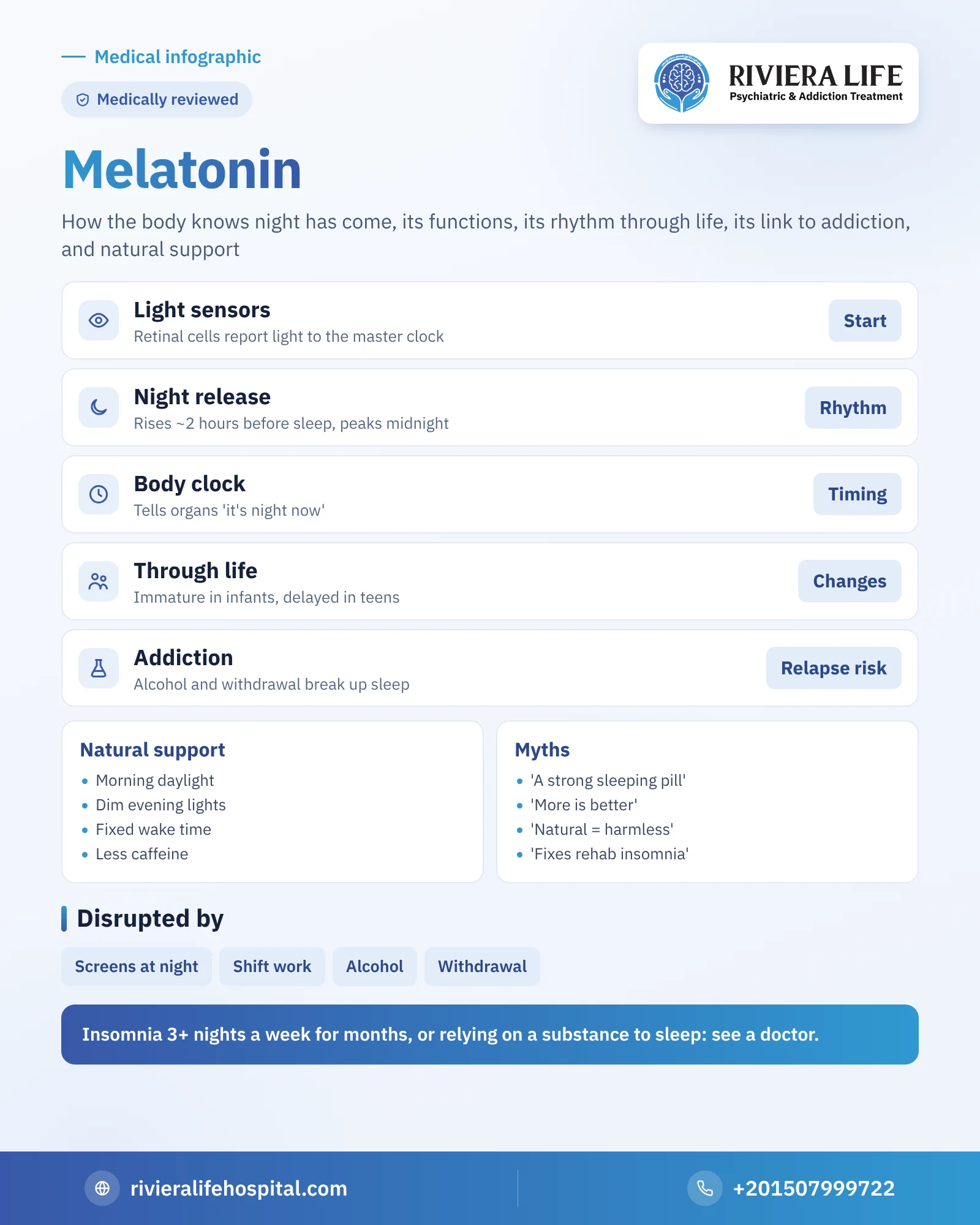
The story begins in the eye. In the retina there are special light-sensitive cells, especially sensitive to bluish light, that don’t help you see but send a report on light intensity to the “master clock” in the brain, a small group of cells in the hypothalamus. When the light decreases, the master clock sends a signal along a long nerve pathway to the pineal gland to start releasing.
Melatonin usually rises about two hours before the usual bedtime, peaks in the middle of the night, then falls toward morning. At the same time, cortisol is at its lowest levels, then the two hormones swap roles at sunrise. Bright light at night, even from a phone screen held close, may delay this rise.
The functions of melatonin
- Setting the body clock: it carries the information “it is night now” to the body’s organs so they regulate their rhythms, from body temperature to digestion.
- Opening the gate to sleep: it slightly lowers alertness and prepares the body for sleep, but does not impose it as sleeping pills do.
- Seasonal rhythms: the duration of its release changes with the length of the night in winter and summer, which matters more in some animals than in humans.
- Other roles under research: such as an antioxidant effect and a link to immunity; the evidence is mostly from the laboratory and is not enough for therapeutic claims.
Melatonin, sleep and mood
Disruption of the melatonin rhythm shows up as difficulty falling asleep at the desired time, waking very early, or daytime sleepiness. Body-clock disorders are a separate category of sleep disorders, such as delayed sleep phase, common in teenagers and young people, shift-work disorder, and jet lag from travel across time zones.
As for mood, the relationship is clear in both directions: most patients with depression suffer from disturbed sleep, and disruption of the daily rhythm is strongly observed in bipolar disorder, where lack of sleep may precede a manic episode. Winter-related seasonal depression is sometimes treated with bright light in the morning. But this does not mean depression is a “melatonin deficiency”.
Melatonin through the stages of life
A baby is not born with a mature melatonin rhythm; the clear difference between night and day in its release begins to appear within roughly the first months, which is why newborns sleep in broken stretches that don’t distinguish night from day. With puberty, the timing of release is delayed in many teenagers, so they feel sleepy late and find it hard to wake early for school; this is a real biological change, not just laziness. In old age, night-time release decreases and sleep becomes lighter and more broken for many, although the causes of insomnia in older people are many and not limited to melatonin.
Late nights, shift work and Ramadan: the clock versus modern life
The body clock was designed for a world governed by sunrise and sunset, while today we live under strong lighting until midnight. Someone who works night shifts asks their body to sleep during the day in sunlight, when melatonin is low, so they sleep less and more lightly. Many in Egypt notice a similar experience in Ramadan, when bedtimes, mealtimes and late nights shift and then work comes in the morning, so the clock is disrupted for weeks and needs days to recover after Eid. The solution is not to fight life, but to fix what can be fixed: a wake time that stays close to constant, morning light, and a completely dark room when sleep is during the day.
Low and high melatonin
Doctors do not measure melatonin in routine tests, because its level changes around the clock. In specialized sleep centers it may be measured in saliva over the evening hours in dim light to determine when release begins, which is mostly a research test.
Night-time melatonin release gradually decreases with age in many people, and may be affected in some blind people whom light signals do not reach, and in chronic night work. An excess, however, usually comes from supplements, and shows as daytime sleepiness, headache, dizziness and vivid dreams.
Melatonin and addiction
Most drugs strike sleep at its core. Alcohol makes a person fall asleep quickly, then breaks up their sleep in the second half of the night, and lowers night-time melatonin in some studies. Stimulants delay sleep by hours. Hash may shorten the time to fall asleep at first, then its withdrawal brings insomnia and disturbing dreams. And in withdrawal from opioids and sedatives, insomnia is one of the longest-lasting symptoms.
This insomnia is not a side detail; lack of sleep raises stress and craving, and is among the known causes of relapse. That is why rehabilitation programs care about resetting the body clock, and the practical details are in the article Melatonin and sleep.
How can you support melatonin naturally?
- Morning light: going out into daylight within the first hour after waking stabilizes the clock and keeps evening release on time. This is one of the most effective means.
- Evening darkness: dimming the lights and keeping screens away about an hour before sleep.
- Fixed schedules: waking at the same time every day, even on holidays.
- Reducing caffeine after midday and staying away from alcohol.
- Food: some foods such as tart cherries and nuts contain amounts of melatonin, but the evidence for their effect on sleep is limited.
Supplements and medicines related to melatonin
Melatonin is available as a supplement in many countries, and in others it is dispensed by prescription. Its regulation as a dietary supplement in some markets means its quality is not always guaranteed; tests on products in circulation have found that the actual amount differs greatly from what is written on the package. There are also medicines that act on melatonin receptors, including a sleeping medicine that mimics its effect and an antidepressant that works partly through these receptors. Some blood-pressure medicines from the beta-blocker class may also lower night-time melatonin release. Choosing what suits you, and when, is for the doctor, not the advertisement.
Common myths about melatonin
Myth: melatonin is a strong sleeping pill. The truth is that its effect on how fast you fall asleep is modest, and its clearer benefit is in setting timing, not in producing sleep.
Myth: a bigger amount is better. The truth is that large amounts do not necessarily give better results, and may increase daytime sleepiness and headache.
Myth: it is a natural hormone, so it is harmless. The truth is that it has side effects and drug interactions, and does not suit everyone, especially children and pregnant women without medical supervision.
Myth: melatonin treats addiction-related insomnia. The truth is that withdrawal and recovery insomnia needs a complete plan, and the supplement is at best a small part of it.
How does the doctor assess a sleep problem?
The doctor does not start by prescribing melatonin or anything else, but first asks: When do you sleep and when do you wake on work days and holidays? How long does it take you to drop off? Do you wake at night, and why? What do you drink or use in the evening? They may ask you to keep a sleep diary for two weeks, which usually reveals a pattern you hadn’t noticed, such as a gradual delay in bedtime or a long nap that steals night sleep. And if they suspect sleep apnea or another disorder, they refer you to a specialized sleep study.
The melatonin guide: each aspect in its own article
- Melatonin and sleep: when supplements may help and when they don’t, and how to deal with insomnia in the stage of recovery from addiction.
- Serotonin: the substance melatonin is made from, and its role in mood.
- How to lower cortisol: the other face of the daily rhythm and its relationship with sleep and stress.
- GABA and anxiety: the brain’s brakes that help switch off racing thoughts before sleep.
When should you see a doctor?
See a doctor if insomnia continues three nights a week or more for about three months, or affects your work and mood, or those around you notice loud snoring with pauses in breathing during sleep, or you feel very sleepy during the day despite enough sleep. And if the insomnia is linked to anxiety or depression, or you have started relying on a sedative, a drink or a substance to sleep, psychiatry is the right place. At Riviera Life, consultant psychiatrists and addiction specialists assess sleep problems linked to mental health and substance use in complete confidentiality, and the first consultation is free on +201507999722.
Medical sources and referencesThe information in this article is based on reliable scientific sources