
In the relationship between melatonin and sleep, melatonin acts as a chemical signal that opens the gate to sleep as darkness falls, but it isn’t a button that switches the brain off. That is why its supplements help in specific cases, most notably body clock disturbance due to travel or a delayed sleep time, while their effect in ordinary insomnia is modest. And the insomnia that accompanies recovery from addiction has a different story, in which the person in recovery needs a full plan, not a single tablet. In this article we explain how melatonin creates sleep, what spoils it, when the supplement may help and when not, and how you regain your sleep after stopping use.
Melatonin and sleep: how does it open the gate to sleep for you?
Sleep needs two forces working together. The first is “sleep pressure”: the longer the hours of wakefulness, the more substances accumulate in the brain that make you sleepier. The second is “body clock timing”: the signal that determines when this sleepiness is allowed to turn into sleep. Melatonin is an essential part of the second force; its rise in the evening tells the brain that night has fallen, lowers body temperature slightly, and calms wakefulness centers. Switching off racing thoughts, on the other hand, depends more on other systems such as GABA.
That is why melatonin may be on time, and the person still stays awake because anxiety, pain or caffeine is stronger than the signal. The scientific details about the hormone itself are in the melatonin guide.
What disrupts melatonin’s rhythm?
- Light at night: screens close to the eyes and strong white lighting may delay the rise of melatonin.
- No morning light: someone who spends their day in closed, poorly lit places has a weaker clock signal.
- Irregular times: staying up on holidays then waking early for work is like traveling between two countries every week.
- Night-shift work: asks the body to sleep at the time the clock is in daytime mode.
- Travel across time zones: the body needs days to reset its clock.
- Caffeine, alcohol and nicotine in the evening.
- Advancing age: night-time secretion falls in many older people.
Do melatonin supplements help? What the evidence says
The picture varies by type of problem:
- Jet lag from travel across time zones: one of the clearest uses supported by evidence, especially when traveling east.
- Delayed sleep phase: when someone consistently sleeps very late and can’t bring their time forward, the supplement may help with careful timing along with morning light.
- Insomnia in some older adults: used in some countries with a prescription for set periods.
- Some children with developmental disorders: only under the supervision of a specialist doctor.
- General chronic insomnia: the effect is modest, shortening the time to fall asleep by a few minutes on average.
Timing is an important factor that may matter more than the amount itself, which the doctor or pharmacist determines according to the case. That is why we don’t mention doses here.
Side effects and who should be careful
Melatonin is considered relatively safe for short-term use in most adults, but it isn’t free of problems. Its possible side effects include headache, dizziness, nausea, drowsiness the next morning, and vivid or disturbing dreams. A doctor’s consultation is worthwhile before using it for:
- Pregnant and breastfeeding women, because of insufficient studies.
- Children and teenagers, who shouldn’t be given it without a medical assessment. And keep the packs out of their reach, especially the types made to look like sweets.
- Anyone taking blood thinners, epilepsy medicines, diabetes medicines or immunosuppressants.
- Anyone taking sedatives or psychiatric medicines, because of possible increased drowsiness.
- Anyone who drives or operates machinery early in the morning.
Why is sleep disturbed in addiction recovery?
The first nights after stopping may be the hardest part of the journey. The substance was forcing artificial sleep or preventing it, and the brain needs time to learn again how to sleep on its own:
- Alcohol: interrupts sleep in the second half of the night, and in its withdrawal insomnia and disturbing dreams are common, as the article on alcohol withdrawal symptoms explains.
- Hash: many smoke it to sleep, so its withdrawal brings insomnia and very vivid dreams that may last weeks; details are in the article on hash withdrawal symptoms.
- Sedatives and pregabalin: insomnia rebounds strongly on stopping, which is why reduction is gradual.
- Opioids and tramadol: withdrawal is accompanied by insomnia with pain and restless legs.
- Stimulants: they may be followed by long, heavy sleep, then disturbed timing for weeks.
Improving sleep is possible, but usually needs weeks to months. And the good news is that improvement usually starts before the person in recovery notices it themselves.
The “sleeping pill” trap in recovery
The biggest mistake at this stage is chasing sleep at any cost: a sedative tablet from a friend, pregabalin without a prescription, or “just one drink”. It may work for a night, but it takes the brain back to the point of dependence, and many relapses started this way. Even melatonin itself doesn’t replace a sleep plan, though it is much safer than sedatives. Any sleep medicine in recovery should be prescribed by a doctor who knows your history with use.
Cognitive behavioral therapy for insomnia: the first choice
Medical guidelines recommend cognitive behavioral therapy for insomnia as a first line for treating chronic insomnia before medicines. It is a structured program over several weeks, whose elements include:
- Temporarily restricting time in bed so sleep becomes continuous and deep again.
- Linking the bed to sleep only, and getting out of it during long insomnia, then returning when sleepy.
- Adjusting anxious thoughts about sleep, such as “if I don’t sleep now my whole tomorrow will be ruined”.
- Relaxation and breathing techniques before sleep.
It is very suitable for people in recovery because it carries no risk of dependence.
What do you do when you wake in the middle of the night?
Waking at night is a natural part of sleep, and the problem starts when it turns into a struggle with the clock. Don’t look at the time, as counting the remaining hours raises tension and drives sleep away. Don’t open the phone, as the light and content together wake the brain. Try slow breathing in the dark for a few minutes, and if the insomnia goes on, go to a dimly lit place and read something calm until sleepiness returns. And most importantly, keep the same wake-up time in the morning even after a bad night, as this is what resets the clock.
A practical plan for your first week
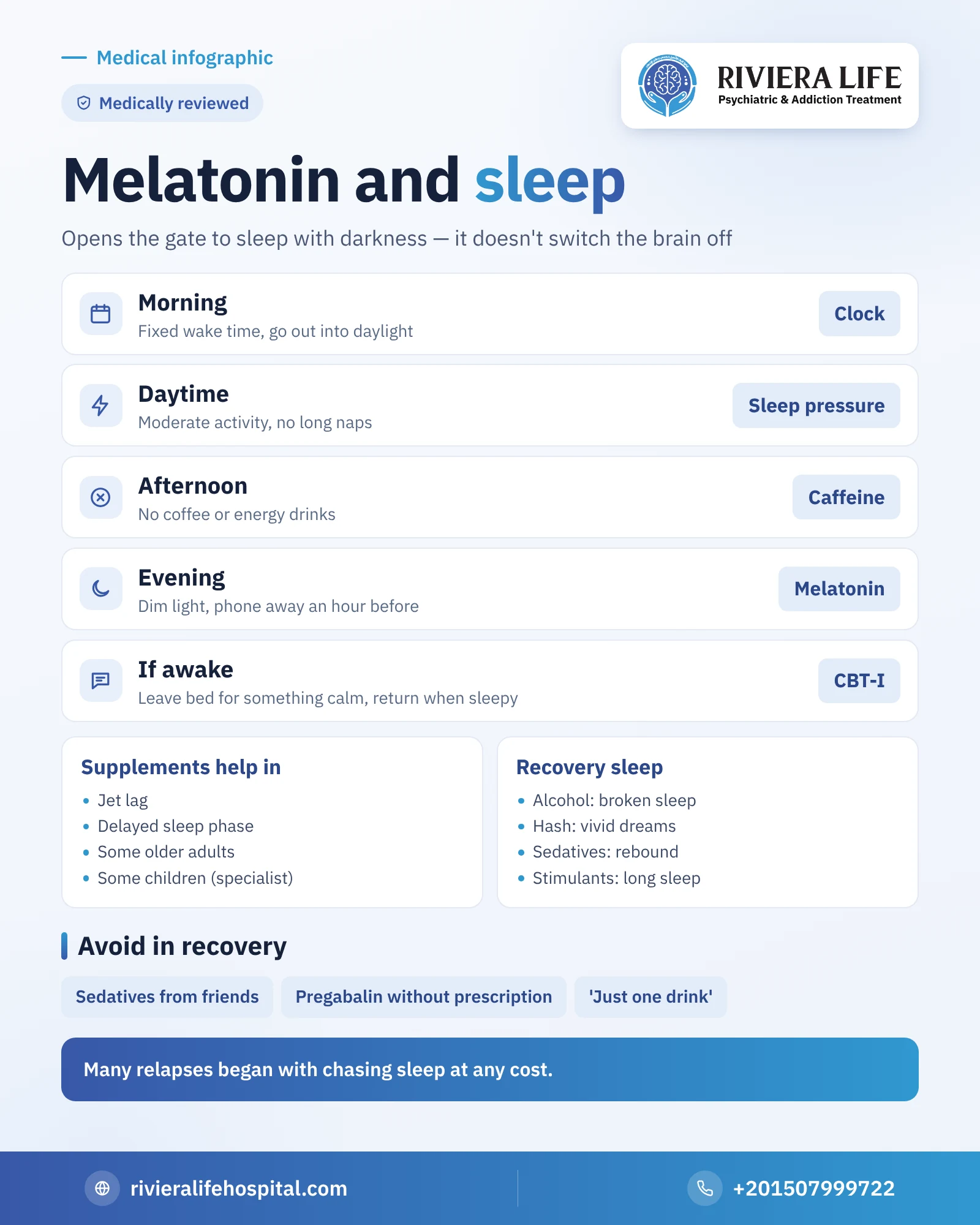
| Time | What to do | Why |
|---|---|---|
| Morning | Wake at a fixed time and go out into daylight | Fixes the clock and makes melatonin rise on time at night |
| Daytime | Moderate physical activity, and avoid long naps | Raises sleep pressure in the evening |
| After the afternoon | No coffee or energy drinks | Caffeine stays in the body for hours |
| Evening | Dim lighting, and put the phone away an hour before sleep | Allows melatonin to rise |
| When awake | Get out of bed for a calm activity then return when sleepy | Prevents linking the bed with worry |
When do you need a doctor?
See a doctor if insomnia continues for more than about three months, or is accompanied by persistent sadness or severe anxiety, as it may be a sign of depression or an anxiety disorder that needs treatment in itself. Likewise if someone notices loud snoring with pauses in breathing during your sleep, or you nod off involuntarily during the day. And in recovery, tell your treatment team immediately if insomnia becomes a motive for thinking about going back to the substance.
Ways to increase melatonin naturally: what works and what isn’t proven?
Your body makes melatonin itself and it can’t be “charged” with food as some think. But you can avoid what suppresses it and prepare the conditions in which it rises on time.
- Morning daylight: exposure to it after waking sets the body clock, so the rise of melatonin comes at a more suitable time in the evening.
- Evening darkness: dim the lighting an hour or two before sleep, and keep close screens away from your eyes.
- Consistent times: sleeping and waking at similar times throughout the week establishes the rhythm.
- Caffeine, nicotine and alcohol: each spoils sleep in its own way, so make your last cup of tea or coffee in the first half of the day.
As for the foods said to raise melatonin, such as tart cherries and nuts, they contain tiny amounts, the evidence for their effect on sleep is limited, and they don’t replace adjusting light and times. The decision on supplements is the doctor’s, especially for someone recovering from addiction. And if you suspect a deeper problem see sleep disorders: types and signs, and avoid chasing sleep with sedatives, as the article on sleeping pill addiction warns.
How does Riviera Life help you?
In Riviera Life’s rehabilitation programs, sleep takes its place in the treatment plan from the first day: a regular daily schedule, follow-up by consultant psychiatrists, insomnia treatment that doesn’t rely on addictive substances, and round-the-clock medical supervision. For a free first consultation in complete confidentiality, call +201507999722.
More from the melatonin guide
- Melatonin: the complete guide to the darkness hormone
- GABA and addiction: why does insomnia rebound after sedatives?
- How to lower cortisol
- Serotonin: the substance melatonin is made from
- Insomnia: the complete guide
- Sleep disorders: types, signs and when to see a sleep doctor or psychiatrist
- Parasomnia: sleepwalking, night terrors and home safety
- Narcolepsy: its symptoms, diagnosis and psychological impact
Questions many people ask
It may be a small part of the plan by the doctor's decision, but it doesn't treat withdrawal insomnia alone. The foundation is regulating the daily rhythm and cognitive behavioral therapy for insomnia.
It varies with the substance and length of use, and many notice gradual improvement within weeks, while some mild disturbances may continue for months.
It is considered relatively safe for short-term use in most adults, but long-term use data is limited. It is better to see the doctor if you need it for more than a few weeks.
One of its clearest uses is jet lag from travel across time zones, especially when traveling east, along with exposure to daylight at the new destination.
Hash reduces dream sleep, so when it stops this type of sleep returns strongly for a while, making dreams more vivid and disturbing. This usually calms gradually within weeks.
There is no recognized independent medical diagnosis called 'melatonin deficiency' with specific symptoms. What is common is delayed sleepiness, a disturbed sleep time and shallow sleep, usually caused by light and habits or a body clock disorder. Anyone with ongoing insomnia should see the doctor to assess the cause instead of relying on a test or supplement.