The relationship between GABA and anxiety is real, but more complex than the phrase “anxiety is a GABA deficiency” widespread online. GABA is the neurotransmitter that calms the brain’s alarm circuits, which is why medicines that strengthen its effect ease anxiety within minutes. But this very speed is what makes them only a short-term solution, while the main treatments for anxiety work in other, slower and safer ways. In this article we explain how the anxious brain behaves, the role of GABA in it, and why a supplement or sedative tablet isn’t enough to solve the problem.
How does anxiety arise inside the brain?
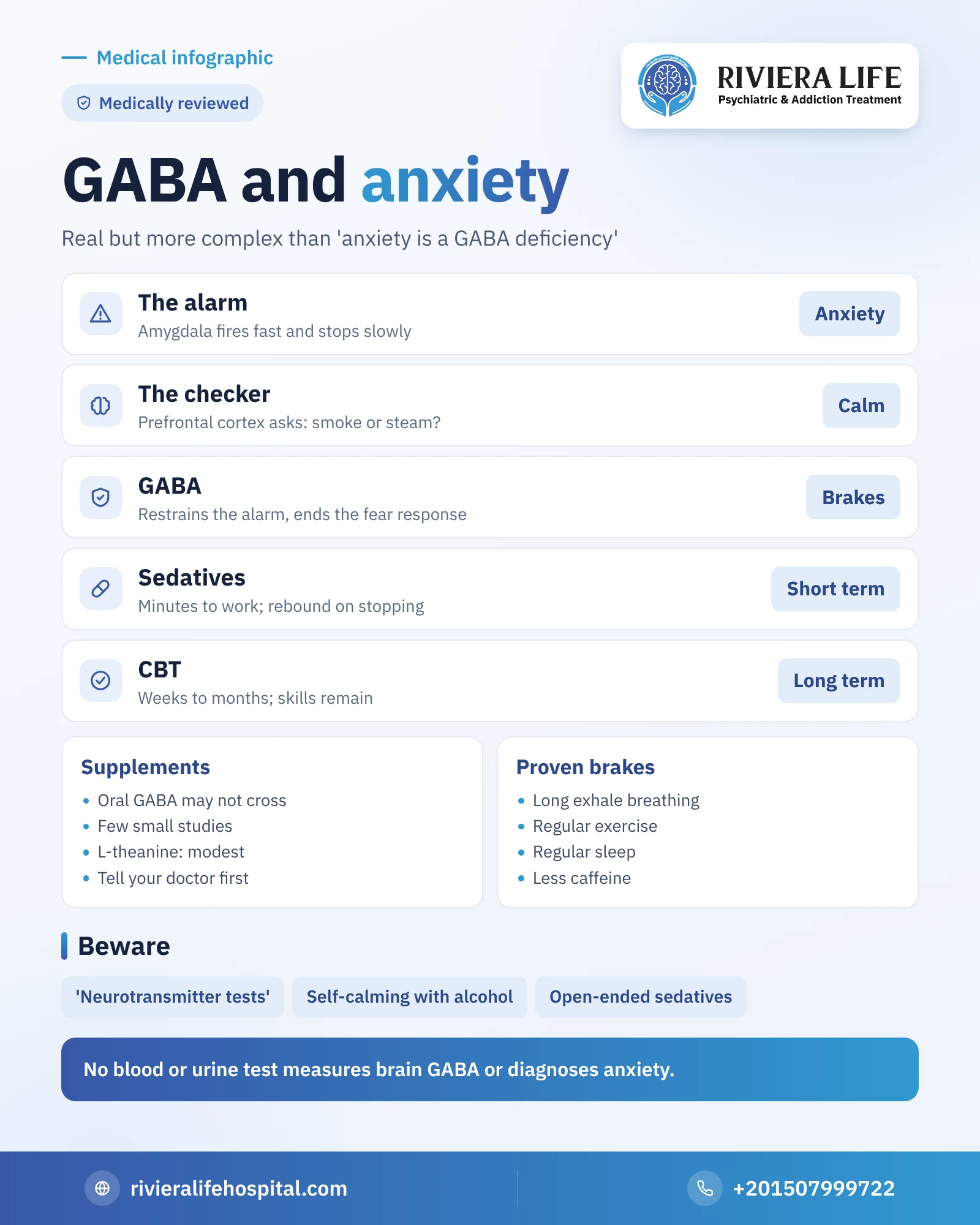
Imagine a house with a sensitive alarm system. When it detects smoke it sounds a siren, and the household gets up and acts. In the brain, the amygdala plays the role of the alarm system, activating at any possible danger and sending signals that raise the pulse and breathing and release stress hormones such as adrenaline. On the other hand, the prefrontal cortex works like the sensible homeowner who checks: is this smoke from a fire or steam from the kitchen?
In anxiety disorders the alarm becomes quick to go off and slow to stop, and the voice of sensible checking weakens. GABA is present on both sides: it restrains the alarm cells themselves, and helps carry calming messages from the cortex to the amygdala.
GABA and anxiety: what exactly is GABA’s role?
GABA is the most important inhibitory transmitter in the brain, as the GABA guide explains. When it binds to its receptors it makes the nerve cell less ready to fire a new signal. In the context of anxiety, this means:
- Reducing the alarm system’s sensitivity to minor stimuli.
- Stopping the fear response after its cause has gone instead of it continuing.
- Calming the racing thoughts that prevent sleep.
- Relaxing the tense muscles anxiety is felt in, in the neck, shoulders and jaw.
Is anxiety caused by GABA deficiency?
This question is the most searched, and the honest answer is: not that simply. Some magnetic resonance spectroscopy studies found lower GABA levels in certain areas in some people with panic disorder or anxiety, but other studies found no clear difference, and the measurements themselves are difficult and imprecise. Serotonin, noradrenaline and cortisol also take part in anxiety, along with heredity, early experiences and learned ways of thinking.
Most important in practice: there is no blood or urine test that measures GABA in the brain and diagnoses anxiety with it. Anyone who offers you a “neurotransmitter test” to determine your treatment is offering something psychiatry doesn’t rely on.
Sedatives: why do they relieve quickly and why are they given for a short period?
Benzodiazepines such as alprazolam and clonazepam attach to the GABA receptor and amplify its effect, so anxiety usually calms in less than an hour. This speed is useful in specific situations: an acute panic attack, the first days before the main treatment starts working, or severe anxiety before a medical procedure.
But the brain adapts to them within weeks, so their benefit decreases and dependence on them increases. That is why medical guidelines generally recommend the shortest possible period, usually a few weeks, with a clear plan for gradual stopping. The story of someone who starts with a tablet out of necessity and then finds themselves a year later unable to sleep without it is common in clinics. This side has a separate article on benzodiazepine addiction symptoms.
The main anxiety treatments work in a different way
The paradox is that the most effective long-term treatments for anxiety don’t target GABA directly:
- Cognitive behavioral therapy: retrains the way risks are interpreted, and gradually exposes the patient to what they fear until the brain learns the alarm is false. The patient keeps their skills after the sessions end.
- Antidepressants from the selective serotonin reuptake inhibitor class and similar: their effect starts within weeks, they don’t cause addiction, and they are usually the first medical choice.
- Pregabalin: approved in some countries for generalized anxiety disorder, it works on calcium channels, not GABA receptors, but carries a risk of misuse, as the article on pregabalin and anxiety explains.
Choosing the right medicine depends on the type of anxiety, accompanying illnesses and history of use, which is discussed in the article on the best medicine for depression and anxiety.
A quick comparison of three ways of calming
| The method | Speed of effect | Does the effect last after stopping? | Risk of dependence |
|---|---|---|---|
| Sedatives acting on GABA | Minutes to an hour | No, and anxiety may rebound stronger | High with long use |
| Antidepressants | Weeks | Partly, especially with psychotherapy | Not addictive, but stopped gradually |
| Cognitive behavioral therapy | Weeks to months | Yes, the skills remain | None |
GABA supplements: are they worth trying?
GABA capsules promising “natural calm” are widespread in online stores. The first problem is that GABA taken by mouth may only cross the blood-brain barrier in limited amounts, and scientists still disagree about this. The second problem is that the studies that tested it in anxiety are few, small and mostly short. The same goes for supplements such as L-theanine found in green tea, or magnesium: modest preliminary results that aren’t enough to treat a real disorder.
If you want to try any of these, tell your doctor first, especially if you take psychiatric or sedative medicines or are pregnant. And most importantly: don’t let the supplement become a reason to postpone treatment you need.
Proven ways to strengthen the brain’s “brakes” without medicine
- Slow breathing with a longer out-breath than in-breath: sends the body a signal of safety, and helps at the start of an anxiety attack.
- Regular physical activity: one of the strongest non-medicine means of easing anxiety, and small studies point to GABA markers rising after it.
- Yoga: limited studies have noted GABA rising after sessions, with improved mood.
- Regular sleep: deprivation makes the brain’s alarm system more sensitive the next day.
- Cutting down caffeine: it increases palpitations and tension in sensitive people.
A panic attack: when the brakes arrive late
In a panic attack the alarm system fires without real danger: strong palpitations, shortness of breath, dizziness, and fear of dying or losing control, then the attack usually calms within minutes. Researchers explain part of this by the calming system not catching up with the speed of arousal.
It helps to know that the attack itself isn’t dangerous to a healthy heart, and that trying to escape it or avoid its places strengthens the alarm next time. Slow breathing and staying in place until the wave passes teach the brain that the danger is false. But if this is the first attack, or there is chest pain in someone with heart risk factors, a medical examination comes first.
The trap of self-calming with alcohol and substances
Many anxiety patients discover by chance that a drink, a tablet of an unknown sedative or a hash cigarette calms them. Because alcohol and sedatives act on GABA, the relief is real but temporary. With repetition the brain adapts, so anxiety rebounds stronger between doses, and the person needs a larger amount. And so self-treatment turns into an addiction added to the original anxiety. If you find yourself in this cycle, read the article on GABA and addiction to understand what is happening and how it is treated safely.
When do you need a psychiatrist?
Passing anxiety is a natural part of life. But ask for an assessment if anxiety continues most days for weeks, or sudden bouts of palpitations and shortness of breath recur, or you start avoiding places and situations, or sleep has become impossible without help. Learn the signs in detail in the article on anxiety symptoms. The diagnosis is made by a psychiatrist after a full interview, not by an online test or a lab test.
How does Riviera Life help you?
The consultant psychiatrists at Riviera Life treat anxiety disorders with psychological and medical treatment together, and pay particular attention to those who have started relying on sedatives or alcohol to calm down, setting a safe reduction plan for them with a real treatment alternative. The first consultation is free and completely confidential on +201507999722.
More from the GABA guide
- GABA: the complete guide to the brain’s brakes
- GABA and addiction: alcohol, sedatives and the danger of withdrawal
- Adrenaline and anxiety
- Anxiety treatment: psychotherapy and medicines
- Ways to increase GABA safely: what helps, what is exaggerated and what to avoid
Questions many people ask
The calming system may be part of the picture in some patients, but attacks arise from many interacting factors. There is no test that proves GABA deficiency in a particular person.
Yes, cognitive behavioral therapy and antidepressants are the main options and their effect lasts longer. Sedatives are used, if needed, for a short period only.
It contains L-theanine, which has shown modest preliminary results for relaxation, but it isn't enough to treat an anxiety disorder. A cup of tea also contains caffeine.
Because the brain adapted to the outside support and reduced the sensitivity of GABA receptors, so rebound anxiety appears on stopping quickly. Gradual reduction under medical supervision reduces this effect.
Small studies suggest GABA markers in the brain rise after exercise, and more importantly the effect of exercise in easing anxiety is consistent across much research.