Gambling doesn’t turn into compulsive behavior because of greed alone, but because several factors meet in the same person: a brain that reacts strongly to unexpected reward, false ideas about luck and control, pressures they are escaping, and games and apps designed to keep them as long as possible. Understanding the causes of gambling addiction doesn’t justify it, but it explains why a gambler returns to betting even though they know they are losing, and identifies what treatment must target. In this article we explain how the cycle forms, the psychological, biological and social risk factors, and who is most vulnerable.
How does betting turn from entertainment to compulsion?
Similar stages recur in patients’ stories. It usually begins with a winning stage: a small bet that succeeds, or a surprise sum won in the first weeks of play, so a sense of talent or that luck is on their side takes root. Then comes the losing stage, in which they bet larger amounts to make up for it, and start hiding and borrowing. Finally comes the desperation stage, when betting becomes an attempt to rescue what can be rescued rather than a source of enjoyment, and debts, lies and isolation pile up. Not everyone goes through the stages in the same order, but the move from enjoyment to necessity is the essence of the change.
What happens in the brain?
The brain’s reward system handles unexpected wins in a distinctive way, releasing dopamine not only on winning but during anticipation and waiting for the result. This anticipation is what makes the moment the roulette wheel spins, or the last minutes of a match you bet on, so exciting. With repetition this system becomes less sensitive, so the person needs bigger or faster bets to feel the same excitement, and ordinary activities seem dull by comparison. Imaging studies indicate that the control areas at the front of the brain work less efficiently in those affected, so it is hard for them to curb the impulse even when they know the consequences.
Why does losing drag you into a new bet?
In most behaviors losing is a reason to stop, but in gambling it becomes a reason to continue. Doctors call this “chasing losses”: the person feels that the money they lost isn’t gone yet, and that they can win it back with one bigger bet. With each failed attempt the amount to be recovered grows, so the next bet grows. This behavior is one of the clearest signs of the disorder, and it explains how some patients lose in one night what they saved over years.
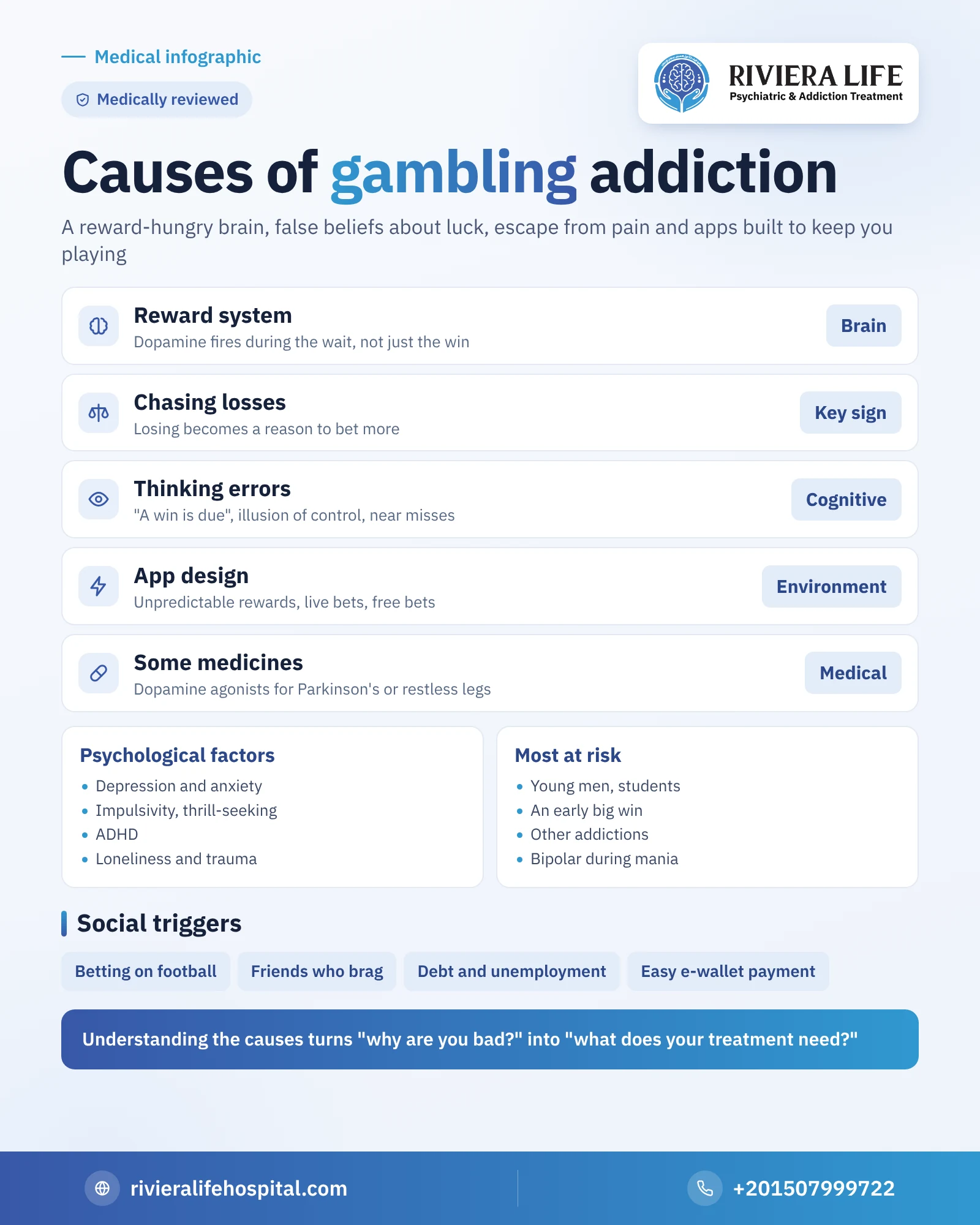
Thinking errors that feed gambling
The gambler holds a set of beliefs that seem logical from the inside, and treatment works to uncover them one by one:
- The gambler’s fallacy: the belief that consecutive losses mean a win is “near”, even though each round is independent of the one before.
- The illusion of control: the idea that knowing football, choosing a certain time or the way of pressing the button changes the result.
- The near miss: a result that “almost” succeeded is read as proof of skill, pushing them to try again.
- Selective memory: remembering wins in detail and forgetting or minimizing losses.
- Rituals and superstition: a lucky number, certain clothes or a time believed to bring luck.
The design of games and apps
Not all causes lie within the person. Modern betting platforms use elements known to increase play: intermittent rewards whose timing can’t be predicted, fast rounds allowing dozens of bets an hour, live betting during the match, welcome bonuses and free bets that make starting easy, and celebration sounds even when the win is less than the stake. Add to that advertising through prediction pages and influencers who show only the wins. And the easier payment is through e-wallets, the weaker the person’s sense that they are paying real money.
Psychological factors: when betting is an escape
Many patients don’t bet looking for money so much as looking for a way out of a painful feeling. An unemployed young man spends the night in front of a betting app escaping the sense of failure, or an employee weighed down by debt sees betting as the only way out of it. Psychological factors linked to gambling include:
- Depression and anxiety, which push towards seeking excitement or temporary relief.
- Impulsivity, thrill-seeking and low tolerance of boredom.
- Attention deficit hyperactivity disorder, which is linked to difficulty delaying desire.
- Loneliness and emptiness after retirement, living abroad or losing a job.
- Untreated trauma and major stress.
Genetics and biological factors
The risk is higher in those with a first-degree relative affected by gambling disorder or substance addiction, and twin studies point to a genetic component partly shared with alcohol addiction. One established medical fact is that some medicines for Parkinson’s disease and restless legs syndrome that stimulate dopamine receptors may cause a sudden urge to gamble or shop in a proportion of patients, and this usually improves when the doctor adjusts the medicine. That is why the doctor always asks about the medicines the patient takes, and no medicine should be stopped without consulting them.
Social and economic factors
The environment determines how easy it is to start. Factors that raise the risk include: exposure to betting at a young age, friends who bet and boast about their wins, a culture of betting on football matches that makes it seem normal, and the pressures of unemployment and debt that make the promise of quick money tempting. Smartphones make gambling accessible at any time and from anywhere, away from the family’s eyes, which is why its online form spreads faster among young people.
Why do many cases start with sports betting?
In Egypt a large number of cases begin with a love of football, not with a casino. The fan feels they understand the teams and players, so they think betting on a match they have followed for years is closer to skill than luck. Then come accumulator bets that promise a huge sum for a small stake, and live betting that turns every minute of the match into a new opportunity. With matches in different leagues almost every day, there is no “day off” from betting. This is how a passion for football becomes a convincing gateway, because the person doesn’t see themselves as a gambler but as an expert investing their knowledge.
Who is most at risk of gambling addiction?
- Young people and men in general, with a noticeable increase among students and followers of sports betting.
- Those who had a big win early in their experience of betting.
- Those with another addiction to alcohol or drugs, or a family history of it.
- People with bipolar disorder, especially during manic episodes.
- Those going through a financial crisis, job loss or long loneliness.
- Those taking dopamine-stimulating medicines without close follow-up.
Having one or more factors doesn’t mean the person will inevitably become addicted, but it means they need to watch early for the signs of gambling addiction.
Is gambling a moral weakness?
Many families explain gambling as corruption or a lack of religion, and many gamblers see themselves the same way, so their shame increases and they hide the problem longer. Religious and moral values are important, and can be a strong motive for change, but gambling disorder also affects religious people who reject what they are doing and can’t stop. Understanding the causes turns the question from “why are you bad?” into “what does your treatment need?”, and this is what opens the way to gambling addiction treatment.
How can Riviera Life help you?
The team at Riviera Life looks for the causes specific to each patient: undiagnosed depression, a medicine that needs adjusting, or the thoughts that convince them a win is near, then builds the plan on them. The first consultation is free and confidential on +201507999722.
More from our gambling addiction guide
- Gambling addiction: the complete guide
- Treating gambling and online betting addiction
- Gambling addiction symptoms
- How to deal with a gambling addict
Questions many people ask
It isn't inherited as such, but the predisposition to it rises in those with a relative affected by gambling or substance addiction. Environment and personal experience decide whether this predisposition turns into a problem.
Because losing creates an intense urge to win back what was lost, so they bet a larger amount; their brain also reacts to anticipating a win, not just to the result, and thoughts such as luck being near feed this continuation.
Yes, some medicines that stimulate dopamine, such as some Parkinson's medicines, may cause an urge to gamble in some patients. Tell the doctor immediately and don't stop the medicine without consulting them.
Because it is available all the time, fast-paced, easy to pay for and easy to hide, and it relies on rewards and notifications that encourage repeated returns.
It can be both. Some people start betting to escape sadness, and losses and debts later deepen depression, which is why the doctor treats both together.