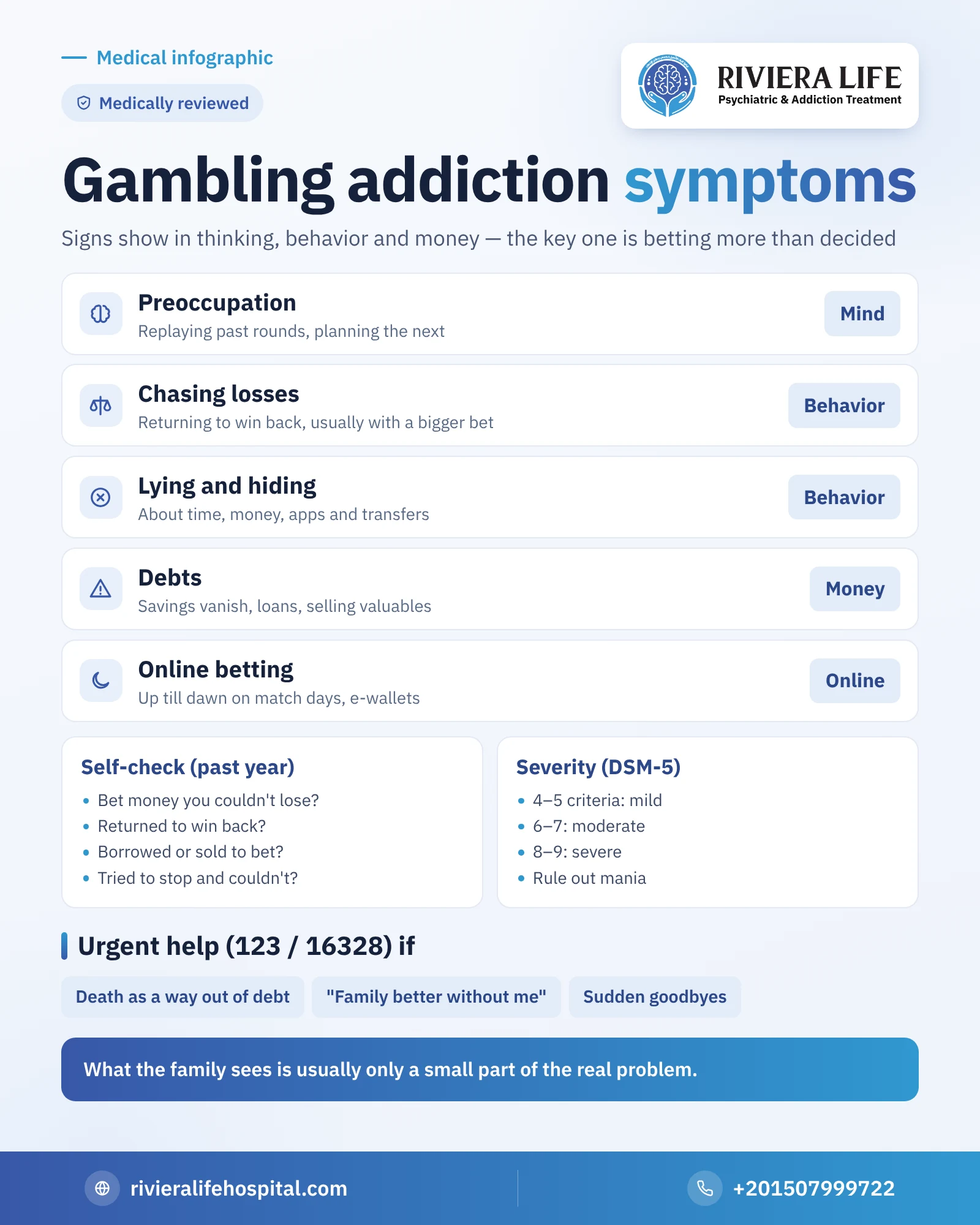
Gambling addiction symptoms appear on three levels: in thinking, when betting becomes a constant preoccupation of the mind; in behavior, when hiding, lying and chasing losses increase; and in money, when savings disappear and debts pile up. The most important sign of all is loss of control: the person bets more than they decided, and returns even though they promised themselves to stop. In this article you will learn the psychological, behavioral and financial signs, what the family can notice, how the doctor makes the diagnosis, and questions that help you assess your situation, bearing in mind that an actual diagnosis is made only by a doctor or psychologist.
When does betting become a problem?
Not everyone who has bet once is an addict. The difference between passing betting and the disorder shows in three questions: can the person stop at the amount and time they set in advance? Do they bet money that they or their family need? And does betting cause them harm while they continue despite it? When the answer to the first is “no” and to the other two “yes”, gambling becomes a condition that deserves assessment, regardless of the size of the amounts.
Psychological signs
- Constant preoccupation with betting: replaying previous rounds and planning the next, and following results and odds even at work or while sitting with family.
- Needing more: betting larger amounts to feel the same excitement they felt at the beginning.
- Tension on stopping: irritability, restlessness and distress when trying to cut down or abstain.
- Betting to escape: turning to it when sad or anxious, or after a quarrel or a bad day.
- Guilt followed by betting: a strong feeling of regret after losing, then a quick return to play to silence this feeling.
Behavioral signs
The clearest behavioral sign is chasing losses: returning the same or the next day to win back what was lost, usually with a bigger bet. Add to this lying about the time and money spent on play, repeated attempts to stop that end in failure, absence from work, study or family occasions, and withdrawal from friends who don’t bet. Some people close to them notice that their mood has become tied to match results or the night hours they spend in front of the screen.
Financial signs
Money is where gambling is usually exposed, even when the person succeeds in hiding everything else:
- Savings or household money disappearing without a convincing explanation.
- Repeated loans from friends and relatives, or from banks and financing apps.
- Selling gold, devices or valuables, sometimes without their owners knowing.
- Overdue bills even though income hasn’t changed.
- Small, repeated transfers through e-wallets to unknown parties.
- Asking others for help paying off debts whose source isn’t explained.
A player in control or a gambler who has lost control?
| Someone who bets occasionally | Someone who has lost control |
|---|---|
| Sets a small amount and stops there | Exceeds what they set almost every time |
| Accepts the loss and forgets it | Returns quickly to win it back |
| Hides nothing from their family | Lies and hides apps and transfers |
| Bets money beyond their needs | Bets rent and household money, or borrowed money |
| Betting is a small part of their time | Betting occupies their thinking most of the day |
This comparison doesn’t mean occasional betting is completely safe, but it shows where the red line begins.
What does the family notice?
A gambler rarely admits the problem at first, but the family picks up scattered signals: a phone that never leaves their hand and is turned face down when someone approaches, sudden irritability after a match, calls from unknown numbers they avoid, repeated going out without a clear reason, and swings between exaggerated generosity after a win and severe distress after a loss. One sign isn’t enough to judge, but several signs together with money problems deserve a calm conversation. If you are in this position, our article on how to deal with a gambling addict helps you choose the right way to raise the subject.
Signs specific to online gambling
Phone betting has a different footprint, because it doesn’t need leaving the house. Its signs include:
- Staying up until dawn with the phone lit, especially on European match days.
- Strange apps that are deleted and come back, or accounts in other people’s names.
- Promotional messages about bonuses and free bets arriving on the phone or by email.
- Transferring almost the whole salary to an e-wallet as soon as it is received.
- Following prediction channels and groups that share bets.
Accompanying physical and emotional symptoms
Gambling doesn’t enter the body as a substance, but its effects show on it. The gambler sleeps little and wakes exhausted, and may complain of headaches, stomach tension and palpitations linked to anxiety about debts. Over time symptoms of depression may appear: loss of pleasure, withdrawal, and a bleak view of the future. When trying to stop, many go through days of tension, insomnia and quick temper; these aren’t dangerous physical withdrawal symptoms, but they are moments when returning to betting is common.
How does the doctor make the diagnosis?
The psychiatrist relies on the criteria of the American DSM-5, which requires at least four of nine criteria during the last twelve months, with clear distress or impairment in life:
- Needing bigger bets to reach the same excitement.
- Tension and irritability when trying to cut down or stop.
- Repeated, unsuccessful attempts to control betting.
- The mind being preoccupied with betting most of the time.
- Betting when feeling distressed.
- Returning to win back losses.
- Lying to hide the extent of betting.
- Putting an important relationship, job or studies at risk.
- Relying on others to solve financial crises caused by betting.
Severity is determined by the number of criteria: mild with four or five, moderate with six or seven, and severe with eight or nine. The doctor makes sure the betting isn’t part of a manic episode, because that changes the diagnosis and treatment.
Questions that help you assess your situation
These questions aren’t a diagnosis, but they help you see the picture clearly. Over the past year:
- Have you bet an amount you couldn’t afford to lose?
- Have you returned on another day to make up what you lost?
- Have you borrowed or sold something to bet or to pay off a betting debt?
- Have you hidden betting from your family or lied about it?
- Have you felt guilty or anxious about the way you play?
- Have you tried to stop and been unable to?
If you answered yes to two or more questions, it is useful to talk with a specialist. To learn why some people fall into this pattern and not others, read the causes of gambling addiction.
Signs that can’t wait
A gambler talking about death as the solution to debts, or that their family would be better off without them, or suddenly saying goodbye to people, are real danger signs, not exaggeration. In this case don’t leave them alone, call an ambulance on 123 or go to the nearest emergency department, and you can call the hotline of the General Secretariat of Mental Health and Addiction Treatment on 16328.
When should you ask for help?
Ask for an assessment if you notice loss of control or debts and lying have started, and don’t wait for losses to pile up more. If you are the family of someone showing these signs, consulting on your own is useful even before they are convinced, because it helps you protect money and choose the right way to talk to them. Remember that many gamblers hide the real size of the problem, so what the family sees is usually a small part of it. Treatment at this stage is easier, and the steps are explained in our article on gambling addiction treatment. Riviera Life’s consultants can assess the case in complete confidentiality, and the first consultation is free on +201507999722.
More from our gambling addiction guide
- Gambling addiction: the complete guide
- The causes of gambling addiction
- Treating gambling and online betting addiction
- My husband gambles, what should I do?
- Kleptomania: how it differs from ordinary theft, its symptoms and treatment
Questions many people ask
It is usually betting more than the person planned, then returning to win back the loss. This is usually followed by hiding and lying about time and money.
Watch for late nights with the phone on match days, mood swings with the results, repeated requests for money, e-wallet transfers, and apps that disappear and come back. Several signs together deserve a calm conversation.
There are no dangerous physical withdrawal symptoms, but many feel tension, insomnia and irritability in the first days, a period in which the risk of returning to betting increases.
Yes, the standard is loss of control and harm, not the size of the amount. A small daily amount may consume the entire income of someone with limited means.
There are validated questionnaires that help with screening, but diagnosis is made by a psychiatrist after an interview reviewing the diagnostic manual's criteria and ruling out conditions such as manic episodes.