Dealing with a gambling addict starts with two steps before any confrontation: protecting the money that could be lost, and the family agreeing on one message. After that comes a calm conversation based on facts, not accusation, clear limits that you actually carry out, and a refusal of any form of rescuing him from the results of betting. This guide is aimed at the gambler’s family, whether he is a son, a brother or a father, and explains what to say, the difference between support and enabling, how to act if he refuses treatment or relapses, and when the situation becomes an emergency. Wives have a separate article because their financial and legal situation is different.
Before the talk: get your position in order as a family
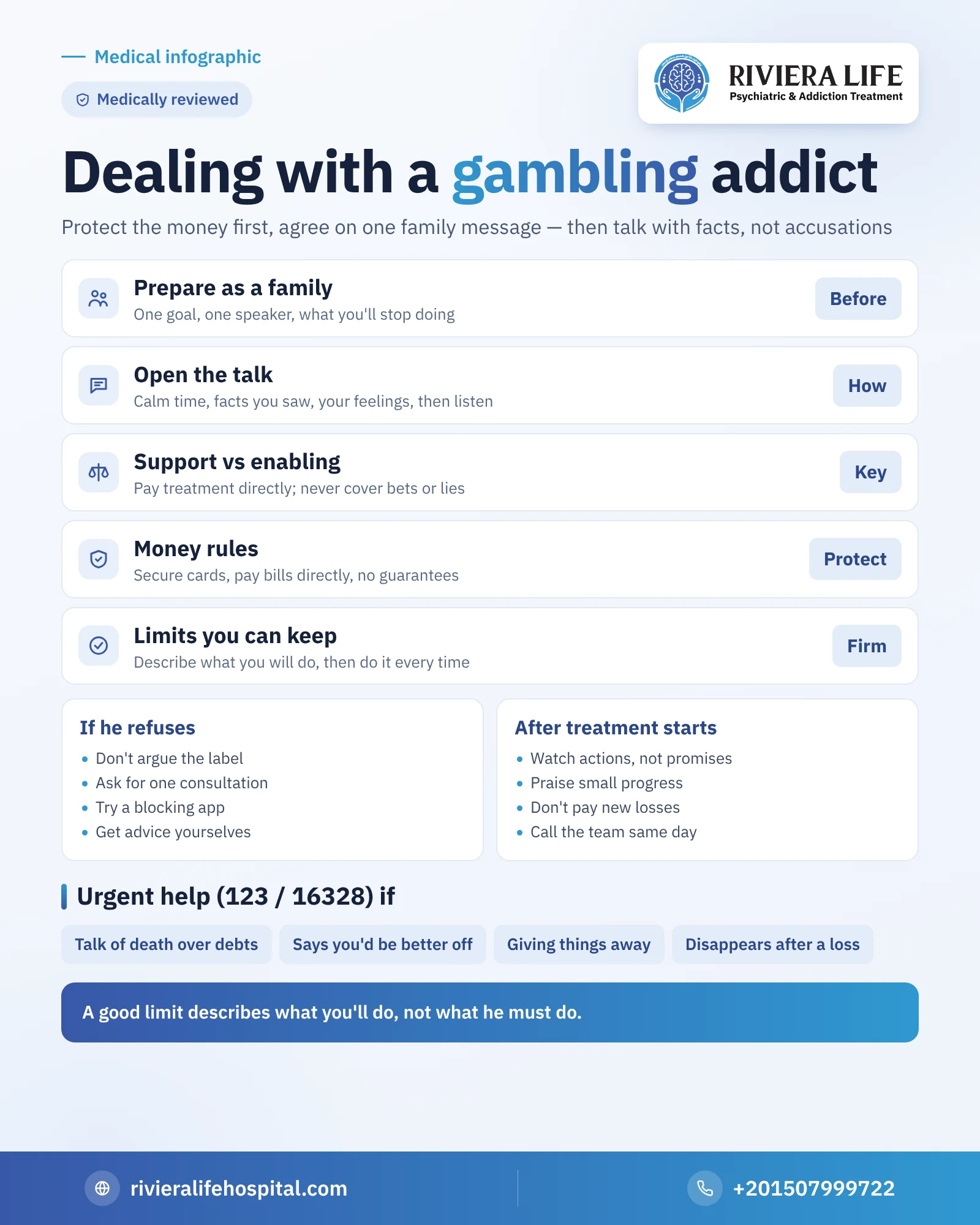
The confrontations that fail most are those that happen at the moment a big loss is discovered, or in which the father speaks in one tone and the mother in another. First sit without him, and agree on three things: the goal, which is for him to accept a specialist assessment, not to confess everything; who will talk to him; and what you will no longer do from today, such as giving him cash or paying a debt without everyone knowing. Gather the facts calmly: sums that disappeared, debts that appeared, missed appointments. And have the number of a treatment provider ready before the talk, so that if he agrees the moment isn’t lost. If you aren’t sure yet, see gambling addiction symptoms.
How do you open the conversation?
Choose a calm time away from a match he is following or a loss that just happened, and a private place without guests or children. Start with what you saw, not with judging him: “I noticed that the money we saved for the car is no longer there, and that you took a loan from your uncle” is much stronger than “you’ve wasted everything”. Then talk about your feelings: “I’m worried about you, and I can’t sleep anymore”. After that stop and listen to him. Many gamblers carry a real fear of scandal or of the size of their debts, and hearing this fear opens a door to a solution.
What to say and what to avoid?
| Instead of saying | Try saying |
|---|---|
| You’re a thief and I don’t trust you | Trust has been shaken, and we want to rebuild it with clear steps |
| How much exactly did you lose? Tell the truth now | We need to know the size of the debts together so we can arrange the solution |
| You have no willpower | Gambling is a condition with a treatment, and willpower alone isn’t enough |
| This is the last time I’ll pay for you | We won’t pay betting debts, and we’ll pay the cost of treatment |
| We’ll all tell people what you did | What happens stays inside the home, and treatment is confidential |
Avoid talking while you are angry, don’t threaten what you won’t carry out, and don’t try to extract a promise from him to stop from tonight, as a promise said under pressure collapses before the first urge.
The difference between support and enabling
Enabling is any action that eases the results of betting for the gambler so it is easier for him to continue, even with good intentions. Examples include: paying his debts secretly, lying to his manager to cover his absence, giving him cash because he is “in need”, and believing every new story about why money disappeared. Support is standing with him in treatment: paying the cost of sessions directly, buying his basic needs yourself, attending family sessions, and letting him face the results of his decisions within limits that don’t endanger his safety. The simple rule: help the person, don’t fund the bet.
Money and debts: rules that protect everyone
- Secure bank cards, gold and important papers, and change passwords and card numbers known to him.
- Pay rent, bills and school fees directly, not through him.
- Don’t borrow in your name and don’t act as a guarantor for any new loan for him.
- Don’t pay any debt before he starts actual treatment, and before you see a complete list of the debts and their source.
- If he accepts, agree with him that a trusted person manages his salary temporarily with a set daily allowance.
These rules aren’t a punishment. They are a barrier that gives treatment a chance, and protects the rest of the family from paying the price.
How do you set limits you can carry out?
A good limit describes what you will do, not what he must do. “I won’t give you cash, and I’ll buy what you need” is a limit that can be carried out, while “Don’t you dare bet again” is a demand you can’t guarantee. Set a small number of clear limits, tell him about them calmly, and carry them out every time.
Every limit broken without a consequence teaches him that words mean nothing. Among the common limits that work with gamblers’ families: no cash, no guaranteeing loans, no lying to others to cover his absence, and no discussion of debts in front of the children. Write them down if you need to, so no one disagrees about them later.
If he denies or refuses treatment
Denial in the first conversation is expected, and doesn’t mean the attempt has failed. Don’t get into an argument about the word “addict”, and ask for a small step: just one consultation, or installing a betting-blocking program for a month as a trial. Research indicates that training the family in an approach that combines encouraging every positive behavior, letting the natural consequences of betting happen without rescue, and choosing the right moments to offer treatment greatly raises the chances of accepting help. You can ask for a consultation for yourselves first to learn this approach even before he agrees.
If the gambler is a teenager or a student
Gambling by phone now reaches school and university students. Here the family has a bigger role in control: monitoring payment tools and wallets linked to his phone, activating parental control tools, and following sources of extra money, with a conversation that respects his age and doesn’t rely on humiliation. And note that some young people start with video games containing random prize boxes, which our guide to video game addiction covers. Anxiety or depression behind a teenager’s betting needs a specialist assessment, not just punishment.
After treatment starts: how do you support him?
With the start of gambling addiction treatment, the family needs patience, because trust doesn’t return by decision. Watch actions, not promises: attending sessions, transparency about spending, and sticking to the debt plan. Praise small progress, and don’t turn every disagreement into a reminder of the past. If a relapse happens, deal with it calmly: don’t pay the new loss, contact the treatment team the same day, and review the gap that allowed the return.
Take care of yourselves too
Gamblers’ families live with anxiety, shame and anger no less than the gambler’s own suffering, and insomnia and depression may appear in them. Don’t carry this alone: talk to a specialist, look for family support groups, and keep the routine of the home and the children. To understand what drives your relative to continue despite everything, read causes of gambling addiction.
When does the situation become an emergency?
Financial pressure and shame may lead the gambler to dangerous despair, especially after a big loss or pressure from creditors. Take any talk of death completely seriously.
Seek urgent help immediately if you see
Call an ambulance on 123 or go to the nearest emergency department, and stay with him until help arrives; you can also call the General Secretariat of Mental Health and Addiction Treatment hotline on 16328.
- Talk of ending his life or that death is easier than the debts
- Saying the family would be better off without him
- Sudden goodbyes or giving away his belongings
- A threat to harm himself or a family member
- Sudden disappearance after a big loss with messages of despair
At Riviera Life the family can start with a free and confidential consultation session, even before the gambler himself agrees, on +201507999722 around the clock.
More from our gambling addiction guide
- Gambling addiction: the complete guide
- My husband gambles: what should I do?
- Treatment of gambling and online betting addiction
- Gambling addiction symptoms
Questions many people ask
Don't pay before he starts actual treatment and you know the full list of debts, because repeated paying makes him feel betting has no consequences. A repayment plan can be arranged later within treatment.
Start with a calm conversation based on specific facts, ask for a small step such as one consultation, keep your limits, and repeat the offer at moments when he is more ready, such as after a loss or a crisis.
It is better to pay for the need itself directly, such as a bill, medicine or food, instead of giving him cash that may go to betting.
Yes, and it is a very useful step. In it the family learns how to protect itself and how to talk to him in a way that raises the chances of his accepting treatment.
Deal with it calmly and without blame, don't pay the new loss, and contact the treatment team quickly to review the plan and close the gap that allowed the return.