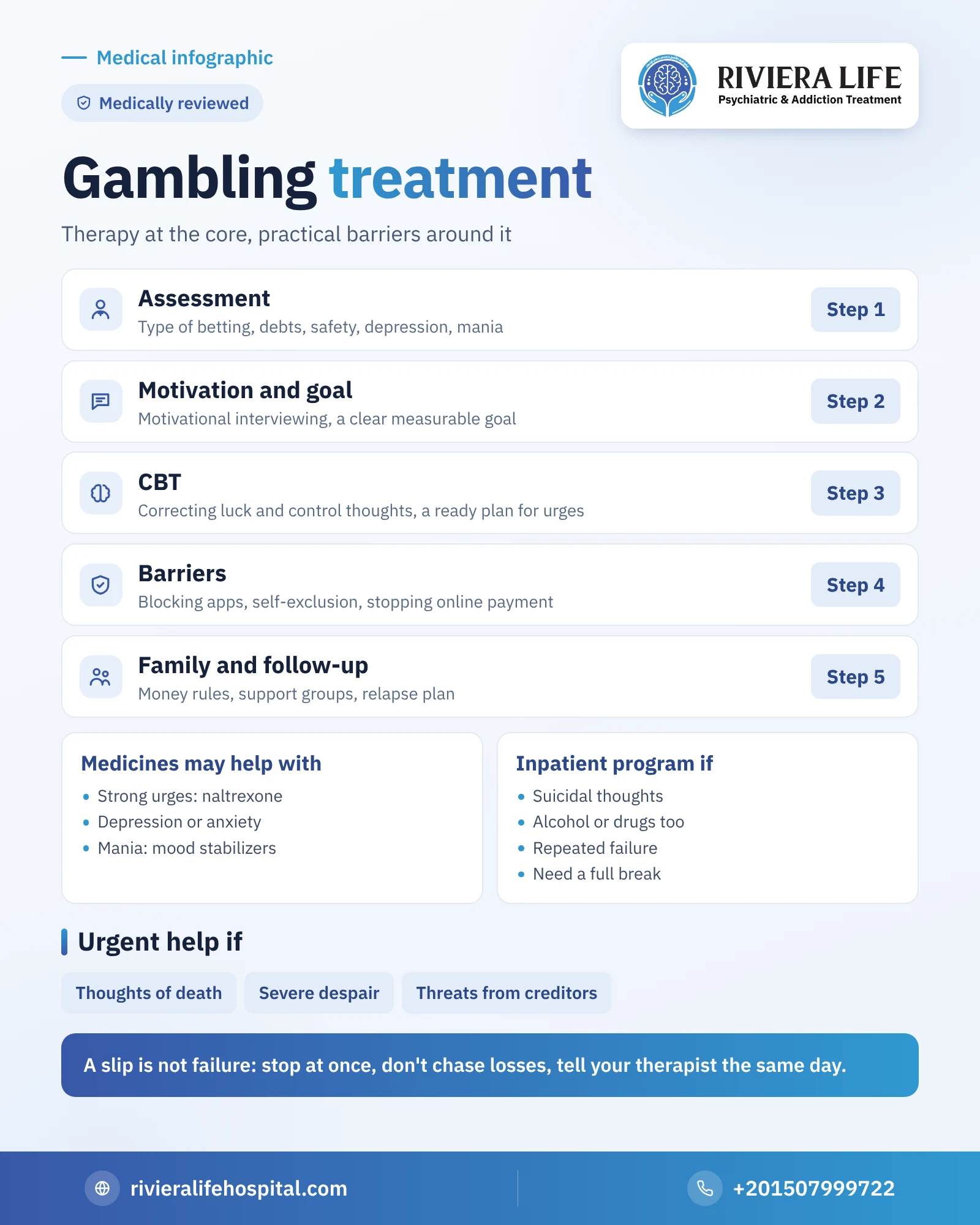
Gambling addiction treatment relies on psychotherapy, with cognitive behavioral therapy at its forefront, together with practical measures that cut off the road to betting sites and apps, temporary management of money, support for the family, and medicines the doctor decides on in specific cases. The patient does not need detox, but they do need a serious plan and long follow-up, because the urge to bet may return weeks after stopping. This article covers the treatment of online gambling addiction and sports betting on the phone in detail, because these are what bring people to the clinic most today.
Can gambling addiction be treated?
Yes. Gambling disorder is one of the addictive disorders researchers have studied well, and trials show that structured psychotherapy clearly reduces gambling days, amounts and urges in many patients. But treatment is not a button pressed once. Most of those who recover went through moments of weakness, and learned from them how to close the gap they went back through. That is why success is measured by the person’s ability to manage the urge and protect their money and life, not by never thinking of betting again.
The start: a comprehensive assessment before any plan
The patient does not have to have lost everything to start, nor to admit every detail from the first session. In the assessment the psychiatrist asks about the type of betting, its timing and amount, about debts, loans and the people they borrowed from, and about previous attempts to stop and what made them fail. Then they assess three matters that change the whole plan:
- Safety: are there suicidal thoughts or severe despair because of debts?
- Co-occurring illnesses: depression, anxiety, attention deficit disorder, or addiction to alcohol or drugs.
- Manic episodes: because impulsive gambling may be a symptom of bipolar disorder rather than a separate disorder.
And if you are not yet sure that what you are going through is addiction, start with the article Gambling addiction symptoms.
What is the goal of treatment: stopping completely or cutting down?
The doctor discusses the goal with the patient frankly. Stopping completely is the most suitable goal for most of those who have reached the stage of addiction, because “controlled” betting restarts the cycle quickly. Even so, some hesitant patients may start with an interim goal, such as stopping a certain type of betting or setting a strict ceiling, then move on to stopping completely when they feel the difference themselves. What matters is that the goal is specific and measurable: I never bet on live matches, I don’t carry more than a certain daily amount, and not a general phrase like “I’ll try to cut down”.
If you are hesitant to stop
Hesitation is natural, as betting was for years a means of excitement and escape, and sometimes the only hope of paying off debts. Here the therapist uses motivational interviewing: they neither argue nor preach, but help you set what gambling gives you beside what it takes from you, and hear your own reasons for change. Many patients discover in these sessions that the real motive is not money, but the wish for their children to trust them again or to sleep without fear of a creditor’s call.
Cognitive behavioral therapy: the heart of the plan
It is the psychotherapy for which international guidelines hold the strongest evidence of benefit in gambling, and it is offered individually or in groups.
Correcting thoughts about luck and control
The gambler holds thoughts that seem completely logical to them: “I lost five times, so a win is coming”, “I understand football better than others”, “I almost won, so I’m close”. In the sessions the patient learns to catch these thoughts the moment they appear, and to test them against the actual figures from their record of losses, so they gradually lose their power to convince.
Dealing with the urge the moment it appears
The patient writes with the therapist a ready plan before the urge comes: to postpone any bet for thirty minutes, to call a person they have agreed with, to leave the place or leave the phone in another room, and to start an activity that occupies their hands and mind. And they record every situation that triggered the urge and what succeeded in facing it, so over time the personal triggers become clear: payday, a big match, a quarrel at home, or a sleepless night.
Treating online gambling addiction: close the road before the urge starts
In betting on the phone, the distance between the urge and the bet is seconds. That is why psychotherapy alone is not enough; the patient needs barriers that give them time to think:
- Installing programs that block betting sites and apps on the phone and computer, and handing their password to a trusted person.
- Requesting self-exclusion from any platform where they have an account, and closing accounts permanently rather than freezing them.
- Stopping online payment on bank cards, and lowering the limits of e-wallets or closing those not needed.
- Temporarily handing management of salary and savings to a person they trust, with a set daily allowance in cash.
- Unfollowing pages and groups that promote bets and predictions, and muting notifications related to matches.
Deleting the app alone is a good step but it is not enough, because downloading it again takes a minute. Multiple barriers are what make the difference.
What is the role of medicines in gambling addiction treatment?
So far there is no medicine approved specifically for treating gambling disorder, and no pills that erase the urge for good. But the doctor may resort to medicines in certain cases:
- Opioid receptor antagonists such as naltrexone: studies indicate they may ease the intensity of the urge in some patients, especially those with strong urges or a family history with alcohol. It is only prescribed after checking liver function and making sure no opioid painkillers are being taken.
- Antidepressants: to treat accompanying depression or anxiety, not to treat gambling itself.
- Mood stabilizers: if it turns out that gambling is linked to manic episodes.
Sedatives, on the other hand, do not treat gambling, and may add a new dependence problem. And every medication decision belongs to the doctor alone after assessment.
Does the patient need to stay in hospital?
Most cases are treated in the outpatient clinic. But the inpatient program is the more suitable option when there are suicidal thoughts or an acute financial crisis that threatens safety, or when gambling is accompanied by an alcohol or drug addiction that needs safe withdrawal, or after repeated failure of outpatient treatment, or when the patient needs a period in which to be completely away from the phone, money and the betting environment to make a real start.
How long does treatment take, and how do you know you are progressing?
Recent British guidelines speak of cognitive behavioral therapy programs that usually run between roughly six and ten sessions, individual or group, but severe cases or those accompanied by other illnesses need longer, and follow-up continues for months after that. Real signs of progress are practical: consecutive days without betting, urges that pass without being acted on, regularity in work and sleep, a debt repayment plan that is moving, and greater frankness with the family. And in follow-up sessions the patient discusses specific situations: what worked this week, where they came close to betting, and what needs adjusting in the plan.
The role of the family and support groups
The family’s participation in some sessions, with the patient’s agreement, helps agree on money rules and the way of talking after any slip. Peer-experience support groups, such as Gamblers Anonymous groups, help break the sense of isolation and shame. And the family itself needs independent support; the details are in the article How to deal with a gambling addict.
Preventing relapse: what do you do if you go back to betting?
A slip does not mean treatment has failed. Stop immediately and don’t try to win back what you lost, because chasing losses is the fastest road from a small slip to a full relapse. Tell your therapist or your trusted person the same day, and review with them the gap that opened the road: an account you forgot to close, money in your hand beyond what was agreed, or pressure you didn’t talk about. And get to know your triggers through the article Causes of gambling addiction.
Ask for urgent help immediately if there appears
Call the ambulance on 123 or go to the nearest emergency department, or call the hotline of the General Secretariat of Mental Health and Addiction Treatment on 16328.
- Thoughts of death or ending your life because of losses or debts
- A feeling that the family would be better off without you
- Severe despair after a relapse with stopping eating and sleeping
- Threats from creditors that make you think of harming yourself
Experiences of those recovering from gambling: what repeats in their stories?
Many write “my experience with gambling” looking for someone who went down the same road. And the stories of those recovering, as therapists and support groups relate them, resemble each other in clear stations:
- Starting with a win: many mention an early win that made them think they understood the game, then the chasing of losses began to make up for what was lost.
- Hiding: loans, lying to the family and selling things from the house precede the admission by a long time in most stories.
- The first weeks after stopping: irritability, insomnia and repeated thinking about betting, and the urge intensifies with payday or seeing an advert or a match.
- What actually helped them: temporarily handing money management to a trusted person, blocking betting sites and apps, cognitive behavioral therapy, and regular attendance at gamblers’ support groups.
- Relapse: many of those recovering mention that they went back once or more before settling, and that what made the difference was a quick return to the plan, not self-punishment.
And the hardest thing those recovering relate is often not the urge itself, but facing the debts and regaining the family’s trust, which is why good treatment includes a financial plan and family sessions alongside the individual sessions.
How do you choose a hospital for gambling addiction treatment?
The right hospital for gambling addiction treatment is the one that offers what a gambler specifically needs: real psychological and behavioral treatment, not general advice, a practical plan for money and the phone, and a serious assessment of depression and suicide risk. Before you decide, ask:
- Does the team offer structured cognitive behavioral therapy for gambling disorder with sessions and written goals?
- Does it deal with online betting specifically: blocking apps and accounts and payment controls?
- Does it assess suicidal thoughts, depression and bipolar disorder at the start?
- Does it treat accompanying addiction to alcohol or drugs within the same plan?
- Does it involve the family and help it arrange money and debt matters without conflict?
- Is there regular follow-up after the program ends to prevent relapse?
And beware of anyone who promises you a guaranteed cure rate or treating gambling in a few days.
How Riviera Life meets these standards in gambling addiction treatment
This is how these standards come together at Riviera Life for those seeking treatment of gambling and online betting addiction in Egypt:
- Government licensing: gambling patients are treated in a psychiatry and addiction hospital that holds a Ministry of Health license.
- Specialized consultants: consultants in psychiatry and addiction treatment assess gambling and the depression or addiction that accompanies it.
- A practical behavioral plan: cognitive behavioral therapy with a plan to block online betting and control money.
- Round-the-clock medical supervision: a safe inpatient program for cases accompanied by despair or risk.
- Dual diagnosis treatment: safe withdrawal from accompanying alcohol or drugs together with treating gambling in one plan.
- A record of recovery: continuous work for fourteen years, during which thousands of patients recovered from addiction and psychiatric disorders.
- Complete confidentiality: your data, the details of your debts and your financial situation are fully protected.
- Family support after discharge: sessions for relatives and follow-up that extends after discharge so the patient does not go back to betting.
The first consultation for gambling addiction treatment is free of charge, our phone +201507999722 is available night and day, and the hospital is located in Sheikh Zayed, Giza Governorate.
More from the gambling addiction guide
- Gambling addiction: the comprehensive guide
- Gambling addiction symptoms and when to ask for help
- Causes of gambling addiction
- My husband gambles: what should I do?
Questions many people ask
Many people stop betting completely and get their lives back with regular treatment, but the urge may return in moments of pressure, so the patient learns skills that stop the urge from turning into a bet and keeps up follow-up.
Some people succeed on their own at first, but relapse is common when accounts stay open, money is available and debts are pressing. Having a therapist, a written plan and a trusted person greatly raises the chances of keeping going.
There is no approved medicine that removes it for good. The doctor may prescribe naltrexone in some cases after suitable tests to ease the intensity of the urge, but it works as an aid to psychotherapy, not a substitute for it.
Deleting is a useful first step, but it is easy to undo. It is better to add blocking with a password held by someone else, closing the accounts, stopping online payment and handing over money management temporarily.
Look for structured cognitive behavioral therapy for gambling disorder, a practical plan for online betting and money, early assessment of depression, suicide risk and bipolar disorder, treatment of any accompanying addiction, family involvement and follow-up after the program. Riviera Life in Sheikh Zayed meets these criteria: it is licensed by the Ministry of Health, and its consultants provide behavioral treatment and a plan to control online betting and money, with round-the-clock supervision and a family program.