A young person doesn’t become addicted to video games because they are “weak-willed”, nor because the game alone is powerful. The causes of video game addiction are a mix of three parties: a person with a certain psychological predisposition, an environment that leaves a gap or pressure, and a game carefully designed to keep them playing as long as possible. When the three come together, playing turns from enjoyment into an escape. This article explains each party, the risk factors that raise the likelihood, and what the family can change among them.
How does the brain learn to become attached to the game?
The brain works with a reward system in which dopamine is released when we achieve or expect something enjoyable. Winning a match, rising to a new level, or getting a rare weapon are all moments that activate this system. And the reward in games is fast, frequent and clear, unlike real life, in which the result of studying is delayed for months. With repetition, the brain learns that the shortest path to feeling satisfied is the screen.
The attachment grows when the reward is unpredictable. The player doesn’t know when they will win or what they will find in the box, and this anticipation itself pushes them to “one more try”. The same principle is what makes slot machines attractive, which is why the mechanics of modern games meet gambling addiction at many points.
Game design: why is it hard to stop?
Game companies measure every minute the player spends, and develop their games to increase these minutes. Among the design tools that make stopping difficult:
- Daily tasks and rewards: a prize for logging in every day, and the streak is lost if you miss a single day.
- Seasons and limited offers: outfits and weapons that disappear after days, so the player fears missing out.
- Loot boxes: the player pays for a prize they don’t know in advance.
- Short back-to-back matches: each match is minutes, so it seems “one more” won’t take time.
- Team commitment: the team is waiting for you, and leaving mid-match exposes you to blame or penalty.
- Rankings and levels: a rank that rises and falls makes the player feel they must defend their position.
This doesn’t mean every player will fall into the trap, but these mechanisms press harder on those with an existing predisposition.
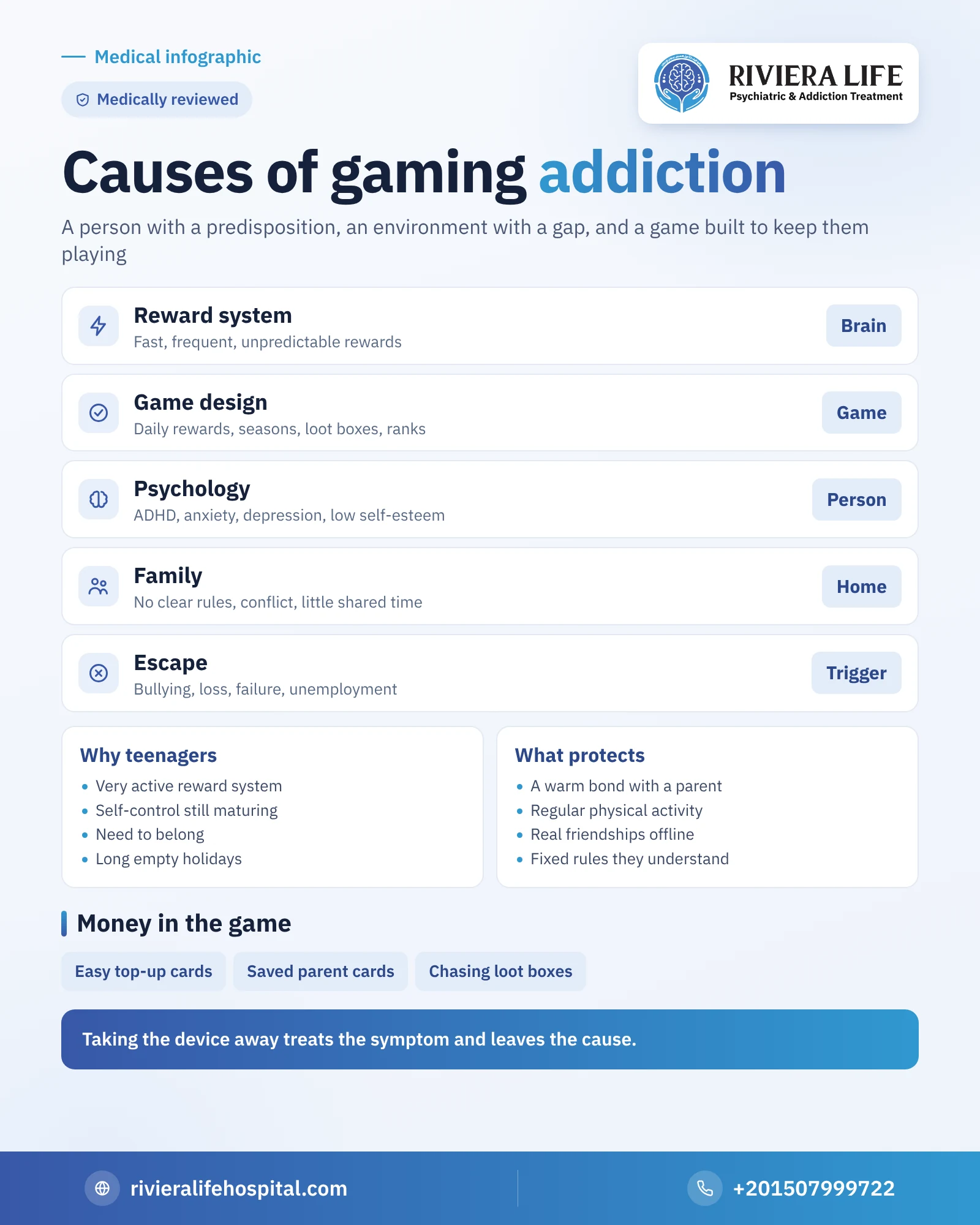
Personal psychological factors
Doctors notice that some traits and disorders recur among those addicted to games:
- Attention deficit hyperactivity disorder: the game provides fast, continuous stimulation that suits a brain that gets bored quickly, so moving to slow tasks such as studying is hard for it.
- Anxiety and social phobia: in the game, the young person communicates without anyone seeing their face or judging their appearance, so they find in it a refuge from situations they fear.
- Depression: when things lose their meaning, the game becomes one of the few things that still gives a feeling of achievement.
- Impulsivity and difficulty delaying pleasure: a trait that is already common in adolescence.
- Low self-esteem: a young person who feels they are failing at school or sport may be a “hero” in the game.
The relationship here runs both ways: depression and anxiety may push towards excessive play, and excessive play makes them worse. That is why the doctor makes sure to assess them, and you will find more on this in the guide to anxiety disorders.
Why are teenagers more vulnerable?
In the teenage years the brain’s reward system is very active, while the frontal lobe responsible for self-control and planning hasn’t yet fully matured. This natural gap makes the teenager more drawn to instant pleasure and less able to stop on their own. Added to this is their intense need for belonging and the esteem of their peers, a need that gaming teams and groups easily meet. That is why it isn’t enough to ask a teenager to “control themselves”; they need an external framework to help them until their internal framework matures.
Family factors
The home isn’t the only cause, but it has a big effect. Among the family circumstances linked to increased risk:
- No clear rules for screens, or rules that change with the parents’ mood.
- Parents being busy for long periods with work or their phones, and little shared time.
- Ongoing marital disputes or separation, so the child escapes to their room and screen.
- Excessive harshness or overprotection, as both weaken the child’s ability to manage themselves.
- Using the device as a “pacifier” for the child from their first years.
Social and environmental factors
In many cities children no longer have a safe place to play in the street, clubs are expensive and transport is exhausting, so the screen becomes the easiest option. PlayStation shops spread through neighborhoods and stay open until late hours. Many teenagers spend the long summer holiday without organized activity, a period in which parents often notice a jump in playing time. Peer pressure also plays a big role: if the whole group of friends plays one game every night, being absent from it means being absent from their conversations the next day.
Money inside the game
Topping up games has become easy with cards sold everywhere, e-wallets, or a parent’s card saved on the phone. Each small purchase seems worthless on its own, but they add up. And spending ties the player to the game more: someone who has paid money into a character or account finds it hard to leave. When buying turns into chasing loot boxes, the behavior comes close to gambling, a sign that must be taken seriously.
Loneliness and escaping reality
Many cases begin with a crisis that has nothing to do with playing: moving to a new school, bullying, the death of a relative, failing an important exam, or unemployment after graduation. In these moments the game offers an alternative world with clear rules and quick results, in which the young person can succeed and be valued. There is nothing wrong with seeking temporary relief, but when the game becomes the only way of dealing with pain, the original problem builds up unsolved, and reliance on escape grows. That is why the therapist always asks: what changed in your life before your playing increased?
Risk factors in brief
| Area | Factors that raise the risk |
|---|---|
| Age and sex | Adolescence and early adulthood, and males more in most studies |
| Mental health | Hyperactivity, anxiety, social phobia, depression |
| Family | No rules, disputes, little shared time |
| Environment | Empty time, few alternative activities, peer pressure |
| The game | Endless team play, daily rewards, loot boxes |
What protects the child?
Protective factors are no less important than risk factors: a warm relationship with at least one parent, regular physical activity, real friendships off the screen, enough sleep, success in some area that gives them self-confidence, and fixed rules whose reason they understand. These things don’t prevent playing, but they make it part of a full life, not the whole of life. And if signs of loss of control have already appeared, see the article on video game addiction symptoms to assess the situation.
Why does understanding the cause matter in treatment?
Because treatment differs with it. A teenager who plays to escape bullying at school needs a solution to the bullying problem, someone with hyperactivity needs it treated, and someone who plays because the home is tense needs family sessions. Simply taking away the device treats the symptom and leaves the cause to appear in another behavior. That is why video game addiction treatment starts with a comprehensive assessment that identifies what feeds the addiction in this particular person.
At Riviera Life, consultant psychiatrists work with the patient and their family to understand these factors before setting the plan, in complete confidentiality, and the first consultation is free.
More from the video games guide
- Video games: the complete guide
- Video game addiction symptoms
- The harms of video game addiction
- Video game addiction treatment
Questions many people ask
There is no gene for gaming addiction, but some traits that raise the risk, such as impulsivity, hyperactivity and anxiety, have a hereditary side. Environment and upbringing remain very influential factors.
Not necessarily, but many free games rely on in-game purchases, daily rewards and limited-time offers, mechanisms that make stopping harder for some.
Because addiction needs factors to come together: personality traits, psychological predisposition and particular circumstances such as bullying or loneliness. Two brothers in one house may differ a lot in these factors.
They resemble gambling in being payment for a prize that isn't guaranteed, which is why many researchers see them as worrying, especially for teenagers, and some countries regulate them with special laws.
The family isn't the only cause and blaming them doesn't help, but they have the greatest ability to help by setting fixed rules, increasing shared time and seeking treatment early.