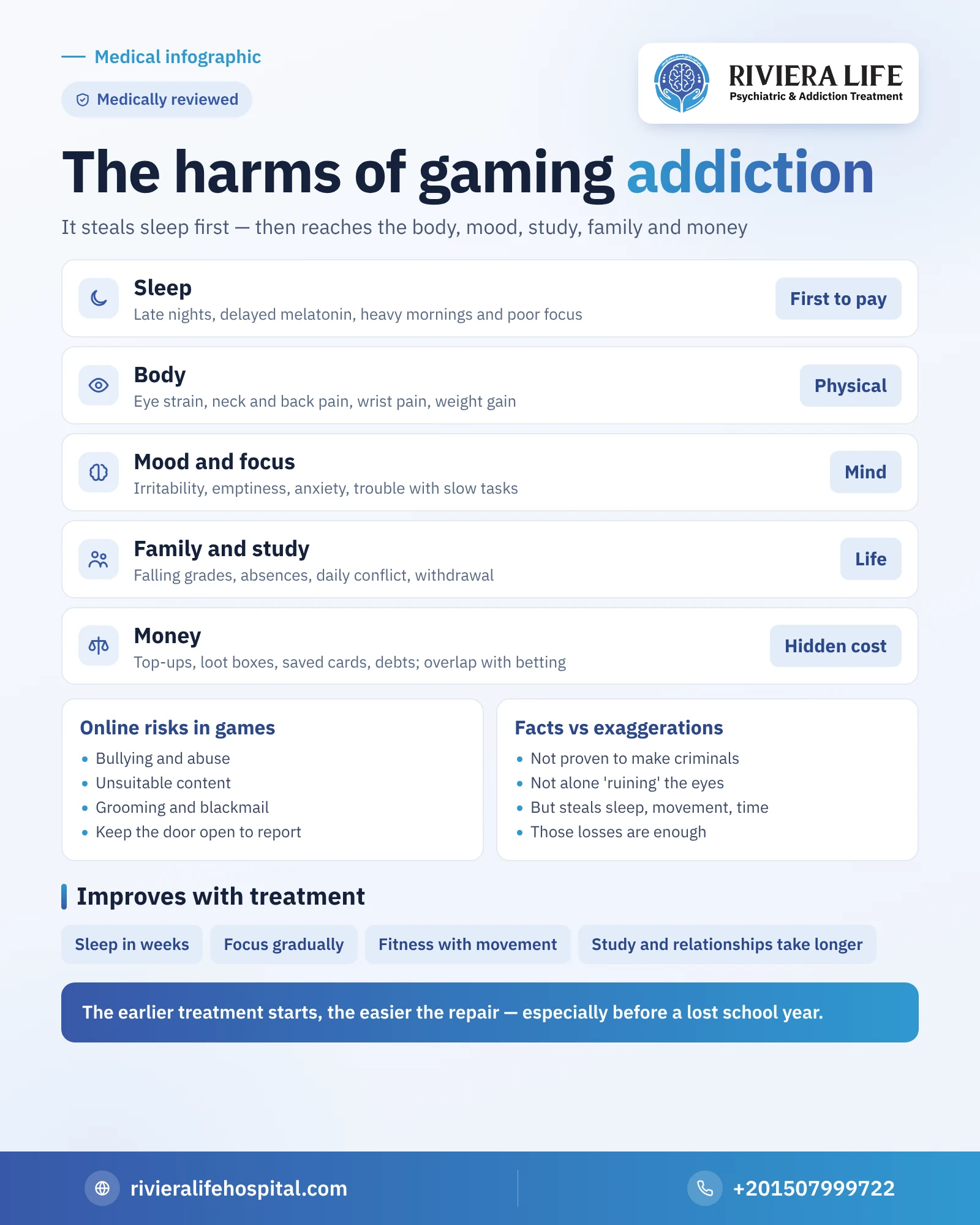
The harms of video game addiction go beyond “wasting time”. The long hours in front of the screen steal sleep first, then their effects extend to the eyes, back and weight, to concentration and mood, and to study, family relationships and money. Most of these harms can be repaired if the addiction is treated early, while some leave a longer mark, such as losing a school year or a job opportunity. In this article we set out the health, psychological and social harms in order, and distinguish established facts from exaggerated fears.
Sleep: the first to pay the price
Someone addicted to games usually sleeps late, because team matches intensify at night, and because the excitement keeps the brain in a state of alertness that makes sleep hard even after the device is switched off. Light from screens also delays the release of melatonin, which is responsible for feeling sleepy. The result is short or reversed sleep, then a heavy morning, poor concentration and irritability. Chronic lack of sleep in teenagers affects growth, immunity, mood and achievement, and it is one of the clearest and easiest harms to notice.
Physical harms
Sitting for hours in a fixed position leaves predictable marks:
- Eye strain: dryness, redness, blurred vision and headache after long sessions.
- Muscle and joint pain: in the neck, shoulders and lower back, and pain in the wrist and thumb from constant control.
- Weight gain: from lack of movement, fast food and fizzy drinks during play.
- Neglecting food and hygiene: in those who become so absorbed that they skip meals and showers.
- Poor fitness: and a decline in the physical activity the body needs during the growing years.
There are rare but real risks: sitting continuously for very long hours without moving may raise the risk of venous clots, and flashing lights may trigger seizures in a few people with light sensitivity. The aim isn’t to frighten, but to stress the importance of movement and breaks.
Psychological harms
The relationship between gaming addiction and mental health runs in both directions. Someone suffering from anxiety or sadness may turn to gaming, and over time the addiction increases these feelings. The most notable effects include:
- Mood swings and quick anger, especially on losing or being interrupted.
- A feeling of emptiness and boredom outside the game.
- Falling self-confidence as real losses pile up in study and relationships.
- Increased anxiety and depression symptoms in some addicted gamers; you’ll find their signs in our article on depression symptoms.
- Constant guilt mixed with an inability to stop.
Anger and aggression at home
Many parents complain of violent outbursts when the internet is cut off or the allowed time ends. This anger doesn’t mean the game created an aggressive person by nature, but it reflects a strong emotional dependence on it, along with exhaustion from lack of sleep and frustration at losing a match. If it recurs to the point of breaking things, threats or assault, this is a sign that the situation needs a specialist assessment, not more confrontation.
Concentration and mental abilities
When the brain gets used to quick rewards every few seconds, slow tasks such as reading a book or solving a long problem seem unbearably boring. Many students complain that they can’t sit down to study for more than a few minutes, despite being able to concentrate for hours in the game. Lack of sleep makes things worse, weakening memory and attention. The good news is that this ability returns gradually when gaming is moderated and sleep is restored.
Academic harms
Study is usually the first arena where tangible loss appears: falling grades, homework not handed in, missed classes and lessons, and sleeping in class. In secondary school in particular, where the university future is built on a year or two, the addiction may cost the student an opportunity that isn’t easily made up. At university it shows as repeated failure or postponing studies.
Its effect on the family and relationships
In many cases the home turns into a daily tug-of-war: the mother calls, the son replies “one minute”, then voices rise. Disagreements pile up between the parents themselves about how to handle it, and siblings feel neglected or jealous. Over time the addicted gamer withdraws from family life, visits and occasions. In adults, the addiction may threaten the marriage itself, when the partner feels they live with someone present in body but absent in mind.
Friendships turn into friends inside the game only. Some are real friends, but a relationship based on gaming alone remains fragile and doesn’t replace the support a present friend gives.
Financial harms
Repeated top-ups and buying currency, outfits and loot boxes can drain a teenager’s pocket money and then the family’s money. Some parents discover large amounts charged to cards saved on the phone without their knowledge. A young person may borrow from friends or take money from home without permission. In adults it can reach real debts, especially if gaming mixes with betting, and here it meets the path of gambling addiction.
Internet risks inside games
Team games are an open space for contact with strangers, which exposes children and teenagers to risks that have nothing to do with the addiction itself but increase with it: bullying and abuse, exposure to unsuitable content, and attempts at grooming or blackmail by people pretending to be the child’s age. That is why it is important for parents to know who their children talk to, and for the child to feel they can tell their parents about any upsetting situation without being punished by losing the game.
Young children: a special kind of harm
A child under six learns speech, movement and emotional control through real play and interaction with those around them. When the screen takes most of their day, talking with them decreases and their movement decreases, and they may fall behind in some skills or become more irritable and less patient. The device also becomes their only way of calming down, so tantrums erupt whenever it is taken away. That is why medical guidance recommends keeping screens to a minimum in the early years, and that they be used with a parent as much as possible.
Adults: work and marriage
In adults the harm doesn’t show in grades but at work and at home. Repeated late nights before working days mean lateness, mistakes and declining performance, and may end in losing the job. At home the partner feels lonely and neglected, responsibilities pile up on one side, and the distance between the couple grows. Some adults hide how much they play and spend, and when it comes out, trust is shaken, a loss that takes longer to repair than giving up the game itself.
Facts and exaggerations
Not all the warnings in circulation are true. The evidence doesn’t prove that games turn a child into a criminal, or that they alone “ruin” the eyes, although long close-up viewing and little time outdoors are linked to more short-sightedness in children. But what is established is that addiction steals sleep, movement, time and relationships, and these losses alone are enough to take the matter seriously. A balanced assessment helps the family focus on the real harm instead of fighting battles over exaggerations.
Do these harms go away after treatment?
Most of them, yes. Sleep usually returns to regularity within weeks of controlling screens at night, concentration improves gradually, and the body regains its fitness with movement. Academic losses and damaged relationships need more time and effort, and the student may need a plan to make up what they missed. The earlier treatment starts, the easier the repair; you’ll find its stages in our article on video game addiction treatment. And if you aren’t yet sure it has reached addiction, start with our article on video game addiction symptoms.
At Riviera Life, we assess what the patient has actually lost, physically, psychologically and academically, and build a plan that starts with the priorities: sleep, mood and the relationship with the family, then recovering study or work step by step.
More from our video games guide
- Video games: the complete guide
- Video game addiction symptoms
- The causes of video game addiction
- Video game addiction treatment
Questions many people ask
Long sessions cause temporary eye strain and dryness. Long periods of close-up viewing with little time outdoors are linked to short-sightedness in children, so breaks and outdoor activity help.
The relationship goes both ways: depression may drive excessive gaming, and addiction may increase isolation and sadness. If they occur together, the person needs assessment and treatment for both.
Repeated late nights cut the hours of sleep a teenager needs for growth, concentration and mood. Keeping devices out of the bedroom is one of the simplest and most useful steps.
Most improve: sleep, concentration and fitness return gradually. Academic losses and damaged relationships need more time and effort.
A child may be exposed to bullying, unsuitable content, or attempts at grooming and blackmail. Privacy settings help, as does open conversation that encourages the child to report without fear of punishment.