Video game addiction treatment is possible, and relies mainly on psychotherapy, not medicines. A successful plan starts with an assessment that reveals what feeds the addiction, then cognitive behavioral therapy that gives the patient back control over his time, and family therapy that turns the home from a battlefield into one team, while treating any accompanying anxiety, depression or ADHD. For most patients the aim isn’t cutting off games forever, but limited play that doesn’t control life. This article explains the steps to recovery, the parents’ role, when the patient needs an intensive program, and how to choose a place of treatment.
Can gaming addiction be treated?
Yes. Scientific reviews indicate that cognitive behavioral therapy and family therapy reduce playing time and the severity of symptoms in a large proportion of patients, and that improvement is clearer when the family takes part and accompanying disorders are treated. But treatment isn’t one session or a decision made in a night. It is gradual learning of new ways to manage time and feelings, which needs weeks and months, and slips may occur during it that the team deals with without treating them as failure.
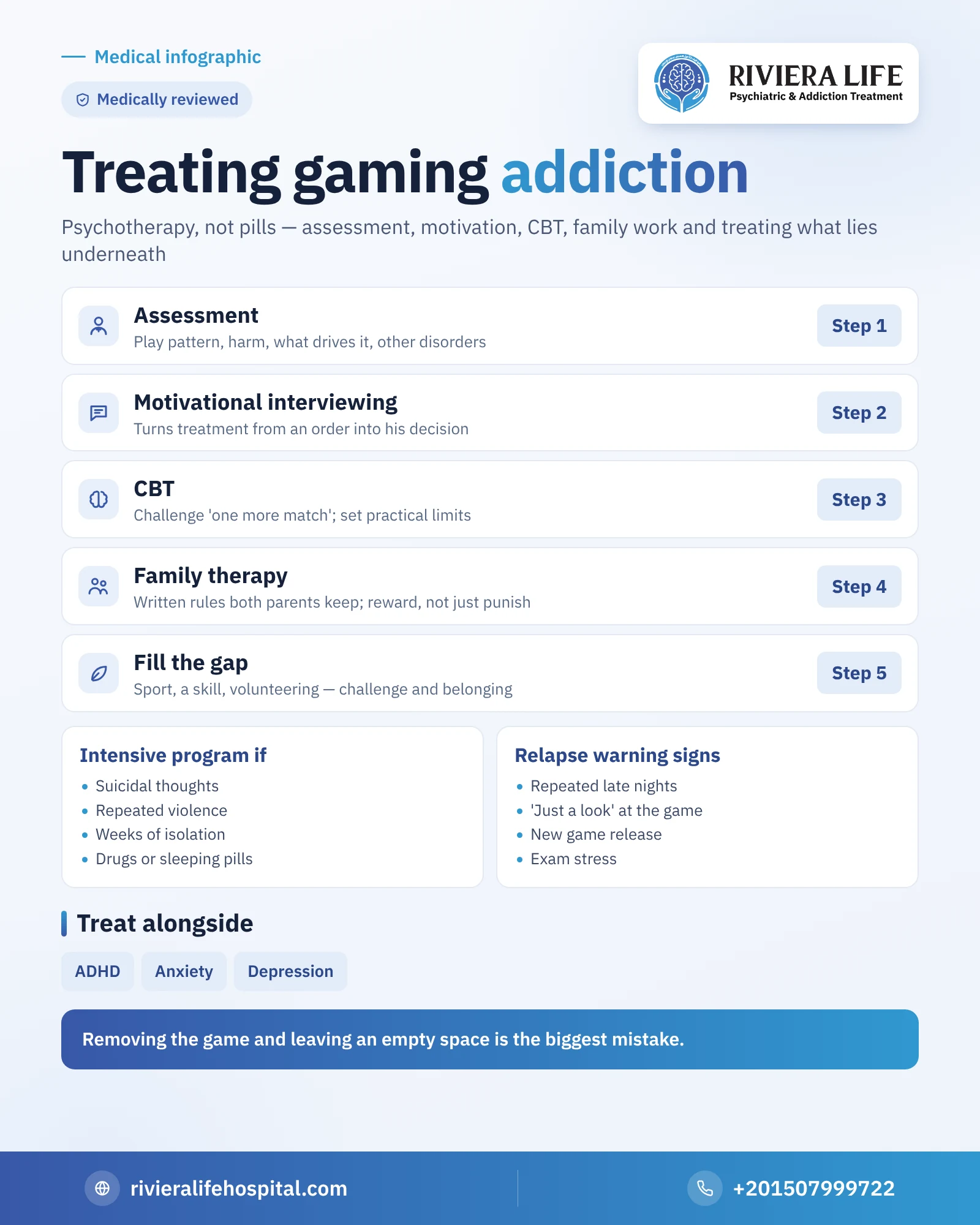
Step one: a comprehensive assessment
Before any plan, the psychiatrist sits with the patient and then with the family, and asks about:
- The pattern of play: which games, how many hours, at what times, and how much he spends on them.
- The extent of harm: sleep, study or work, relationships and health.
- What drives him to play: boredom, anxiety, sadness, escape from a problem, peer pressure.
- The presence of accompanying disorders such as attention deficit hyperactivity disorder, anxiety, depression or suicidal thoughts.
- How ready the patient himself is for change.
After that a written plan is set with realistic goals everyone agrees on. And if the family isn’t yet sure of the diagnosis, our article on video game addiction symptoms helps it organize what it observes before the visit.
Motivational interviewing: when the teenager refuses to admit it
Many teenagers come to the clinic forced, and see the problem as lying with their “strict parents”, not with gaming. Preaching doesn’t help here. The therapist uses motivational interviewing, asking the teenager what he wants for himself: getting into a particular faculty, regaining his fitness, or getting out of the arguments at home. Then he helps him see for himself how gaming stands between him and what he wants. This calm conversation turns treatment from an imposed order into a decision the patient takes part in.
Cognitive behavioral therapy
It is the most studied treatment in gaming addiction, and works on two fronts:
Thoughts
The patient learns to notice the thoughts that justify playing, such as “just one more match”, “I won’t be anything outside the game” or “my friends will drop me if I’m absent”, to question them and replace them with more realistic thoughts.
Behavior
He records his playing time precisely, identifies the situations that spark the urge, then sets practical limits: fixed times, an alarm that announces the end, keeping the device away from the bed, and deleting the most consuming games or closing the account if necessary. He learns alternative skills to calm anxiety and boredom without a screen. The program usually lasts several weeks, in individual or group sessions.
Family therapy and the parents’ role
In the case of teenagers specifically, the family is half the treatment. Family sessions help with:
- Agreeing on clear written rules that both parents keep together, not just one of them.
- Replacing shouting and threats with predictable consequences the son knows in advance.
- Rewarding keeping the rules, not just punishing breaking them.
- Bringing back shared time: a daily meal without phones, a weekly outing, an activity the son loves.
- Setting parental control tools and in-game payments in a way everyone agrees on.
- Dealing with marital disputes that may have pushed the son into isolation.
The parents also learn to be role models; it is hard for a son to stick to an hour of play while his father spends the whole evening on his phone.
Treating accompanying disorders
There is no approved medicine to treat gaming addiction itself. But when the doctor finds an accompanying disorder, treating it often improves control over gaming. The doctor may decide on ADHD medicines if the diagnosis is confirmed, or antidepressants in cases of clear depression or anxiety, with psychotherapy directed at them, and you will find details in our article on anxiety treatment. Choosing the medicine, its dose and duration is a decision the doctor alone takes after assessment, and no medicine should be given to a teenager without follow-up.
Alternatives that fill the gap
The biggest mistake in treatment is to take away the game and leave its place empty. There must be activities that give the patient part of what the game gave him: challenge, achievement and belonging. This may be a team sport, learning a skill such as programming or design, volunteering, or a summer job. A young man who loved competing in a football game may find in a real team what makes up for it.
When does the patient need an intensive program?
Most cases improve with outpatient follow-up. But an intensive program or a short stay under medical supervision may be advised when:
- Suicidal thoughts, self-harm or severe depression appear.
- Anger reaches repeated violence against family members.
- The patient cuts off study or work completely and isolates himself in his room for weeks.
- Gaming addiction comes together with use of drugs or sleeping pills.
- Outpatient follow-up fails despite the family’s commitment.
Preventing relapse
Relapse is common in the first weeks and months, especially in holidays, when a new game is released, or after stress such as exams. During treatment the patient learns to recognize early warning signs, such as repeated late nights or going back to the game “just to take a look”, and to set with his family a ready plan to deal with them. Booster sessions after the core program ends help. And it helps everyone to remember that one slip doesn’t mean losing everything that has been achieved.
The right hospital for video game addiction treatment: how to choose
The right hospital for video game addiction treatment is one that provides what this patient specifically needs: a real understanding of the world of modern games, experience in dealing with teenagers and their families, and the ability to diagnose and treat ADHD, anxiety and depression. Before you decide, ask:
- Does the team offer structured cognitive behavioral therapy for gaming addiction, not just general advice?
- Does it have psychiatry consultants able to assess accompanying ADHD, anxiety and depression?
- Does the program include family sessions that train parents to set rules and apply them?
- Does the team deal with the teenager respectfully and in a motivational way that secures his cooperation?
- Is intensive medical supervision available for severe cases or those with dangerous thoughts?
- Is there follow-up after the program ends to prevent relapse?
Beware of any place that promises to get rid of gaming addiction in days or with a guaranteed recovery rate.
How Riviera Life meets these standards
At Riviera Life, these criteria take the following form:
- Licensed by the Ministry of Health: Riviera Life is an officially accredited hospital for psychiatry and addiction treatment.
- Specialist consultants: psychiatry and addiction consultants assess the gamer and any accompanying anxiety, depression or ADHD.
- An individual behavioral treatment plan: suited to the patient’s age, the type of games he is addicted to, and his study or work circumstances.
- A family program: sessions that train parents in clear rules and calm dialogue instead of daily battles.
- Round-the-clock medical supervision: for severe cases or those with depression or dangerous thoughts.
- Experience built up over fourteen years: during which thousands of patients have recovered in psychiatry and addiction.
- Complete confidentiality: the data of the patient and family are protected at every stage.
- Aftercare: follow-up after the program ends to prevent a return to the old pattern.
If your son won’t leave the screen, call us any time on +201507999722; the first consultation is free, and we receive you in Sheikh Zayed, Giza.
More from our video games guide
- Video games: the complete guide
- Causes of video game addiction
- The harms of video game addiction
- Video game addiction symptoms
Questions many people ask
There is no approved medicine for gaming addiction itself. The doctor may prescribe medicine for an accompanying disorder such as ADHD, depression or anxiety if its diagnosis is confirmed.
Not always. Many plans aim for limited, controlled play, while complete stopping of a particular game that was the most consuming may be advised, depending on the assessment.
The duration varies with severity and accompanying disorders, but the core psychological program usually lasts several weeks to months, followed by follow-up to prevent relapse.
Start by visiting the doctor or therapist yourself to learn how to talk and set rules. Many teenagers agree to come later when it is offered to them respectfully rather than as a punishment.
Look for structured CBT for gaming, assessment of ADHD, anxiety and depression, family sessions, round-the-clock cover for severe cases, and aftercare. Riviera Life in Sheikh Zayed meets these criteria and is licensed by the Ministry of Health.