Noradrenaline, also called norepinephrine, is a chemical that works in the brain as a neurotransmitter setting alertness, attention and the response to stress, and in the body as a hormone and nervous mediator that raises blood pressure and prepares the heart and muscles for movement. It is what makes you suddenly pay attention when your name is called in a crowded hall, and what keeps your blood pressure up when you get out of bed. Well-known classes of medicines target it, including some antidepressants and ADHD medicines, and stimulants raise it strongly. This page explains what noradrenaline is, where it is made, its functions, and its relationship with mood, sleep, addiction and mental illness, then leads you to the specialized articles.
What is noradrenaline? A neurotransmitter or a hormone?
The precise answer: both, depending on the location. Noradrenaline belongs to the catecholamine family, which also includes dopamine and adrenaline. Inside the brain it works as a neurotransmitter released by nerve cells at their points of contact with other cells. In the body, sympathetic nerve endings release it directly onto the heart, blood vessels and other organs, and it is the main transmitter of this part of the nervous system. The adrenal medulla also releases an amount of it into the blood along with adrenaline, where it plays a hormonal role. That is why it is said, in short, that adrenaline is primarily a hormone and noradrenaline is primarily a neurotransmitter.
Where and how is noradrenaline made?
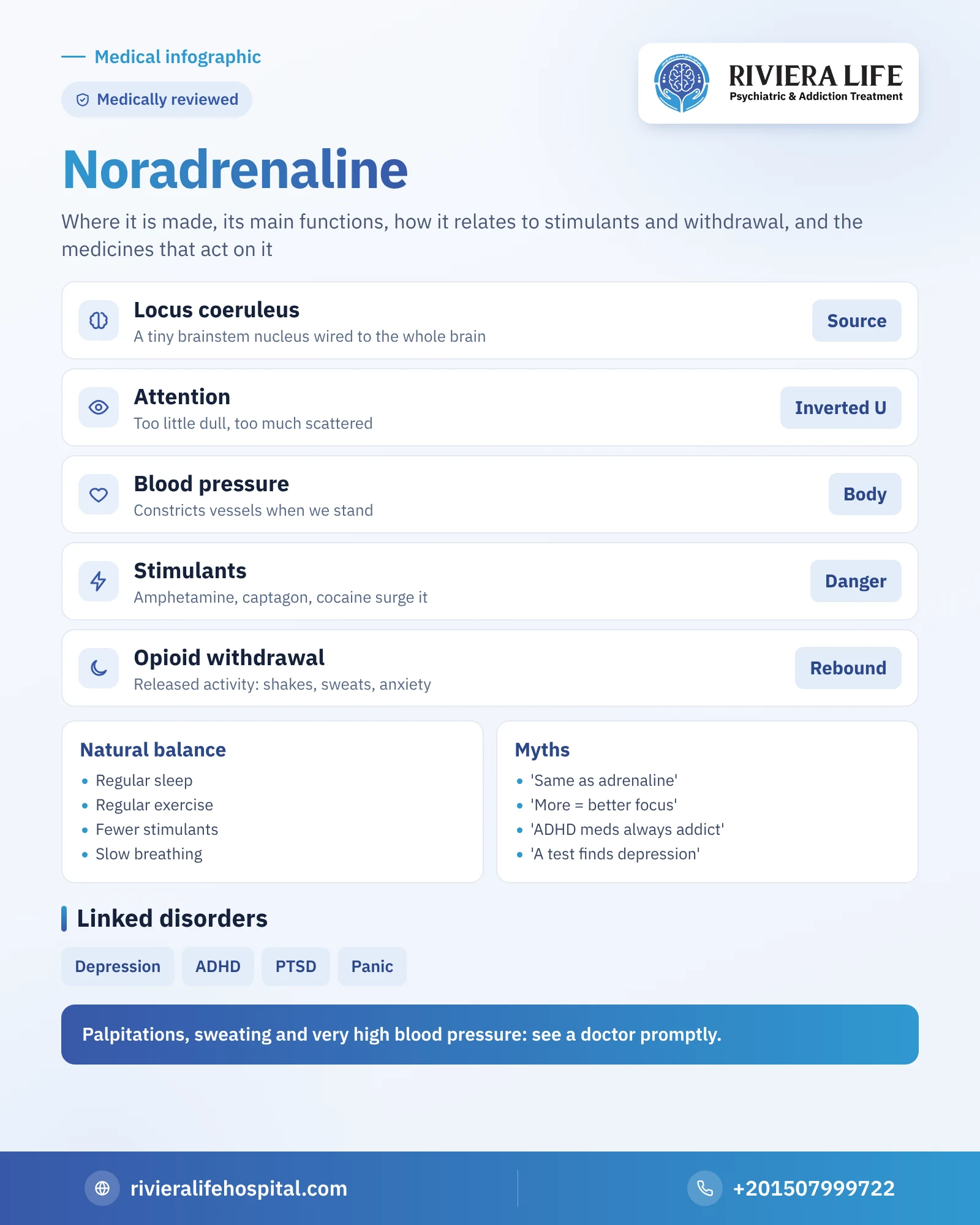
In the brainstem there is a very small nucleus called the locus coeruleus, whose cells number no more than roughly tens of thousands, but whose fibers extend to most areas of the brain: the frontal cortex, the memory center, the amygdala, the cerebellum and the spinal cord. This nucleus is the most important source of noradrenaline in the brain, and resembles a master light switch that raises or lowers the level of alertness.
The method of production is a chain of steps that begins with the amino acid tyrosine found in proteins, which is converted into a substance called dopa and then into dopamine, then a special enzyme converts dopamine into noradrenaline inside the nerve cell’s vesicles. After it is released, the cell reabsorbs most of it through the “reuptake transporter”, then enzymes break it down, including monoamine oxidase. These three stations, production, reuptake and breakdown, are exactly what the medicines we will mention later target.
The main functions of noradrenaline
- Alertness and arousal: the activity of the locus coeruleus rises on waking and falls with drowsiness, and rises strongly with surprise or danger.
- Attention and focus: it helps the frontal cortex distinguish the important from the noise. The relationship here resembles an inverted curve: too little makes the mind sluggish, too much makes it scattered and anxious, and the middle level is best for focus.
- Emotional memory: it strengthens the storage of emotionally charged events, which is why we remember great moments of fear and joy in finer detail.
- Blood pressure: it constricts peripheral blood vessels, maintaining pressure when we stand up or lose fluids.
- Heart and energy: it raises the speed and strength of the heart, and releases glucose and fats to become fuel.
- Pain relief: it takes part in a nerve pathway descending from the brain to the spinal cord that reduces the passage of pain signals, which explains the use of some medicines that act on it in treating nerve pain.
Noradrenaline, mood, sleep and behavior
In sleep, the locus coeruleus falls almost completely silent during dream sleep, its activity decreases in deep sleep, then returns on waking. So anything that raises noradrenaline in the evening, whether anxiety, stimulant drinks or stimulant drugs, delays sleep and makes it broken. In mood, low activity is linked to lethargy, low energy and slow thinking, while overactivity is linked to tension, irritability and being easily aroused. In behavior, it helps you switch quickly from one task to another when something more important appears, a useful skill at work, but one that turns into distraction when the level exceeds what is needed.
Low and high noradrenaline in brief
There is no routine blood test that measures noradrenaline in the brain for the doctor to diagnose depression or distraction with; what is measured in the blood mostly comes from peripheral nerves and changes with standing, exertion and stress at the moment the sample is drawn. The cases in which the doctor orders a test for catecholamines or their breakdown products in blood or urine are specific physical conditions, the best known being a suspected pheochromocytoma of the adrenal gland when attacks of headache, sweating and palpitations with a sharp rise in blood pressure keep recurring.
On the other side, some diseases of the autonomic nervous system disrupt the release of noradrenaline from the nerves, so blood pressure drops sharply on standing and the patient feels dizzy or faints. Between the two lies the best-known effect: chronic stress that keeps the system more active than necessary, the subject of the article Noradrenaline and stress.
Noradrenaline, addiction and drugs
Stimulants act on this system directly. Amphetamine and captagon push cells to release noradrenaline and dopamine, and cocaine blocks their reuptake. The result is excessive alertness, staying up and loss of appetite, together with palpitations and raised blood pressure and temperature, which may reach heart attacks, strokes or psychosis. Then the crash comes after the effect ends: exhaustion, long sleep and low mood.
The picture is reversed with opioids. They suppress the locus coeruleus, so the brain raises its activity to compensate with chronic use. And when the patient stops suddenly, this suppressed activity is released all at once, so tremor, sweating, chills, runny nose, diarrhea and severe anxiety appear. That is why doctors sometimes use medicines that calm this surge during detox, by medical decision and under supervision. Similar activity occurs in withdrawal from alcohol and sedatives, a withdrawal that can be dangerous and is not managed at home.
Noradrenaline and mental disorders
Noradrenaline has been linked to a number of mental disorders, with the reminder that none of them is a simple “deficiency” of one substance:
- Depression: a disturbance in the serotonin and noradrenaline systems is believed to take part in some of its symptoms, especially low energy and concentration, which is why several classes of antidepressants affect both systems.
- ADHD: weak regulation of noradrenaline and dopamine in the frontal cortex is part of its explanation, and most of its medicines work on these two transmitters.
- Post-traumatic stress disorder: overactivity of this system appears in it, in the form of hypervigilance, startle and nightmares.
- Anxiety and panic attacks: it takes part in the physical symptoms along with adrenaline, as the article Adrenaline and anxiety explains.
Noradrenaline symptoms: what does high look like and what does low look like?
A person does not feel noradrenaline itself, but what it does to the body and to attention. The clinical picture resembles many conditions, so a symptom is read in its context, not on its own.
When the system’s activity increases
- Palpitations and raised blood pressure.
- Sweating, cold extremities and trembling hands.
- Excessive alertness and difficulty sleeping.
- Anxiety, tension and being easily aroused.
This picture appears with intense fear and chronic stress, and also with stimulants such as cocaine and amphetamines that amplify this transmitter’s signal. When attacks of headache, sweating and palpitations with very high blood pressure recur, the doctor considers physical causes that must be ruled out.
When its activity decreases
- Lethargy, slow thinking and low motivation.
- Difficulty concentrating and scattered attention.
- Dizziness or a drop in blood pressure when standing up quickly.
- Low mood accompanying depression in some cases.
These signs are not evidence of a noradrenaline deficiency specifically; depression, anemia and lack of sleep give a similar picture. If tension is what you feel most, read Noradrenaline and stress, and if it is mixed with panic attacks and palpitations, the comparison in Adrenaline and anxiety will help you.
How can you support noradrenaline balance naturally?
The goal is not to “raise” noradrenaline, but for it to rise when you need it and calm when the need is over. The means with the best evidence are regular, sufficient sleep, regular physical activity that improves the body’s ability to return to calm after exertion, and reducing stimulant drinks, especially after the afternoon. Slow-breathing techniques and meditation have good evidence for calming the sympathetic nervous system, although their effect on noradrenaline specifically is less studied. As for the supplements marketed to “boost focus” through this system, their evidence is weak, and some raise blood pressure or interact with medicines.
Medicines that affect noradrenaline
We mention the classes only; choosing the medicine and its dose is the doctor’s decision alone:
- Serotonin and noradrenaline reuptake inhibitors: a class of antidepressants used in depression, anxiety and some cases of chronic pain.
- Selective noradrenaline reuptake inhibitors: including a non-stimulant medicine used to treat ADHD.
- Medical stimulants: dispensed by prescription for ADHD and some sleep disorders; they act on noradrenaline and dopamine, and carry a potential for misuse if taken without supervision.
- Tricyclic antidepressants and monoamine oxidase inhibitors: older classes that affect the same system and need close follow-up.
- Alpha-2 receptor agonists: they reduce noradrenaline release, are used for blood pressure and ADHD, and some doctors use them for withdrawal symptoms.
- Beta blockers and alpha blockers: they block its effect on the heart or vessels, and are used for blood pressure and sometimes for the physical symptoms of anxiety or trauma-related nightmares.
Noradrenaline itself is used as a medicine in intensive care, intravenously and under close monitoring, to raise collapsed blood pressure in cases of severe shock such as sepsis.
Common myths about noradrenaline
Myth: noradrenaline and adrenaline are two names for one substance. The truth is that they are chemically close substances, but the first works mainly as a neurotransmitter and the second as a hormone, and each has a different distribution and effect.
Myth: more noradrenaline always means better focus. The truth is that a large increase causes distraction and anxiety, which is why people who use stimulants in large doses lose the ability to think in an organized way.
Myth: ADHD medicines are “drugs” that always cause addiction. The truth is that using them with a prescription and follow-up for someone actually diagnosed is completely different from taking them to stay up or study without supervision; the latter is what carries the risk of dependence.
Myth: the cause of depression can be found with a noradrenaline test. The truth is that there is no approved test for this, and the diagnosis is based on psychological assessment.
The noradrenaline guide: each aspect in its own article
- Noradrenaline and stress: how it works in acute and chronic stress, its relationship with focus and sleep, ADHD medicines and antidepressants, and the dangers of stimulants.
- Adrenaline: the hormonal sibling released by the adrenal gland in moments of danger.
- Adrenaline and anxiety: the fight-or-flight response, panic attacks and how to calm the body.
- Cortisol: the long-term stress hormone that works with noradrenaline.
When should you see a doctor?
See a doctor if attacks of palpitations, sweating and headache with raised blood pressure recur, or dizziness and fainting on standing, or if distraction and poor concentration have disrupted your study or work since childhood, or if exhaustion and loss of interest last more than two weeks. And if you use stimulants or “focus” pills without a prescription, or need sedatives to sleep after them, early assessment saves a lot. At Riviera Life, consultant psychiatrists and addiction specialists assess the case in complete confidentiality, and the first consultation is free via +201507999722 in Sheikh Zayed, Giza.
Medical sources and referencesThe information in this article is based on reliable scientific sources