
The relationship between noradrenaline and stress starts from the first moment of pressure: it is the first thing to move in the brain, and within seconds it raises alertness, speeds up the heart, and directs attention towards the source of threat. This is useful in a short situation such as an exam or a crowded road, but when it continues for weeks because of work pressure, family problems or lack of sleep, it turns into constant tension, distraction and insomnia.
The same system is targeted by a number of medicines, including ADHD medicines and some antidepressants, and stimulants exploit it in a harmful way. This article explains what happens to noradrenaline under pressure, why focus weakens, and when stress needs treatment.
What happens in the brain at the moment of pressure?
Imagine you are driving at night and suddenly someone appears in front of you crossing the road. The amygdala, the alarm center, sends a signal to a small nucleus in the brainstem called the locus coeruleus, and this nucleus floods wide parts of the brain with noradrenaline. The range of attention widens towards the danger, the senses become sharper, and the body prepares to move. At the same time the sympathetic nerves release noradrenaline onto the heart and vessels, and the adrenal medulla releases adrenaline into the blood. All this before you consciously think about what is happening. For a wider explanation of how this substance is made and its functions, see the complete guide to noradrenaline.
Two speeds for one response: noradrenaline and cortisol
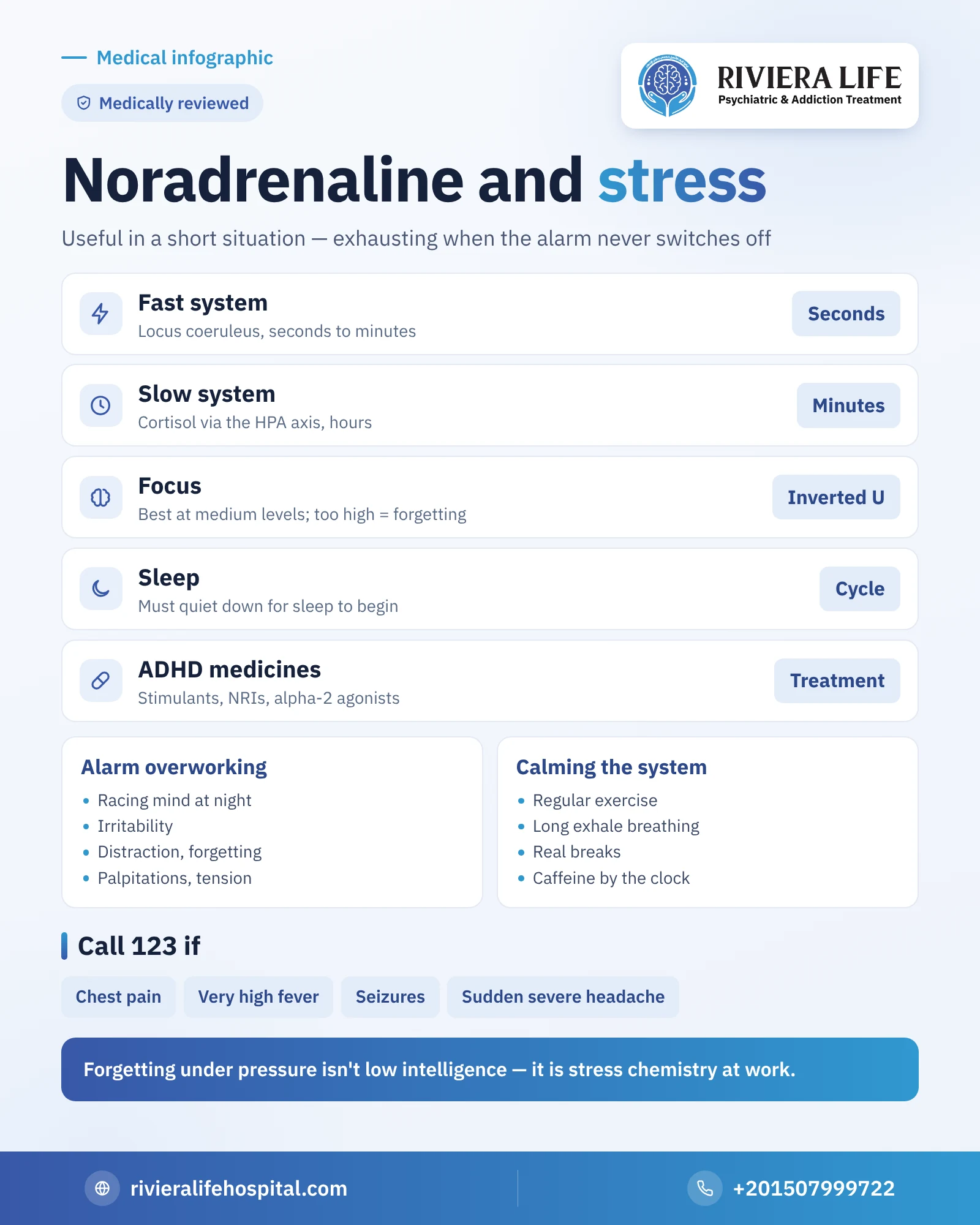
The body works under pressure with two complementary systems. The fast system is led by noradrenaline and adrenaline, starts within seconds and usually calms within minutes after the situation ends. The slower system passes through the hypothalamus and pituitary gland to the adrenal cortex, raising cortisol within minutes, its effect lasting hours, maintaining energy supply if pressure continues. Each system affects the other, as cortisol that stays high for long periods changes the sensitivity of noradrenaline circuits. The physical details of this side are in the article on high cortisol symptoms.
Why does focus weaken under pressure?
The prefrontal cortex, responsible for planning, controlling impulses and holding information temporarily, works best when noradrenaline is at a medium level. If it falls, the mind becomes sluggish, and if it rises a lot under severe pressure, this cortex’s work declines and leadership moves to older circuits responsible for quick reactions and habits. That is why a student forgets information they know well in an exam, an exhausted employee makes hasty decisions, and a stressed father answers his child with irritability he regrets. This isn’t low intelligence or weak personality, but the chemistry of stress at work.
Noradrenaline and chronic stress: from passing pressure to exhaustion
The problem isn’t the rise itself, but the system not returning to calm. When pressure recurs daily without enough rest periods, noradrenaline circuits seem to become more sensitive, so the response fires faster and with a smaller trigger. The sound of the phone is enough to raise the pulse, and a message from the manager is enough to ruin the day. Many describe this stage as being “on edge” all the time, without remembering the last time they felt real relaxation. And if the source of this pressure is an inner need for constant work that never calms, see the article on work obsession and how to treat it.
Signs that the alert system is working more than it should
- Difficulty sleeping or waking early with a feeling that the mind is “running”.
- Irritability and quick reactions over small things.
- Distraction, forgetfulness and difficulty completing tasks.
- Palpitations, sweating or trembling in ordinary situations.
- Tension in the neck and shoulder muscles, and repeated headaches.
- Exaggerated startle at sudden sounds.
- Relying on stimulants by day and sedatives or substances at night.
These signs don’t necessarily mean a psychological disorder, but they are a sign that the lifestyle needs reviewing, and if they continue, a medical assessment.
Stress and sleep: a cycle that is hard to break alone
The locus coeruleus must calm down for sleep to begin, and is almost silent in the dream stage. If it stays active because of pressure, sleep is delayed and becomes light. Lack of sleep in turn raises the sensitivity of the alarm center the next day, so tension increases, so sleep falls again. People often try to break the cycle with coffee in the morning and sleeping pills or hash at night, adding a second cycle of dependence to it. The more useful start is fixing the wake-up time, cutting down screens and stimulants in the evening, and asking for help if insomnia continues for weeks.
ADHD: when regulation is the problem
In attention-deficit/hyperactivity disorder, the problem doesn’t lie in pressure, but in weak regulation of noradrenaline and dopamine in the prefrontal cortex since childhood, so it is hard for the person to hold their attention or restrain their impulses. Medical treatment, when the doctor decides on it after careful diagnosis, relies on specific categories:
- Medical stimulants: raise noradrenaline and dopamine, and are dispensed with a prescription and regular follow-up of blood pressure, pulse, sleep and appetite.
- Selective noradrenaline reuptake inhibitors: a non-stimulant alternative, whose effect appears gradually over weeks.
- Alpha-2 receptor agonists: calm the release of noradrenaline, and help some patients especially with impulsivity or sleep disturbance.
Behavioral training and organizing the environment and tasks are added to the medicine, as medicine alone doesn’t teach skills.
Antidepressants that act on noradrenaline
Serotonin and noradrenaline reuptake inhibitors are a class of antidepressants the doctor prescribes in depression, generalized anxiety disorder, and some types of chronic pain such as nerve pain. Similar are some older classes such as tricyclic antidepressants. Because they affect noradrenaline, the patient may notice at first sweating or a slight rise in blood pressure or pulse, which is why the doctor follows them. These medicines aren’t stopped suddenly, but reduced gradually under medical supervision. To learn how the doctor chooses between the different classes, see the article on the best medicine for depression and anxiety.
Stimulants without a prescription: why aren’t they a treatment for pressure?
Some students in exam season, and some workers on long shifts, turn to stimulant pills or Captagon to stay up and focus. These substances raise noradrenaline and dopamine much more strongly than focus needs, so the effect becomes reversed over time: distraction, irritability and insomnia, then a sharp drop in mood and energy when the effect ends that pushes to another dose. With repetition dependence appears, and psychotic symptoms or heart problems may appear. The details are in the article on the harms of amphetamine. These pills also include prescribed wakefulness medicines such as modafinil, and we explain the steps to stop them in Bravamax addiction treatment.
Call an ambulance on 123 immediately if you see
These are signs of stimulant poisoning or severe overactivity of the sympathetic system, and can't wait.
- A feeling of pain or heaviness in the chest, or strong, irregular palpitations
- A severe rise in body temperature with sweating or dehydration
- Seizures or loss of consciousness
- Severe agitation, hallucinations or frightening suspicion of others
- A sudden severe headache or weakness on one side of the body
How do you calm the system in practice?
- Regular movement: aerobic exercise improves the body’s ability to return to calm after each stress response.
- Slow breathing: breathing out longer than in for a few minutes activates the calming nervous system.
- Real breaks: minutes without a screen between tasks, and a day of rest each week.
- Caffeine by calculation: no stimulants after roughly the afternoon, and no energy drinks.
- Breaking big tasks down: a vague task raises the alarm more than a clear one.
- Talking to someone you trust: social support is one of the strongest protective factors against the effects of pressure.
And you will find complementary methods for the long-term stress hormone in the article on how to lower cortisol.
When is stress a disorder that needs treatment?
When tension continues for months and disrupts work, relationships and sleep, or panic attacks appear, or worry about many things becomes constant, or nightmares, intrusive memories and excessive alertness follow a traumatic event, or it is accompanied by sadness and loss of pleasure for more than two weeks. Here it may be an anxiety disorder, post-traumatic stress disorder or depression, and a psychiatrist determines this by assessment, not tests. Psychotherapy, especially cognitive behavioral therapy, has strong evidence in these cases, and medicine is added when needed. To learn the different signs of anxiety, see the anxiety page.
How does Riviera Life help you?
The consultant psychiatrists at Riviera Life distinguish between passing life pressure and anxiety disorders, depression and ADHD, and assess those who use stimulants or sedatives to bear their day, then set a plan to suit the case, in complete confidentiality. The first consultation is free on +201507999722.
More from the noradrenaline guide
- Noradrenaline: the complete guide
- Adrenaline and anxiety
- GABA and anxiety
- Cortisol: the stress hormone
- Psychological stress: its signs, its effect on the body and how to deal with it healthily
Questions many people ask
Yes, it raises it within seconds of facing pressure, and it is a natural part of the response. The problem is when the rise continues for weeks without rest periods.
A big rise in noradrenaline weakens the work of the prefrontal cortex responsible for holding information temporarily and organizing thinking, so the ability to recall falls even though you know the information.
Medical stimulants have a potential for misuse if taken without a prescription or in higher doses, but using them for someone genuinely diagnosed under medical follow-up differs from using them to stay up or study.
Regular sleep, exercise, slow breathing and cutting down stimulants help the system return to calm, and if tension continues and life is disrupted, medical assessment is better.
Some may raise blood pressure or pulse slightly in some patients, which is why the doctor follows them and adjusts the plan when needed, and they aren't stopped suddenly.