The short answer
Amphetamine is a synthetic compound that stimulates the nervous system, close in structure to noradrenaline and dopamine. It has recognized medical uses in treating attention-deficit hyperactivity disorder and narcolepsy at calculated doses. But its family also includes substances that are widely misused: counterfeit captagon, and methamphetamine known as ice and shabu. The difference between medicine and drug here lies in the way of use, not in the substance, and Egyptian law criminalizes its possession outside the medical framework.
- CategoryNervous system stimulants
- Medical useADHD and narcolepsy
- RelativesCaptagon and ice
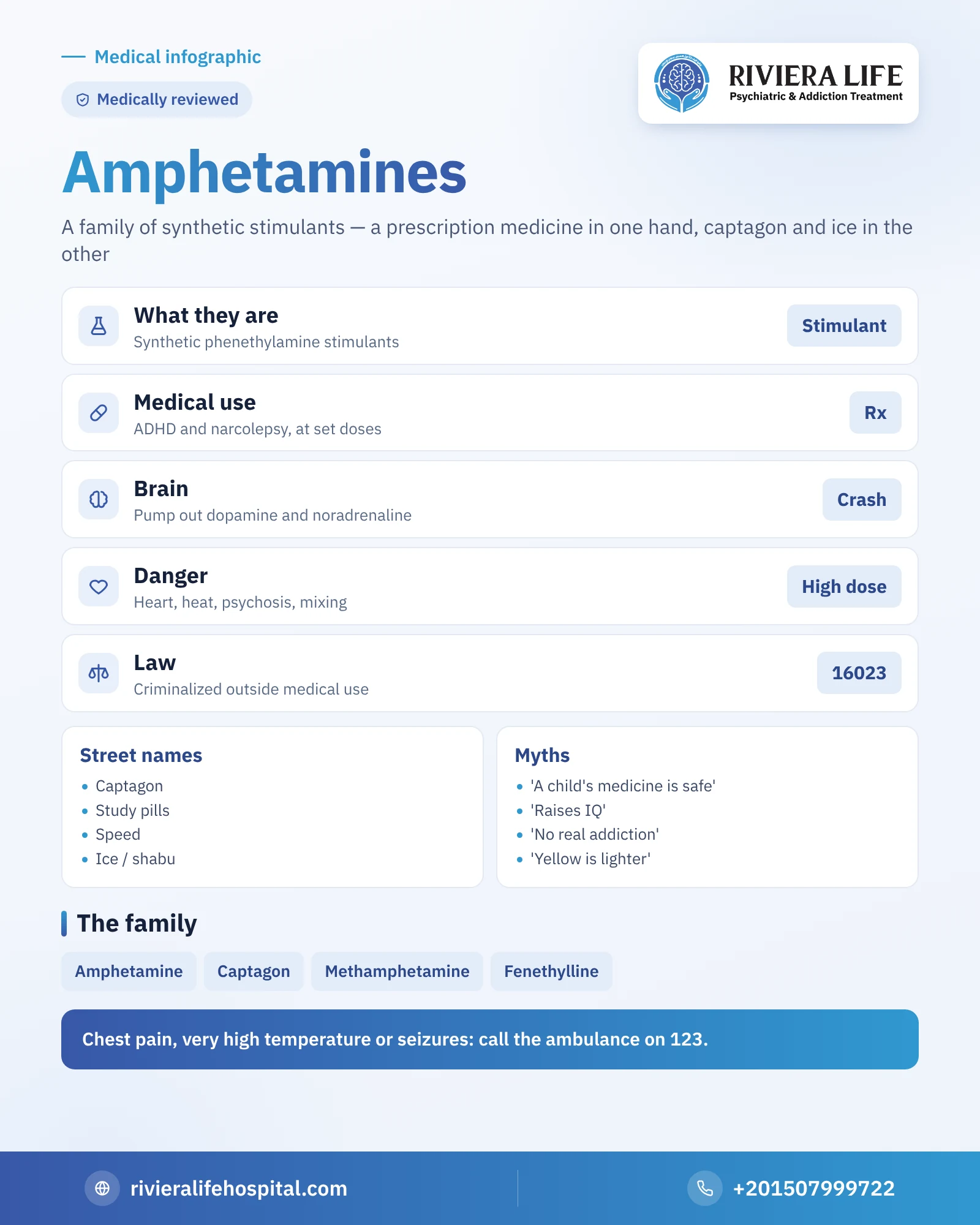
Amphetamines is the name of an entire family of stimulants, not the name of a single substance. Some of its members are medicines dispensed by prescription to treat attention-deficit hyperactivity disorder or narcolepsy, and some are sold on the street as pills “for staying up” or “for studying”, including counterfeit captagon and methamphetamine known as ice. What brings them together is that they raise the activity of the brain and heart powerfully, and that use outside medical supervision may turn into an addiction that is hard to break. This page explains the whole family: what it is, how it works, when it is a medicine and when it becomes a danger, then leads you to a detailed article for each of its aspects.
What are amphetamines?
Amphetamine is a synthetic compound that chemically belongs to a class called “phenethylamines”, a class close in structure to noradrenaline and dopamine, that is, to the chemical messages the body itself uses to wake, pay attention and be motivated. Amphetamine was first synthesized in the late nineteenth century, then used in the first half of the twentieth century in nasal sprays, weight-loss tablets and to keep soldiers alert, before its ability to cause dependence became clear and strict restrictions were imposed on it.
When doctors talk about “amphetamines” in the plural they usually mean amphetamine in its two chemical forms (dextroamphetamine and levoamphetamine), the medicines derived from it, then the stronger methamphetamine, in addition to substances that turn into amphetamine inside the body such as fenethylline, the original substance that carried the name captagon. United Nations reports use a wider term, “amphetamine-type stimulants”, and place them among the most widespread drugs in the world after cannabis.
Names of amphetamines circulating in Egypt and the region
A user rarely says they use “amphetamine”. The names families usually hear are different:
- “Captagon”: the best-known name in the Arab region for small white or yellow pills, which often carry a two-crescent logo, so some call them “Abu Hilalain” (the two crescents).
- “Staying-up pills”, “study pills” and “focus pills”: common descriptions among students, drivers and night-shift workers, which may hide any stimulant underneath.
- “Speed”: an imported name for amphetamine sulfate powder.
- “Ice”, “shabu” and “crystal”: names of crystalline methamphetamine, the strongest member of the family.
The problem is that the name doesn’t guarantee the content. A pill sold as captagon may contain amphetamine with caffeine and fillers, and may contain something else entirely. That is why the diagnosis isn’t built on what the seller or user says, but on medical examination and testing.
Forms of amphetamines and ways of using them
Amphetamines appear in several forms, each with a different audience and habits:
- Tablets and capsules: whether a licensed medicine that leaked from a medical prescription, or pills manufactured in illegal labs.
- A white or yellowish powder: snorted through the nose or dissolved and drunk, and sometimes injected.
- Clear crystals resembling broken glass: this is methamphetamine, and it is usually smoked in glass devices.
Swallowing is the most common method with pills, and its effect is slower and longer. Snorting, smoking and injecting deliver the substance to the brain within seconds or minutes, so the euphoria is more intense and the crash after it harsher, and this is exactly what speeds the road to addiction and raises the risk of poisoning.
How do amphetamines affect the brain and body?
Amphetamines work in a way that differs from most drugs. They don’t just block the reuptake of dopamine and noradrenaline, but enter the nerve cells themselves and push them to pump their store of these transmitters out. The result is a chemical flood in the areas of reward, attention and movement, followed by the following:
- Sharp wakefulness, excess energy and the disappearance of the sense of tiredness and sleepiness.
- High self-confidence and talkativeness, and sometimes a feeling of euphoria.
- Loss of appetite, dry mouth and dilated pupils.
- A racing heartbeat and raised blood pressure and body temperature.
- With large doses: irritability, paranoia and repetitive purposeless movements.
After the effect ends comes the “crash”: severe exhaustion, low mood and a desire to sleep for long hours. With repetition, the dopamine the brain releases on its own decreases, so ordinary pleasures fade and the person comes to need the substance to feel “normal”. The story gradually turns from seeking energy to escaping the crash.
The medical use of amphetamines
Unlike many drugs, amphetamine has recognized medical uses. The most important is treating attention-deficit hyperactivity disorder in children and adults, where calculated doses help improve focus and control impulsivity. It is also used to treat narcolepsy, a disorder in which the patient is suddenly overcome by sleep during the day. Among the medicines known worldwide are the mixture of amphetamine salts, and lisdexamfetamine, which only becomes active after it is converted inside the body.
The difference between medicine and drug here isn’t in the substance, but in the way of use. A patient who takes the prescribed dose by mouth, with a clear diagnosis and regular follow-up, is completely different from someone who grinds tablets to snort them, or takes several times the dose to stay up three nights in a row. Even so, these medicines remain under strict control in every country of the world, and in Egypt no preparation of them may be dispensed except under the controls for narcotic medicines, and it is never right to take a medicine prescribed for someone else.
Why are amphetamines dangerous?
Many underestimate amphetamines because they are “pills” and not injections or powders, or because some of them are medicines. But their danger comes from several directions at the same time:
- The heart and vessels: raised blood pressure and rhythm disturbance, which may reach a heart attack or stroke even in young people.
- Temperature: body temperature may rise to degrees that damage the muscles and kidneys, especially with staying up, dancing and dehydration.
- Psychosis: paranoia, hallucinations and persecutory thoughts are known complications with large doses and continuous sleeplessness.
- Mixing: many users in Egypt resort to tramadol, pregabalin or hashish to “calm” themselves after the stimulant, so the risks accumulate and a double addiction forms.
- The unknown: neither the concentration nor the contents of street pills are known.
The details of these harms, organ by organ, are in the article on the harms of amphetamine to the heart, brain and body.
Amphetamines as a family: amphetamine, captagon and methamphetamine
It helps to see the members of the family side by side. Amphetamine itself is the origin, and it has a medical face and an illegal face. Captagon was originally a trade name for a medicine containing the substance fenethylline, which the body converts into amphetamine, but this medicine disappeared from the markets decades ago, and what is sold today under the same name is counterfeit pills whose content is mostly amphetamine with other substances; you will find its details on the captagon page.
Methamphetamine differs from amphetamine by a small chemical group that makes it cross into the brain faster and stay longer, which is why it is considered more addictive and more harmful to nerve cells; it has a separate page, methamphetamine (ice), and a detailed comparison between the two in the article on the difference between methamphetamine and amphetamine.
Amphetamines and the law in Egypt
Egypt’s anti-narcotics law lists amphetamine and its derivatives in its annexed schedules, so their possession, use and trafficking outside the medical framework are criminalized, and the penalty escalates with trafficking and importing. The legitimate medicines from this family are only circulated under special dispensing controls. On the other hand, the law allows someone who comes forward on their own to seek treatment to be treated without a criminal case being brought against them, information that reassures many hesitant families. For the details of any specific case it is advisable to consult a specialized lawyer, and you can also contact the hotline of the Fund for Drug Control and Treatment of Addiction on 16023.
Types of stimulants: what does this category include?
Stimulants are a wide group of substances that raise the activity of the central nervous system, and they differ in their source, strength and medical use.
- Amphetamines: amphetamine, methamphetamine and what is sold counterfeit under the name captagon.
- Cocaine: a short-acting stimulant of natural origin, whose details you will find on the cocaine page.
- Attention medicines: such as methylphenidate and some ADHD medicines, which are prescribed medically for specific conditions.
- Cathinone derivatives: the synthetic stimulants known by names such as “flakka”, whose composition changes constantly.
- Socially accepted mild stimulants: such as caffeine and nicotine, which are weaker in effect but stimulate the same system.
What brings these substances together is raising wakefulness and heart rate and reducing appetite, and what separates them is the speed of reaching the brain and the duration of the effect, which are what determine the strength of the addiction. Methamphetamine, for example, is stronger than amphetamine, as the difference between methamphetamine and amphetamine explains.
These substances also vary in the risk of overdose; synthetic stimulants with changing compositions are harder to predict than known medicines, which is why cases of raised temperature and psychosis recur with them.
Even medicines dispensed by prescription have a dividing line between medical use and use to enhance performance, which is the subject of Adderall, modafinil and the risks of using them for studying.
The amphetamines guide: each aspect in a separate article
Every question about amphetamine has its own article, so you find the answer complete without repetition:
- Amphetamine addiction symptoms: the signs the family notices in the body, behavior and mood, and how the disorder is diagnosed.
- Amphetamine withdrawal symptoms: the stages of the crash and withdrawal and their duration, and when the case needs a doctor immediately.
- Amphetamine addiction treatment: the steps of treatment, supporting medicines, behavioral therapy and relapse prevention.
- Causes of amphetamine addiction: why use begins, who is most at risk, and how we protect our children.
- The harms of amphetamine: what happens to the heart, brain, kidneys, teeth and daily life.
- How long amphetamine stays in the body: how long it remains visible in urine, blood, saliva and hair tests, and why the result may be wrong.
- Amphetamine and sex: its effect on desire, erection and the relationship, and what returns after stopping.
- The difference between methamphetamine and amphetamine: strength, duration, danger and treatment.
Common myths about amphetamines
The myth: as long as it is a medicine dispensed for children, it is safe for everyone. The truth is that safety is linked to the diagnosis, the dose and the follow-up. The same medicine at higher doses or by another method raises blood pressure, threatens the heart and causes dependence.
The myth: study pills raise intelligence and grades. The truth is that they may prolong staying up and give a feeling of focus, but lack of sleep, anxiety and the crash afterwards harm memory and performance, and they haven’t been proven to make a healthy person smarter.
The myth: stimulants don’t cause real addiction because they don’t cause painful physical withdrawal. The truth is that their withdrawal is mostly psychological, but it may be very harsh: deep depression and intense craving, which are among the strongest causes of relapse.
The myth: the yellow pill is lighter than the white one. The truth is that the color indicates nothing; the content is unknown in all cases.
Found pills in your son’s room? Start here
Don’t start by shouting and don’t throw the pills in his face. Keep them in a safe place, take a photo of the strip or the logo if there is one, and write down what you have noticed in recent weeks: staying up, eating little, mood swings and asking for money. Then choose a time when he is calm and not under the influence of the substance, and start with an open question about his pressures before you ask about the pills.
Many young people start with them to escape an exam or exhausting work, and understanding this motive opens a door to dialogue. And if he refuses to talk, contact a specialized doctor yourself to get guidance, as the family needs support too. And if you aren’t sure of the substance, the general signs are explained in the article on amphetamine addiction symptoms.
Amphetamine poisoning: emergency signs
Call the ambulance on 123 immediately if any of these appear
Stimulant poisoning may develop within an hour, and the temperature and heart are the greatest danger.
- Pressure or pain in the chest, or strong heartbeats with a disturbed rhythm
- A very high temperature with hot skin and heavy sweating, or sweating that has stopped
- Seizures or loss of consciousness
- Severe agitation, hallucinations or paranoia that makes the person a danger to themselves or others
- A violent headache that starts suddenly, weakness in one side of the body, or stumbling speech
Until the ambulance arrives, move the person to a quiet, cool, dimly lit place, loosen their clothes, and talk to them in a low voice without arguing. Don’t try to restrain them by force unless they are exposing themselves to direct danger, and don’t give them any sedative, alcohol or other substance “to calm down”, as mixing may make the condition worse. And tell the paramedics what you know about the substance, the amount and the time.
When should you ask for help?
Ask for a medical assessment if the person has come to need the stimulant to start their day or finish their work, has gradually increased the amount, has failed to stop despite their promises, or has shown episodes of paranoia or depression after the crash. Don’t wait for things to get worse; early intervention is easier and less costly for the body and the family. The Riviera Life team in Sheikh Zayed receives these cases in complete confidentiality, and carries out a comprehensive psychological and physical assessment before putting in place the appropriate plan.
Medical sources and referencesThe information in this article is based on reliable scientific sources
1SAMHSA TIP 33 — How stimulants affect the brain and behaviorncbi.nlm.nih.gov2MedlinePlus — Amphetamine medicine: uses and side effectsmedlineplus.gov3NHS — Treatment of attention-deficit hyperactivity disordernhs.uk4StatPearls — Amphetamine toxicity: mechanism, signs and managementncbi.nlm.nih.gov5NIDA — Research report on methamphetaminenida.nih.gov