When the word “opioids” is mentioned, most people’s minds go to heroin alone, even though this family also includes painkillers dispensed daily in hospitals and pharmacies, such as morphine, codeine, tramadol and fentanyl. What brings these substances together is that they act on the same receptors in the nervous system, so they relieve pain powerfully, and at the same time carry the risk of dependence and respiratory depression. On this page we draw the full picture of the family: where it comes from, how its members differ, and why a beneficial medicine sometimes turns into addiction. Then we lead you to detailed articles on symptoms, withdrawal, testing and treatment.
What are opioids?
Opioids is a collective name for every substance that binds to the opioid receptors in the brain, spinal cord and intestines and activates them. Some of these substances are extracted directly from the poppy plant, and some are made entirely in labs with no connection to the plant. Some specialists distinguish between natural opiates, that is, those extracted from the plant such as morphine and codeine, and opioids in the broad sense that includes everything acting on the same receptors, whether natural or synthetic. In this guide we use the word in its broad sense.
The body itself makes substances close to them, the best known being endorphins, which it releases on injury or intense effort to ease the sensation of pain. But it releases them in small amounts that wear off quickly. An opioid medicine or drug, however, floods the receptors at a much higher concentration and for longer, and it is precisely from this gap that the difference begins between useful relief and a dependence that is hard to get out of.
Names of opioids circulating in Egypt
The word “opioids” is rarely used on the Egyptian street; each substance is known by its name or by a nickname of its own:
- “Powder” (el-bodra): the best-known name for heroin, though the word is sometimes applied to other powders.
- “Tamol” and tramadol: painkiller tablets that have become the most widespread opioids among different age and occupational groups.
- Raw opium: a dark, sticky sap from the poppy pod, which still has a limited presence in some areas.
- Cough syrups containing codeine, which are sometimes misused for their sedating effect.
- Painkiller injections such as morphine and nalbuphine, which may leak from medical use into illegal use.
Opioids are often used in Egypt with substances from other families, such as pregabalin, sedatives and hashish, so their danger multiplies and their treatment becomes more complex.
Forms of opioids and ways of using them
The form of the opioid substance differs according to its medical purpose or its illegal source:
- Tablets and capsules, some immediate-release and some extended-release that release the medicine over long hours.
- Liquid syrups, the best known being cough medicines containing codeine.
- Ampoules for injection into a muscle or vein, whose natural place is hospitals and emergency rooms.
- Skin patches that release the medicine slowly over days, such as the fentanyl patches used for cancer pain.
- Illegal powders such as heroin, and raw sap such as opium.
The ways of use vary between swallowing, injecting, smoking and snorting. Many think swallowing is safe because it is the method the doctor writes on the prescription, but medical safety comes from the calculated dose, the set duration and the follow-up, not from the way the substance enters the body. Tampering with extended-release tablets releases their contents all at once, a well-known cause of poisoning cases.
How do opioids affect the brain and body?
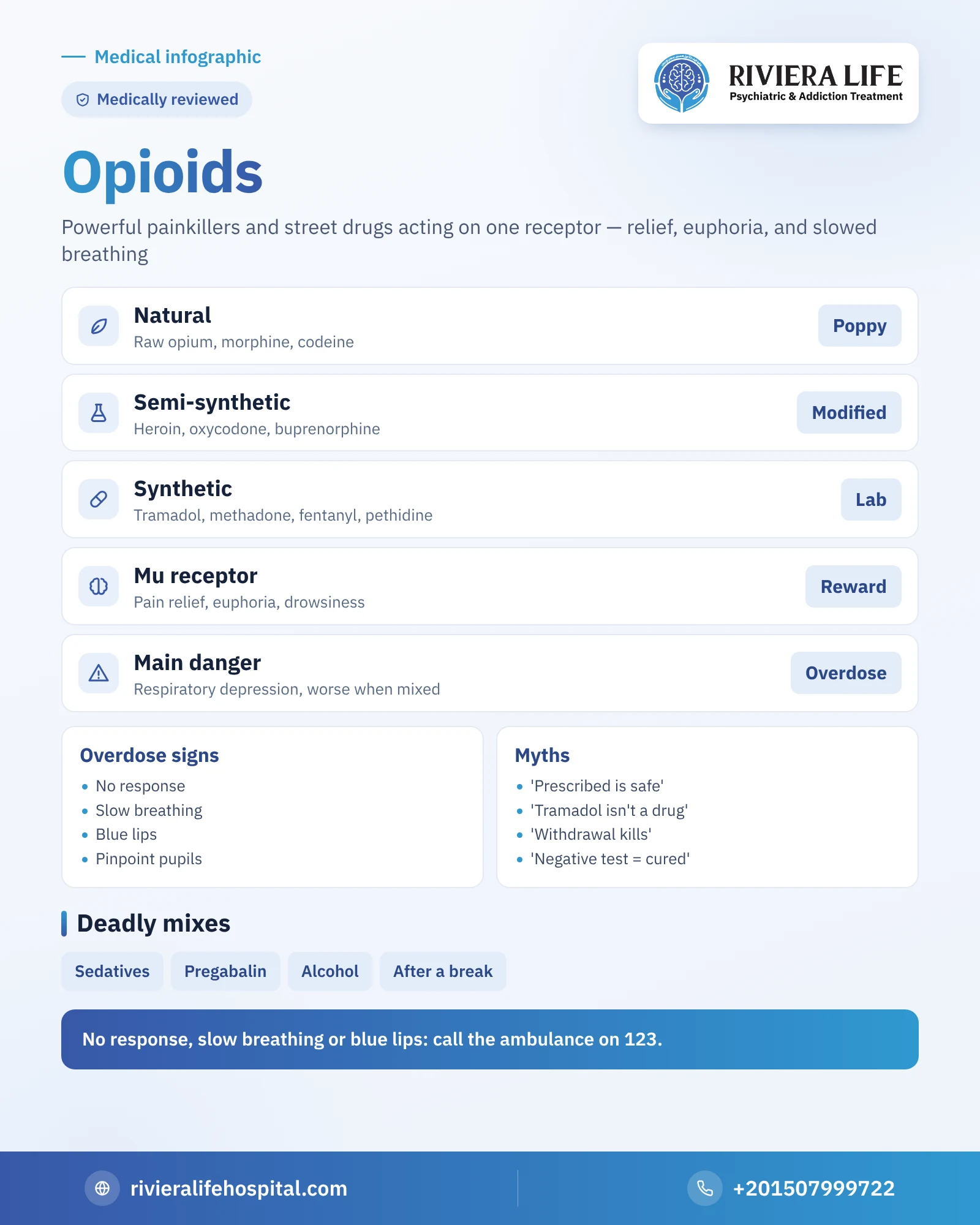
The most important receptor in the addiction story is the “mu” type opioid receptor. When it is activated, a group of effects happens at the same time:
- Pain eases, or remains present but loses its ability to bother.
- Dopamine rises in the reward circuits, so the person feels relief or euphoria that makes them want to repeat it.
- Drowsiness, calm and slowed thinking appear.
- The pupils narrow and bowel movement slows, so constipation appears.
- The breathing center in the brainstem slows, the effect that turns a large dose into a danger to life.
With repetition the nervous system adapts. The effect the same amount used to give decreases, and this is tolerance. Then the body comes to need the substance to function in a way that seems normal, and if it is absent, troublesome symptoms appear, and this is physical dependence. The paradox is that some who use opioids for a long time become more sensitive to pain, not less, in a phenomenon called opioid-induced hyperalgesia. Even so, physical dependence alone isn’t addiction; addiction adds to it loss of control and continuing despite the harm.
Do opioids have a medical use?
Yes, and unlike many drugs, medicine can’t do without them. They are the main option for relieving severe pain after surgeries, fractures and burns, and in cancer pain and palliative care, and some of them, such as fentanyl, are part of anesthesia. Codeine is found in some cough medicines, and methadone and buprenorphine are used to treat opioid addiction itself. You will find these medicines with their names and uses in the article on types of opioid painkillers.
The problem, then, isn’t the existence of the medicine, but the way it is used. A dose the doctor sets for a limited number of days and for a clear purpose is completely different from continuing after the pain has gone, raising the dose without consultation, or buying without a prescription. A notable share of the addiction cases we receive started with a legitimate prescription after an accident or a surgical operation.
Why are opioids among the most dangerous addictive substances?
- Respiratory depression: opioids are behind the largest share of drug-related overdose deaths around the world according to the World Health Organization.
- Mixing: adding sedatives, pregabalin or alcohol multiplies respiratory depression, a common pattern in Egypt.
- Variation in strength: some synthetic opioids are dozens of times stronger than morphine, so a very small amount of them is enough to cause poisoning.
- Withdrawal: its painful symptoms push many to go back to the substance just to stop them.
- Lower tolerance after abstinence: someone who goes back to their old amount after days or weeks of stopping may receive a dose their body can no longer tolerate.
- Harms specific to some members: such as the seizures linked to tramadol, and heart rhythm disturbance with high doses of methadone.
The opioid family: from the poppy to the lab
Doctors divide the members of the family according to their source and the way they act on the receptors:
| Group | Examples | What distinguishes it |
|---|---|---|
| Natural from the poppy | Raw opium, morphine, codeine | The oldest members of this family known to humans |
| Semi-synthetic | Heroin, oxycodone, hydromorphone, buprenorphine | Produced by chemically modifying a natural substance |
| Fully synthetic | Tramadol, methadone, fentanyl, pethidine | No connection to the plant, and vary greatly in strength |
| Mixed action | Nalbuphine, pentazocine | Activate some receptors and oppose others |
| Opioid antagonists | Naloxone, naltrexone | Block the receptors and are used in emergencies and treatment |
Three members of the family have separate guides on our site, because each has particular features in symptoms, testing and treatment:
Heroin
A derivative of morphine that reaches the brain much faster than it and is shorter-acting, so it is used repeatedly during the day, and is linked more than others to injecting and sudden overdose.
Tramadol
A synthetic painkiller with a weaker effect on opioid receptors, but it also raises serotonin and noradrenaline, so it combines the risk of dependence with the risk of seizures, and it is the most widespread in Egypt.
Morphine
The parent substance of the family and the yardstick against which the strength of the other opioids is compared. Its main place is the hospital, and addiction to it usually happens after long pain treatment, and sometimes among health workers because of easy access to it.
Pethidine represents an example of a synthetic opioid carrying additional risks to the nervous system, which has led many hospitals to replace it with other painkillers.
Opioids and the law in Egypt
Egyptian law deals with the members of this family on two levels. Heroin and raw opium are completely banned substances, and possessing, using or trafficking them is a crime whose penalty is graded and becomes harsher with trafficking. Opioid medicines such as morphine, fentanyl and tramadol are medically permitted, but their dispensing is subject to strict control and only takes place with a medical prescription, and any possession or sale outside this framework exposes a person to accountability. Tramadol in particular has seen a notable tightening of controls in past years after its misuse widened.
What matters more to families is that the law distinguishes between someone caught in the act and someone who comes forward of their own will seeking treatment, so a criminal case isn’t usually brought against the latter. For any legal question related to a specific case, the specialized lawyer remains the reference, and the Fund for Drug Control and Treatment of Addiction also provides a free, confidential hotline on 16023.
The opioids guide: each aspect in a separate article
We have dedicated a separate article to each question concerning the whole family, while you will find the details of each specific substance on its own page:
- Opioid addiction symptoms: the physical, behavioral and psychological signs the family notices, and when use counts as addiction.
- Opioid withdrawal symptoms: when the symptoms begin and peak, and how withdrawal differs between short-acting and long-acting substances.
- Opioid addiction treatment: the stages of treatment, approved medicines, psychological rehabilitation and how to choose a hospital.
- The harms of opioids: what they do to breathing, hormones, the digestive system and the mind, and the risks of overdose and mixing.
- How long opioids stay in the body: detection windows in urine, blood, saliva and hair, and why a single strip doesn’t detect all opioids.
- Types of opioid painkillers: the best-known opioid medicines by name, when they are used medically, and the risks of each.
- Causes of opioid addiction: why it starts and why stopping is hard
- Methadone: uses, benefits, risks and its role in treating addiction
- Buprenorphine: uses, benefits, harms and contraindications
- Naltrexone: uses, benefits, harms and warnings
- Naloxone: how it works and how to save someone from an opioid overdose
- Opium: raw opium: its source, its effect and why it causes addiction
- Opium addiction treatment: a treatment plan that suits long-term opium use
- Codeine: codeine in cough medicines and painkillers and its risks
- Nalbuphine: nalbuphine, the risks of injecting it and the truth about it being safe
- Nalbuphine addiction treatment: the stages of treating nalbuphine addiction
Common myths about opioids
The myth: as long as the doctor prescribed the medicine, I can’t become addicted to it. The truth is that a prescription reduces the risk but doesn’t cancel it, especially if the duration grows longer or the dose increases without review, or the person has a previous history of addiction.
The myth: tramadol is an ordinary painkiller and not a drug. The truth is that it is a synthetic opioid that causes dependence and withdrawal, and adds to them the risk of seizures with high doses or with some medicines.
The myth: opioid withdrawal is deadly, so continuing is a must. The truth is that withdrawal is painful but rarely threatens the life of a healthy person if it is managed medically, and the greatest danger is returning to use with a body that has lost its tolerance.
The myth: once the test becomes negative, the problem is over. The truth is that the substance usually leaves the urine within days, while the brain changes and intense craving remain for months and need treatment and follow-up.
If you are from the patient’s family: start here
Discovering that a son or husband is using an opioid, even if it is a painkiller tablet, confuses any family. These are practical steps that help you make the right start:
- Calmly write down what you have noticed: the changes in sleep, mood and money, and the names of any medicines or blister strips you found.
- Read about opioid addiction symptoms to tell a passing sign from a continuing pattern.
- Don’t try to stop the medicine suddenly or lock the person in the house, as unmanaged withdrawal may push them towards more dangerous sources.
- Choose a time when they are lucid to talk about your worry for them, not about your shame at them.
- Ask for a specialized consultation for yourself even before they agree, as the family needs guidance too.
Signs of an opioid overdose
Call the ambulance on 123 immediately if you notice
An overdose of any opioid, whether a tablet or an injection, may stop breathing within minutes.
- No response to being called or shaken
- Very slow or irregular breathing, or unusual snoring
- Bluish lips or nails
- Very narrow pupils
- Cold, clammy skin and a weak pulse
Until the ambulance arrives, don’t leave the person alone. If they are breathing but not responding, put them on their side so they don’t choke on vomit, and watch their breathing continuously. Don’t try to wake them with cold water or another substance. The medical team can give naloxone, which temporarily reverses the effect of opioids, but its effect may wear off before the opioid’s effect does, which is why the patient needs to stay under observation in hospital.
When should you ask for help?
Don’t wait for things to reach injecting or overdose. It is enough that the person finds it hard to stop an opioid painkiller, raises their dose without a doctor, or mixes it with other substances, for them to deserve a specialized assessment. At Riviera Life in Sheikh Zayed, the consultants in psychiatry and addiction treatment assess the case in complete confidentiality, and determine whether it needs admission under round-the-clock medical supervision or outpatient follow-up, with a program for the family and care after discharge. The first consultation is free on +201507999722.
Medical sources and referencesThe information in this article is based on reliable scientific sources