Why do two young men smoke bango on the same night, and one leaves it after months without trouble, while the other finds himself a year later unable to sleep without it? The answer is that the causes of bango addiction aren’t limited to one factor, but bring together factors related to the person themselves, others related to their environment, and a third group related to the substance and the way it is used. In this article we explain why use begins in the first place, why it turns from an experiment into dependence for some people, and what factors raise or lower the risk, so the family knows where to intervene.
How does bango turn from an experiment into dependence?
At first bango is linked with pleasant feelings: laughter, relaxation and easier sleep. The brain quickly learns that this cigarette means comfort, so it begins to ask for it whenever tension or boredom appears. With repetition the brain reduces the sensitivity of the cannabinoid receptors to protect itself from overactivation, so its ability to regulate mood, sleep and appetite without outside help weakens.
Here the goal changes: after bango was for pleasure, it becomes a means of returning to the normal state. And the more days in the week, the faster this shift. Medical estimates indicate that a considerable proportion of those who use cannabis regularly show some degree of dependence, and that the proportion is clearly higher in those who started in adolescence.
Starting at an early age
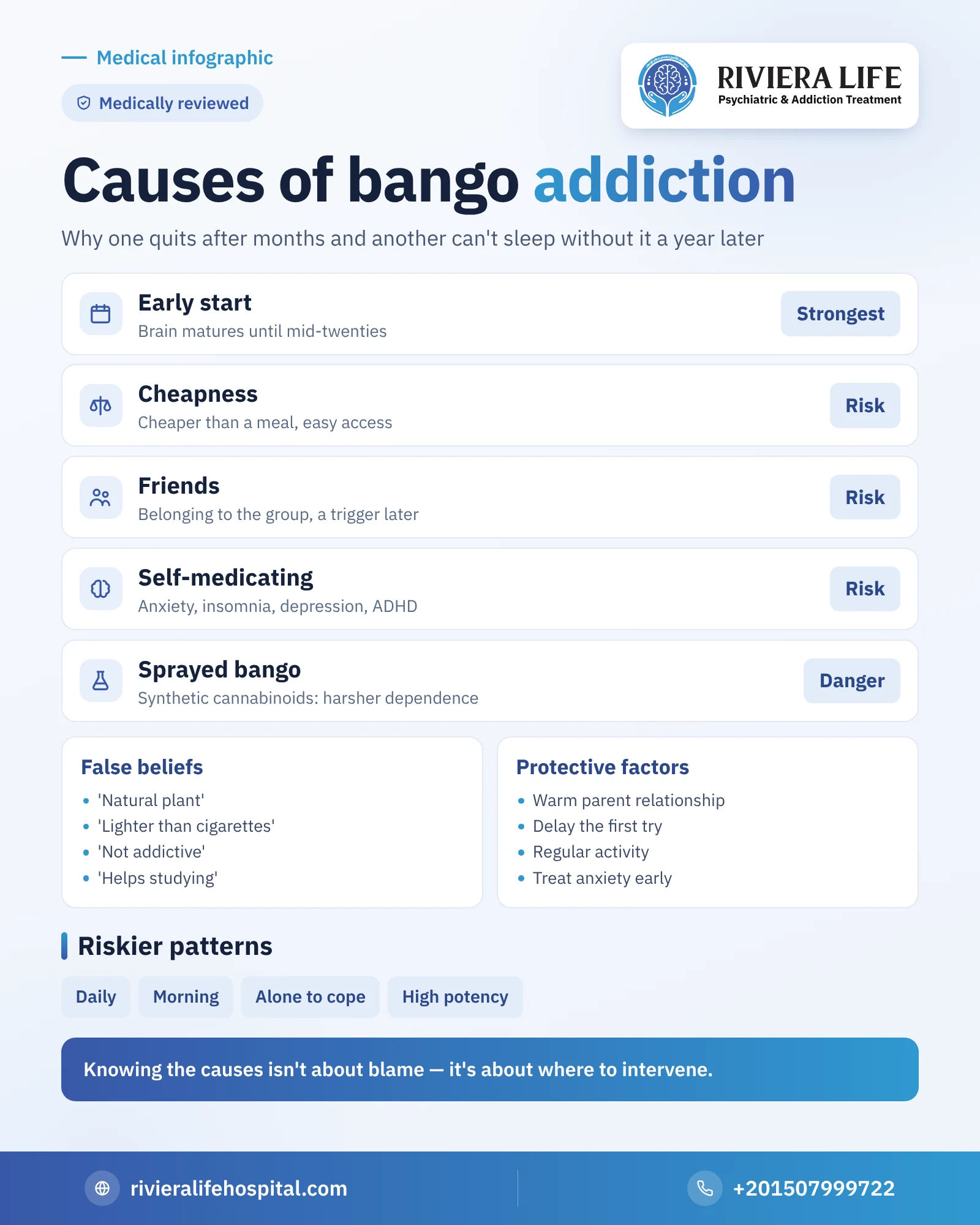
Age at the first cigarette is among the strongest predictors of later addiction. The brain remains in the process of maturing until roughly the mid-twenties, and the areas responsible for controlling impulsivity and estimating consequences are the last to mature. The teenager therefore feels reward strongly, while the brakes are still weak. And when bango intervenes at this stage, part of the brain’s development forms around it. Because bango in Egypt is often the first drug to reach a teenager’s hand due to its cheapness, this scenario repeats often in the cases we see.
Cheapness and easy access
Among the most important things distinguishing bango from others in Egypt is that it is cheap and available. When the price of a cigarette is less than a meal, money doesn’t stand as a barrier to repetition, and daily use becomes possible even for a student with limited pocket money. Easy access through friends or in some areas helps break the first psychological barrier, so the experience seems normal with no risk in it.
Friends and the surrounding atmosphere
Rarely does anyone start bango alone. The most common start is a “gathering” with friends on a rooftop, in a car or after a match, where the cigarette is part of belonging to the group. The pressure increases when the person is new somewhere, feels lonely, or wants to prove they are “grown up”. Over time the group itself becomes a trigger: meeting these friends is enough for craving to appear.
Anxiety, depression and the attempt at self-treatment
Many of those who depend on bango started using it to calm something else: social anxiety, chronic insomnia, undiagnosed depression, or painful memories. Bango eases these feelings temporarily, so it seems like the solution. But it treats the symptom and deepens the problem, so when its effect wears off the anxiety returns more severe, and the person comes to need it to calm down. That is why good treatment always looks for the disorder behind the use, as we explain in the article on bango addiction treatment.
Attention deficit and hyperactivity
People with undiagnosed attention deficit hyperactivity disorder are more likely to try bango and continue on it, because it outwardly calms impulsivity and restlessness. Diagnosing and treating this disorder properly reduces the need for bango in many of them.
Genetics and family history
Predisposition to addiction is partly passed on through genes. If one of the parents or siblings suffers from addiction to any substance, the likelihood that experimenting turns into dependence is higher. Genetics here doesn’t mean inevitability; it makes the person more sensitive to the effect of the substance, but environment, upbringing and early intervention can change the outcome a great deal. That is why we advise families with a history of addiction to deal with the first sign more seriously.
The family and daily pressures
Some homes increase the risk unintentionally: ongoing disputes between the parents, the father’s absence working abroad for long periods, completely absent supervision, or conversely suffocating supervision that pushes towards rebellion. Daily pressures also play a big role, such as unemployment and long idle time after graduation, the pressure of the secondary school exams, and working night shifts. Idleness in particular recurs in patients’ stories: long hours without purpose filled with sitting with friends and the cigarette.
False beliefs about bango
Among the most dangerous things that facilitate addiction is that bango is surrounded by a pleasant image: “a natural plant”, “lighter than cigarettes”, “it isn’t addictive”, “it helps with studying”. These ideas make the person use without caution, and postpone acknowledging the problem until dependence deepens. They are reinforced by online clips talking about the legalization of cannabis in some countries as if it were proof that it is safe, even though legalization is a legal decision, not a medical certificate.
Method of use and type of bango
Not all patterns of use are equal in risk. Daily use, use more than once a day, in the morning right after waking, or alone to calm emotions, are all patterns linked to faster dependence. Also, a higher concentration of the active substance in some types speeds the appearance of tolerance. Bango sprayed with synthetic cannabinoids adds another factor, because these substances are much stronger and cause more severe dependence and harder withdrawal symptoms, and you can read more about them on the strox page.
Does bango lead to other drugs?
Not everyone who smokes bango moves on to harder substances, but this path repeats enough to deserve attention. The reason isn’t some magic in the plant itself, but a group of things that come together: someone who buys bango deals with the same dealer who offers pills, the company that uses bango tries others, and tolerance pushes some people to look for a stronger effect.
Added to this, someone who started young has a brain that learned early that comfort comes from an external substance. That is why we see common combinations in Egypt that start with bango and then add tramadol or pregabalin, and you will find details of the latter on the pregabalin page. Intervening at the bango stage cuts this road before it gets long.
Factors that protect against addiction
Against the risk factors there are real protective factors that reduce the likelihood even in those who have tried:
- A warm relationship with at least one parent whom the son can talk to frankly.
- Delaying the first experience as much as possible, as every extra year protects the brain.
- Regular activity that fills time: sport, work or a hobby with an audience.
- Diagnosing and treating anxiety, depression and attention deficit early.
- Friends who don’t use, and honest knowledge of the harms of bango without exaggeration.
What does the family do with this information?
Knowing the causes isn’t aimed at finding someone to blame, but at knowing where to intervene. If bango is a means of calming anxiety, treating the anxiety is part of the solution. If idleness is the entry point, a realistic daily plan is part of the solution. And if the company is the trigger, rebuilding an alternative social circle matters more than prohibition alone.
Start by watching for the signs explained in the article on bango addiction symptoms, then ask for a specialized assessment. The Riviera Life team can help you in a free first session to understand what lies behind your son’s use specifically, and set a plan that deals with the cause, not just the cigarette. For the general picture of the substance see the bango page.
More from the bango guide
- Bango: the comprehensive guide
- Bango addiction symptoms
- The harms of bango
- Bango addiction treatment
Questions many people ask
No, most who try it don't reach addiction. But the risk rises greatly with daily use, starting in adolescence and the presence of anxiety, depression or a family history of addiction.
Because it is relatively cheap and available through friends, and surrounded by a false image that it is natural and harmless. This combines with the nature of adolescence, which tends towards experimenting and belonging to the group.
Genetics increases predisposition but doesn't make it inevitable. Someone with a first-degree relative suffering from addiction is more vulnerable, but environment and early intervention change the outcome a great deal.
Yes, many use it to calm anxiety, insomnia or sadness, so they feel temporary relief and then the anxiety returns more severe. Treating the original psychological disorder is an essential part of addiction treatment.
A frank relationship with the parents, delaying the first experience, regular activity that fills time, early treatment of any anxiety or attention deficit, and friends who don't use.