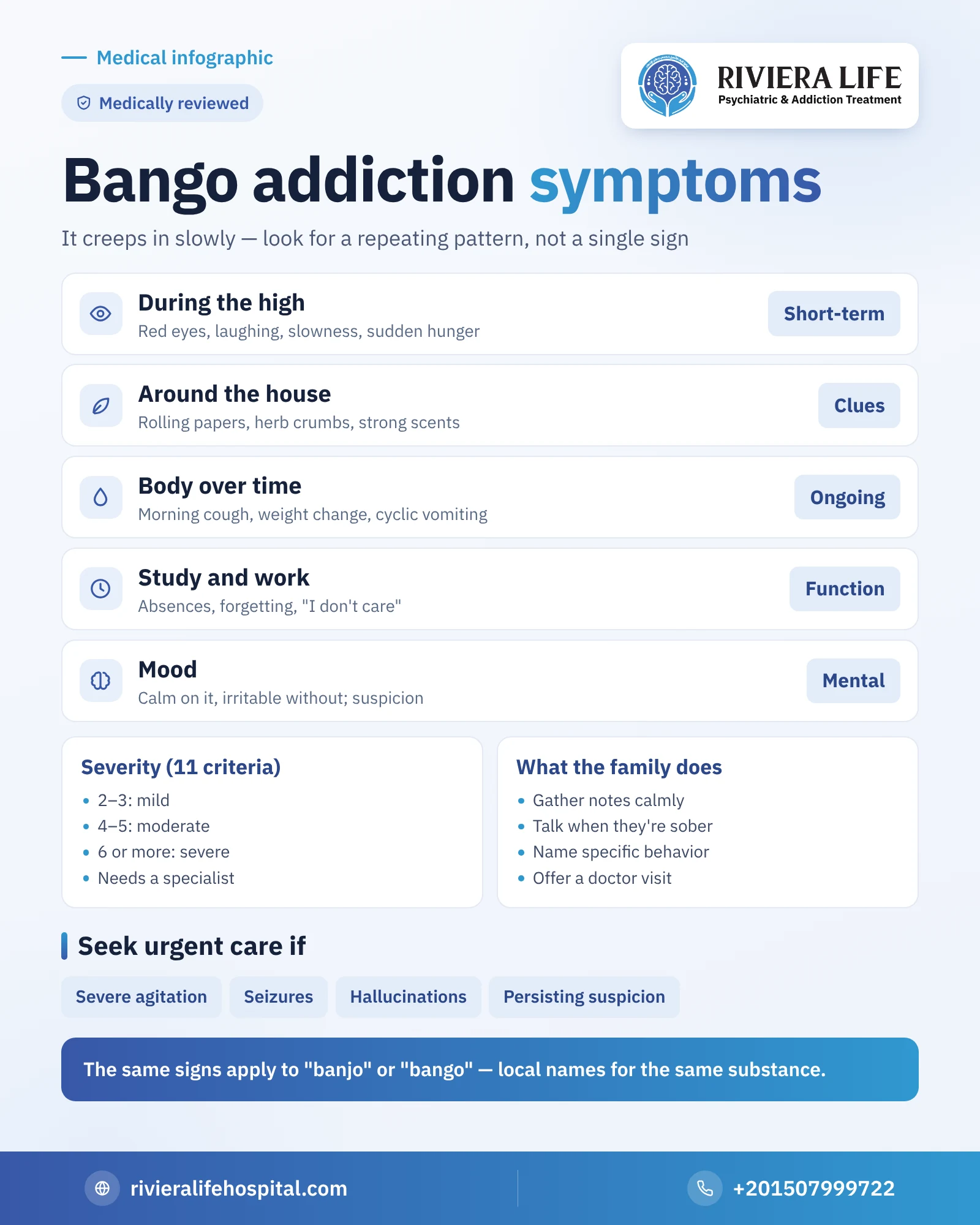
Bango addiction symptoms don’t appear suddenly as happens with some pills, but creep in slowly: red eyes in the evening, then a disturbed appetite, then falling grades and changing friends. That is why many families are late to notice, or consider what they see “a phase that will pass”. The signs you will read here are of three types: what appears during the high, what accumulates with continued use, and what indicates that use has become a dependence that needs treatment. One sign isn’t enough to judge; what matters is the pattern that repeats.
The same signs apply to what is called “banjo” or “bango” in some countries, as these are local names for the same substance.
Signs that appear during the effect of bango
In the hours after smoking you may notice a group of short-term signs that disappear when the effect wears off:
- Clear redness in the whites of the eyes, and heavy eyelids or a sleepy look.
- Laughing for no understandable reason, or unusual absent-mindedness and silence.
- Slow speech and movement, and forgetting what was said minutes earlier.
- Sudden hunger and eagerness for sweets and fast food at odd times.
- A dry mouth and drinking lots of water or juice.
- Sometimes anxiety, tension or a feeling that others are watching them.
These signs alone don’t mean addiction, as they may appear in someone who tried it once. But if they recur on many days of the week, or become part of the evening routine, they are a signal that deserves attention.
Things that may catch your eye at home
Many families discover bango from its tools before they see its symptoms. Among the most common: thin cigarette rolling papers, butts of hand-rolled cigarettes, crumbs of green or brown herbs in pockets or on the carpet, small plastic bags, and many lighters.
The person may take care to lock their bedroom door or open the window in cold winter, or spend a long time in the bathroom or on the roof without a clear reason. You may notice a pungent herbal smell different from ordinary cigarettes, which they try to hide with incense, air fresheners or excessive perfume, along with frequent use of eye drops.
Physical signs with continued use
When bango becomes a daily habit, slower effects begin to appear:
- A recurring cough and phlegm in the morning, and shortness of breath on exertion.
- A change in weight, gain with eating binges, or loss with neglected meals.
- Constant fatigue and morning sluggishness even after long sleep.
- Neglect of personal hygiene and clothes.
- In some long-term users: repeated bouts of nausea and vomiting with abdominal pain, relieved by long hot showers, a medically known syndrome that deserves an examination.
Changes in study and work
Bango hits short-term memory, concentration and motivation, so its effects show clearly in daily performance. A student who used to study regularly starts missing classes and forgetting assignments, and their grades decline without a clear reason. An employee becomes late and sluggish and loses interest in promotion. Many repeat one phrase: “I don’t care”. This listlessness isn’t pure laziness in every case; it may be a direct effect of daily use, or depression the person is trying to calm with bango.
Behavioral and social signs
- A new circle of friends the parents don’t know, and old friends disappearing.
- Repeatedly going out late, and spending hours on the roof or in the car.
- Repeated requests for money with different excuses, or small things disappearing from home.
- Lying about small details, and intense anger at any question about where they were or their friends.
- Giving up sport or hobbies they used to love.
- Playing it down with phrases such as “it’s just bango” or “everyone smokes”.
Psychological and mood signs
Mood changes are among the most distinctive features of dependence on bango. The person may be calm and pleasant while under the influence, then irritable and tense when they can’t find it. Among the things families mention most: difficulty sleeping without a joint, loss of interest in anything, and isolating in their room for hours.
In some cases unjustified suspicions of family or friends appear, or strange ideas about surveillance and conspiracy. These suspicions deserve special attention, because they may be the start of a psychotic disorder, especially if the bango was sprayed or there is a family history of psychiatric disorders. Details of the long-term psychological effects are in our article on the harms of bango.
How do you tell bango signs apart from other causes?
Red eyes may be an allergy, withdrawal may be depression, and declining studies may be stress or a learning problem. Don’t base your judgment on one sign; look at several signs coming together, their repetition and their coinciding with going out or being alone. The important difference is that bango signs fluctuate: the person is one way before going out and another after coming back.
If signs more violent than usual appear, such as severe agitation, seizures or hallucinations, what they used may have been bango sprayed with synthetic cannabinoids, which needs a prompt medical assessment. Testing can help confirm, bearing in mind that its result has limits explained in our article on how long bango stays in the body.
When does bango use become addiction?
Doctors use approved criteria to diagnose what is called cannabis use disorder. It isn’t enough for the person to use; a pattern of loss of control and harm must appear within twelve months, and among its most prominent criteria are:
- Using larger amounts or for longer than intended.
- A persistent wish to cut down, with failed attempts.
- Spending a lot of time getting bango, using it or recovering from its effect.
- Intense craving or a strong desire to use.
- Falling short in study, work or home because of it.
- Continuing despite problems with family or friends.
- Giving up or reducing important activities.
- Using in dangerous situations such as driving.
- Continuing despite a psychological or physical problem that bango worsens.
- Tolerance: needing a larger amount to get the same effect.
- Withdrawal symptoms on stopping, or using to avoid them.
Two or three criteria indicate a mild disorder, four or five a moderate disorder, and six or more a severe disorder. This division helps the doctor choose the suitable level of treatment, but it needs a specialist assessment and isn’t suitable for self-diagnosis from a list.
Symptoms that appear on stopping
One of the clearest signs of dependence is that the person changes when they try to stop or run out of bango: irritability, insomnia, loss of appetite, anxiety and disturbing dreams. Many users explain this as “stress” or “being fed up”, and don’t notice it is withdrawal. The full details of the timing and duration of these symptoms are in our article on bango withdrawal symptoms.
Signs in teenagers
In those of school age the first sign is usually educational or behavioral, not physical: absences, clashes with teachers, older friends, and a sudden change in clothes or language. Because the brain at this stage is more affected, early intervention here is more important than at any other age. To understand why teenagers in particular are more prone to start and continue, you can read our article on the causes of bango addiction.
What do you do if you notice these signs?
Gather your observations calmly before confronting, and choose a time when the person isn’t under the influence. Talk about specific behavior you saw, not general accusations. Instead of threatening, suggest seeing a doctor to assess sleep, mood and concentration, an entry point many young people accept. The family can start by asking for a consultation on its own even before they agree. At Riviera Life the first consultation is free and confidential, and a consultant psychiatrist assesses whether it is experimentation that guidance is enough for or a disorder that needs a bango addiction treatment plan.
More from our bango guide
- Bango: the complete guide
- The causes of bango addiction
- Bango withdrawal symptoms
- Bango addiction treatment
Questions many people ask
Not necessarily; allergy, late nights and fatigue also cause red eyes. Redness becomes significant when it recurs with other signs such as sudden hunger, an herbal smell and mood changes.
There is no fixed period; it depends on how often they use, their age when starting and their psychological predisposition. Daily use for several months, especially in adolescence, clearly raises the risk.
Yes, especially at first or when using at times away from home. That is why the family watches the general pattern in study, sleep, money and friends more than momentary signs.
Bango may cause anxiety and suspicion in some people, increasing with heavy use or sprayed material. If suspicions continue after the effect wears off, they need an urgent psychiatric assessment.
A psychiatrist or addiction specialist diagnoses it through a detailed interview and approved criteria, and may use tests. Lists on the internet help raise awareness but don't replace an assessment.