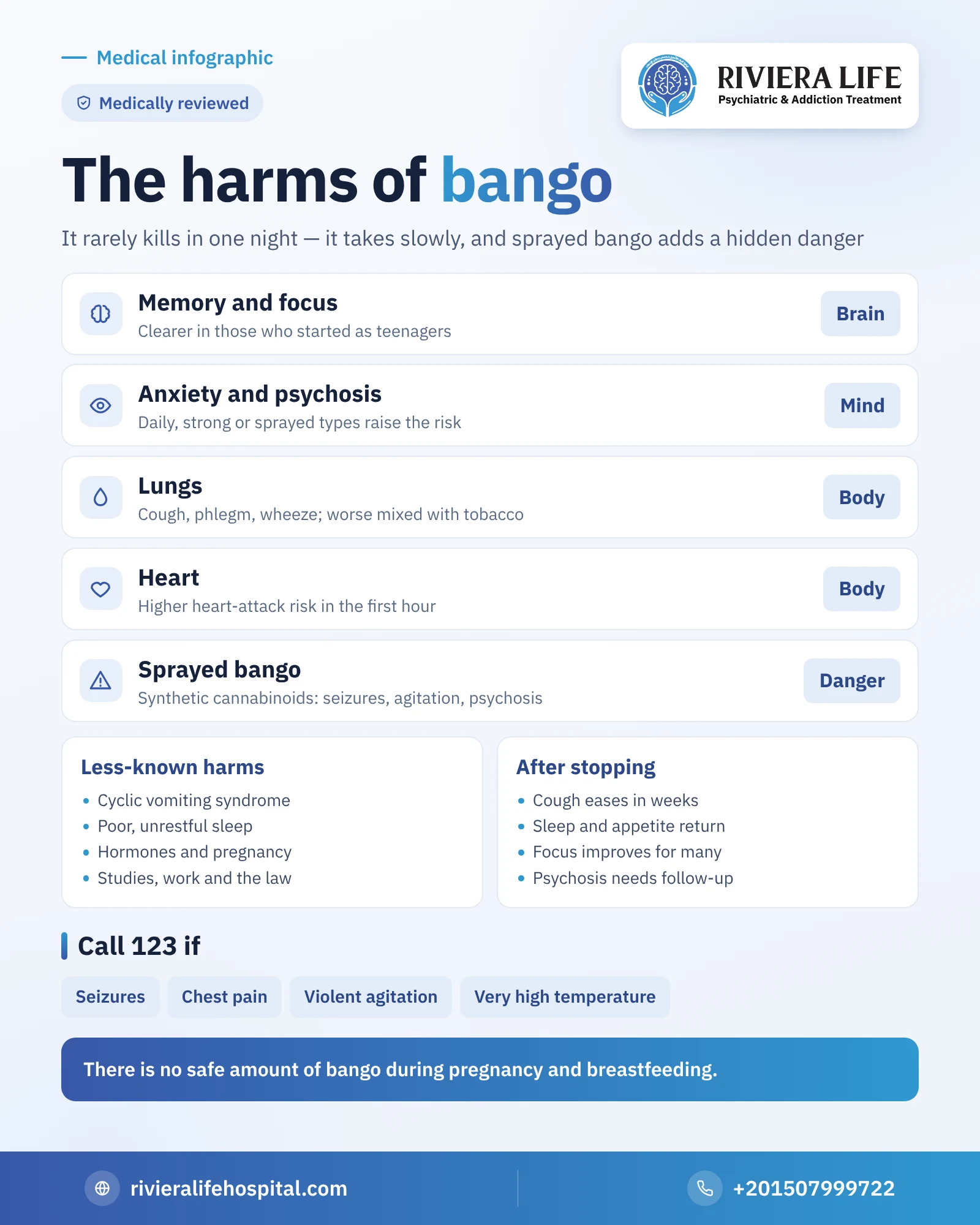
The harms of bango are real even if they seem quieter than the harms of heroin or stimulant pills. It doesn’t usually kill in one night, but it takes from its user slowly: weaker memory, less motivation, disturbed sleep, strained lungs, and a higher risk of anxiety and psychosis. Making matters worse, the bango circulating in Egypt may be sprayed with chemicals more dangerous than the plant itself. Here we present the harms of bango on the brain, mental health, the body and daily life, what appears quickly and what accumulates over the years, and when these harms call for asking for help.
Short-term harms after smoking
During the hours of the effect a person may face problems that have nothing to do with addiction but with the state itself:
- Weak short-term memory and concentration, making it hard to learn or make a sound decision.
- Slow reactions and disturbed judgment of distances, which makes driving under its influence a danger to the driver and others.
- A faster heart rate and a drop in blood pressure on standing suddenly, sometimes with dizziness or fainting.
- Bouts of anxiety, panic or a feeling of persecution, especially with larger amounts or in someone trying it for the first time.
The harms of bango on the brain and memory
The receptors bango works on are dense in the brain areas responsible for memory, learning and planning. With regular use, attention, speed of processing information and the ability to remember are affected. Research indicates that this effect is clearer in those who started in adolescence and used regularly for a long time, and that part of it may persist even after stopping, while another part improves gradually with abstinence. Many daily users describe a state of listlessness, lack of enthusiasm and constant procrastination, a state in which the effects of bango overlap with depression, and telling them apart needs a specialist assessment.
The harms of bango on mental health
Anxiety and panic attacks
The paradox is that many start bango to calm anxiety, then find that anxiety has become worse between joints. Over time, real panic attacks may appear during or after the effect.
Depression
Heavy use is linked to increased symptoms of depression. The relationship here runs both ways: depression pushes towards use, and use deepens depression and delays its treatment.
Psychosis and schizophrenia
This is one of the most serious things linked to cannabis. Daily use, especially of high-potency types, raises the risk of a psychotic disorder in which hallucinations, suspicions and strange ideas appear, and the risk is greater in those with a family history of schizophrenia or who started young. The condition may begin as a passing episode during the effect, then recur and last longer in some people.
Sprayed bango: the harm you can’t see
This is the point that distinguishes bango in Egypt from the global talk about marijuana. Cheap herbs may be sprayed with synthetic cannabinoids to increase their strength, or carry residues of pesticides and chemicals from unregulated farming and storage. Synthetic cannabinoids are much stronger than the plant’s substance, and may cause severe agitation, seizures, a dangerously fast heartbeat and acute psychosis, and sometimes kidney damage. The problem is that the user can’t tell a pure bag from a sprayed one before smoking.
Call an ambulance on 123 immediately if you see
After smoking bango of unknown origin, these signs may mean poisoning with a sprayed substance, and delay may be dangerous.
- Seizures or loss of consciousness
- Chest pain or a very fast heartbeat
- Violent agitation or hallucinations that don’t settle
- A very high body temperature with heavy sweating
The harms of bango on the lungs
Bango smoke carries many of the irritating substances found in tobacco smoke, and is usually inhaled deeply and held in the chest longer. With regular use, symptoms resembling chronic bronchitis appear: coughing, phlegm and wheezing. When bango is mixed with tobacco in the same cigarette, the smoker combines the harms of both.
The harms of bango on the heart and blood vessels
Bango raises the heart rate, and may raise or lower blood pressure depending on the situation. Studies indicate that the risk of a heart attack rises in the first hour after use, a risk that deserves attention in older people and those with heart disease or risk factors such as smoking and high blood pressure. Heavy use has also been linked to an increased risk of stroke in some studies.
Repeated vomiting: a syndrome many don’t know
Some people who use bango daily for years develop repeated bouts of nausea, severe vomiting and abdominal pain, and notice that bathing in hot water relieves them, so they repeat it for long periods during the day. This is a known medical syndrome linked to cannabis; it may lead to severe dehydration and repeated emergency visits, and its decisive treatment is stopping use. Many think bango treats nausea so they increase the amount, and the condition gets worse.
The harms of bango on sleep
Many think bango is the best sleeping aid, because it makes falling asleep faster at first. But what happens afterwards is less kind: the share of deep sleep and the dreaming stage decreases, so the person wakes up heavy and unrested despite long hours. With continued use bango becomes a condition for sleep, so the user can’t close their eyes without it, their bedtime is pushed back to dawn, and their body clock is turned upside down.
Add to that the repeated late nights at “sessions” that deprive the body of regular rest, which shows in concentration and mood the next day. When they stop using, they suffer insomnia and disturbing dreams for weeks, which pushes many to return.
Harms to hormones and pregnancy
Regular use may affect sex hormones and sperm quality in men, and the regularity of the cycle in some women. During pregnancy the active substance crosses to the fetus, and is linked to low birth weight and later problems with development and attention, and it also passes into breast milk. That is why there is no safe amount of bango during pregnancy and breastfeeding.
The harms of bango on studies, work and life
Social harm is often the first thing that brings the family to the clinic. A decline in grades that may end in dropping out, repeated lateness at work that may end in dismissal, quarrels at home, and money constantly spent. Add to that the legal risk, as possessing bango is a crime in Egypt that may change a young person’s future in a moment. To understand how these changes look from the outside, you can read our article on bango addiction symptoms.
When bango is mixed with other substances
On the Egyptian street bango is often combined with tramadol, pregabalin, alcohol or sedatives. This mixing multiplies drowsiness, slow movement and the risk of accidents, may increase the risk of seizures with tramadol, and makes treatment more complex because the patient needs withdrawal from more than one substance. You will find details on tramadol on the tramadol page.
Do the harms of bango disappear after stopping?
The good news is that many of the harms improve after stopping. The cough eases within weeks to months, sleep and appetite gradually return, and concentration and memory improve in many people with continued abstinence. But the first weeks may be difficult because of withdrawal symptoms, the subject of our article on bango withdrawal symptoms. Severe psychological harms such as psychosis need regular medical follow-up.
When should you ask for help?
Ask for a medical assessment if suspicions or hallucinations appear, repeated vomiting, chest pain, worsening depression, or if bango has become daily and stopping hasn’t worked. At Riviera Life, consultants in psychiatry and addiction treatment assess the physical and psychological harms together, and set a bango addiction treatment plan suited to the case in complete confidentiality.
More from our bango guide
- Bango: the complete guide
- The causes of bango addiction
- How long bango stays in the body
- Bango withdrawal symptoms
Questions many people ask
It doesn't cause psychosis in every user, but daily use and strong or sprayed types raise the risk, especially in teenagers and those with a family history of schizophrenia. Persistent suspicion or hallucinations need urgent assessment.
Concentration and memory improve in many people with continued abstinence over weeks and months. Part of the effect may remain in those who started young and used heavily for many years.
Bango smoke contains many of the same irritating substances, is inhaled more deeply, and causes coughing, phlegm and bronchitis symptoms. Mixing it with tobacco combines the harms of both.
It can't be known by appearance or smell. Signs such as seizures, severe agitation, chest pain and a very fast heartbeat after smoking point to poisoning that needs an ambulance immediately.
No. The active substance crosses to the fetus and passes into breast milk, and is linked to low birth weight and problems with development, so there is no safe amount during pregnancy and breastfeeding.