The short answer
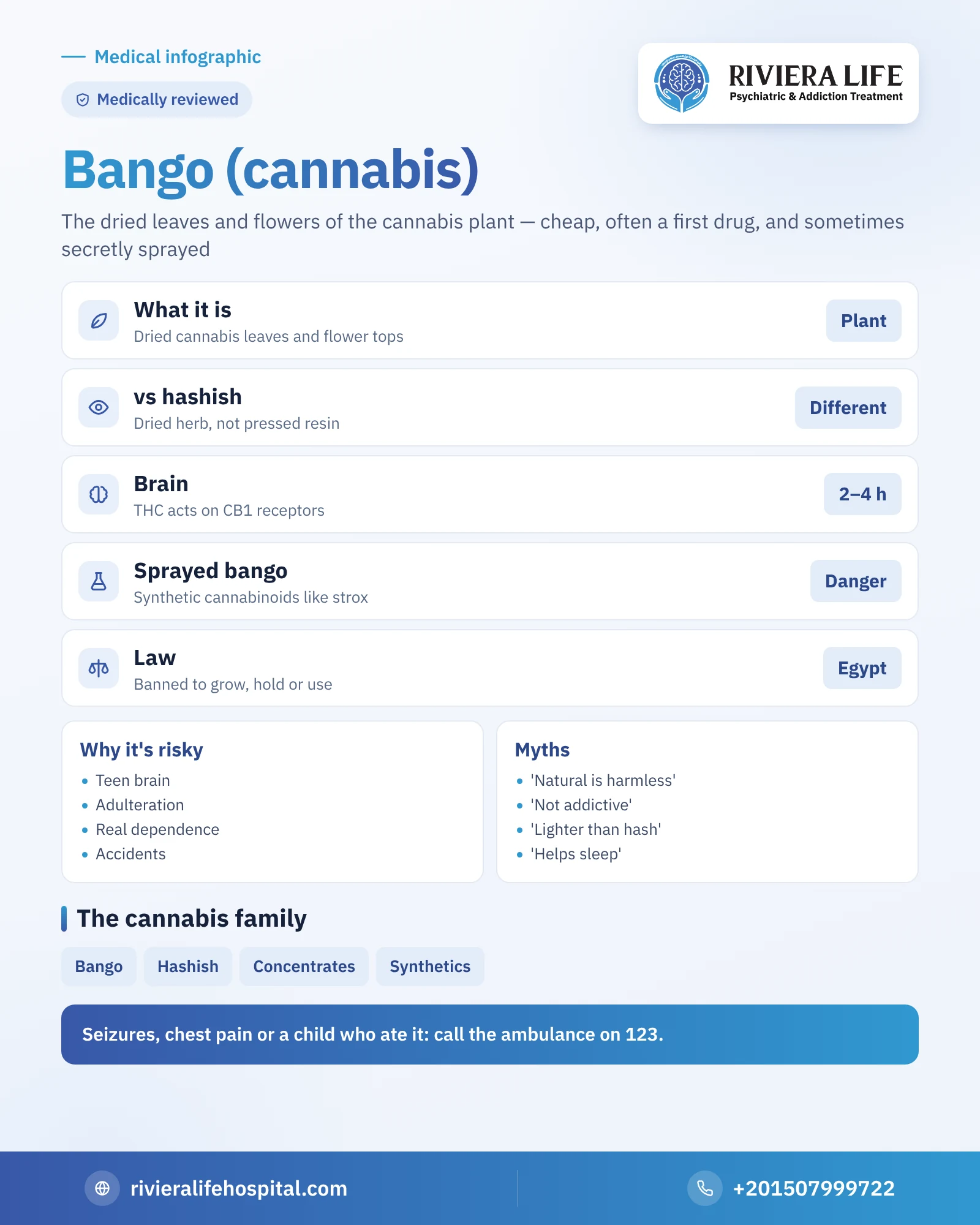
Bango is the dried green parts of the cannabis plant: the leaves and flower tops, along with stems and seeds in the cheap types. It is also written “bango” or “banjo”, and in Sudan and some Gulf countries it is called “banqo”. It looks like chopped dried herbs, green or brownish, with a pungent smell, while hashish is pressed pieces of the same plant’s resin and is usually more concentrated. Its active substance is THC, whose concentration varies from bag to bag, and the most dangerous is bango sprayed with synthetic cannabinoids. It is banned in Egypt.
- Other namesBanjo, banqo, “the green”
- Difference from hashishDried plant, not pressed resin
- Status in EgyptBanned to grow, possess and use
Bango is the name the Egyptian street knows for the leaves and flowers of the cannabis plant after drying and crumbling, and it is usually the cheapest plant drug available and the easiest to reach the hands of teenagers and young people. Many families see it as “lighter” than hashish or “just a cigarette”, while young people arrive at addiction clinics every day having lost their studies or suffered panic attacks and suspicion, and some of them used bango sprayed with substances they knew nothing about. On this page we explain what bango is precisely, what distinguishes it from hashish, how it affects the brain, and why it is a real danger despite its reputation, then link you to a separate article for each of its aspects.
Its name is also written “banjo”, and in Sudan and some Gulf countries it is called “banqo”.
What is bango?
Bango is the dried green parts of the cannabis plant (Cannabis sativa): the leaves and flower tops, and with them, in the cheap types, pieces of stems and seeds. The plant contains hundreds of compounds, the most important being tetrahydrocannabinol (THC), which is responsible for the psychological effect known as being “stoned”, and cannabidiol (CBD), which doesn’t cause this effect to the same degree.
What the world knows as marijuana is in essence the same form, that is, the dried plant. But the word bango in Egypt has become linked with a specific image: a plant grown or smuggled at varying quality, sold in small bags at low prices compared with others, and often containing more leaves and stems than flower tops. That is why the concentration of the active substance in it differs from one bag to another, so the user doesn’t know what is actually entering their body.
The difference between bango and hashish
Bango and hashish come from the same plant, but they aren’t one and the same. Hashish is the resin, that is, the sticky substance secreted by the tiny hairs on the plant’s tops, which is collected and pressed into brown or dark pieces called in Egypt “tarba” or “the piece”. Bango is the plant itself after drying, green or brownish, with a pungent herbal smell.
- Look: hashish is pressed pieces that are heated and crumbled, and bango is chopped dried herbs.
- Concentration: hashish usually contains a higher concentration of the active substance per gram, while bango varies greatly according to the proportion of leaves and stems in it.
- Price and spread: bango is usually cheaper, which is why it is often the first drug a teenager tries.
- Adulteration: both may be adulterated, but bango, in its herbal form, is easier to spray with chemicals without anyone noticing.
For details on the two other forms of the same plant you can see the hashish page and the marijuana page.
Names of bango circulating in Egypt
The best-known name is bango itself, and you may hear among young people words such as “el-akhdar” or “el-khodra” (the green), in reference to its color, and the word “el-keif” is sometimes used in a general sense covering both hashish and bango. The rolled cigarette made from it is called a “stuffed cigarette” or a “laffa”. More dangerous than these names is the phrase “synthetic bango” or “sprayed bango”, which usually refers to herbs sprayed with synthetic cannabinoids such as strox, substances completely different in their strength and danger, which we have explained on the strox page.
How is bango used?
Bango is mostly smoked rolled in cigarette paper, alone or mixed with tobacco, or using a shisha and handmade smoking devices. Less often it is added to food or drinks, and here the effect is delayed by an hour or more, so the person thinks they didn’t feel anything and takes more, then the effect comes to them doubled. On the Egyptian street bango is often combined with other substances, the best known being tramadol, pregabalin and alcohol, combinations that multiply the harms and cancel none of them.
What does bango do in the brain and body?
When smoked, the active substance reaches the blood within minutes, and binds to receptors in the brain called type 1 cannabinoid receptors. These receptors are part of a natural system that takes part in regulating memory, mood, appetite, sleep and movement, and usually responds to substances the body releases in small, calculated amounts. When bango floods them, well-known effects appear:
- Relaxation, laughter and a change in the perception of time, colors and sounds.
- Red eyes, dry mouth and a racing heartbeat.
- Intense hunger and a craving for sweets after an hour or two.
- Slow reactions and weakened concentration, short-term memory and balance.
- In some people or with larger amounts: anxiety, panic attacks and suspicion of others.
The effect usually lasts two to four hours when smoked, but the substance is stored in fatty tissue and leaves slowly, which is why its trace remains in tests for days or weeks in someone who uses regularly. With repetition the number of available receptors and their response decrease, so the person needs a larger amount, and mood, sleep and appetite become harder in the absence of the substance.
Does bango have a medical use?
Bango isn’t used in Egypt for any therapeutic purpose, and isn’t dispensed by prescription. In some countries there are medicines extracted from cannabis or synthesized to mimic its compounds, such as a medicine of pure cannabidiol for rare types of childhood epilepsy, and medicines containing a substance similar to the active substance for treating the nausea that accompanies chemotherapy. These are medicines with a fixed, known concentration under medical supervision, and have nothing to do with a bag of bango of unknown origin and concentration. The existence of a medicine derived from the plant doesn’t mean that smoking the plant is a treatment.
Why is bango dangerous?
- Age: most of those who start bango are teenagers, and the brain at this stage is still maturing, so it is more affected in memory, attention and motivation.
- Adulteration and spraying: the user doesn’t know whether the herbs are pure or sprayed with synthetic cannabinoids or pesticides, and some of these substances may cause seizures or an acute psychotic disorder.
- Addiction: many think bango doesn’t cause addiction, while estimates indicate that a notable proportion of those who use it regularly develop cannabis use disorder, and the proportion rises with early onset and daily use.
- Mental health: heavy use is linked to anxiety and depression, and to an increased risk of psychosis in those who are predisposed.
- Driving and accidents: it slows reactions and weakens the judgment of distances, raising the risk of road accidents.
- A gateway to mixing: bango is often the entry point that is later combined with more dangerous pills or substances.
Bango within the cannabis family
The cannabis family includes three natural forms people know: the dried plant (bango or marijuana), the pressed resin (hashish), and concentrated oils with a very high concentration. They all act on the same receptors, and differ in concentration and the speed and intensity of the effect. Alongside them there are synthetic cannabinoids such as strox and voodoo, which aren’t a plant at all but chemicals made in labs and sprayed onto herbs, and their effect is much stronger and less predictable. That is why a bag of bango may in practice be either of these two completely different things without the buyer knowing.
Bango is known in Sudan as banqo, and the guide to addiction treatment in Sudan covers the most widespread substances there and the bodies currently working.
Bango and the law in Egypt
Egypt’s anti-narcotics law lists the cannabis plant with its parts among the banned substances, and criminalizes growing, possessing, using and trafficking it, with the penalty becoming harsher with cultivation and trafficking. At the same time, the law allows a user who comes forward on their own or through their family seeking treatment not to have a criminal case brought against them. This point reassures many families who hesitate out of fear of the consequences. For special cases it is advisable to ask a specialized lawyer, and you can also contact the hotline of the Fund for Drug Control and Treatment of Addiction on 16023 confidentially.
The bango guide: each aspect in a separate article
We have divided the discussion of bango into articles, each answering a single question in detail without repetition:
- Bango addiction symptoms: what the family notices in the eyes, appetite, sleep, studies and mood, and when use counts as a disorder.
- Causes of bango addiction: why a teenager starts, and why trying it turns into daily dependence in some people.
- The harms of bango: its effect on memory, mental health, the lungs and the heart, and what sprayed bango adds.
- How long bango stays in the body: when it shows in urine, blood, saliva and hair tests, and the factors that affect the result.
- Bango withdrawal symptoms: when irritability, insomnia and loss of appetite begin, and how long they last.
- Bango addiction treatment: the stages of psychological and behavioral treatment, when admission is necessary, and how to choose a hospital.
Common myths about bango
The myth: bango is a natural plant, and what is natural doesn’t harm. The truth is that many toxins are plant-based in origin, and that the bango in circulation may not be natural at all if it has been sprayed with chemicals.
The myth: bango doesn’t cause addiction. The truth is that dependence on it is medically documented, and it has clear withdrawal symptoms such as irritability, insomnia and loss of appetite.
The myth: bango is lighter than hashish, so there is no need to worry. The truth is that the low concentration in some types pushes the user to smoke larger amounts, and that it is easier to adulterate, so the comparison doesn’t mean safety.
The myth: it helps with sleep and getting rid of stress. The truth is that it may shorten the time needed to fall asleep at first, but depending on it spoils the quality of sleep and makes anxiety more severe on stopping.
Discovered your son is using bango? Start here
Many families discover the matter from a herbal smell in the room or rolling papers in a pocket. Don’t start by shouting or searching every day, as this pushes towards hiding. Write down what you have noticed and its dates, choose a time when your son is sober and calm, and talk about your worry for his health and studies, not about scandal.
Ask him what he gets from bango, as the answer may reveal anxiety, depression or a problem with friends. And don’t wait until he agrees to treatment before you ask for advice yourself; an early assessment determines whether the matter is experimenting that needs follow-up or dependence that needs a treatment plan. You will find practical steps for the conversation in the article on how to deal with a hashish addict and convince him to get treatment, as the same rules apply to bango.
When is bango an emergency?
Poisoning with pure bango rarely threatens life directly, but the picture changes when it is sprayed with synthetic cannabinoids, mixed with pills and sedatives, or when a small child takes it by mistake.
Call the ambulance on 123 immediately if any of these appear
These signs after smoking bango may mean it was sprayed with another substance or that the body couldn't tolerate it, and don't wait for them to go away on their own.
- Seizures or an epileptic fit
- A severely racing heartbeat that doesn’t calm down, or chest pain
- Severe agitation, hallucinations or sudden violence
- Loss of consciousness or difficulty coming round
- Repeated vomiting that doesn’t stop, with clear dehydration
- A child who has eaten food or a substance containing bango
Until the ambulance arrives, move the person away from any tool that might hurt them, put them on their side if they are asleep or barely conscious, and keep what remains of the substance to show the doctor.
When should you ask for help?
Ask for a medical assessment if bango has become daily, if the person can’t sleep or eat without it, if their studies or work have declined, if suspicion, isolation and mood swings have appeared, or if you have tried stopping and failed. At Riviera Life, a team of consultants in psychiatry and addiction treatment assesses the case in complete confidentiality, and puts in place a plan that suits it, from outpatient follow-up to admission under round-the-clock medical supervision, with a program for the family and aftercare. The first consultation is free via +201507999722.
Medical sources and referencesThe information in this article is based on reliable scientific sources
1NIDA — Facts about cannabis (marijuana): its effect and the risk of addictionnida.nih.gov2WHO — Cannabis: prevalence and health effectswho.int3MedlinePlus — Cannabis (marijuana)medlineplus.gov4StatPearls — Cannabis use disorderncbi.nlm.nih.gov5StatPearls — Marijuana toxicity: signs and managementncbi.nlm.nih.gov