The first cause of flakka addiction is that the substance itself is chemically designed to flood the brain’s reward system quickly, then withdraw from it quickly, generating a desire to repeat the dose within a single session. But the substance alone doesn’t explain everything; not everyone who has tried it has become addicted. The risk rises when personal factors such as impulsivity or an untreated psychological disorder come together with environmental factors such as friends who use, a cheap price and ease of concealment. In this article we explain why flakka grips its users so strongly, who is most at risk, and what protects young people from it.
Why does flakka cause addiction so strongly?
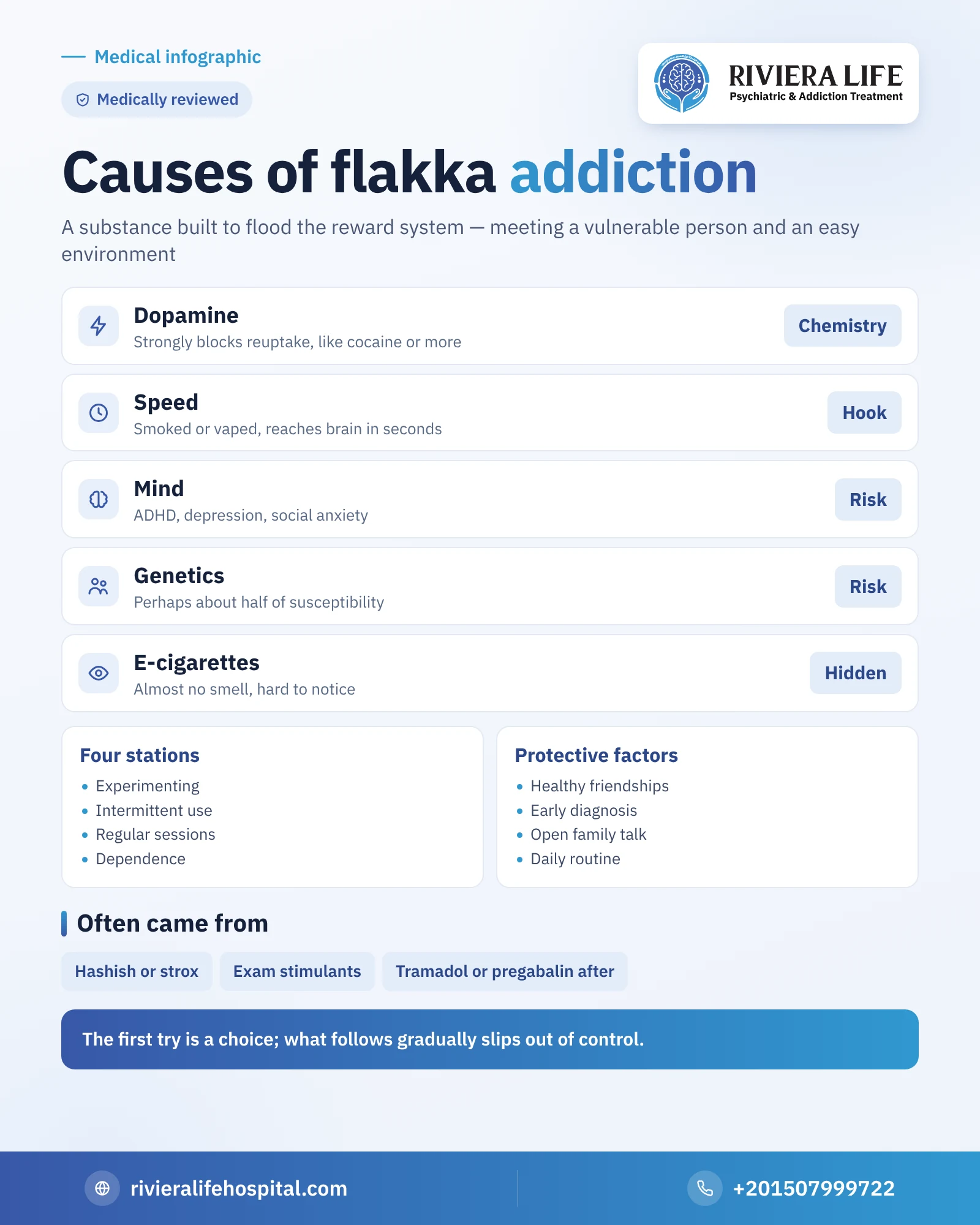
Flakka strongly blocks the dopamine reuptake gates in the brain, so this transmitter accumulates in the areas responsible for the feeling of reward and motivation. Studies on animals indicate that its ability to push the organism to repeat use matches or exceeds cocaine and methamphetamine. Two things add to this:
- Speed of arrival: smoking and vaping deliver the substance to the brain in seconds, and the brain strongly links the act and the reward when the gap between them is short.
- Short effect: after a few hours mood suddenly drops, so repeating the dose becomes the nearest solution, and a single dose turns into a long session.
This rhythm of a quick rise and a quick fall is one of the strongest known drivers of forming a compulsive habit.
From experimenting to addiction: how does it develop?
Rarely does anyone decide to become an addict. The road usually goes through successive stations:
- Experimenting: out of curiosity or keeping up with friends at a party, and often with complete ignorance of what the substance is.
- Intermittent use: on holidays or occasions, with a false feeling of control.
- Regular use: weekly sessions or more, and the start of sacrificing sleep, study and money.
- Dependence: intense craving and crashing between sessions, and failed attempts to stop.
This distance may shrink with flakka more than with other substances, because the pattern of the repeated session sometimes begins from the first times.
Why do some young people start with flakka specifically?
Many families ask: why this substance in particular? The answers that recur in the clinic are similar:
- The low price compared with cocaine, with a promise of a stronger effect.
- Marketing it under misleading names suggesting that it is a “new” or less dangerous chemical product.
- The desire to stay up long or feel energy and confidence in gatherings.
- Ease of obtaining it through acquaintances or messaging apps.
- The absence of a clear picture of its danger among young people, despite what circulates about it in the news.
Genetic and biological factors
Addiction research indicates that genetics explains a considerable part of a person’s susceptibility to addiction in general, perhaps about half according to various estimates. This doesn’t mean there is an “addiction gene”, but a set of inherited characteristics: the way the brain responds to reward, the degree of impulsivity, and the person’s ability to tolerate pressure. Having a father or brother who suffered from addiction to any substance raises the likelihood of risk but doesn’t decide it. Also, in the brain in adolescence and the early twenties the control and planning areas haven’t fully matured yet, so it is more sensitive to substances that strike the reward system strongly.
Psychological disorders and dual diagnosis
It recurs in the clinic that behind the addiction lies an undiagnosed psychological disorder. A young man with attention deficit hyperactivity disorder may find temporary focus in a stimulant, someone with depression may look for energy they lack, and someone with social anxiety may find boldness in gatherings in it. The problem is that flakka worsens these disorders in the long run, so the cycle turns: a disorder pushing towards the substance, and a substance deepening the disorder. That is why good treatment begins with a full psychological assessment, as the article on flakka addiction treatment explains.
Trauma and accumulated pressures
Difficult experiences in childhood, such as neglect, family violence or losing a parent, are linked to a higher risk of addiction at later stages. So are acute pressures in the present: unemployment, academic failure or an emotional crisis. In these circumstances the substance becomes a quick means of escaping a feeling the person doesn’t know how to deal with, and repeated escape turns into a habit.
Environment and friends
The circle of friends is the strongest external influence on starting use, especially in adolescence. When flakka is present in gatherings as something normal, the sense of its danger decreases and refusing becomes harder. Other factors add their weight: weak family supervision or excessive harshness, money available without follow-up, and long idle time without activity or purpose.
A similar story recurs in the clinic: a young man of twenty finished his exams, spent the summer without work or a plan, and started staying up with a new group he met at a café. At first the session was once every two weeks, then it became every Thursday, then he started disappearing from home for two whole days. No one in this story was planning addiction, but idleness, company and the ease of obtaining the substance built the road step by step.
Ease of concealment: the e-cigarette
Among the reasons for flakka’s spread among young people is that it can be vaped in e-cigarettes that leave hardly any smell. This allows use in the car, the room or even among people without anyone noticing, and deprives the family of the chance of early observation. Home strips also don’t usually detect it, which is explained in the article on how long flakka stays in the body.
Moving from other substances
Few start with flakka directly. Many went before it through hashish or strox, or stimulant pills during exam periods, then moved on to something stronger. Some use tramadol or pregabalin after sessions to calm down and sleep, so they find themselves after months dependent on two substances instead of one. That is why the doctor always asks about everything the patient has used, not about flakka alone.
Who is most at risk of flakka addiction?
- Teenagers and young people under roughly thirty.
- Those with a family history of addiction.
- Those suffering from an untreated psychological disorder, especially hyperactivity and depression.
- Those who have previously used stimulants or other substances.
- Those living under acute pressures without family or social support.
- Those whose behavior is characterized by impulsivity and thrill-seeking.
Risk factors and protective factors
| Factors that raise the risk | Factors that protect |
|---|---|
| Friends who use | Healthy friendships and sporting activities or hobbies |
| An untreated psychological disorder | Early diagnosis and regular treatment |
| A family history of addiction | The family’s awareness of the risk and open dialogue |
| Idleness and money without follow-up | A daily routine and clear responsibilities |
| Traumatic experiences without support | A close relationship with a trusted adult |
Is flakka addiction a choice?
The first decision to try is a choice, but what happens after that gradually slips out of control. Repeated use changes circuits in the brain responsible for judgment and impulse control, so the person faces a craving they can’t resist by willpower alone. Understanding this doesn’t exempt the person from responsibility, but it changes the way they are dealt with: from punishment and stigma to treatment. And anyone who wants to understand what they see at home can read flakka addiction symptoms.
How do you protect your children from flakka?
Protection doesn’t start with searching, but with early and frank dialogue about new drugs and what they do, without exaggeration that loses you credibility. Know your children’s friends and where they stay up, and pay attention to unusual late nights and unexplained spending. Don’t ignore signs of anxiety, depression or attention deficit, and ask for an early assessment for them. And if a problem has actually appeared, ask for help quickly, as early intervention saves a great deal of pain. You will find full background on the substance on the flakka page.
More from the flakka guide
- Flakka: the comprehensive guide
- Flakka addiction symptoms
- The harms of flakka
- Flakka addiction treatment
Questions many people ask
Addiction in its medical sense needs repetition, but flakka pushes towards repeating the dose within the first session itself, so the pattern of compulsive use begins faster than with many substances.
Addiction isn't inherited directly, but genetics affects a person's susceptibility to addiction in general. A family history raises the risk without deciding it.
Because of its low price, strong effect and ease of hiding it in e-cigarettes, in addition to the influence of friends and the absence of a clear picture of its danger.
A depressed person may look for temporary energy in stimulants, but flakka deepens depression after its effect wears off. That is why the psychological disorder needs early treatment.
Open dialogue with the family, the parents knowing his friends, a daily routine with activity and purpose, and early treatment of any anxiety, depression or attention deficit.