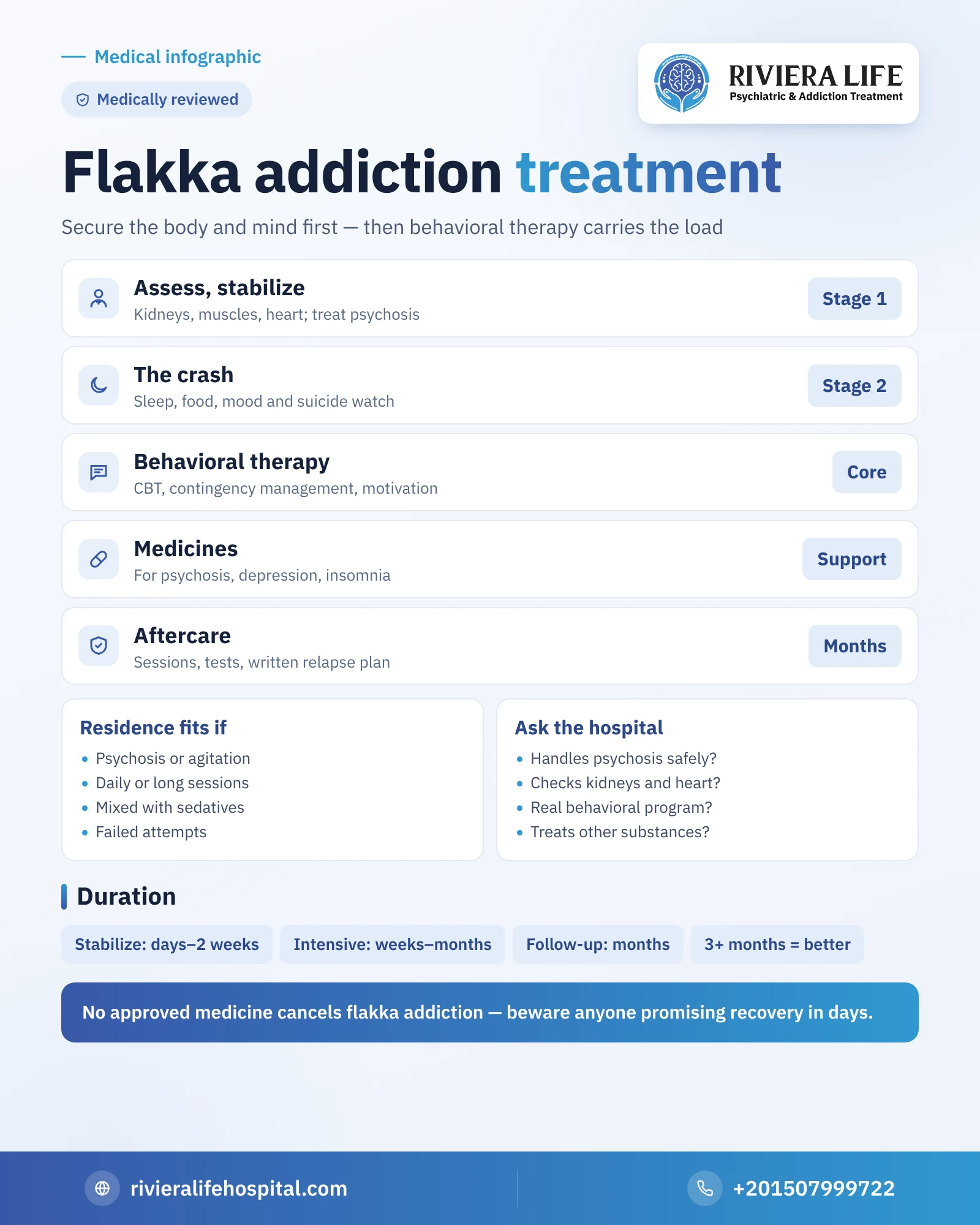
Flakka addiction treatment is possible, and usually starts from a different point than treatment of many drugs: securing the physical and psychological state first, because the patient may arrive in a psychotic episode or after days of staying up, heat and dehydration. After that treatment goes through clear stages: managing the crash stage, then intensive psychological and behavioral therapy, which is the cornerstone, with medicines that treat accompanying symptoms, then long follow-up to prevent relapse. There is so far no approved medicine that cancels flakka addiction on its own, but organized programs achieve good results. In this article we explain each stage, the expected duration of treatment, and how to choose the right hospital.
Stages of flakka addiction treatment
The details differ from patient to patient, but a good path passes through these stations:
- Assessment and stabilization: a physical and psychological examination, tests of kidney, muscle and heart function, and dealing with any psychosis or agitation.
- Managing the crash stage: days of sleep, nutrition and close monitoring of mood and suicide risk.
- Psychological and behavioral therapy: an organized program to understand triggers and build alternative skills.
- Treating co-occurring disorders: depression, anxiety, hyperactivity and dependence on other substances.
- Follow-up and aftercare: regular sessions and a written plan to face relapse.
The beginning: securing the body and mind first
Many flakka patients don’t arrive calmly. Some come after a long session in a state of pathological suspicion and hallucinations, and some suffer from dehydration and muscle pains that may hide the start of muscle breakdown. That is why the first days begin with basic tests of kidney function, muscle enzymes and an ECG, with fluid replacement. If the patient is in a psychotic episode they are treated with antipsychotic medicines or short-term sedatives at doses the doctor determines, in a calm environment away from stimulation. This stage doesn’t aim to treat the addiction yet, but to make the patient safe and able to take part in treatment.
Managing the crash stage and detox
After stopping, the energy reserve collapses, so the patient sleeps long and eats with appetite, then enters days of depression and urgent craving. Medical management here means an environment that allows sleep to be made up, suitable nutrition, daily monitoring of mood, and medicines for insomnia or severe anxiety when needed. The time details of this stage are in the article on flakka withdrawal symptoms. What matters is that the family knows that the end of these days isn’t the end of treatment, but its real beginning.
Is there a medicine to treat flakka addiction?
So far there is no globally approved medicine to treat flakka addiction or stimulants in general, unlike opioid or alcohol addiction. But this doesn’t mean medicines have no role; they treat the symptoms accompanying addiction that may push toward relapse if left:
Antipsychotics
Used if hallucinations or pathological suspicion appear, usually for a limited period after which the need for them is reviewed.
Antidepressants
The patient may need them if depression continues after the end of the crash stage, or if they suffered from depression before use.
Sleep and anxiety medicines
Used cautiously and for short periods, avoiding what may cause new dependence, especially in those who have previously misused sedatives or pregabalin.
Research is being conducted on different medicines to reduce craving for stimulants, but their results are still under study, and the patient shouldn’t take any medicine without medical supervision.
Psychological and behavioral therapy: the main pillar
In stimulant addiction behavioral methods carry the greatest burden of treatment, and the most evidence-supported are:
- Cognitive behavioral therapy: helps the patient monitor the circumstances and thoughts that push them toward flakka use, then sets a considered alternative action for each.
- Contingency management: an incentive system that rewards the patient for negative test results and commitment to sessions, among the most effective methods with stimulants.
- Motivational interviewing: strengthens the internal motivation for change instead of relying on external pressure.
- Group therapy: gives the patient a space in which they see similar experiences and learn from them.
- Family therapy: repairs the way of communicating inside the home and turns it from a source of tension into support.
Treating co-occurring disorders and other substances
Rarely does a flakka patient come with a single problem. Many suffer from depression, anxiety or ADHD since before use, and many use hash, strox, tramadol or pregabalin with it. Neglecting any of these aspects makes relapse almost certain. That is why the assessment covers all substances and all psychological symptoms, and they are treated together in one plan. Understanding the causes of flakka addiction in the patient themselves helps set the priorities of this plan.
Residential or outpatient treatment?
Residence inside the hospital is usually the most suitable option in these cases:
- The presence of psychosis, agitation or suicidal thoughts.
- Daily use or repeated long sessions.
- Mixing flakka with other substances, especially sedatives.
- Previous attempts to stop that didn’t succeed.
- An unstable home environment or friends who use around the patient.
In less severe cases, or after the residence period ends, outpatient treatment is the suitable option; the patient keeps up regular sessions while resuming work or study step by step.
How long does flakka addiction treatment take?
The stabilization and crash stage takes days to about two weeks, the intensive program usually extends from weeks to a few months, then outpatient follow-up continues for several more months or more. Research indicates that staying in organized treatment for at least three months is clearly linked to better results. More important than the number is continuity without breaks between one stage and another.
The family’s role in treatment
The family needs to learn how to support without covering up use, how to set clear limits on money and going out without cutting the connection, and how to act if signs of suspicion or irritability return. That is why good programs dedicate sessions to the family itself. Recognizing the signs of flakka addiction helps parents notice any relapse early.
Relapse prevention and aftercare
The first months after the intensive program are the most sensitive. Among what protects the patient in them: keeping away from friends and places linked to sessions, getting rid of the e-cigarette linked to use, organizing sleep, food and exercise, committing to follow-up sessions and periodic tests, and having a written plan for what to do when urgent craving comes. If relapse happens, it is a signal to adjust the plan, not to declare failure.
The right hospital for flakka addiction treatment: how to choose
The right hospital for flakka addiction treatment is the place that offers what a flakka patient specifically needs: the ability to deal safely with psychosis and agitation, follow-up of the physical condition after long sessions, and a real behavioral program that doesn’t stop at the days of isolation. Ask before you decide:
- Does the hospital hold an official license, and does it include consultants in psychiatry and addiction treatment?
- Can it receive a patient in a state of psychosis or agitation and deal with them under round-the-clock medical supervision?
- Does it check kidney, muscle and heart function at the start, and not settle for psychological assessment?
- Does it offer cognitive behavioral therapy and organized incentive systems, or does it settle for detox?
- Does it treat accompanying substances such as tramadol, pregabalin and strox in the same plan?
- Does it involve the family, and provide clear follow-up after discharge?
And beware of any party that promises you a guaranteed cure rate or getting rid of flakka addiction within days.
How Riviera Life meets these standards in flakka addiction treatment
These criteria are what Riviera Life offers, and their details are as follows:
- Official license: a hospital licensed by the Ministry of Health.
- Fourteen years of experience: in addiction treatment, with thousands of recovered cases.
- Consultant expertise: treatment is supervised by consultants in psychiatry and addiction, able to treat the psychosis stimulants cause and the depression that follows the crash.
- Uninterrupted care: a medical team beside the patient night and day in the most dangerous first days.
- An individual plan: a comprehensive assessment of the physical and psychological condition and accompanying substances, then treatment combining medical care and the behavioral program.
- Support for the family: sessions that guide the family to correct support and setting clear limits.
- Aftercare: organized follow-up after discharge to prevent relapse.
- Complete confidentiality: full protection of the privacy of the patient and their family.
You can get a free first consultation regarding flakka by calling us at any hour on +201507999722, and we are also happy to receive you at our base in Sheikh Zayed, Giza.
More from the flakka guide
- Flakka: the complete guide
- Flakka withdrawal symptoms
- The harms of flakka
- Causes of flakka addiction
Questions many people ask
Yes, many recover with a program combining medical care, behavioral therapy and long follow-up. Relapse is possible, but it means adjusting the plan, not its failure.
There is so far no approved medicine that treats flakka addiction on its own, but medicines are used to treat accompanying psychosis, depression and insomnia, while behavioral therapy plays the main role.
The stabilization stage is days to about two weeks, the intensive program weeks to months, then follow-up for several months. Continuing for at least three months is linked to better results.
Some milder cases may be treated with an outpatient program under medical supervision, but the presence of psychosis, suicidal thoughts or mixed substances makes hospital residence safer.
Choose one that combines safe handling of psychosis and agitation, a behavioral program and follow-up. Riviera Life in Sheikh Zayed meets these criteria with a Ministry of Health license, fourteen years of experience and round-the-clock supervision.