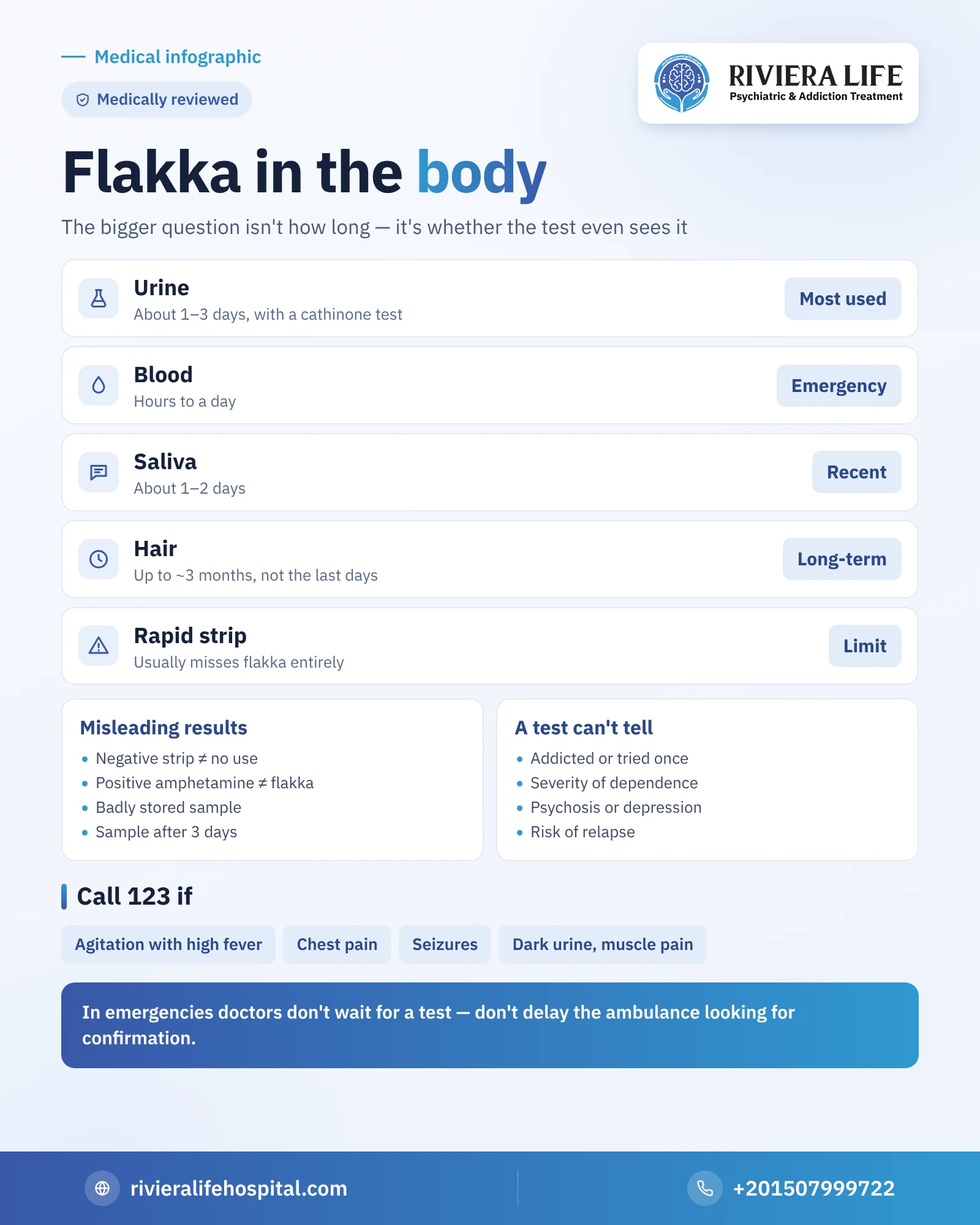
How long flakka stays in the body differs according to the type of sample; it remains detectable in urine usually for roughly one to three days after the last dose, in blood for hours that may reach a day, in saliva about one to two days, while hair retains its trace for weeks and may reach roughly three months.
But the more important question isn’t how long it stays, but whether the test sees it at all; the usual rapid test strips in pharmacies and labs don’t detect flakka in most cases, and proving it needs a specialized laboratory test. In this article we explain what happens to the substance inside the body, how long it appears in each type of test, and what makes the result misleading.
What happens to flakka inside the body?
After smoking or snorting, flakka reaches the blood then the brain within minutes, and the liver begins breaking it down into other compounds called metabolites. Some of these metabolites form by adding a chemical group to the original molecule, and some by changing the ring in its structure. The original substance and its metabolites leave mainly in urine. What matters here is that specialized labs usually look for both the original substance and these metabolites, because metabolites may remain a little longer than the substance itself.
And because the effect the user feels ends within a few hours, many think the substance has left the body completely. The truth is that the end of feeling the effect doesn’t mean the end of the substance or its metabolites being present in fluids and tissues.
How long flakka shows in each type of test
Urine test
The most used in detecting flakka. The substance and its metabolites usually show in it for roughly one to three days after the last use, and the period may lengthen slightly with repeated intensive sessions. The condition is that the test itself is designed to look for cathinones.
Blood test
Its window is short, from hours to about a day. It is mostly used in emergency departments or in forensic cases, because it reflects more accurately what is going on in the body at the time the sample is drawn.
Saliva test
It detects recent use, usually within roughly one to two days. Its advantage is that the sample is taken in front of the person so it is hard to tamper with, but its availability for detecting flakka is limited.
Hair test
It retains the trace of repeated use for a longer period, usually extending to about ninety days in the hair close to the scalp, depending on the length of the sample. But it doesn’t detect the last few days, because hair needs time to grow and carry the substance outward.
| Type of test | Approximate period | When is it used? |
|---|---|---|
| Urine | One to three days | Follow-up and routine detection |
| Blood | Hours to a day | Emergencies and forensic cases |
| Saliva | One to two days | Very recent use |
| Hair | Up to about three months | Detecting repeated use over the long term |
Does flakka show in an ordinary drug test?
In most cases no. The widespread rapid test strips look for specific groups, such as hash, opioids, amphetamines, cocaine and sedatives. And flakka, although a stimulant, differs in its chemical structure enough that the amphetamine or cocaine strip doesn’t recognize it reliably. That is why a young man may come out of a session that lasted two days with a completely negative result on the home strip, and the family is reassured by a result that means nothing.
How is use detected accurately?
Real proof needs a lab with advanced separation and analysis equipment, which relies on separating the components of the sample then identifying each substance from its chemical fingerprint. These techniques are able to distinguish flakka from other cathinones, and to detect its metabolites. They are more expensive and slower than rapid strips, and aren’t available in every lab, which is why it is preferable for a doctor who knows what they are looking for and how to interpret the result to request them.
Why does the period differ from person to person?
The previous figures are approximate averages, and are affected by several factors:
- The amount and number of times of use in one session.
- The duration of use, weeks or months.
- The liver’s efficiency in breaking down the substance, and the kidneys’ efficiency in removing it.
- The sensitivity of the technique used and the minimum threshold the lab adopts to consider the result positive.
- The purity of the substance itself, as what is sold as flakka may be a mixture of different cathinones.
Mixing with other substances and its effect on the result
Many who use flakka in Egypt use hash, strox, tramadol or pregabalin with it. That is why the strip result may come out positive for another substance and negative for flakka, so the family thinks the problem is hash alone. The reverse also happens: the substance sold as flakka may be mixed with another stimulant that shows on the amphetamine strip. The complete picture needs a comprehensive test and a medical assessment, not a single strip.
When is the result misleading?
- A negative result on a rapid strip doesn’t rule out flakka use, because it doesn’t look for it in the first place.
- A positive amphetamine result doesn’t necessarily mean the substance is flakka, as it may be another stimulant or a prescribed medicine.
- A sample collected or stored incorrectly may give an inaccurate result in both directions.
- A sample taken after more than three days may be negative despite regular use.
That is why any result, positive or negative, is shown to a doctor before taking a decision based on it.
What can’t the test tell you?
A test answers one question: is the substance present in the sample now? But it doesn’t determine whether the person is addicted or tried it once, doesn’t measure the severity of dependence, doesn’t reveal accompanying psychosis or depression, and doesn’t predict relapse. These are questions answered by medical and psychological assessment, and you can read about the signs it relies on in the article on flakka addiction symptoms.
Advice for the family before a home test
If you suspect flakka in particular, the home strip may give you false reassurance. More importantly, forcing the young man to take a test in an atmosphere of accusation may push him toward denial and hiding. It is better to gather your observations and present them to a doctor, and for the test to be part of a comprehensive assessment done with his agreement as much as possible, not a tool for a trial inside the home.
Flakka leaving the body doesn’t mean its effect is over
The test may become negative after days, while the brain remains in a state of imbalance for weeks: depression, urgent craving and weak concentration, and sometimes remnants of pathological suspicion. This stage is explained in the article on flakka withdrawal symptoms. Also, some physical harms, such as kidney injury after an episode of severe heat, may remain long after the substance has left, and their details are in the article on the harms of flakka.
How are tests used during treatment?
In treatment programs tests turn from a tool of accusation into a tool of support. They are done at intervals agreed with the patient, and their negative results are used to strengthen their commitment and reward them, a basic idea in the motivational methods used in treating stimulant addiction. And if a positive result appears, it is a signal to adjust the plan, not to end treatment. You will find the details of these programs in the article on flakka addiction treatment.
Testing in emergencies: the priority is life
When someone arrives at the emergency department in a state of agitation and high temperature, doctors don’t wait for the test result to start treatment, as cooling, calming the agitation and protecting the kidneys begin immediately. That is why you shouldn’t delay calling the ambulance looking for confirmation of what they used.
Call an ambulance on 123 immediately if there appear
Don't wait for the result of any test in these cases.
- Severe agitation with confusion and high temperature
- Chest pain or severe palpitations
- Seizures or loss of consciousness
- Dark urine or a severe reduction in urine with muscle pains
More from the flakka guide
- Flakka: the complete guide
- Flakka addiction symptoms
- Flakka withdrawal symptoms
- Causes of flakka addiction
Questions many people ask
Flakka and its products usually show in urine for roughly one to three days after the last use, provided a test designed to detect cathinones is used.
In most cases no, as its chemical structure differs enough for the strip not to recognize it reliably. A negative strip result doesn't rule out use.
Yes in specialized labs, as hair can reflect repeated use for a period extending to roughly three months, but it doesn't detect the last few days.
The test needs a lab with advanced separation and analysis equipment, and it is preferable for a specialist doctor to request it, determine the type of sample and interpret the result within a comprehensive assessment.
Not necessarily, as the test may not be designed to detect it, or the sample was taken after the detection window ended. The decision depends on medical assessment, not one test.